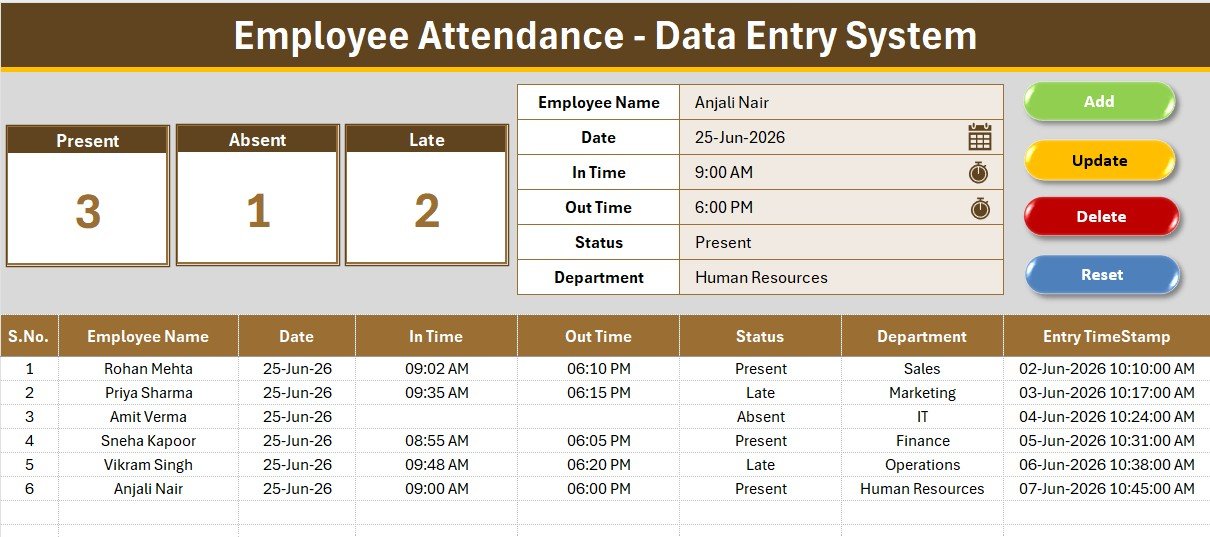
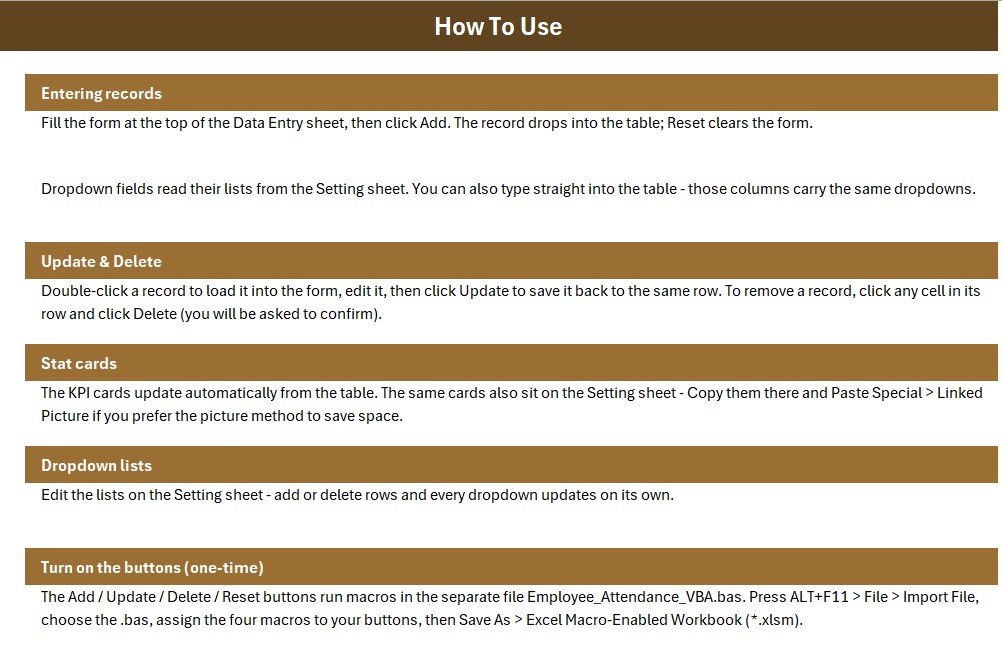
The Employee Attendance Data Entry System in Excel records six fields per entry — Employee Name, Date, In Time, Out Time, Status and Department — and rolls them into three live KPI cards: Present, Absent and Late. Setup takes under five minutes, and the workbook works fully offline with no per-user fees.
Most small teams still track attendance in a loose grid where a single mistyped status quietly breaks the monthly count. This guide walks through how the Employee Attendance Data Entry System in Excel fixes that with a guided form, validated dropdowns and VBA-powered buttons, so every record stays clean and every count stays accurate.
Key Features of the Employee Attendance Data Entry System
The system is built around one principle: data goes in through a form, not by typing into random cells. That single decision keeps the records table consistent and the KPIs trustworthy.
- Three live KPI cards — Present, Absent and Late are driven by COUNTIF on the Status column and refresh instantly whenever a record is added, updated or deleted.
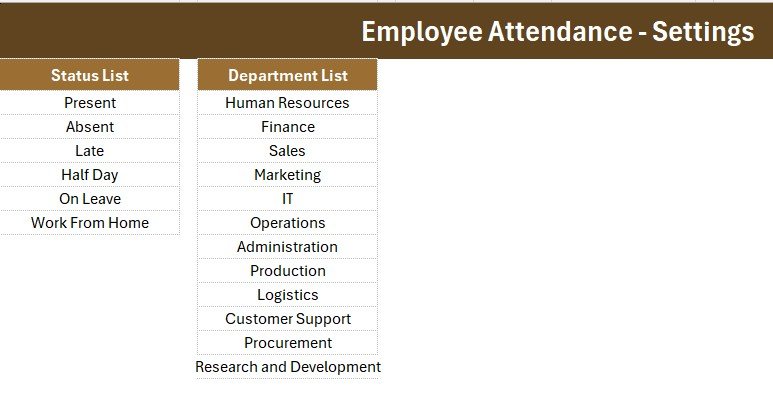
- Two validated dropdown lists — Status (Present, Absent, Late, Half Day, On Leave, Work From Home) and Department (12 editable entries) prevent typos at the point of entry.
- Four VBA macro buttons — Add, Update, Delete and Reset cover the full record lifecycle and clear the form after each save.
- A self-maintaining records table — serial numbers renumber on their own, dates stay formatted, and an Entry TimeStamp logs exactly when each row was saved.
- Four organised sheets — Data Entry, Setting, Instructions and Get More Templates.
Sheets Explanation
Data Entry Dashboard
The main screen places the Present, Absent and Late KPI cards at the top, the entry form beside them, and the full attendance records table below — so you log and monitor on a single screen.
Entry Form and Dropdown Lists
The form captures Employee Name, Date, In Time, Out Time, Status and Department. Status and Department are wired to Excel data-validation dropdowns, so attendance can never be mistyped.
Records Table and Settings
Saved entries land in a clean records table with auto serial numbers and timestamps, while the Setting sheet holds the editable Status and Department source lists that feed both the dropdowns and the KPI formulas.
Employee Attendance Data Entry System vs. Google Sheets vs. Paid HR SaaS — Feature Comparison
| Feature | Employee Attendance Data Entry System (Excel) | Google Sheets equivalent | BambooHR / Keka / Zoho People |
|---|---|---|---|
| Cost | $5.99 one-time | $0–low, manual build | $3–$8 / user / month |
| Platform | Microsoft Excel (offline) | Browser + Google account | Cloud only |
| Setup time | Under 5 minutes | Build from scratch | Hours of onboarding |
| Works offline | Yes | No | No |
| One-click Add / Update / Delete | Yes, via VBA | Manual or scripts | Yes |
| Editable fields and lists | Fully editable | Editable | Limited to plan |
| Per-user fees | None | None | Charged per employee |
| Year-1 cost at 5 users | $5.99 | $0 + your time | $180–$480 |
For small teams that want quick, accurate attendance logging without paying per employee every month, the Employee Attendance Data Entry System in Excel sits in the sweet spot.
Who Should Use This Template
Perfect for:
- Small business owners and office managers tracking 5–100 staff.
- HR coordinators who want a tidy daily log without a cloud subscription.
- Clinics, shops and schools that record In/Out times and statuses by hand.
Not a fit if:
- You need biometric or RFID hardware integration and single sign-on.
- You require automatic geofenced clock-in from a mobile app.
Real-World Use Cases
Neha manages a 28-person design studio. Each morning she logs attendance through the form, scans the Present and Late cards, and at month-end exports the records table straight into payroll — with no per-seat HR software bill.
Dr. Rao runs a small clinic with nine staff. Reception records In Time and Out Time per shift and marks On Leave or Half Day from the dropdown, keeping a fully timestamped history inside one Excel file the practice owns outright.
Advantages of the Employee Attendance Data Entry System
Because entry happens through a form and validated lists, the data stays clean enough to trust for payroll and compliance. There is no monthly fee, no login, and no vendor lock-in — the file lives on your machine and the Entry TimeStamp gives you a defensible audit trail. At $5.99 one-time, a five-person team avoids roughly $180–$480 in first-year SaaS costs.
Opportunities for Improvement
This is an Excel workbook, so it is single-writer by nature — two people cannot edit the same file simultaneously. In Time and Out Time are stored as text rather than true time values, which keeps entry simple but means you would add a helper column if you want automatic worked-hours math. Teams that outgrow a single file should look at the web-app edition below.
Best Practices
- Edit the Status and Department lists on the Setting sheet before your first entry so the dropdowns match your organisation.
- Always use the Add button rather than typing into the table directly — it keeps serial numbers and timestamps correct.
- Save a fresh copy each month or year to keep individual files fast and easy to archive.
Explore Relevant Templates
- Student Attendance Data Entry System in Excel — the same form-based system tuned for classrooms.
- Patient Appointment Data Entry System in Excel — ideal for clinics and front desks.
- Daily Sales Entry Data Entry System in Excel — log daily sales with the same workflow.
- HR Analytics Dashboard in Excel — turn your HR records into visual insights.
Need multi-user login and a browser interface instead? See the Employee Attendance Payroll Management System Web App, or browse the full HR & Payroll Templates collection. To go further, the Recruitment & Talent Acquisition Bundle packs seven HR templates into one.
Frequently Asked Questions
What does the Employee Attendance Data Entry System in Excel track?
The Employee Attendance Data Entry System in Excel tracks Employee Name, Date, In Time, Out Time, Status and Department for each record, and summarises them into Present, Absent and Late KPI counts that refresh automatically.
Do I need to enable macros?
Yes. The Employee Attendance Data Entry System uses VBA for its Add, Update, Delete and Reset buttons, so you import the included .bas module, save the workbook as .xlsm and enable macros when Excel prompts you.
How long does setup take?
Most users finish in under five minutes — import the macro module, attach the four buttons, edit the Status and Department lists on the Setting sheet, and start entering attendance.
Can I change the departments and statuses?
Absolutely. The Setting sheet holds both source lists, so you can rename, add or remove Department and Status options and the dropdowns and KPIs update with them.
How does this compare to BambooHR or Zoho People?
Paid HR platforms charge per employee every month. The Employee Attendance Data Entry System in Excel is a one-time $5.99 file you fully own, works offline, and has no per-user fees — ideal for small teams.
About the Author
Built by PK — Microsoft Certified Professional with 15+ years of Excel, Google Sheets and Power BI experience. Founder of NextGenTemplates, reaching 300K+ subscribers across YouTube channels. Every template is hand-built and tested before release.
Conclusion
If you need accurate daily attendance without a monthly bill, the Employee Attendance Data Entry System in Excel gives you a form, validated dropdowns, live KPIs and one-click record management in a file you own forever.
👉 Click here to Purchase the Employee Attendance Data Entry System in Excel
Instant download · One-time payment · No subscription. For step-by-step video tutorials, visit YouTube.com/@PK-AnExcelExpert.
Last updated: June 2026