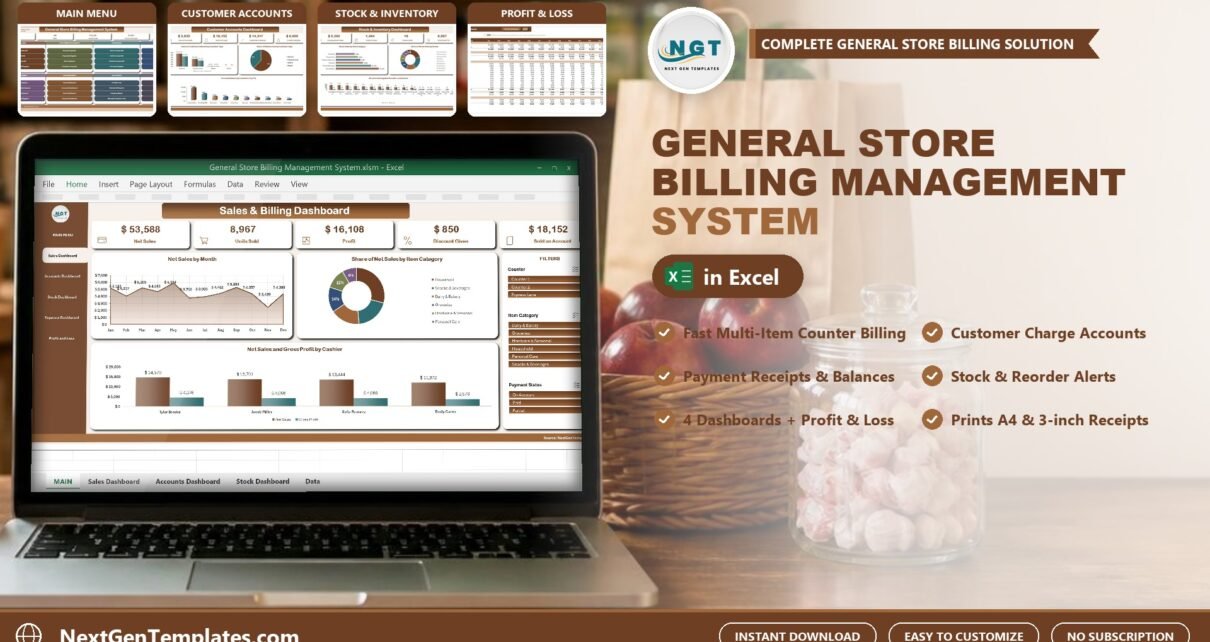
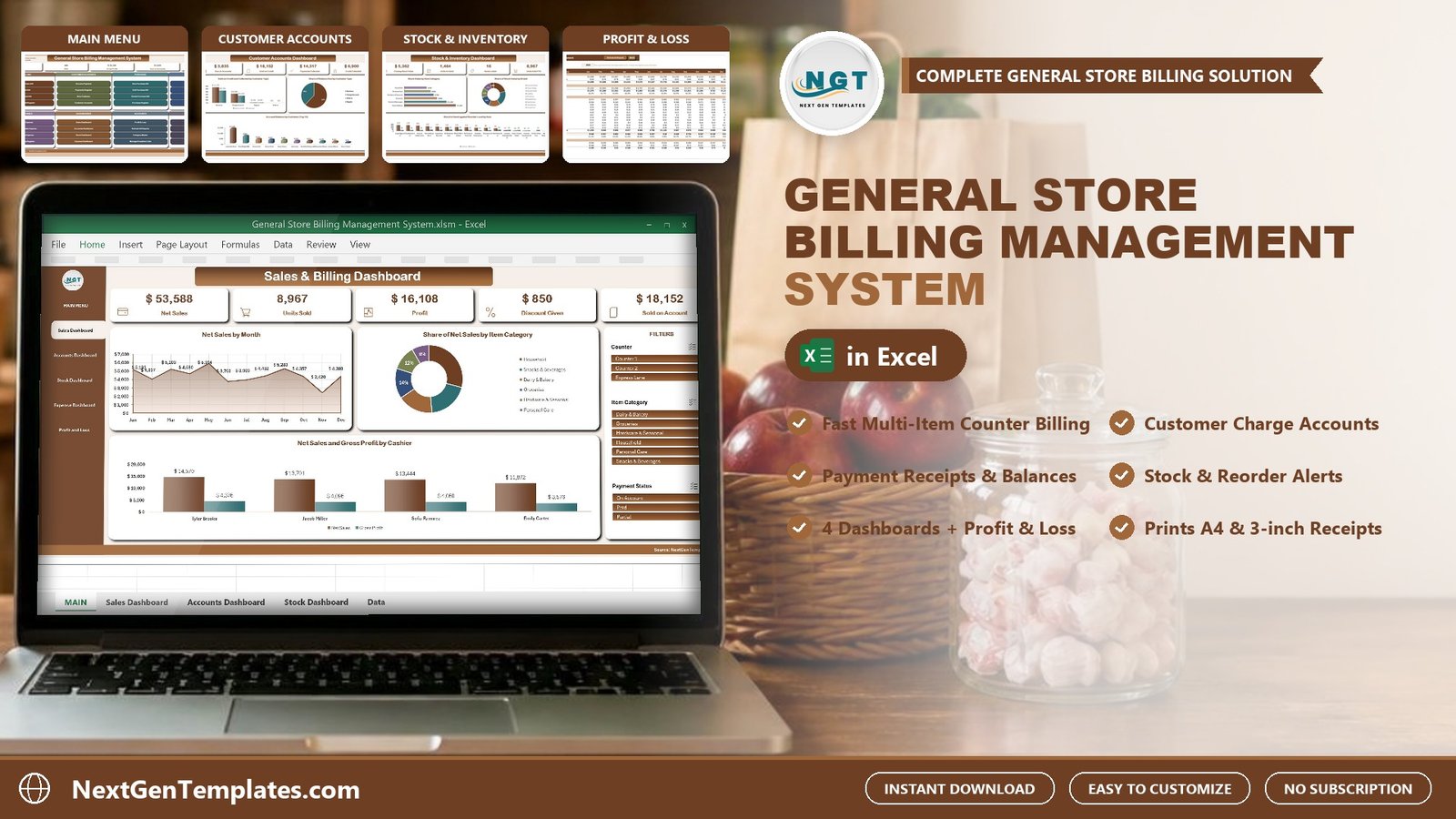
The General Store Billing Management System is a macro-enabled Excel workbook that runs a general store from one file: counter billing, customer charge accounts, supplier purchases, stock, expenses and profit. It has 15 worksheets, 10 VBA forms, 4 pivot dashboards, a live Profit & Loss statement and 3 printable documents that come out at A4, 4 inch and 3 inch. It ships with 468 sample sales bills, 120 purchase lines, 90 payment receipts and 180 expense vouchers, so every chart is populated the first time you open it.
Most small shops do not need a monthly POS subscription. They need a bill that prints properly, a record of who owes what, stock that moves when something sells, and a monthly profit figure. A plain billing sheet gives you the first and then stops: stock does not change, customer balances are typed by hand and nothing prints for the counter. This excel billing system closes that gap and keeps every record on your own PC. If you have been searching for billing software in Excel that behaves like real store software, this Excel VBA billing software is what it looks like.
What the General Store Billing Management System Does
Everything goes in through a checked form, so nobody types straight into a data sheet. The main jobs are:
- Billing: the Sales Bill form is a basket. Choose the customer, counter and cashier, search an item, enter quantity and discount %, add as many lines as needed and save under a GSB- number.
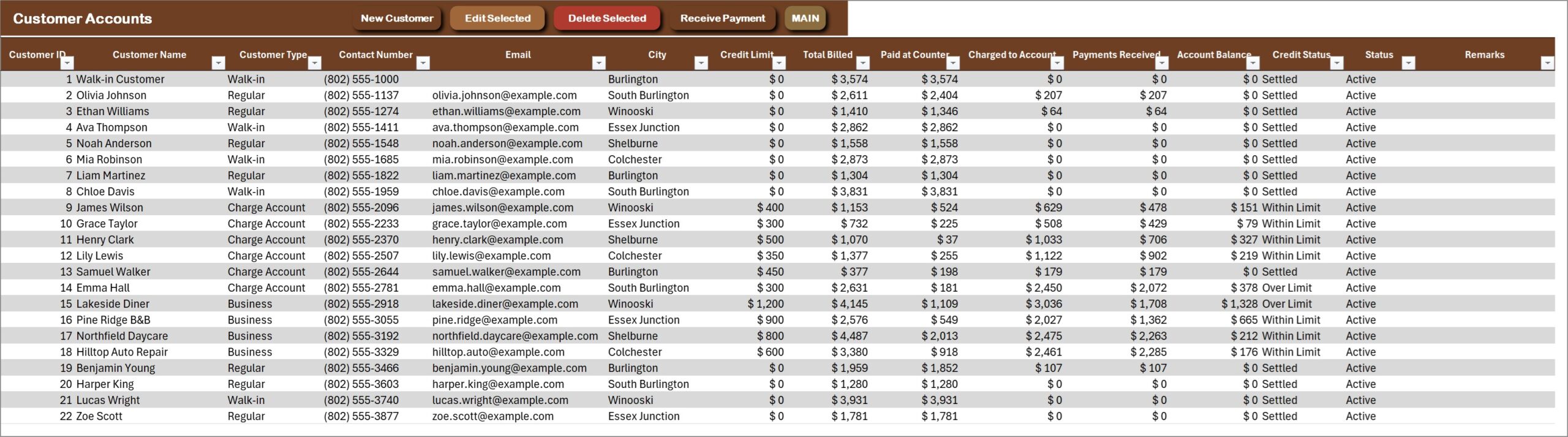
- Customer charge accounts: mark a bill Paid, Partial or On Account. Each customer has a credit limit, an account balance and a credit status.
- Payment receipts: Receive Payment records cash, card, check, bank transfer or mobile wallet against an account and prints an RCPT- receipt.
- Stock: purchases add stock, sales take it away, and each item shows In Stock, Low Stock or Out of Stock against its reorder level.
- Purchases and expenses: a purchase basket for supplier bills with payment terms, and an expense register that feeds the Profit & Loss.
It is a lightweight excel pos system for a single counter, with the accounts and stock behind it. You can see every screen in the full product listing.
Dashboard Pages and Sheets Explained
MAIN menu
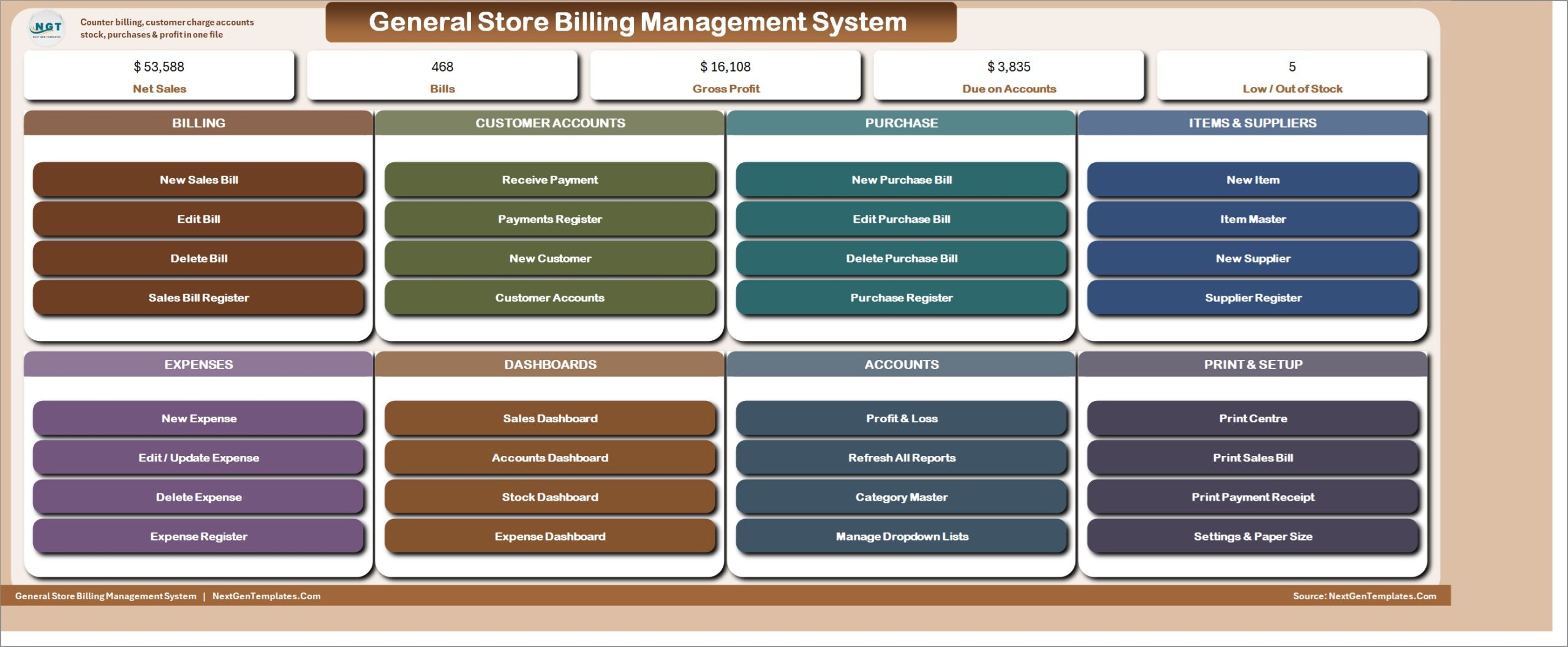
The file opens on a menu with five live KPI chips (Net Sales, Bills, Gross Profit, Due on Accounts and Low / Out of Stock) and eight cards of buttons: Billing, Customer Accounts, Purchase, Items & Suppliers, Expenses, Dashboards, Accounts and Print & Setup.
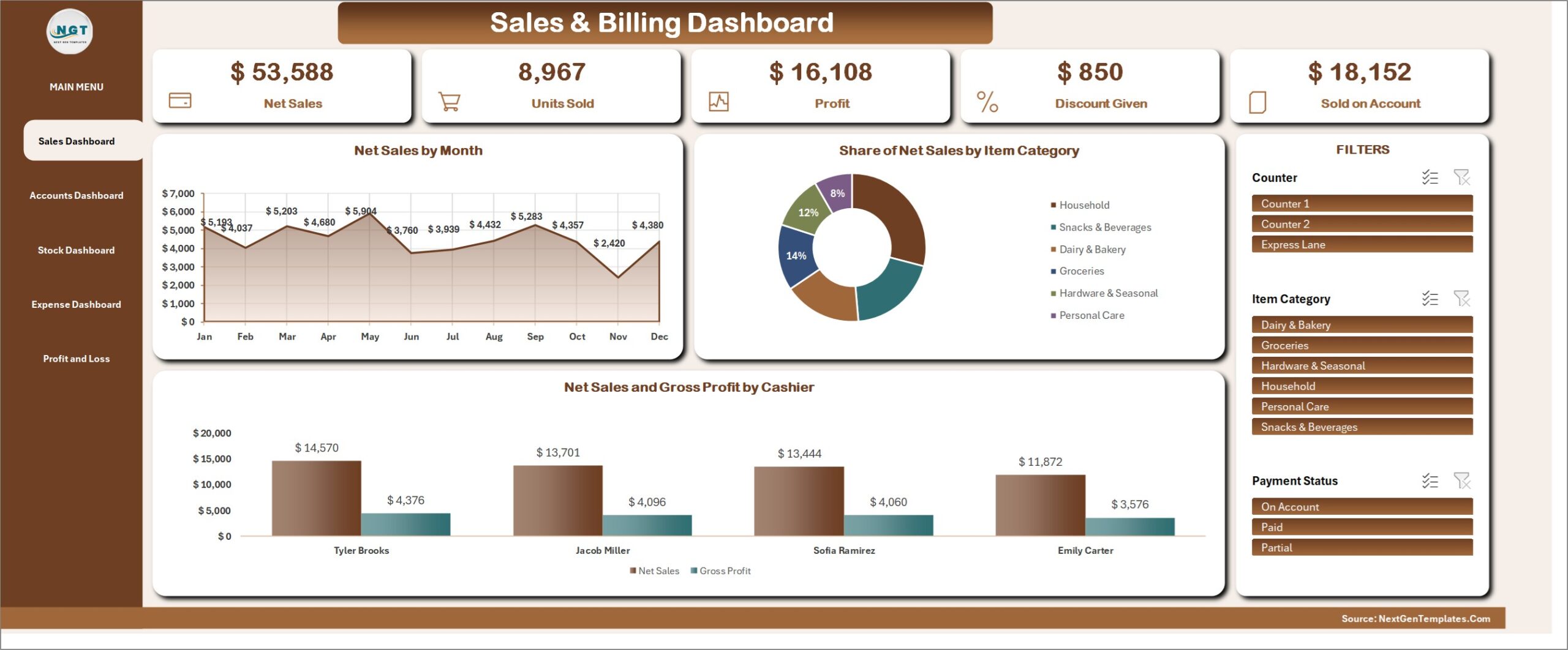
Sales and Billing Dashboard
Net Sales, Units Sold, Profit, Discount Given and Sold on Account, with sales by month, sales by item category and gross profit by cashier. Slicers for counter, item category and payment status.
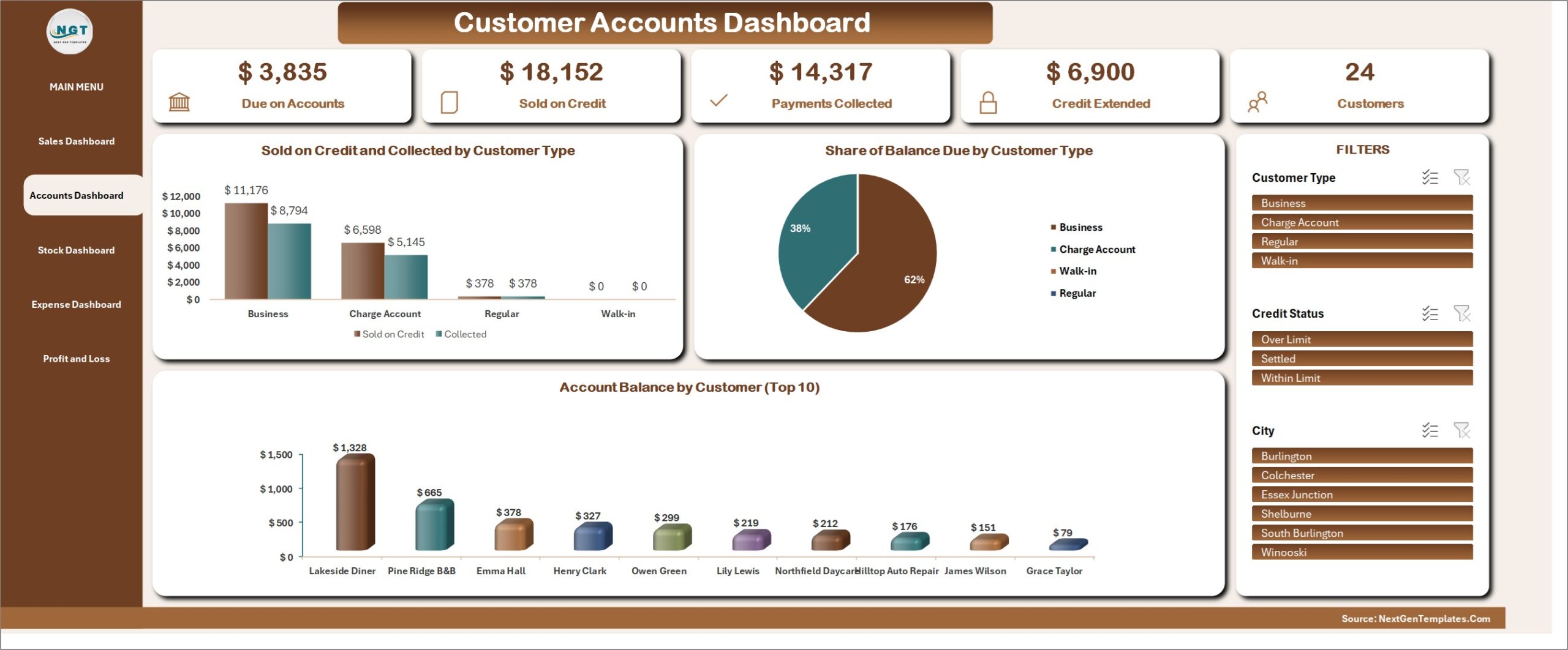
Customer Accounts Dashboard
Due on Accounts, Sold on Credit, Payments Collected and Credit Extended, with the account balance of the top ten customers. This is the page to open before you chase payments.
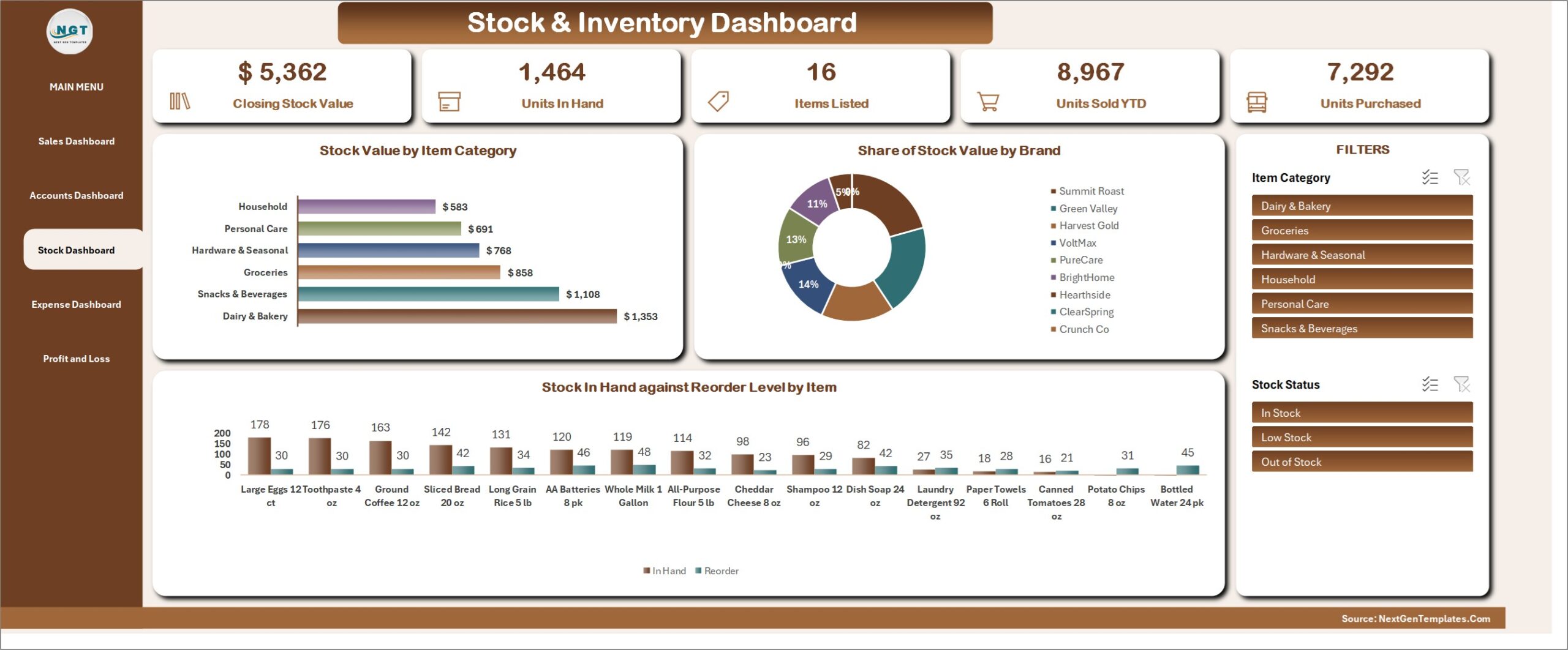
Stock and Inventory Dashboard
Closing stock value, units in hand and items listed, with stock value by category and brand, and stock in hand against the reorder level for every item.
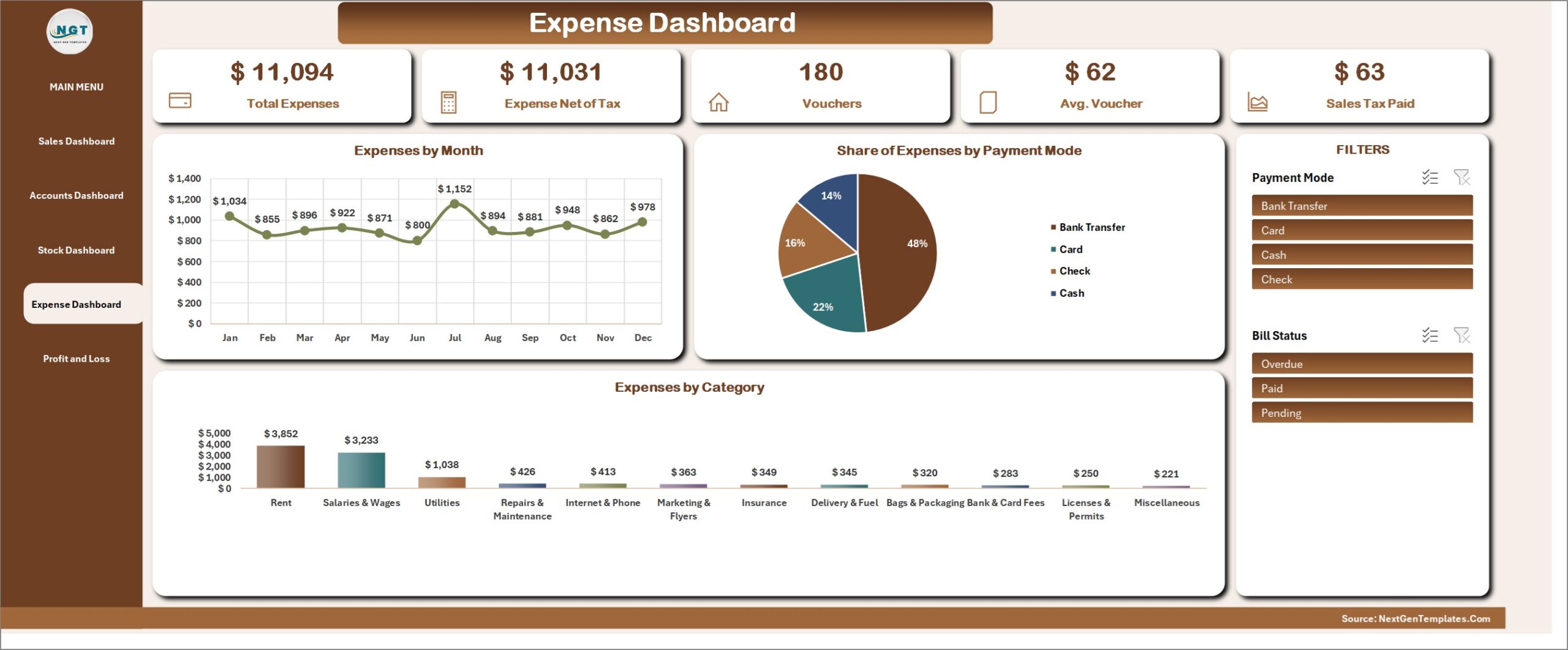
Expense Dashboard
Total expenses, expenses net of tax, vouchers and average voucher, with spend by month, by payment method and by category.
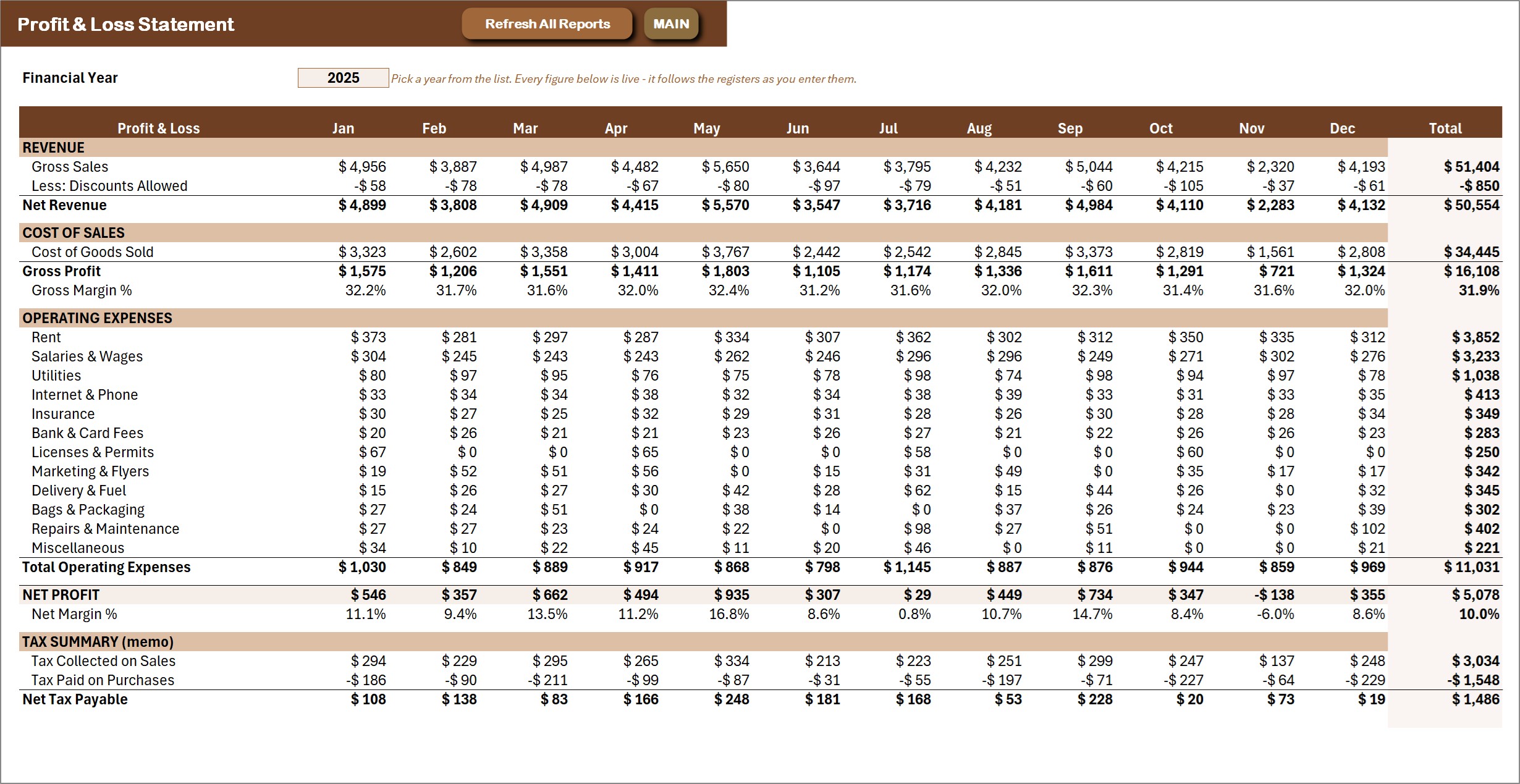
Profit and Loss statement
Twelve months and a year total, from gross sales and discounts through cost of goods sold to net profit, with a sales tax memo. The Financial Year dropdown picks the year.
Registers and settings
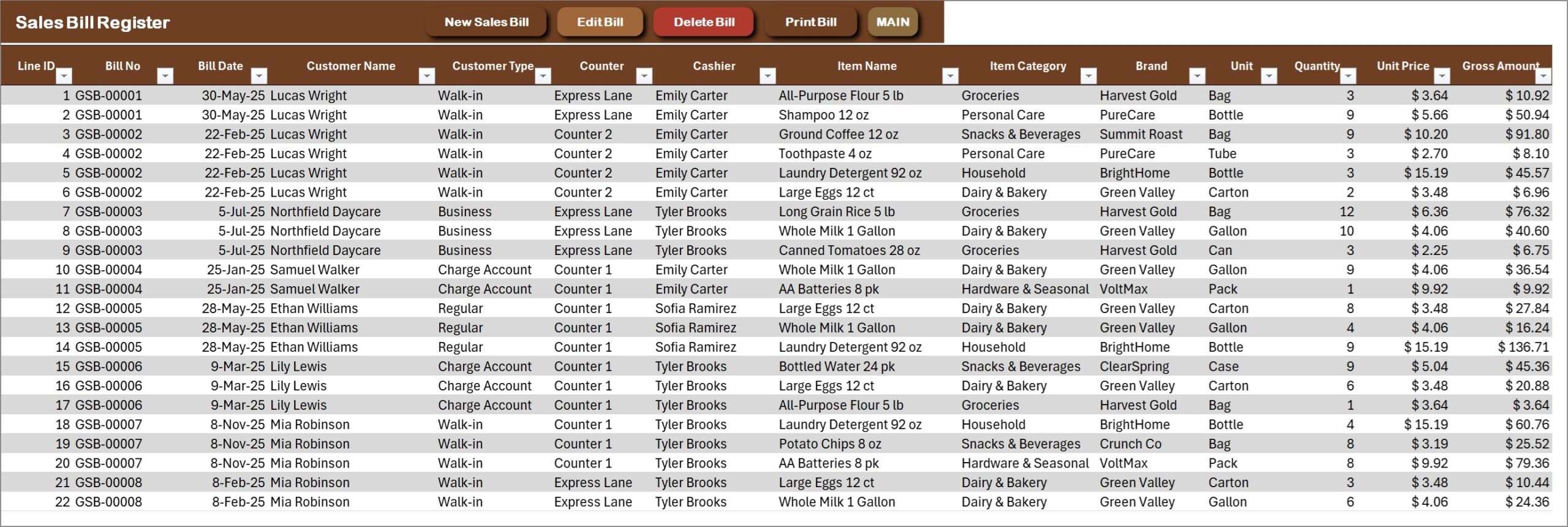
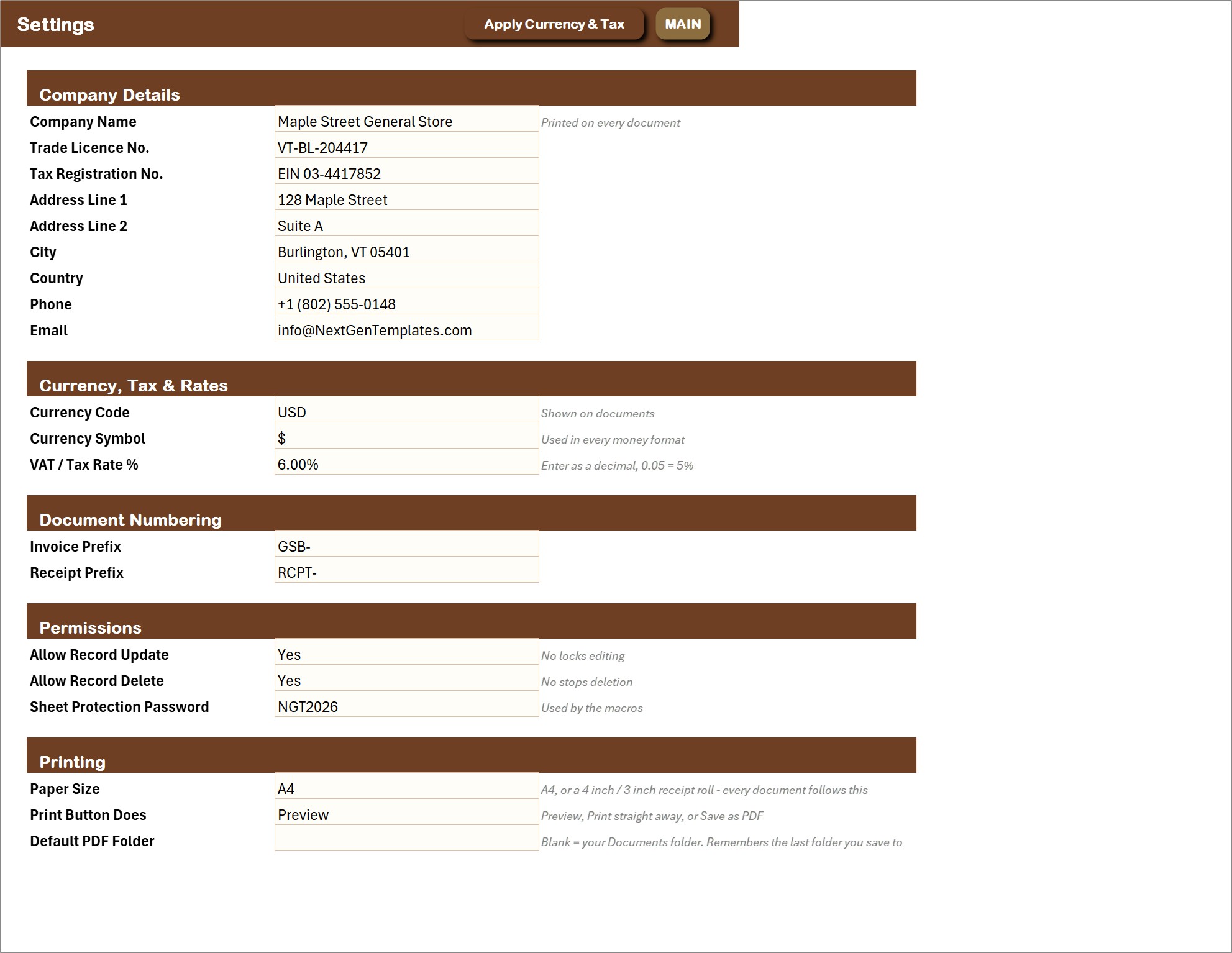
Behind the dashboards sit the Sales Bill Register (one row per bill line), the Purchase Register, the Item Master, Customer Accounts, the Supplier Register, the Payments Register and the Expense Register, plus a Category Master for the dropdown lists and a Settings sheet for store details, currency, sales tax rate, numbering prefixes, permissions and printing defaults.
General Store Billing Management System vs. a Billing Spreadsheet vs. Cloud POS
| Feature | This Excel VBA system | Plain billing spreadsheet | Cloud POS / billing app |
|---|---|---|---|
| Cost | One-time purchase | Free to a few dollars | Monthly subscription, often per register |
| Multi-item bills with discount and tax | Yes, basket form | One row at a time | Yes |
| Customer credit limit and balance | Yes, automatic | Manual | Depends on plan |
| Stock moves with every bill | Yes, with reorder status | Manual | Yes |
| Prints A4, 4 inch and 3 inch | Yes | No | Receipt printer or PDF |
| Card terminal and barcode scanner | No | No | Yes |
| Works offline | Yes | Yes | Usually no |
Who Should Use This Template
It suits general stores, convenience stores and neighbourhood shops that bill at one counter, sell on credit to regular customers and want stock, purchases and monthly profit in the same file. It is a single-user desktop workbook for Microsoft Excel on Windows with macros enabled. It is not for several people billing at the same time, for Mac or Excel on the web, or for stores that need card-terminal or barcode-scanner integration.
Real-World Use Cases
- One till, many small bills. The cashier adds items to the basket, takes payment and prints a 3 inch bill; the owner reads net sales and gross profit on the Sales & Billing Dashboard.
- Regulars on a tab. Bills are marked On Account, the Customer Accounts register shows each balance against its credit limit, and Receive Payment prints a receipt when they settle.
- Weekly restocking. The Stock Dashboard shows items that are Low or Out of Stock, New Purchase Bill records what arrived, and the Purchase Order prints for the supplier.
Advantages and Limits
Advantages: one-time cost, no subscription, data stays on your PC, bills and receipts print at three paper sizes, and every list is editable from the Manage Dropdown Lists form. Limits: single user, Windows desktop Excel only, a simple sales tax rate rather than tax-return filing, and no built-in barcode or card-terminal integration. If you need those, use a cloud POS, or try the multi-user General Store POS Web App.
How to Set It Up in Under 20 Minutes
- Download the ZIP, extract it, open the .xlsm file and click Enable Content.
- Open Print & Setup, then Settings, and enter your store details, currency symbol, sales tax rate and paper size.
- Replace the sample counters, categories, brands, cashiers and cities in Manage Dropdown Lists.
- Add your items, customers and suppliers, then start billing with New Sales Bill.
- Delete the sample rows when you are ready; the dashboards and the Profit & Loss refresh themselves.
Try It Free for 7 Days
You do not have to take our word for it. The 7-day free trial on the product page is the complete system, so you can enter your own bills and test every form, dashboard and printout before you buy. After 7 days it locks, and the full version, with unlocked VBA code, is a one-time purchase.
Frequently Asked Questions
Is this a real billing system or just a sheet?
It is a real workbook-based system. The Sales Bill form is a multi-item basket, stock and customer balances update from the bills, and bills and receipts print at A4, 4 inch or 3 inch.
Can I sell on credit and track balances?
Yes. Mark a bill On Account or Partial and the amount is charged to the customer. The register tracks the credit limit, balance and credit status, and Receive Payment brings the balance down.
Does it work on Mac or Excel for the web?
No. The forms and printing engine are VBA, so it needs Microsoft Excel for Windows with macros enabled.
Can I change the currency and tax rate?
Yes. The sample store uses US dollars and 6% sales tax; set your own on the Settings sheet.
Can you customise it for my store?
Yes. Write to NextGenTemplates with what you need.
Get the General Store Billing Management System
👉 See the General Store Billing Management System V1.0 in Excel VBA on NextGenTemplates.com – instant download, one-time payment, with a 7-day free trial and an illustrated PDF user manual.
Related Posts
- Grocery Store Billing Data Entry System in Excel – a lighter billing data-entry workbook.
- CRM and Sales Pipeline Management System in Excel VBA – track business customers, deals and quotations.
- Microsoft: enable or disable macros in Office files