Part of the free Module 2: Fill, Auto Fill and Flash Fill · Lesson 3 of 6 · Full Excel course
Updated on 5 September 2026 · Works in Excel 365, 2021, 2019, 2016 and 2013; not available in Excel 2010 or earlier.
Flash Fill in Excel recognises a pattern from one or two examples you type and completes the rest of the column instantly, without a formula. Press Ctrl+E and Excel extracts first names, splits addresses, combines columns, adds dashes to phone numbers or changes case. This lesson shows three worked examples and explains when a formula is the safer choice.
What Flash Fill is and where to find it
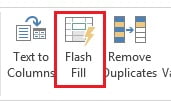
Flash Fill arrived in Excel 2013. It sits on the Data tab in the Data Tools group and answers to Ctrl+E. You type the result you want beside the first row of data; when you press Ctrl+E in the cell below, Excel studies your example, infers the transformation and fills the whole column. Excel also offers a live suggestion while you type the second example: the column appears in grey, and pressing Enter accepts it. The output is static text, so use Flash Fill for one-off clean-ups and a formula such as TEXT, LEFT or TEXTSPLIT when the source data will keep changing.
After a fill, a small Flash Fill Options button appears next to the range. It lets you undo the fill, accept the suggestions permanently, or select all changed cells so you can check them. If nothing happens when you press Ctrl+E, confirm that File > Options > Advanced > Automatically Flash Fill is ticked.
What Flash Fill can do and the formula that does the same
| Task | Flash Fill example you type | Formula alternative (updates automatically) |
|---|---|---|
| First name from full name | Priya | =LEFT(A2,FIND(" ",A2)-1) or =TEXTBEFORE(A2," ") |
| Last name from full name | Sharma | =TEXTAFTER(A2," ",-1) |
| Domain from an e-mail address | example.com | =TEXTAFTER(A2,"@") |
| Combine first and last name | Priya Sharma | =A2&" "&B2 or =TEXTJOIN(" ",TRUE,A2:B2) |
| Month name from a date | January | =TEXT(A2,"mmmm") |
| Format a phone number | 98765-43210 | =TEXT(A2,"00000-00000") |
| Change case | PRIYA SHARMA | =UPPER(A2), =PROPER(A2) |
| Initials | PS | =LEFT(A2)&MID(A2,FIND(" ",A2)+1,1) |
| Remove non-numeric characters | 9876543210 | No simple formula; Flash Fill or Power Query |
TEXTBEFORE, TEXTAFTER and TEXTSPLIT are Excel 365 and 2021 functions. In older versions use LEFT, RIGHT, MID and FIND.
Worked example 1: extract day and month from a date
Column A holds dates. We want the day number in column B and the month name in column C.
| A: Date | B: Day (you type row 2) | C: Month (you type row 2) |
|---|---|---|
| 01-Jan-2026 | 1 | January |
| 14-Feb-2026 | 14 (filled) | February (filled) |
| 23-Mar-2026 | 23 (filled) | March (filled) |
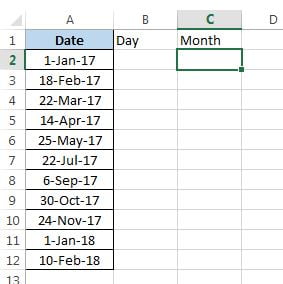
- In B2 type 1, the day of the first date.
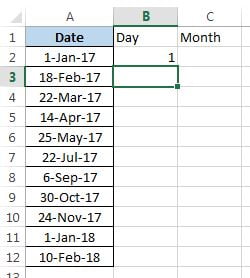
- Select B3 and press Ctrl+E (or Data > Flash Fill). The day numbers fill the column.
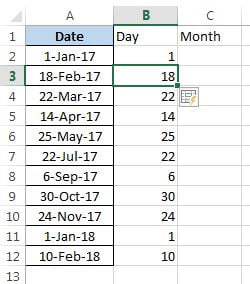
- In C2 type the month name of the first date, select C3 and press Ctrl+E.
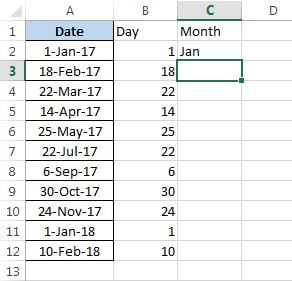
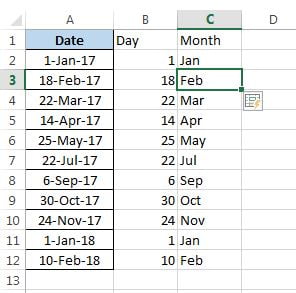
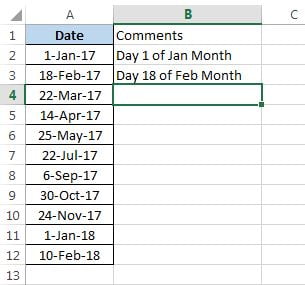
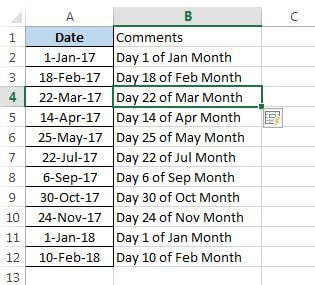
- Flash Fill can also build a sentence from the date. Type one or two examples such as “1st day of January” and press Ctrl+E.
Worked example 2: split, abbreviate and combine text
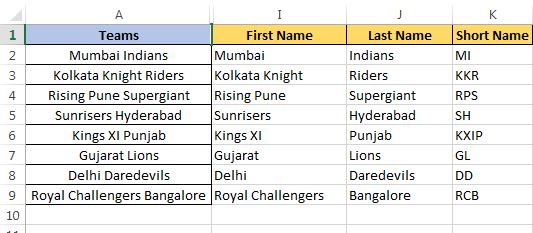
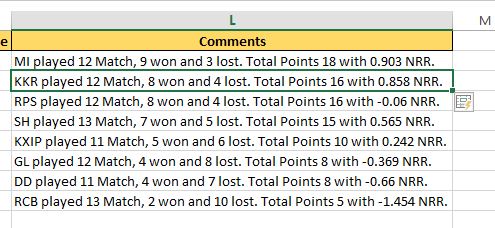
The table lists IPL teams. The yellow columns must hold the first part of the name, the last word, the initials and a summary sentence.
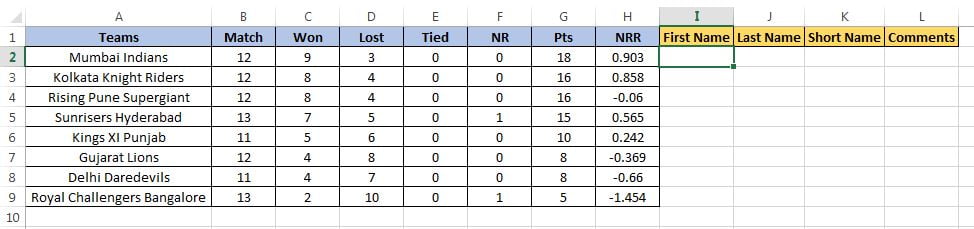
- Type Mumbai in I2. One example is not enough here, because three-word names should keep two words, so also type Kolkata Knight in I3 to show the rule.
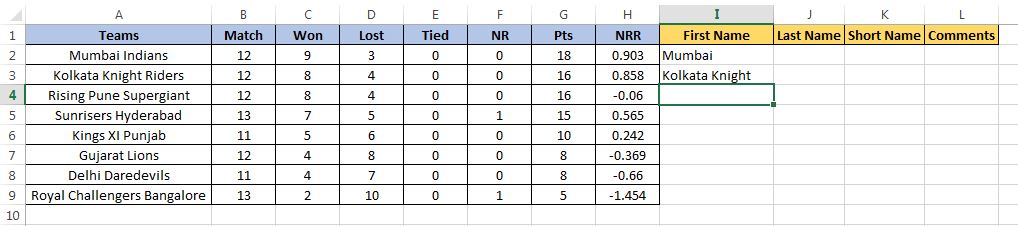
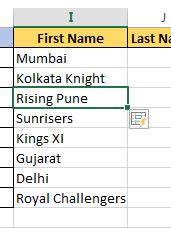
- Select I4 and press Ctrl+E.
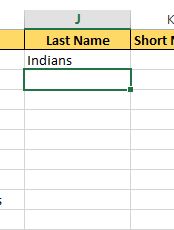
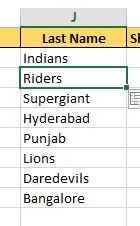
- For the last word type one example and press Ctrl+E.
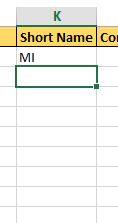
- For initials type MI for Mumbai Indians and press Ctrl+E.
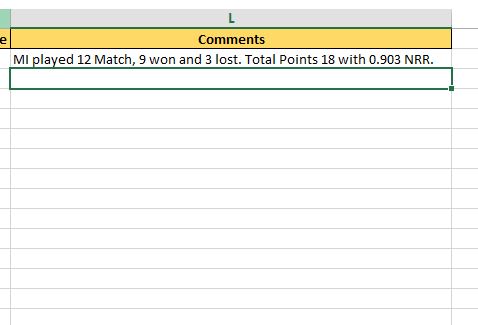
- To combine several columns into a sentence, type one full example that uses each column and press Ctrl+E.
Worked example 3: reformat and extract digits from numbers
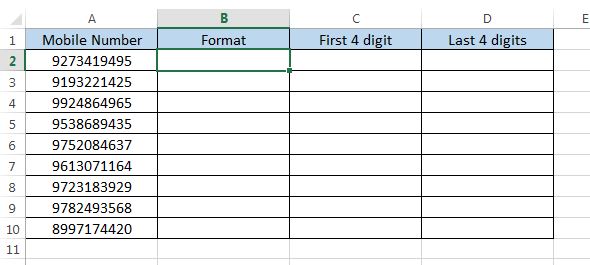
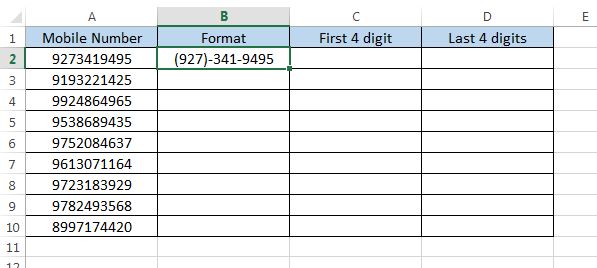
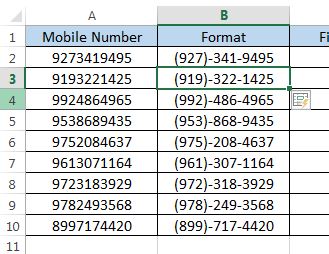
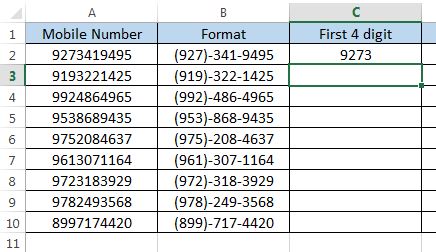
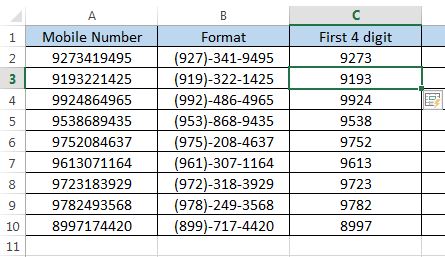
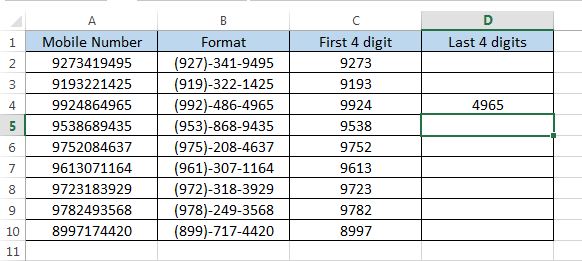
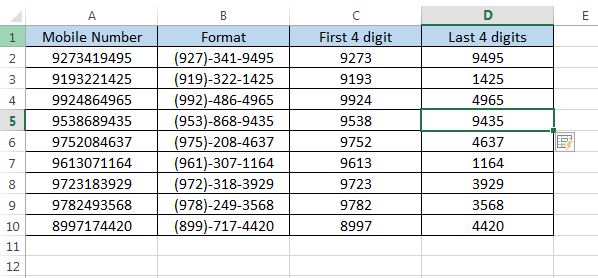
Column A holds ten-digit mobile numbers. Type the first number with the format you want, for example 98765-43210, and press Ctrl+E in the next cell to reformat every row. Type the first four digits in another column and press Ctrl+E to extract them; do the same with the last four digits. The example does not have to be in row 2; Flash Fill learns from whichever row you fill.
Tips and common mistakes
- Check the result. Flash Fill guesses; scan the column for rows that did not match the pattern and add a second example if needed.
- Results are values, not formulas. They will not update when the source changes. Use a formula for live data.
- Leading zeros vanish because output that looks numeric is stored as a number. Format the target column as Text before pressing Ctrl+E.
- Keep the example next to the data. Flash Fill only reads the columns immediately beside the one you are filling; a blank column between them breaks the link.
- Consistent input is essential. Mixed formats such as “Smith, John” and “John Smith” in one column produce wrong rows.
- Nothing happens? Enable it under File > Options > Advanced > Automatically Flash Fill, and make sure there is at least one example.
- Two examples beat one whenever the rule depends on word count, position or punctuation.
Errors and how to fix them
| Problem | Cause | Fix |
|---|---|---|
| “We looked at all the data next to your selection and didn’t see a pattern” | Example is not adjacent, or the rule is unclear | Move the example beside the source column and type a second example |
| Some rows are wrong | One example did not define the rule | Correct a wrong cell, select the next cell and press Ctrl+E again |
| Leading zeros dropped | Result stored as a number | Format the column as Text first, then Flash Fill |
| Dates appear as serial numbers | Extracted text was converted to a date value | Format the column as Text, or use TEXT(A2,”dd-mmm”) |
| Ctrl+E does nothing | Flash Fill disabled, or Excel 2010 or earlier | Enable it in Options > Advanced; use formulas in older versions |
| Results stop updating | Flash Fill output is static | Re-run Ctrl+E after new rows arrive, or switch to a formula |
Practice exercise
Download the Flash Fill practice workbook and try these:
- Extract the year from the dates in column A into a new column with one example.
- Build the sentence “[Team] plays at [City]” for every team with a single typed example.
- Reformat the mobile numbers as +91 98765 43210 and then extract only the middle two digits.
- Type a list of e-mail addresses and pull out the part before the @ sign.
- Repeat task 1 with a TEXT or YEAR formula and compare what happens when you change a date.
Key takeaways
- Flash Fill fills a column by pattern from one or two typed examples; the shortcut is Ctrl+E.
- It extracts, combines, reformats and changes case, but its results are static values.
- Keep the example adjacent to consistent source data and add a second example when rows go wrong.
- Format the target column as Text to keep leading zeros.
- Use LEFT, TEXT, TEXTBEFORE or TEXTSPLIT instead when the source data will change.
Related lessons
- Fill, AutoFill and Flash Fill course hub
- AutoFill with the fill handle and custom lists
- Fill blank cells with the value above, including Power Query Fill Down
- LEFT function and TEXT function
- TEXTJOIN function
- Microsoft Support: Using Flash Fill in Excel
Frequently asked questions
What is the shortcut for Flash Fill in Excel?
Ctrl+E. Type the example result in the first cell beside your data, select the cell directly below it and press Ctrl+E, or click Data > Flash Fill. Excel fills the column and shows a Flash Fill Options button so you can undo or review the changed cells.
Why does Flash Fill give wrong results for some rows?
One example was not enough to define the rule, or the source data is inconsistent. Correct one of the wrong cells by hand, select the next empty cell and press Ctrl+E again so Excel learns from both examples. If names use different formats, clean them first or use a formula.
Is Flash Fill better than formulas?
Flash Fill is faster for one-time clean-ups because there is nothing to write. Formulas win when the data will change, when the logic must be auditable, or when the same task repeats every month. TEXT, LEFT, RIGHT, TEXTBEFORE and TEXTSPLIT cover most of the same jobs and update automatically.
Does Flash Fill keep leading zeros?
Not by default. When the result looks like a number, Excel stores it as a number and drops the zeros. Select the target column, set the number format to Text, then run Flash Fill. The same fix stops extracted digits from being turned into dates or scientific notation.
Which versions of Excel have Flash Fill?
Flash Fill is available in Excel 2013, 2016, 2019, 2021 and Excel 365 for Windows and Mac. It is not in Excel 2010 or Excel for the web. In those environments use text functions or Power Query to achieve the same result.
Want the finished version? Ready-made Excel dashboards, trackers and VBA systems are available at NextGenTemplates.com.