Managing staff duties in the insurance industry requires accuracy, coordination, and timely planning. Insurance companies handle multiple responsibilities daily, including customer service, policy processing, claim handling, inspections, compliance activities, and internal meetings. Therefore, organizations must maintain a structured staff scheduling system to ensure smooth operations.
However, many teams still rely on manual planners, emails, or disconnected spreadsheets. As a result, scheduling conflicts occur, duties overlap, and important events get missed. Consequently, productivity decreases and coordination becomes difficult.
To solve these challenges, organizations increasingly use automated calendar-based planning tools. One powerful and practical solution is the Insurance Staff Duty Calendar in Excel — a ready-to-use scheduling system designed to manage staff duties, events, and operational planning through an interactive calendar interface.
In this comprehensive article, you will learn everything about the Insurance Staff Duty Calendar in Excel, including its structure, features, advantages, implementation methods, best practices, and frequently asked questions.
Click to Purchases Insurance Staff Duty Calendar in Excel
What Is an Insurance Staff Duty Calendar in Excel?
An Insurance Staff Duty Calendar in Excel is an interactive scheduling and event management tool that helps insurance organizations plan staff duties, meetings, and operational activities using automated calendar views.
Instead of managing schedules manually, users can organize duties across annual, monthly, and daily views. Consequently, managers gain better visibility into workforce planning.
Moreover, automated event forms simplify data entry. Because Excel updates calendars dynamically, users always see accurate scheduling information.
Why Do Insurance Organizations Need a Staff Duty Calendar?
Insurance operations involve multiple teams working simultaneously. Therefore, proper scheduling becomes essential.
Common Scheduling Challenges
-
Staff duty overlaps
-
Missed meetings or inspections
-
Poor workload distribution
-
Lack of centralized planning
-
Difficulty tracking events
Hence, a structured calendar system ensures organized staff management.
Click to Purchases Insurance Staff Duty Calendar in Excel
Key Features of Insurance Staff Duty Calendar in Excel
This ready-to-use template includes five worksheets, each designed to manage scheduling efficiently.
1. Home Sheet – Central Navigation Panel
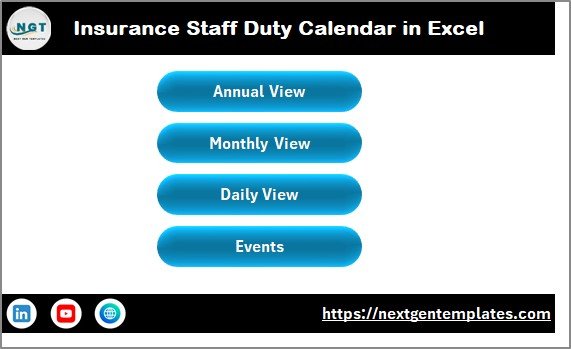
The Home Sheet acts as the index page of the calendar.
Navigation Buttons Included
-
Annual View
-
Monthly View
-
Daily View
-
Events
Because navigation uses buttons, users quickly move between calendar views without searching manually.
Click to Purchases Insurance Staff Duty Calendar in Excel
2. Annual View Sheet – Yearly Planning Dashboard
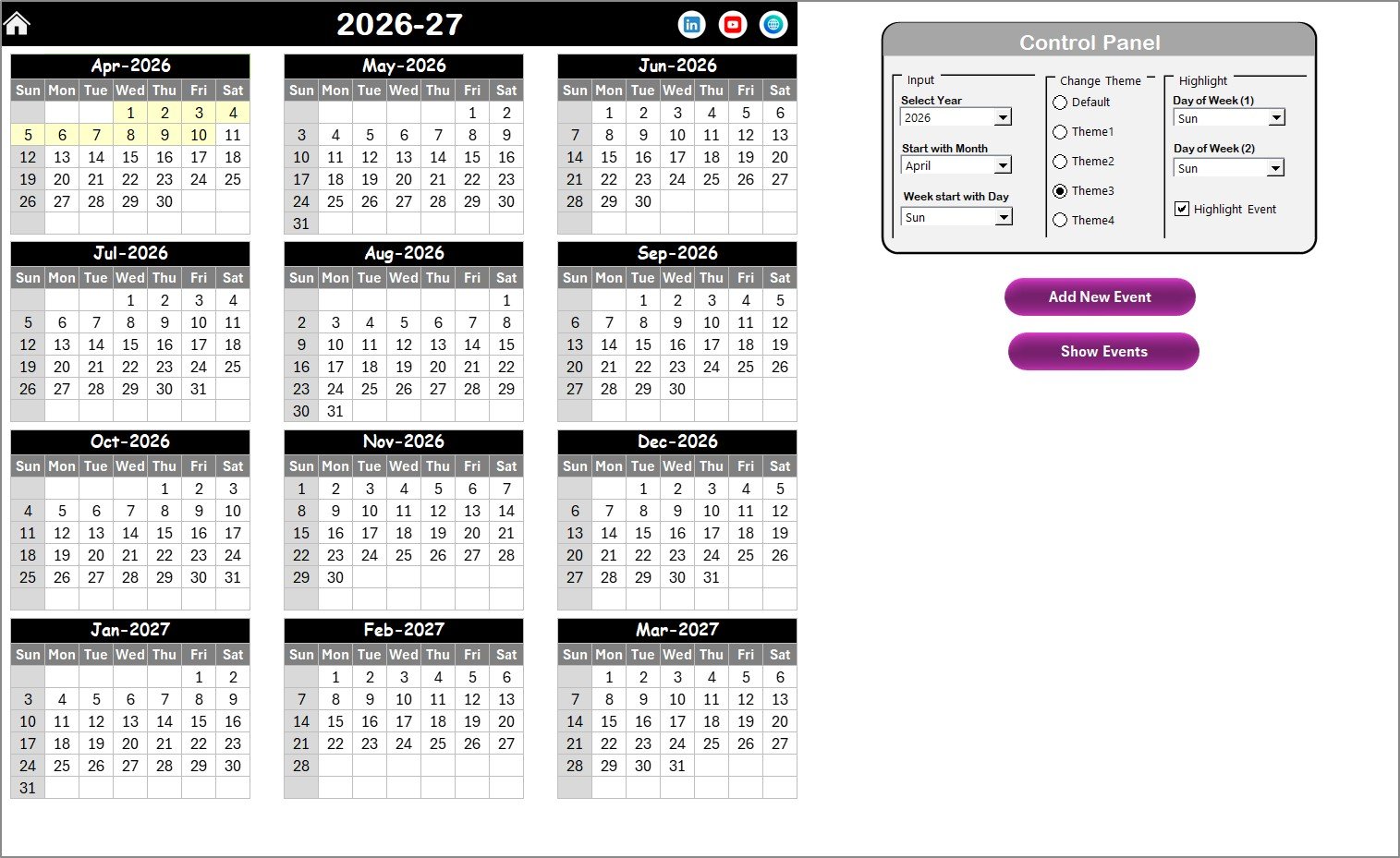
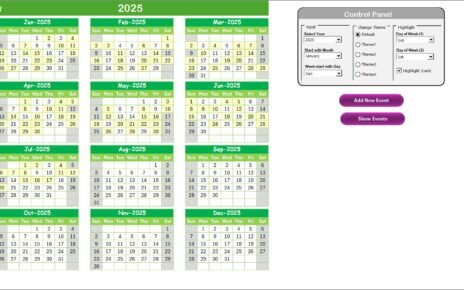
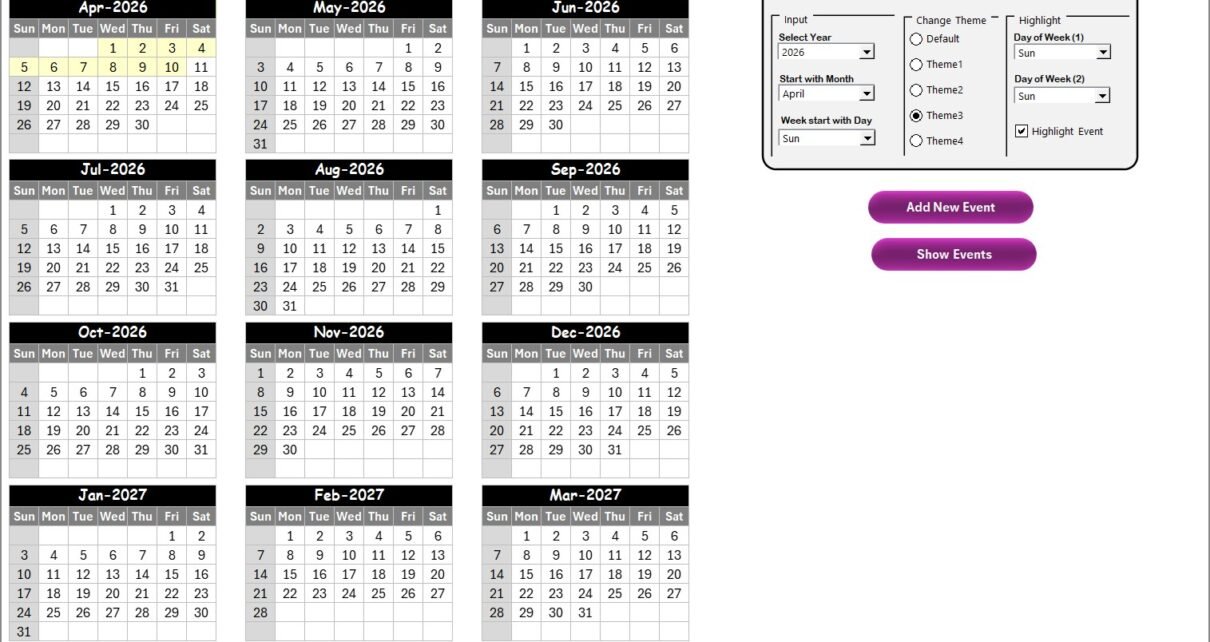
The Annual View Sheet displays all 12 months in a single calendar layout.
Control Panel Features
The control panel allows users to customize the calendar dynamically.
Input Group
Users can:
-
Select the year
-
Change starting month
-
Set the starting day of the week
As a result, the calendar adjusts automatically.
Change Theme Group
Five color themes are available. Users can apply a preferred theme across the entire workbook instantly.
Highlight Group
Users can highlight specific days such as weekends.
Example:
-
Highlight Saturday and Sunday in grey color.
Additionally, a Highlight Event checkbox marks event dates in yellow for easy identification.
Event Management Buttons
Add New Event Button
-
Select a date
-
Click the button
-
Fill the event form
-
Submit to save
Show Event Button
Displays all events scheduled for the selected date.
Therefore, yearly planning becomes quick and visual.
Click to Purchases Insurance Staff Duty Calendar in Excel
3. Monthly View Sheet – Detailed Monthly Planning
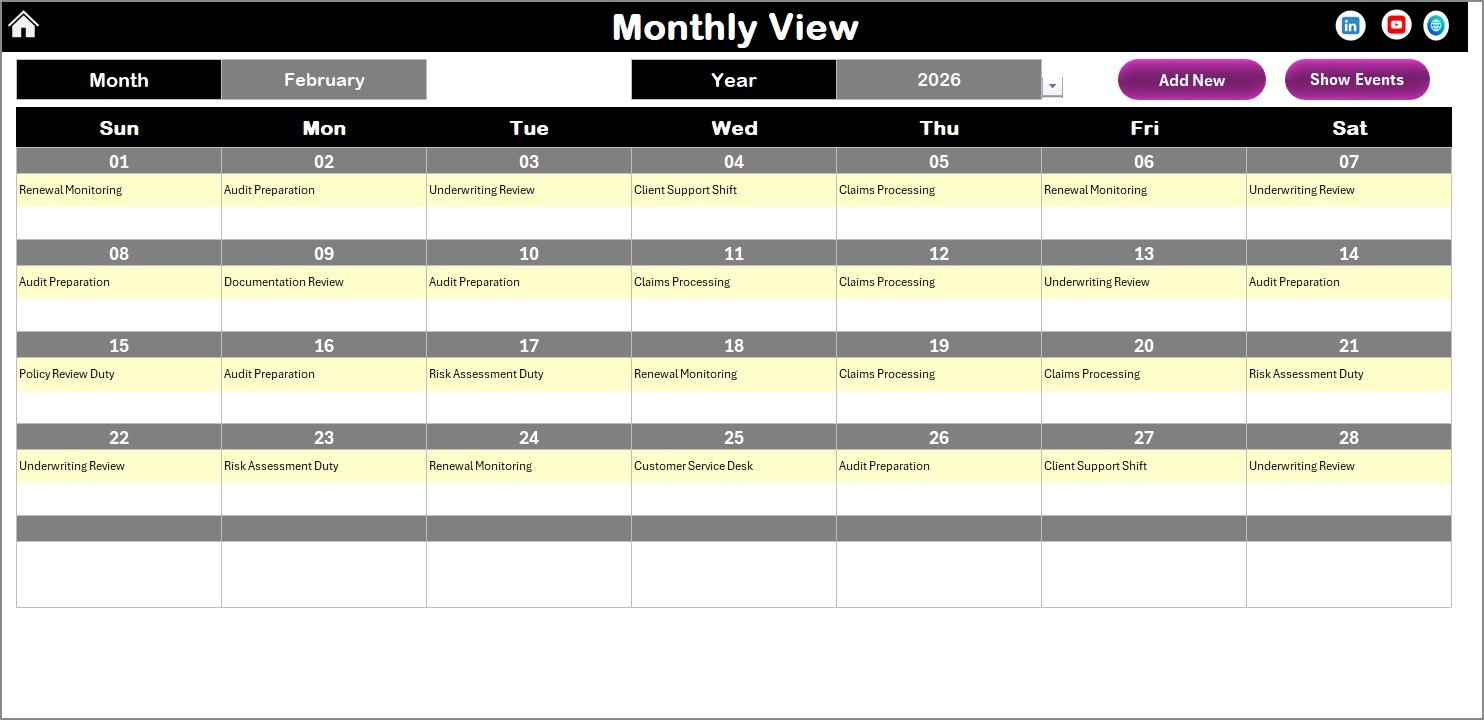
The Monthly View Sheet shows one month at a time.
Dynamic Selection
Users select:
-
Month
-
Year
The calendar updates automatically.
Event Display Logic
-
Shows one event directly on the date
-
Displays “more than 1…” when multiple events exist
This approach keeps the calendar clean while maintaining information clarity.
Available Buttons
-
Add New Event
-
Show Event List
Consequently, users manage schedules directly from the monthly view.
4. Daily View Sheet – Event Detail Analysis
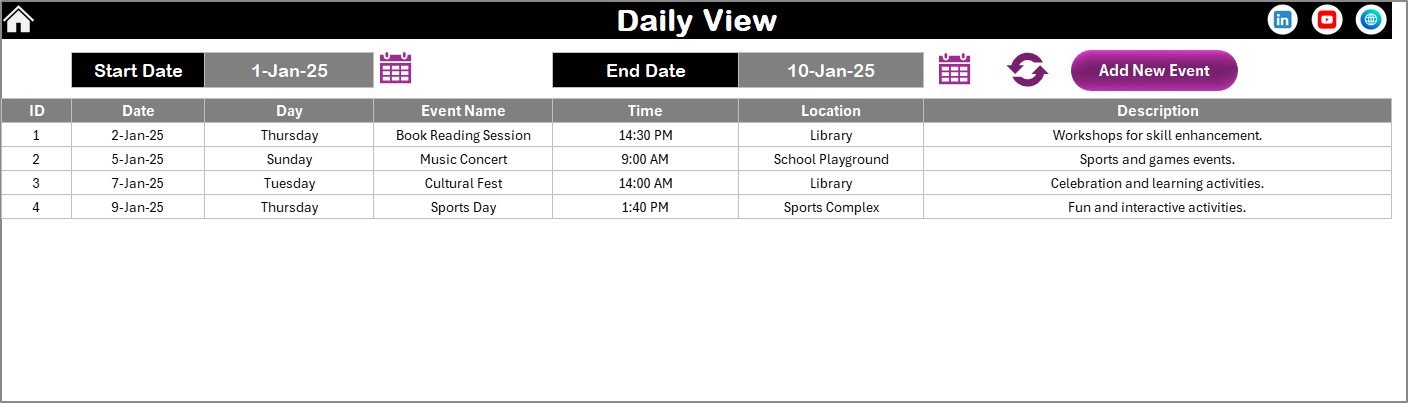
The Daily View Sheet provides detailed event tracking.
Date Range Selection
Users enter:
-
Start Date
-
End Date
Using calendar icons simplifies date selection.
After clicking the Refresh Button, the sheet displays all events within the selected range.
Additional Feature
An Add New Event button allows quick entry without switching sheets.
Therefore, managers can review workload distribution easily.
Click to Purchases Insurance Staff Duty Calendar in Excel
5. Events Sheet – Central Event Database
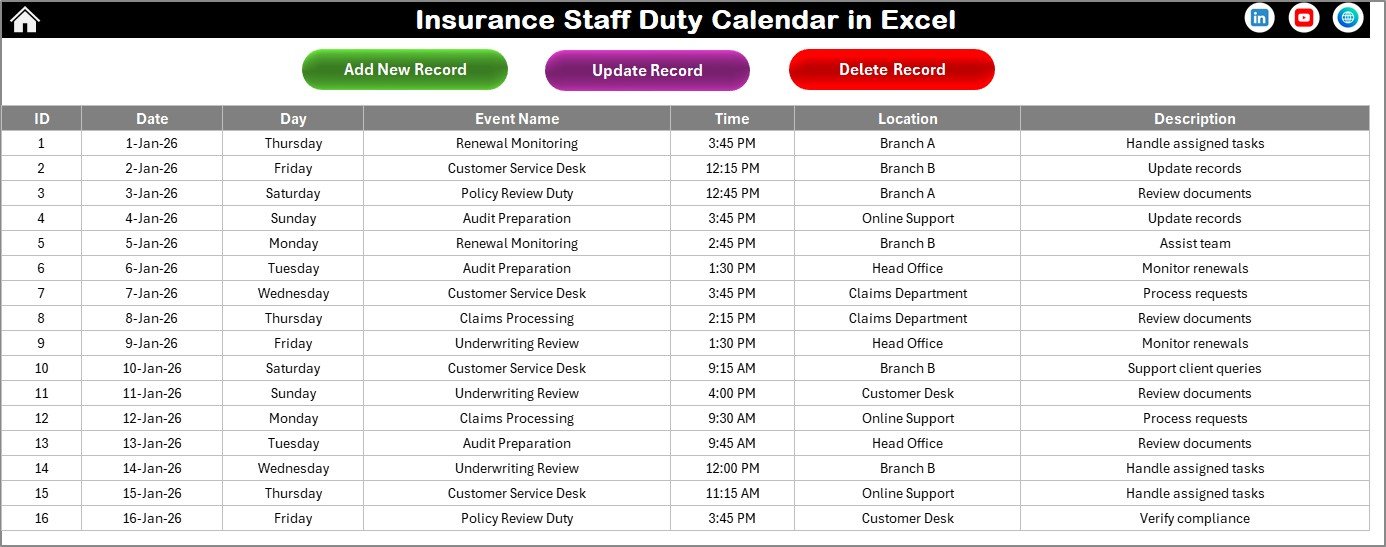
The Events Sheet works as the backend database storing all event records.
Data Fields Included
-
ID (Auto-generated)
-
Date
-
Day
-
Event Name
-
Time
-
Location
-
Description
Because data remains centralized, all calendar views update automatically.
Event Management Controls
Add New Record
Opens event entry form for new records.
Update Existing Record
Select ID → Edit details → Submit updates.
Delete Record
Removes selected event permanently.
Thus, users maintain accurate scheduling data effortlessly.
Click to Purchases Insurance Staff Duty Calendar in Excel
How Does the Insurance Staff Duty Calendar Work?
The system follows a simple workflow.
Step 1: Add Events
Use buttons to create staff duties or meetings.
Step 2: Store Data Automatically
Events save in the database sheet.
Step 3: View Across Calendars
Annual, monthly, and daily views update instantly.
Step 4: Monitor Activities
Managers review workload and schedules visually.
As a result, planning becomes structured and efficient.
What Activities Can Be Managed Using This Calendar?
Insurance organizations can schedule various operational tasks.
Staff Management
-
Duty rosters
-
Shift assignments
-
Team meetings
Operational Activities
-
Policy reviews
-
Claims processing schedules
-
Client appointments
Compliance Activities
-
Audits
-
Regulatory deadlines
-
Documentation reviews
Training & Events
-
Staff training sessions
-
Workshops
-
Internal reviews
Advantages of Insurance Staff Duty Calendar in Excel
Using this calendar provides multiple benefits.
✅ Centralized Scheduling
All duties appear in one system.
✅ Improved Staff Coordination
Teams understand schedules clearly.
✅ Visual Planning
Calendar layouts simplify workload tracking.
✅ Automated Event Management
Forms reduce manual entry errors.
✅ Flexible Customization
Users adjust themes and settings easily.
✅ Time Saving
Navigation buttons speed up operations.
✅ Cost-Effective Solution
Excel removes the need for expensive software.
Click to Purchases Insurance Staff Duty Calendar in Excel
How to Implement the Insurance Staff Duty Calendar Successfully?
Follow these steps for smooth implementation.
Step 1: Define Scheduling Needs
Identify staff duties and recurring activities.
Step 2: Configure Calendar Settings
Set year, starting month, and week preferences.
Step 3: Add Staff Events
Enter duties using event forms.
Step 4: Train Team Members
Explain event entry and updates.
Step 5: Review Calendar Regularly
Monitor schedules weekly.
Click to Purchases Insurance Staff Duty Calendar in Excel
Best Practices for the Insurance Staff Duty Calendar in Excel
✔ Keep Event Names Clear
Short titles improve readability.
✔ Update Events Immediately
Avoid outdated schedules.
✔ Use Highlight Features
Mark weekends or critical days.
✔ Maintain Accurate Descriptions
Provide enough context.
✔ Review Daily View Regularly
Ensure balanced workloads.
✔ Avoid Duplicate Entries
Update existing records instead.
✔ Backup Data Periodically
Protect important scheduling information.
Click to Purchases Insurance Staff Duty Calendar in Excel
Common Challenges and Solutions
Challenge: Missed Updates
Solution: Assign calendar ownership.
Challenge: Scheduling Conflicts
Solution: Review monthly view regularly.
Challenge: Data Entry Errors
Solution: Use event forms instead of manual typing.
Challenge: Overloaded Calendar
Solution: Categorize events properly.
Click to Purchases Insurance Staff Duty Calendar in Excel
Why Excel Is Ideal for Staff Duty Calendars?
Excel provides flexibility and accessibility.
-
Easy customization
-
Automated calculations
-
Visual formatting
-
Form-based data entry
-
No subscription costs
-
Easy sharing
Therefore, organizations can implement professional scheduling systems quickly.
How Staff Duty Calendars Improve Organizational Efficiency
A structured calendar improves operations significantly.
First, it increases visibility into staff availability.
Next, it improves coordination across departments.
Then, it reduces scheduling conflicts.
Finally, it enhances productivity and accountability.
Consequently, teams operate more efficiently.
Click to Purchases Insurance Staff Duty Calendar in Excel
Future of Staff Scheduling in Insurance Organizations
Modern scheduling increasingly integrates with:
-
Workforce analytics
-
HR systems
-
Automated reminders
-
Digital workflow platforms
However, Excel calendars remain highly valuable because they combine simplicity with flexibility.
Conclusion
The Insurance Staff Duty Calendar in Excel provides a practical and efficient solution for managing staff schedules, duties, and operational events. Instead of relying on manual planning methods, organizations gain centralized scheduling with automated updates and multiple calendar views.
Because the template includes annual, monthly, and daily planning along with event management forms and database control, users manage schedules with clarity and precision. Furthermore, customizable themes and highlight features enhance usability.
Ultimately, companies that adopt structured duty calendars improve coordination, reduce errors, and achieve better workforce management. Therefore, this Excel calendar serves as an essential tool for organized insurance operations.
Click to Purchases Insurance Staff Duty Calendar in Excel
Frequently Asked Questions (FAQs)
1. What is an Insurance Staff Duty Calendar?
It is an Excel-based scheduling tool used to plan staff duties, meetings, and operational events.
2. Can I customize the calendar year?
Yes. You can change the year, starting month, and week settings easily.
3. How do I add events?
Select a date and click the Add New Event button to open the event form.
4. Can I update existing events?
Yes. Select the event ID and use the update button.
5. Does the calendar support multiple views?
Yes. It includes annual, monthly, and daily views.
6. Is Excel knowledge required?
No advanced skills are required. The template uses buttons and forms.
7. Is this calendar suitable for small teams?
Yes. It works for both small and large insurance organizations.
Click to Purchases Insurance Staff Duty Calendar in Excel
Visit our YouTube channel to learn step-by-step video tutorials