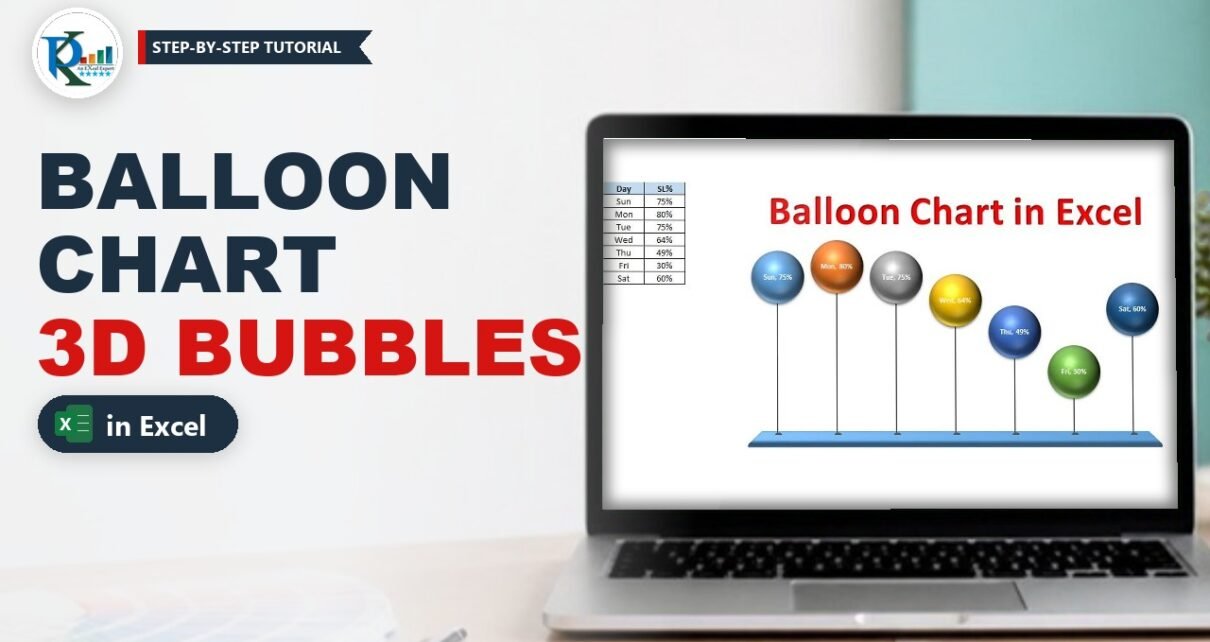
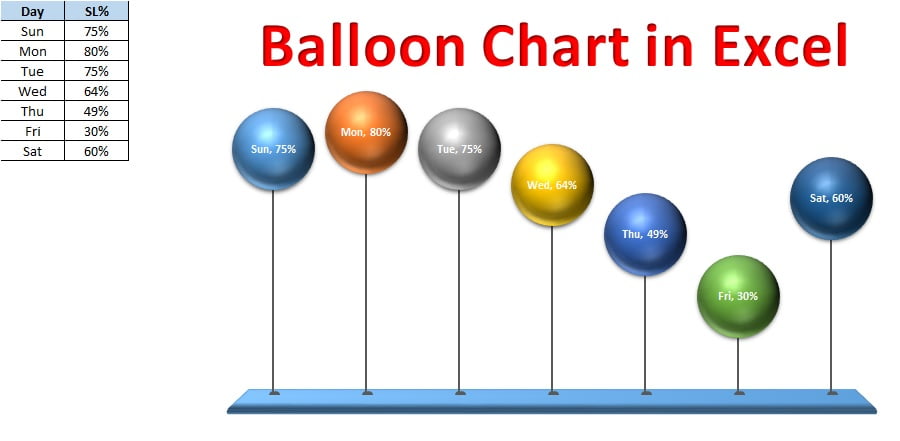
A balloon chart in Excel is a playful alternative to a column chart: every value floats as a glossy balloon on a string, and the higher the value, the higher the balloon flies. In this tutorial you build one for a week of service level (SL%) figures using a 3-D bubble chart, error bars that act as strings, labels pulled from cells and a 3-D rectangle as the stand. No VBA is needed, and when a number changes, its balloon moves up or down automatically. It is a great eye-catcher for dashboards and team reports.
Watch the Video Tutorial
In the video, PK turns a plain bubble chart into balloons with minus error bars and oval arrow ends, switches it to 3-D bubbles, adds day labels and builds the 3-D stand.
What You Will Build
- A bubble chart where every bubble has the same size and its height equals the value.
- Balloon strings made from minus error bars set to 100% of each value.
- Colourful 3-D balloons using the 3-D Bubble chart type and Vary colors by point.
- Labels such as Sun, 75% combining the day name from cells with the value.
- A 3-D stand drawn with a rectangle and 3-D rotation, placed behind the chart.
Part 1 – Prepare the Data
Step 1: Enter the daily values
Put the days in column A and the service level in column B, with headers in row 1:
Day   SL%
Sun   75%
Mon   80%
Tue   75%
Wed   64%
Thu   49%
Fri   30%
Sat   60%
Keep the values as percentages between 0% and 100%. The chart scale is fixed to that range later, so every balloon has room to fly.
Part 2 – Build the Balloon Chart in Excel
Step 2: Insert an empty bubble chart and add the series
Click an empty cell and go to Insert > Insert Scatter (X, Y) or Bubble Chart > Bubble. Right-click the chart, choose Select Data and click Add. Fill the Edit Series box like this (the video’s sheet is named Sheet2):
Series name:         =Sheet2!$B$1
Series X values:     (leave blank)
Series Y values:     =Sheet2!$B$2:$B$8
Series bubble size:  ={1,1,1,1,1,1,1}
Leaving X blank makes Excel place the seven points at positions 1 to 7, one per day. The bubble size is a typed array of seven 1s, so every balloon is exactly the same size. Only the height changes with the data.
Step 3: Fix the vertical axis from 0 to 100%
Make the chart a little bigger, double-click the vertical axis and in Format Axis > Bounds set Minimum 0 and Maximum 1. Even if Excel already shows 0 to 100%, typing the bounds stops the scale jumping when values change, so a 75% balloon is always at the same height.
Part 3 – Turn Bubbles into Balloons
Step 4: Add error bars as strings
Remove the chart title, axes and gridlines with the Chart Elements (+) button and tick Error Bars. Select the vertical error bars (in the Format pane choose Series SL% Y Error Bars) and set:
- Direction: Minus
- End Style: Cap
- Error Amount: Percentage, 100%
Then click the horizontal error bars and press Delete.
How the error bar trick works
- A minus error bar draws a line from the point downwards only.
- Percentage 100% means the line is 100% of the value long. For a 75% bubble the bar runs 75% down, so it ends exactly at zero.
- Because every bar ends at the axis floor, all the strings finish on the same baseline, where the stand will sit.
Step 5: Colour the balloons and style the strings
Right-click any bubble > Format Data Series > Fill & Line and tick Vary colors by point, so each day gets its own colour. Next select the error bars, open Fill & Line > Line, set the Width to 1.5 pt and choose an oval End Arrow type. The small oval looks like the knot that ties the balloon down.
Step 6: Switch to 3-D bubbles
Right-click the chart > Change Chart Type and pick the 3-D Bubble option. On the Chart Design tab choose a chart style with glossy balls. A new style brings back the axes and gridlines, so remove them again, and re-apply the error bar settings (1.5 pt width, oval end arrow), because the style resets them.
Step 7: Make the chart background transparent
Select the whole chart and on the Format tab set Shape Fill > No Fill and Shape Outline > No Outline. Turn off gridlines on the View tab so the balloons float on a clean sheet.
Part 4 – Labels and the Stand
Step 8: Show the day and value on each balloon
Right-click a balloon > Add Data Labels. Right-click a label > Format Data Labels and set:
- Tick Value From Cells and select the day names
=Sheet2!$A$2:$A$8. - Keep Y Value ticked and use a comma separator.
- Label Position: Center.
On the Home tab make the label font white. PK uses Arial Rounded MT Bold. Each balloon now reads like Sun, 75%.
Step 9: Build the 3-D stand
- Insert a Rectangle and stretch it along the bottom of the strings.
- Right-click > Format Shape > Effects > 3-D Rotation, choose the preset Perspective Relaxed and set Perspective to 120°.
- In 3-D Format set the Top bevel to Circle.
- Right-click > Send to Back so the strings appear to stand on it.
Change any value in column B and that balloon rises or sinks at once. In the video, typing 80% for Monday lifts its balloon above the rest.
Step 10: Optional flat-bubble version
If you prefer a flatter look, use Change Chart Type to switch back to the plain Bubble chart. Then select the series and apply Format > Shape Effects > Bevel > Circle to give the bubbles a rounded finish.
Common Errors and Fixes
These fixes are additions based on general Excel behaviour, not shown in the video.
The balloons are different sizes
The bubble size points at your data instead of the array. Edit the series and set Series bubble size to ={1,1,1,1,1,1,1}, with one 1 per data point.
The strings do not reach the stand
The error amount is not 100% or the axis minimum is not 0. Set both, then line the stand up with the bottom of the strings.
Labels show only numbers
Value From Cells was not ticked or the range is wrong. Reselect the day names in column A.
The error bars lost their oval ends
Applying a chart style resets error bar formatting. Re-apply the width and End Arrow type after choosing the style.
Tips
- Add more points by extending the Y values range and adding the same number of 1s to the bubble size array.
- Use the balloon chart for any small set of percentages, such as attendance, quality scores or target achievement by team.
- Keep it to about 5 to 10 balloons; more than that and the labels start to overlap.
- Group the chart and the stand so they move together on a dashboard.
- Microsoft’s guides on bubble charts and error bars cover the options used here.
Want It Ready-Made?
If you want the finished workbook with the balloons, labels and stand already in place, get the Balloon Chart in MS Excel template, or browse more Excel chart templates on NextGenTemplates.com. To master charts, infographics and dashboards step by step, join the course Excel Pivot Tables and Dashboards on NextGenTemplates Academy.
Related Tutorials
- Conditional Formatting in a Lollipop Chart in Excel
- Candle Infographic Chart in Excel
- Stunning Thermometer Chart in Excel
- Stunning Battery Chart in Excel
- Traffic Lights in Excel
Frequently Asked Questions
Which chart type is used for a balloon chart in Excel?
It is a 3-D Bubble chart with one series. The Y values set the height, the bubble sizes are all 1, and minus error bars draw the strings.
How do I keep all balloons the same size?
In the Edit Series box, set Series bubble size to a typed array of 1s, with one 1 for each data point, as shown in Step 2. Equal sizes mean only the height shows the data.
How are the balloon strings created?
They are vertical error bars set to Minus with an error amount of 100%. Each bar runs from the balloon down to zero, and an oval end arrow adds the knot.
Does the balloon chart update automatically?
Yes. It is a normal chart linked to the data range, so changing a value moves that balloon up or down at once. No macro is involved.
Can I use it for values that are not percentages?
Yes. Set the axis maximum to a value just above your largest number instead of 1, and the error bars still end at zero because they use 100% of each value.
About the Author
PK is a Microsoft Excel expert and trainer and the founder of PK: An Excel Expert and NextGenTemplates.com. He has been teaching Excel, Power Query and Power BI since 2016 on his YouTube channel.
Conclusion
A balloon chart in Excel is just a bubble chart with equal bubble sizes, minus error bars as strings, 3-D styling, labels from cells and a simple 3-D stand. It shows the same information as a column chart but is far more memorable on a dashboard or in a presentation. Build it once with your own data, and every update will send the balloons to their new heights automatically.