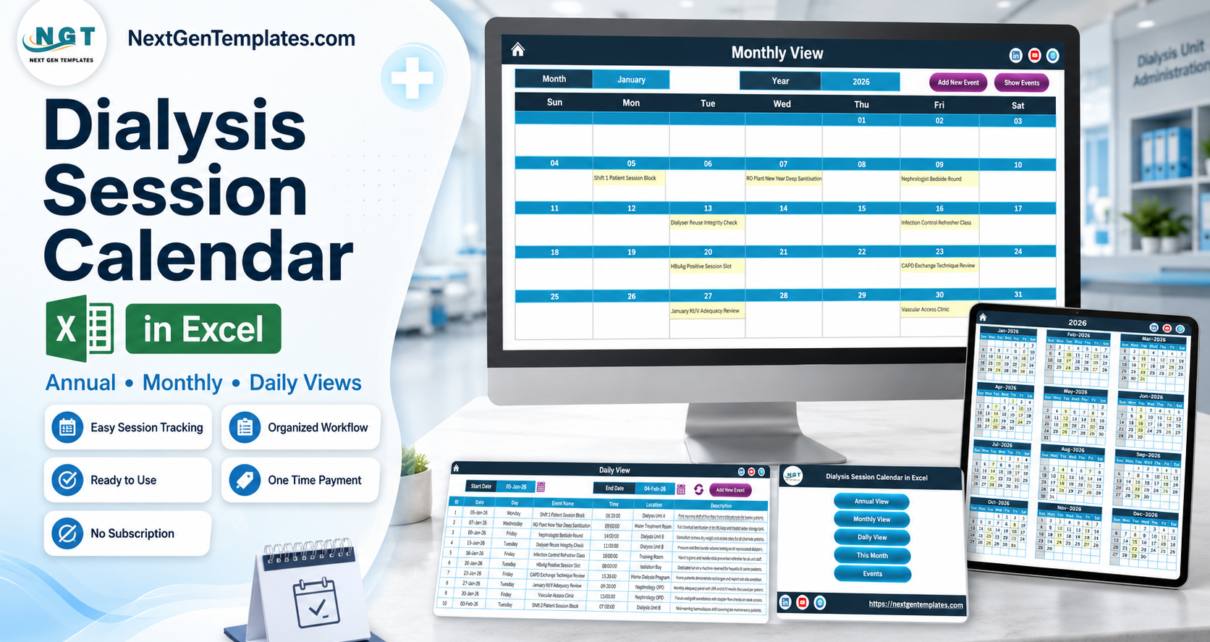
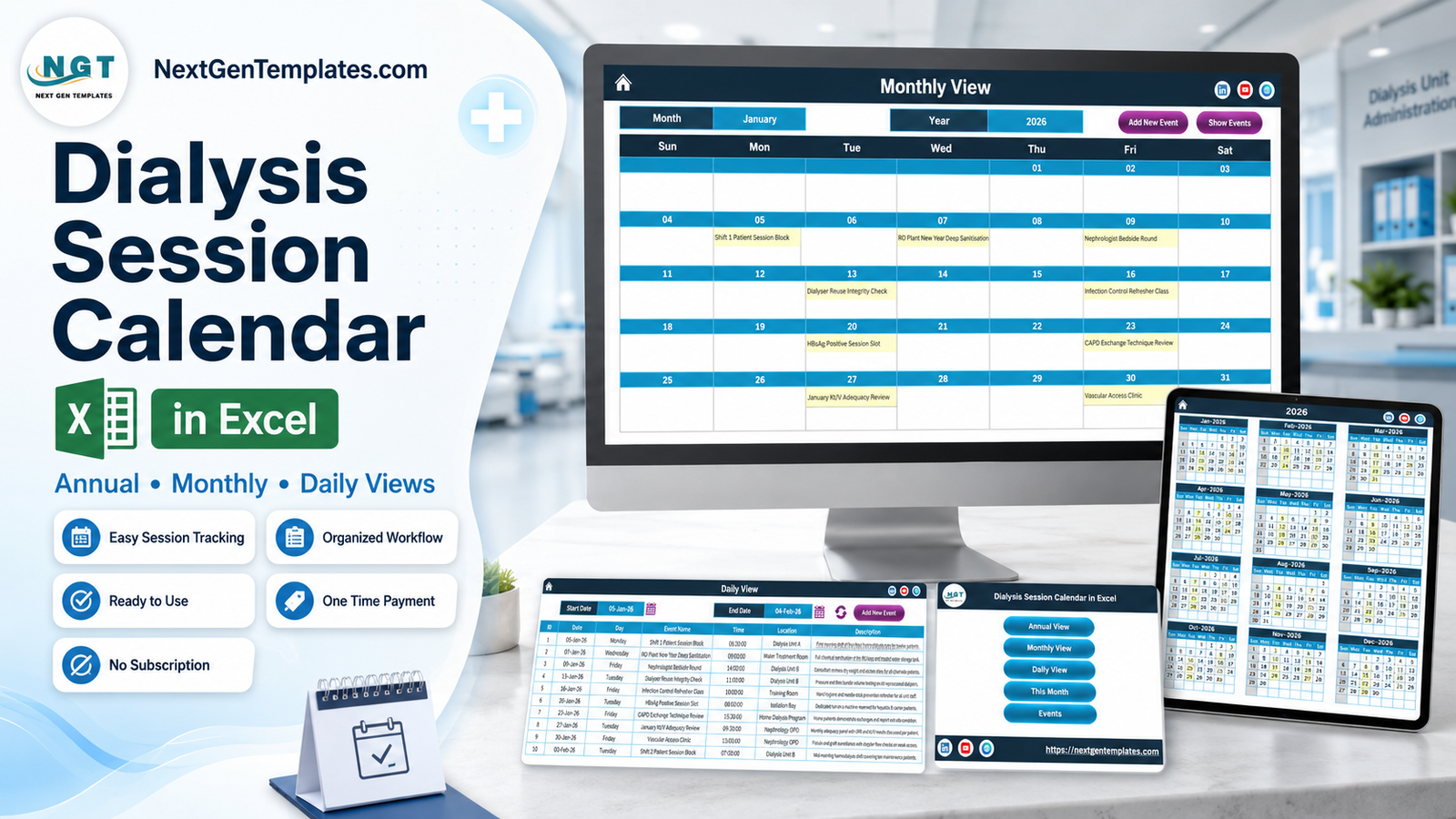
A dialysis unit runs on a timetable that never stops. Four shift blocks a day, isolation slots that cannot move, an RO plant that has to be sanitised on schedule, dialyser reuse checks, monthly Kt/V reviews, cannulation training, infection-control audits, home-programme setup visits – and most units still plan all of it on a whiteboard that gets wiped every Friday. The Dialysis Session Calendar in Excel puts that year into one macro-enabled workbook: 7 worksheets, 100 ready-made sample sessions dated from 5 January to 29 December 2026, 7 unit locations, 18 start times from 06:30 to 21:00, and a VBA form that adds, updates and deletes an entry without anyone touching a formula. It costs $4.99 once and it stores no patient data at all – which, as you will see, is the most important sentence in this article. Dialysis Session Calendar in Excel
Key Features of the Dialysis Session Calendar in Excel
- Seven worksheets: Home, Annual View, Monthly View, Daily View, This Month, Events and Setting.
- One Events sheet drives everything. Seven columns – ID, Date, Day, Event Name, Time, Location, Description – in rows 5 to 104. Every view reads from it.
- 100 different sample sessions, no repeats, spread evenly across all twelve months: 9 in January, 8 in February, 9 in March, 8 in April, 8 in May, 8 in June, 9 in July, 8 in August, 8 in September, 9 in October, 8 in November and 8 in December.
- Seven locations built in: Nephrology OPD (22 entries), Dialysis Unit A (20), Dialysis Unit B (18), Home Dialysis Program (12), Water Treatment Room (10), Training Room (10) and the Isolation Bay (8).
- VBA entry form with a date picker and a time picker behind Add New Record, Update Record and Delete Record.
- Setting sheet with a year list running 2021 to 2051, a start month, a week-start day, two highlight-weekday rules, an event-highlight switch and five colour themes.
- No patient name, patient ID, MRN, date of birth, diagnosis or notes column anywhere in the file.Dialysis Session Calendar in Excel
Workbook Pages Explanation
Home
Five buttons – Annual View, Monthly View, Daily View, This Month, Events – under the workbook title. It exists so a technician or a ward clerk never has to hunt through the tab bar.
Annual View
All twelve months of the chosen year in a three-by-four grid on a single printable page, with every date that carries a session shaded. It is the sheet that goes on the noticeboard in January.
Monthly View
Pick a month and a year in the two selectors at the top and the calendar redraws with the session name written inside each date cell. January 2026 in the sample file shows the Shift 1 Patient Session Block on the 5th, RO Plant New Year Deep Sanitisation on the 7th, the Nephrologist Bedside Round on the 9th, the Dialyser Reuse Integrity Check on the 13th, the Infection Control Refresher Class on the 16th, the HBsAg Positive Session Slot on the 20th, the CAPD Exchange Technique Review on the 23rd, the January Kt/V Adequacy Review on the 27th and the Vascular Access Clinic on the 30th. Add New Event and Show Events buttons sit on the same header. Dialysis Session Calendar in Excel
Daily View
Set a Start Date and an End Date and the sheet lists everything in that window with ID, date, day, session name, time, location and description. This is the sheet you print for the floor – a day, a week or a whole month of run sheets.
This Month
Four counters across the top – Events This Month, Active Days, Locations Used, Next 7 Days – then an Events by Day of Week table and a Top 5 Locations ranking, then the full list for the month. In the sample file August 2026 reads 8 events, 8 active days, 7 locations used and 2 in the next seven days, with four sessions on Tuesdays and four on Fridays.
Events and Setting
Events is the raw table with the three record buttons on top. Setting holds the year, start month, week start day, highlight rules and colour theme. Change the year on Setting and every view follows.
Dialysis Session Calendar in Excel vs. Google Sheets vs. Paid Clinic Scheduling SaaS – Feature Comparison
| Dialysis Session Calendar in Excel | Google Sheets calendar | Paid clinic scheduling SaaS | |
|---|---|---|---|
| Cost | $4.99 once | Free, or $4.99 for a ready-made Sheets calendar | $40-$150 per user per month |
| Platform | Excel for Windows desktop, macros enabled | Browser, any device | Browser plus vendor app |
| Setup time | About 2 minutes | About 2 minutes | Days to weeks, plus onboarding |
| Real-time team collaboration | No – one file, one editor | Yes | Yes |
| Mobile access | Read-only; macros do not run | Yes | Yes |
| Customisable fields | Yes – it is your workbook | Yes | Only what the vendor exposes |
| Share with a link | No – you send the file | Yes | Yes |
| Year-1 cost at 5 users | $4.99 | $0-$4.99 | $2,400-$9,000 |
| Works with no internet | Yes | No | No |
| Stores patient data | No, by design | Only if you add it | Yes |
| Generates a recurring Mon/Wed/Fri rota | No | No | Yes |
Who Should Use This Template
Standalone and satellite dialysis units that plan shift blocks, cohort and isolation slots, machine and water-treatment tasks, adequacy review dates, staff training and audits. Home dialysis programme co-ordinators tracking setup visits, training weeks, supply deliveries and follow-up calls. Renal technicians who own the RO plant and machine-service calendar. Nephrology departments that want one printable year plan for the unit’s operating diary.
It is the wrong tool if you need per-patient recurring rotas generated for you, simultaneous editing by several people, patient-facing booking or SMS reminders, or a schedule that has to stand up as a clinical or regulatory record. Those needs belong to a renal information system, not to a spreadsheet.
Real-World Use Cases
A 15-machine satellite unit. The unit manager keeps four shift blocks, the HBsAg and HCV cohort slots and the Isolation Bay terminal cleans in Monthly View, prints it on the last Friday of the month and pins it in the nurses’ station. Because there are no patient names in the file, nothing sensitive ends up on the wall.
A renal technician’s service calendar. RO plant deep sanitisation, water endotoxin and culture rounds, softener resin regeneration checks, machine conductivity verification, transducer calibration, heat and chemical disinfection cycles, dialyser bundle volume testing. Daily View from today to month-end is the work list; the evidence that each task was completed lives in the quality system.
A home dialysis programme. Filter the Home Dialysis Program location and you have setup visits, training weeks 1 and 2, supply deliveries, peritonitis follow-up visits, CAPD exchange reviews and the holiday supply check. The Next 7 Days counter on This Month becomes a Monday morning to-do list.
Advantages of the Dialysis Session Calendar in Excel
- It runs with no internet. Dialysis units are not always places where the Wi-Fi reaches, and the file works on a laptop in the plant room.
- Privacy by omission. There is no field in which a patient identifier can be typed, which is a far stronger control than a policy telling people not to.
- Four ways to look at the same data – a year, a month, a date range and a summary – all off one table.
- Every cell is yours. Rename the seven locations, rewrite all 100 rows, change the theme, move the year to 2031. Nothing is locked.
- One payment. No renewal, no seat count, no vendor able to change the price next year.
Opportunities for Improvement
Four honest limitations, all of them worth knowing before you buy:
- No recurrence generator. Maintenance haemodialysis is a Mon/Wed/Fri or Tue/Thu/Sat pattern by nature, and this workbook will not expand that pattern for you. You enter each session, or copy a block of rows on the Events sheet and change the dates. It is a calendar, not a rota engine.
- Monthly View shows only the first session on a date. It looks the date up rather than filtering it, so a second entry on the same day appears as an “N more…” flag in the cell. Daily View and This Month list all of them. The sample file puts its 100 sessions on 100 different dates, so you will only meet this once your own data goes in.
- Nothing prevents a double booking. Enter two sessions in the same unit at the same time and the workbook accepts both without a warning.
- There is a start time but no duration or end time, so machine and chair utilisation cannot be calculated from the file.
Best Practices
- Save as .xlsm. Saving as .xlsx strips the macros and the buttons stop responding.
- Schedule by session type, unit and station. If you feel the need for a patient column, add a chair or machine number instead.
- Set the year and the colour theme on Setting before you enter data, not after.
- Keep the water-treatment and machine-disinfection rows as reminders. The completed records that satisfy AAMI or ISO 23500 belong in your quality system.
- Give the file one owner. It is a single workbook, so two people editing two copies is how a schedule goes wrong.
- Print Annual View once a year and Monthly View once a month; keep Daily View for the shift run sheet.
Explore Relevant Templates
- Nurse Duty Roster Calendar in Excel – the same engine applied to ward shifts, so the roster lines up with the session plan.
- Operation Theatre Booking Calendar in Excel – theatre lists across eight theatres.
- Radiology Slot Booking Calendar in Excel – imaging rooms and slot types.
- Patient Follow-Up Visit Calendar in Excel – outpatient review and recall dates.
- Dialysis Centers Dashboard in Excel – analytics on the unit rather than a schedule.
Frequently Asked Questions
Is this an EHR, a patient record or a renal information system?
No. It is a scheduling and record-keeping calendar for the unit’s own operating diary. It is not an EHR/EMR, not a renal or dialysis information system, not a practice-management or booking system, and not a regulated medical device.
Is it HIPAA or GDPR compliant?
No. It holds no certification. It is an Excel file with no access control, no encryption and no audit trail – anyone who opens it can change any row without trace.
Does it calculate Kt/V, URR, dry weight or water quality?
No. The adequacy reviews and water tests in the sample data are calendar reminders that a task is due. The workbook performs no clinical calculation, stores no results, connects to no analyser or machine, and makes no clinical or safety recommendation of any kind.
Do I need macros enabled?
Yes. The Add, Update and Delete buttons and the pop-up entry form are VBA. Microsoft’s guide to enabling macros in Microsoft 365 files covers the prompt if your IT policy blocks it.
Will it work on a Mac, in Excel for the web or on a phone?
It is built for Excel for Windows desktop. The sheets will open elsewhere but the entry form and the buttons will not run.
Can I change the year, the locations and the colours?
Yes. Any year from 2021 to 2051, five colour themes, and every location name and sample row is editable.
What is in the download?
A ZIP containing the .xlsm workbook and the Excel Calendar user manual as a PDF.
About the Author
Built by PK – Microsoft Certified Professional with 15+ years of Excel, Google Sheets, and Power BI experience. Founder of NextGenTemplates, reaching 300K+ subscribers across YouTube channels. Every template is hand-built and tested before release.
Conclusion
The Dialysis Session Calendar in Excel does one job well: it turns a renal unit’s operating year into four views of a single hundred-row table, printable, offline, and free of anything that identifies a patient. It will not generate a per-patient rota, it will not stop a double booking, and it will not tell you anything clinical – and it says so on the tin. If what you need is the unit’s timetable rather than a clinical system, it is $4.99 and about two minutes of setup.
Get the Dialysis Session Calendar in Excel →
More Excel walkthroughs on the channel: youtube.com/@PKAnExcelExpert.