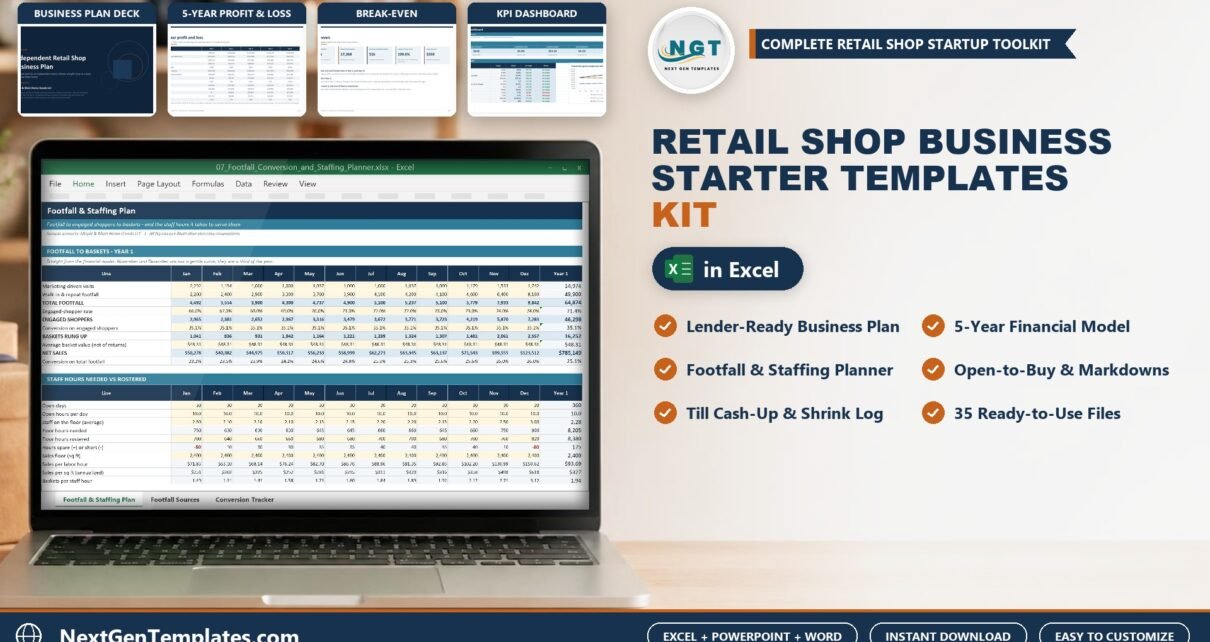
Most retail shop business plan drafts fail the same way: they open with a sales number that nobody can trace back to a shopper walking through the door. The Retail Shop Business Starter Templates Kit starts at the other end. It is 35 files in nine folders — a 44-slide PowerPoint business plan, a 13-section Word plan, 26 numbered Excel workbooks, three ready-made tools and a PDF guide — and the five-year financial model at its centre derives every number from footfall.
That matters because the people who walk in and actually shop the floor are the real ceiling on a shop. Footfall × engaged-shopper rate × conversion gives baskets; each basket carries its cost of goods, bags and gift wrap, card fees, a shrinkage allowance and a markdown allowance. In this article I walk through every part of the kit, what each workbook does, and the few decisions that decide whether a new shop makes money.
Watch the Retail Shop Business Plan: 35-File Starter Templates Kit walkthrough
In under a minute:
Key Features of the Retail Shop Business Plan Kit
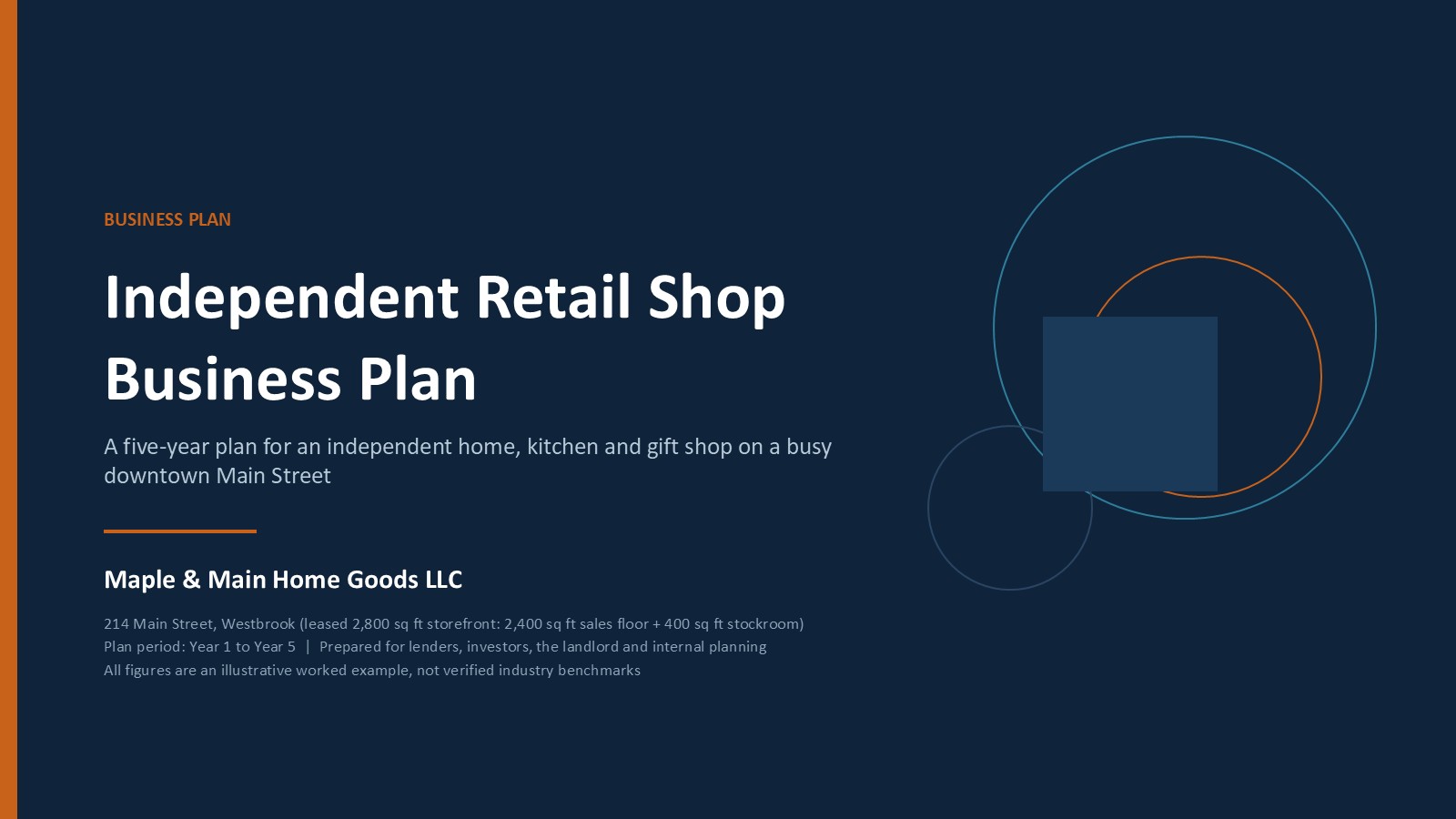
The kit is built around one fictional worked example — Maple & Main Home Goods LLC, an independent home, kitchen and gift shop on a busy downtown Main Street, in a leased 2,800 sq ft storefront — so the presentation, the Word plan and the workbooks agree with each other to the dollar. Every figure is an illustrative planning assumption, not an industry benchmark.
- Footfall drives everything. Baskets come from shopper visits and conversion by product family, not from a guessed growth rate.
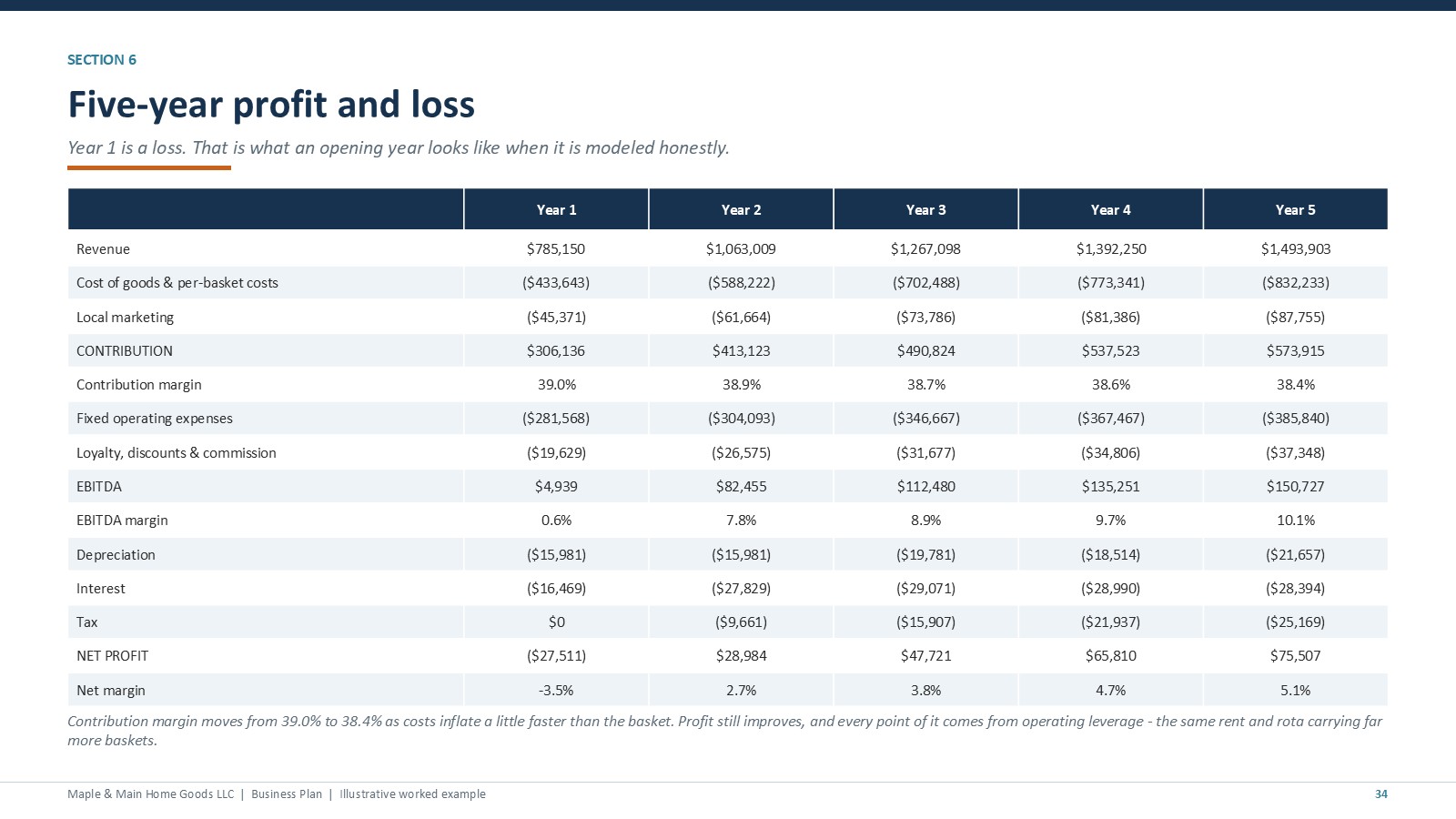
- Year 1 is allowed to lose money. The example takes $785,150 in Year 1 with $4,939 of EBITDA and a ($27,511) net loss, then reaches $1,493,903 revenue, $150,727 EBITDA (10.1%) and $75,507 net profit by Year 5.
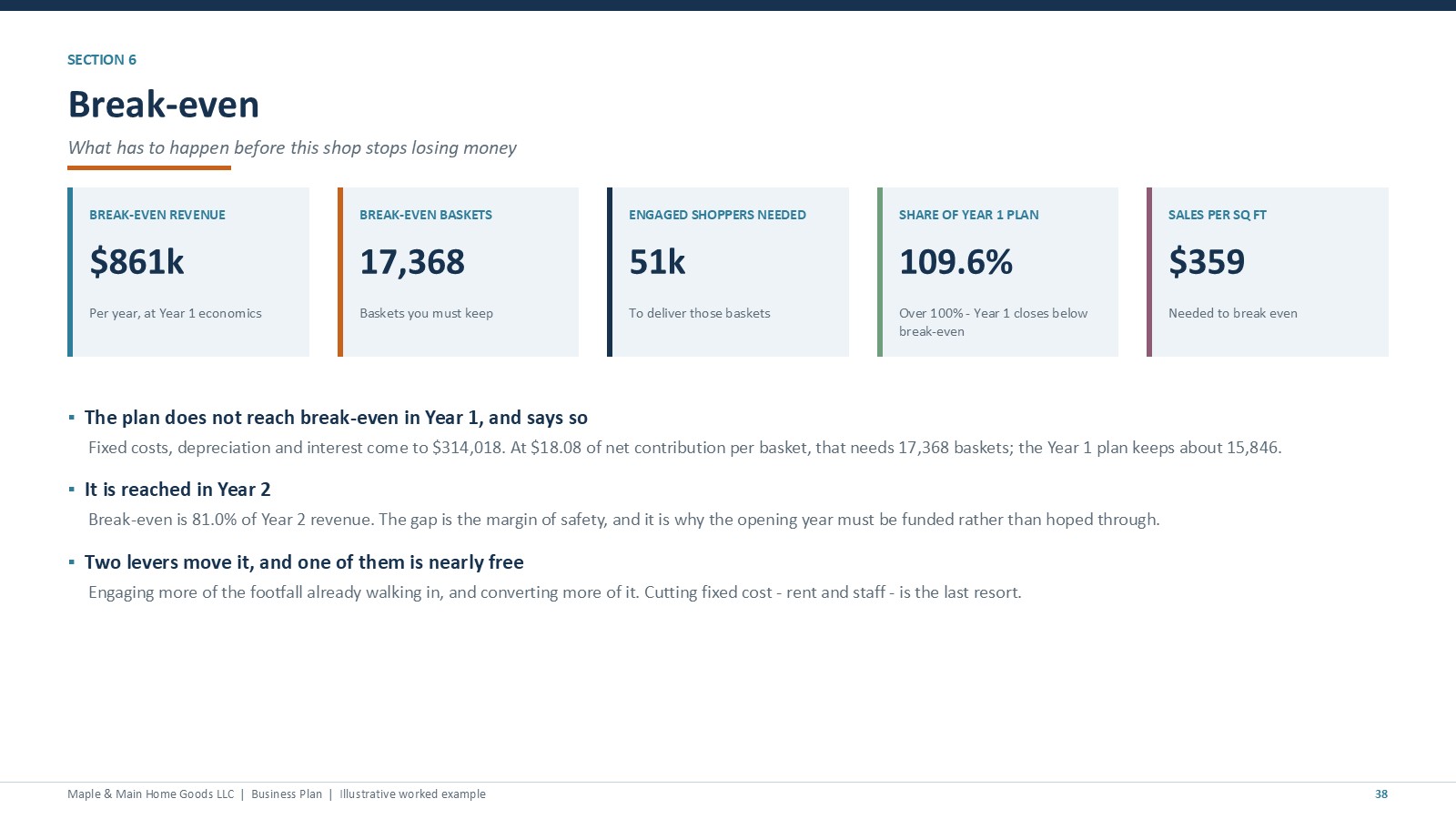
- Break-even is explicit. $861k of revenue or 17,368 baskets a year at Year 1 economics, reached in Year 2.
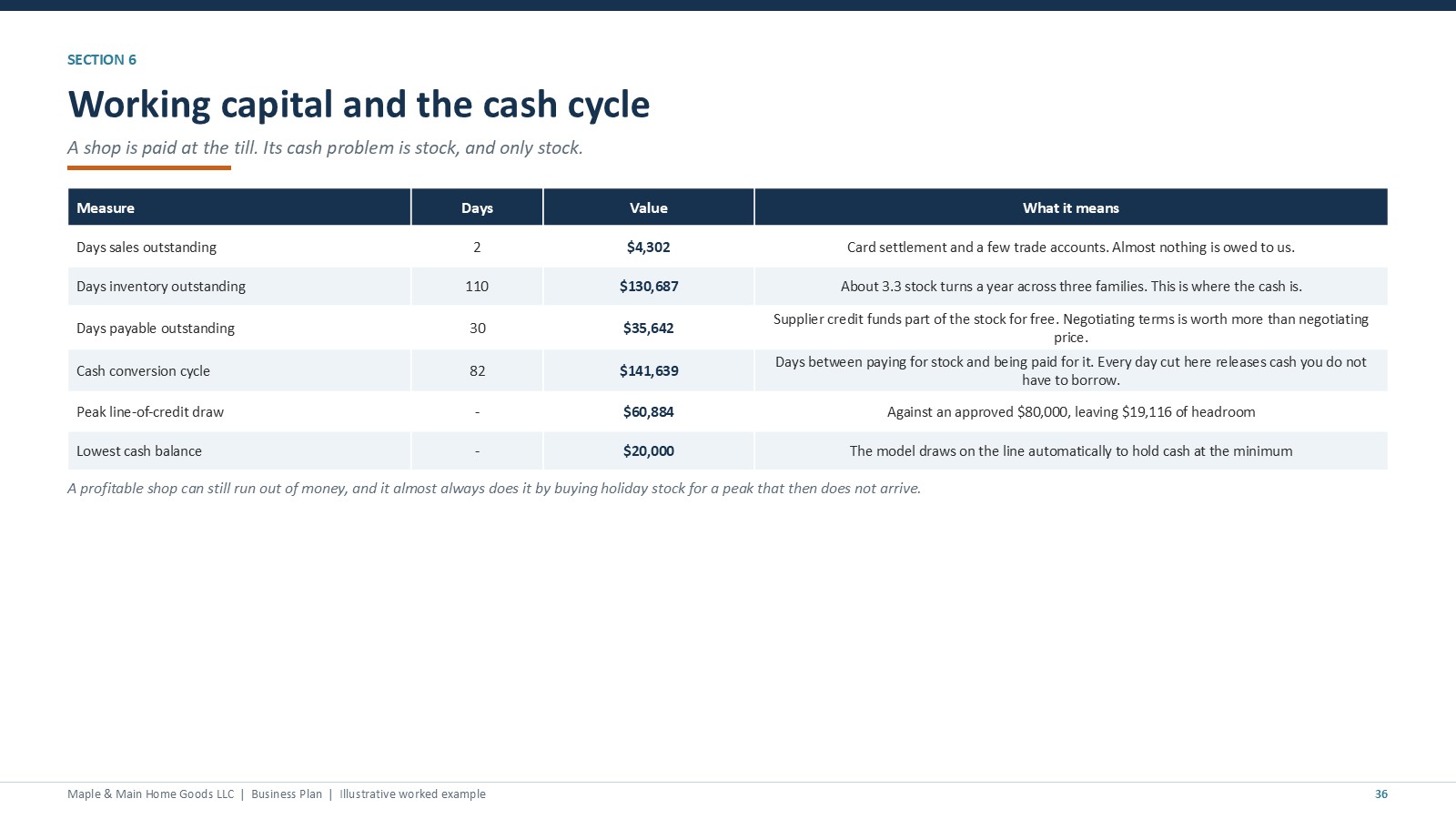
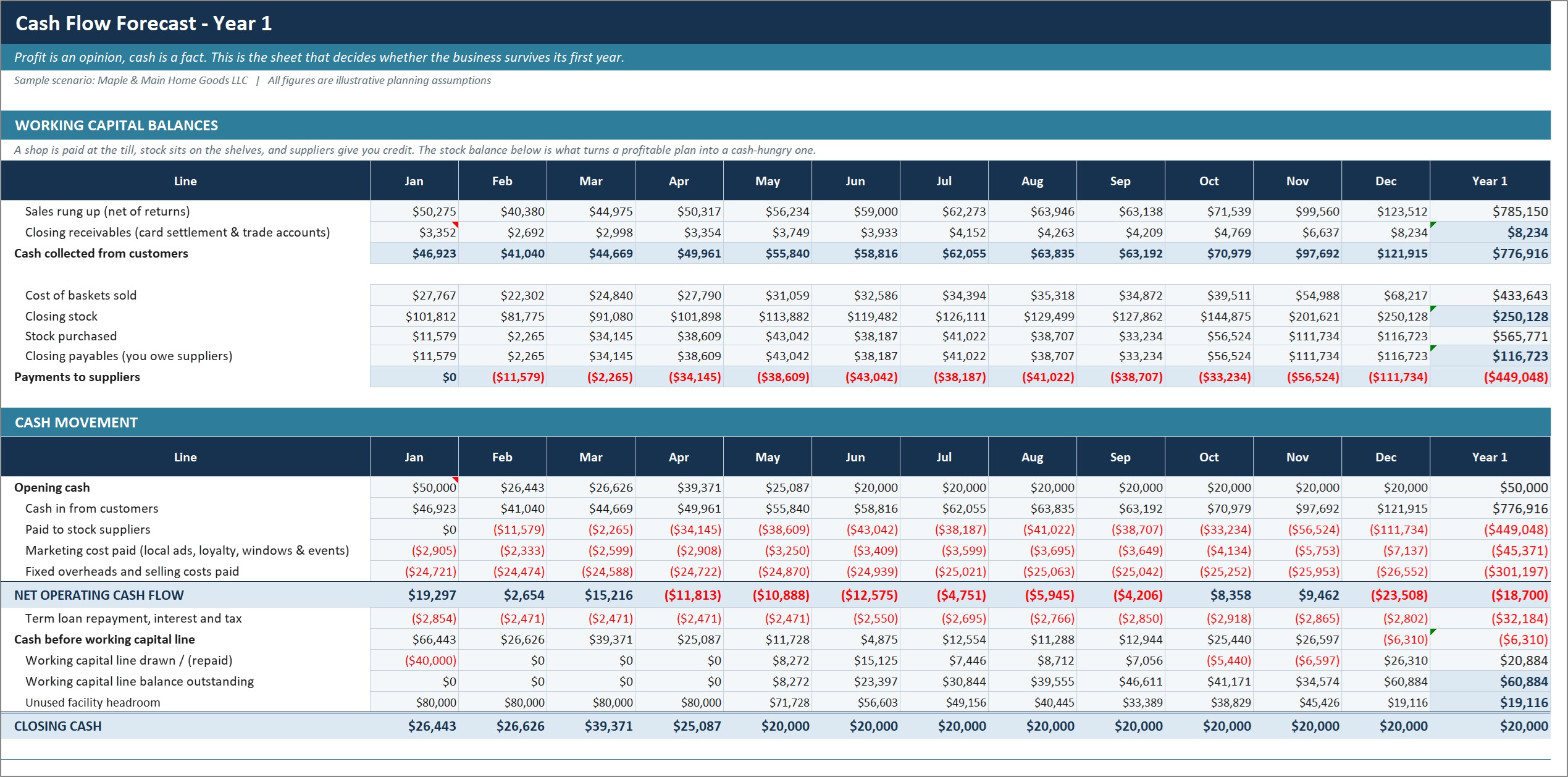
- Stock is modelled as the cash problem it is. Inventory sits at 110 days, and a line of credit draws automatically, peaking at $60,884 against an approved $80,000.
- Excel 2013 and later, zero formula errors. No XLOOKUP, no dynamic arrays, no add-ins.
Every File in the Retail Shop Business Starter Templates Kit, Explained
The kit ships in nine folders: presentation, Word plan, financial planning, sales and marketing, operations, people and HR, admin and compliance, business tools and instructions. The READ ME gives a ten-step order that follows how the numbers depend on each other.
The 44-slide PowerPoint business plan
Seven sections — the business, the market, products and operations, sales and marketing, organization, the financial plan and execution — with native editable charts and tables and speaker notes on 35 slides. It is written to be presented to a lender, an investor or a landlord.
How a passer-by becomes a basket
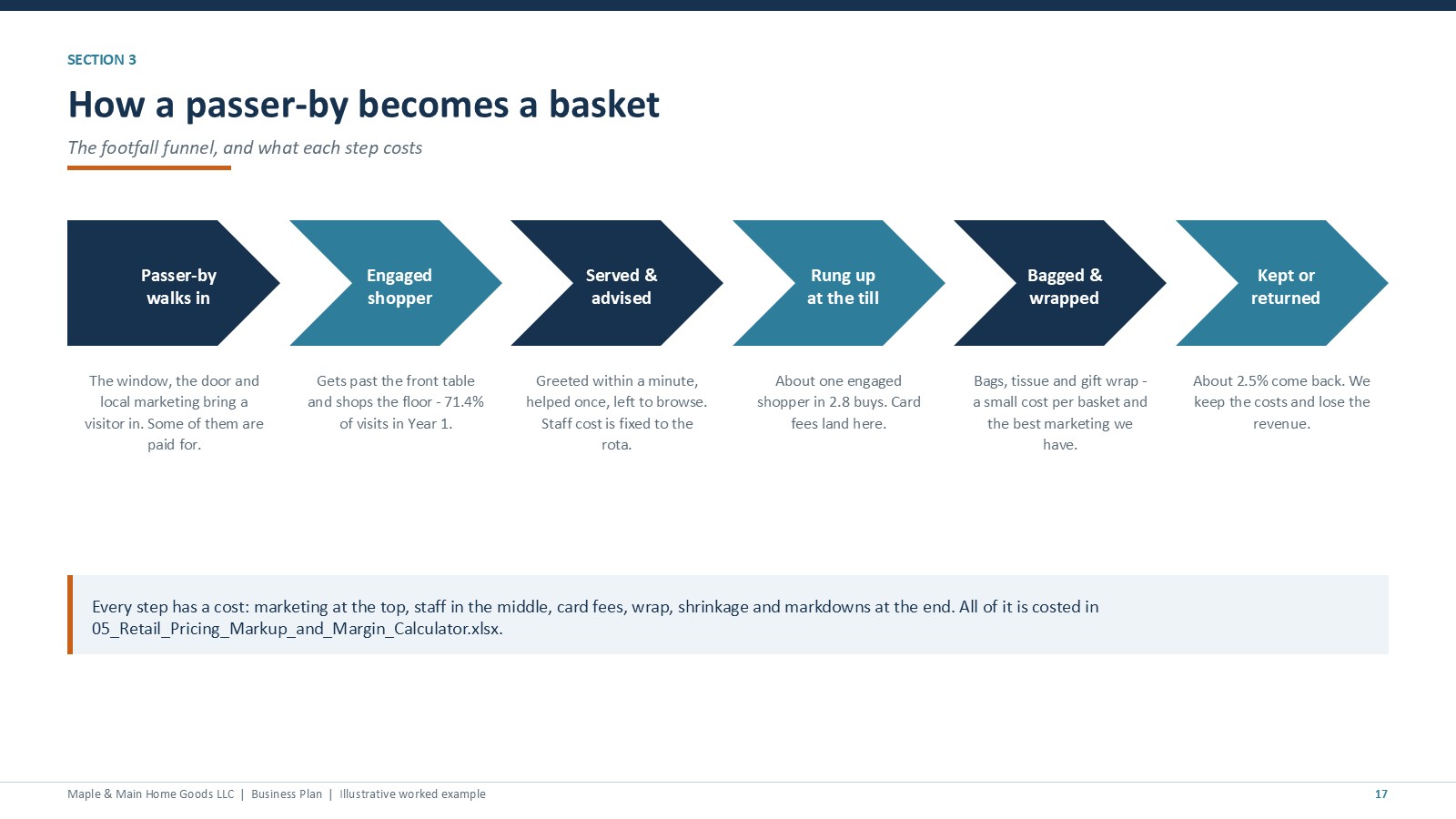
The footfall funnel slide breaks the sale into six steps: walks in, engaged shopper, served and advised, rung up at the till, bagged and wrapped, kept or returned. Every step has a cost — marketing at the top, staff in the middle, card fees, wrap, shrinkage and markdowns at the end — and all of it is costed in the pricing calculator.
The Year 1 ramp-up
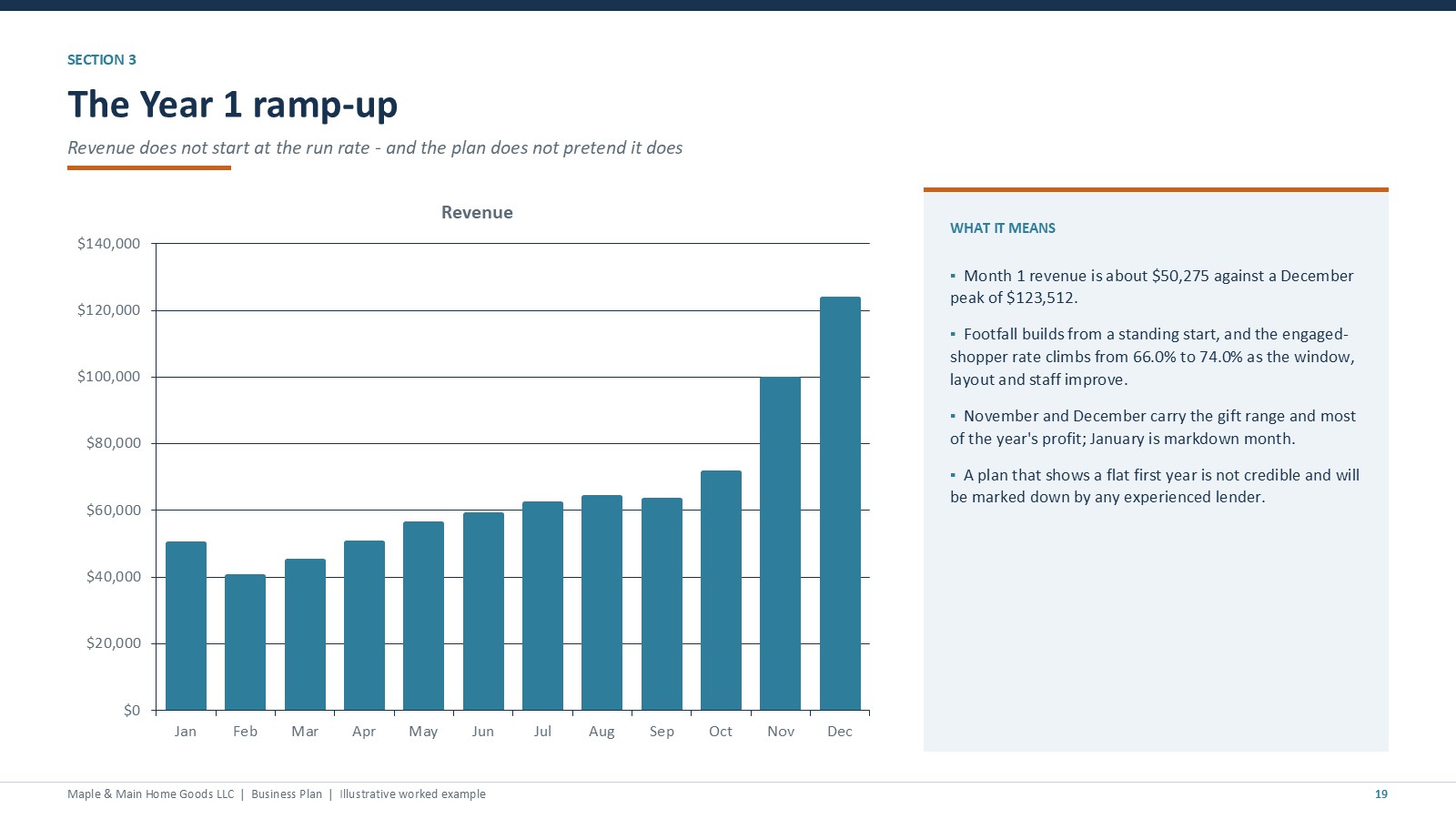
Revenue does not start at the run rate. Month 1 is about $50,275 against a December peak of $123,512, and November and December carry the gift range and most of the year’s profit. A plan that shows a flat first year is not credible to an experienced lender.
Pricing and positioning
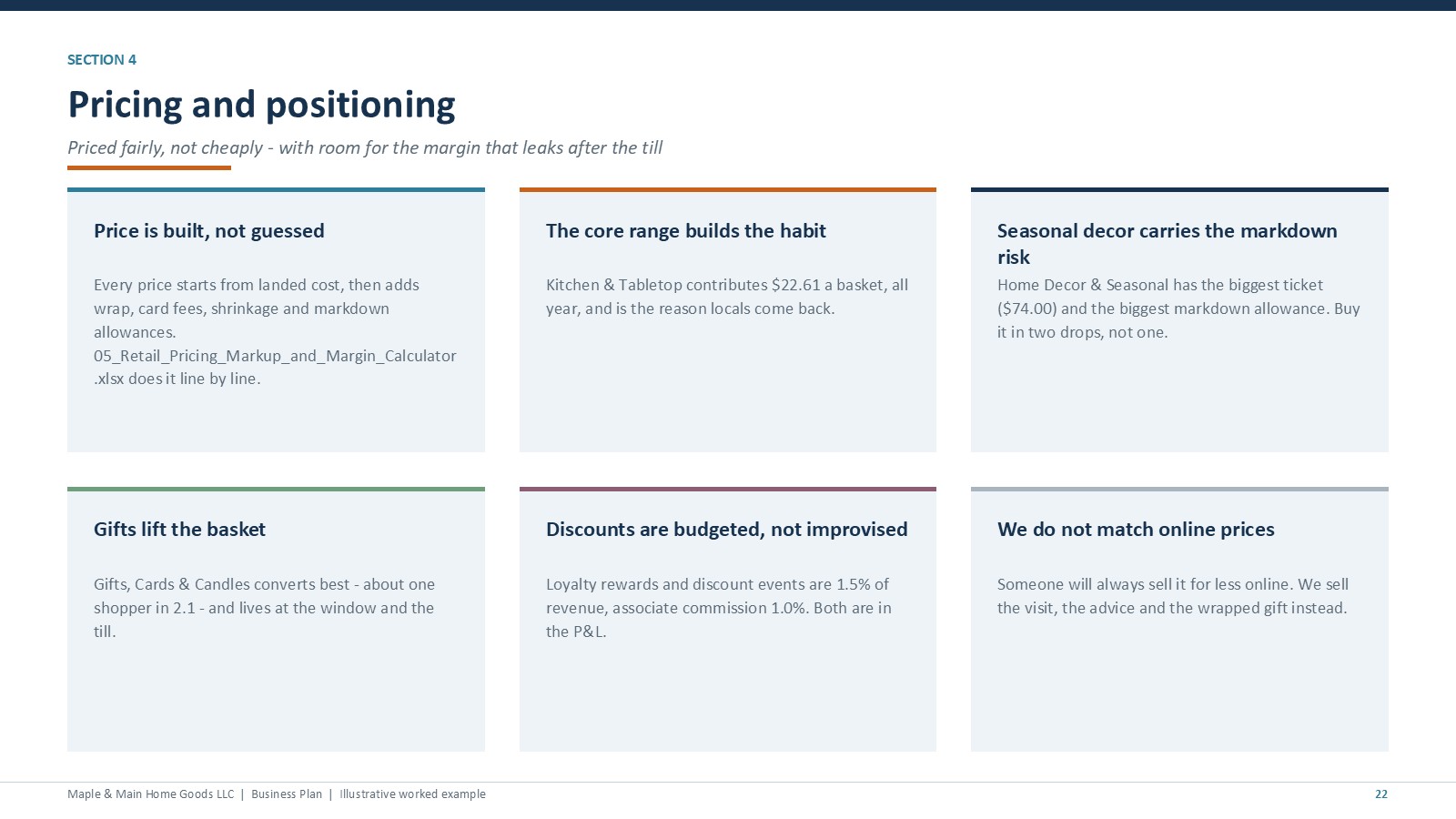
Prices are built from landed cost, not guessed. Kitchen & Tabletop is the core range that builds the habit, Home Decor & Seasonal carries the biggest ticket and the biggest markdown risk, and Gifts, Cards & Candles lifts the basket.
Startup investment
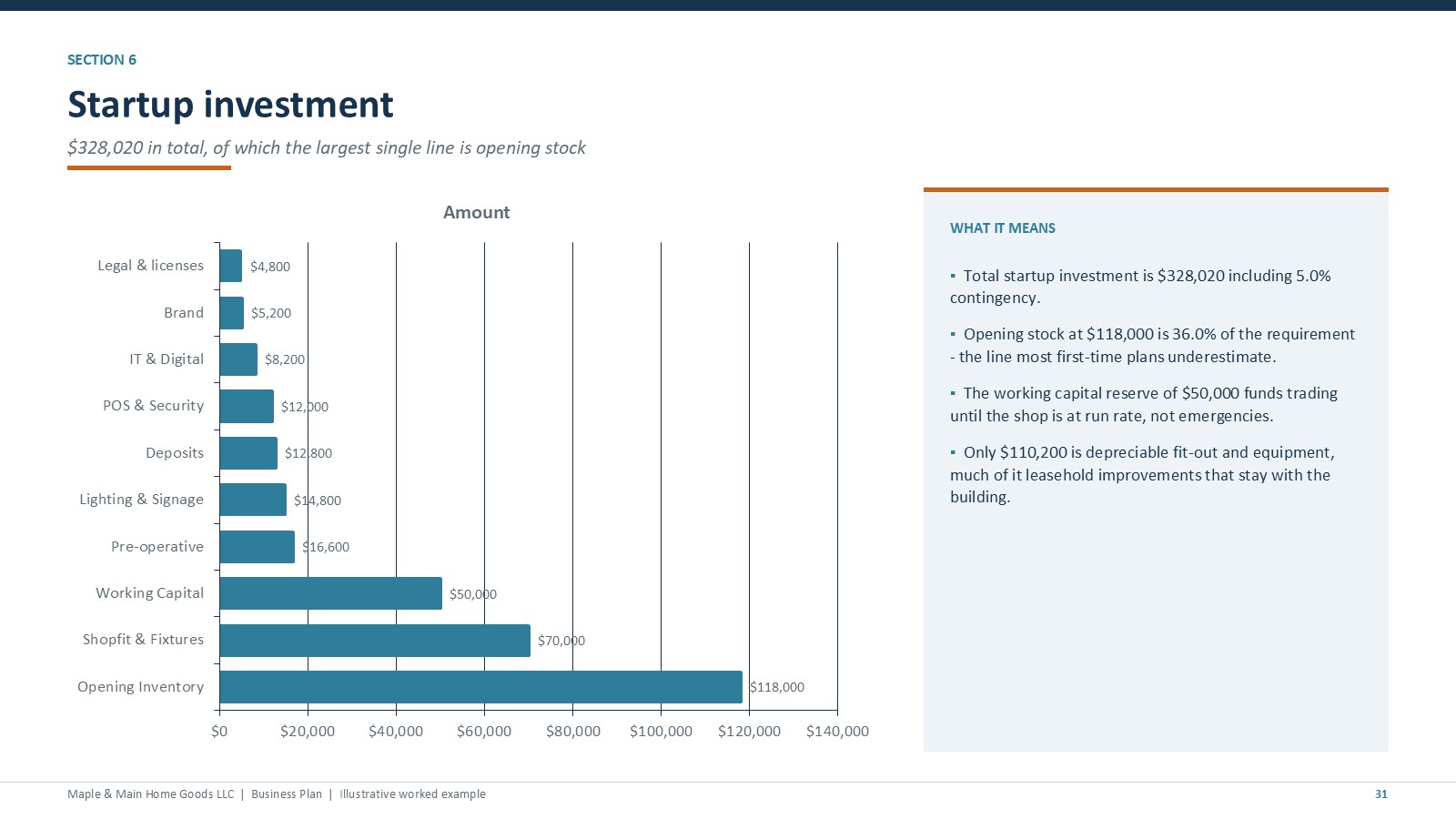
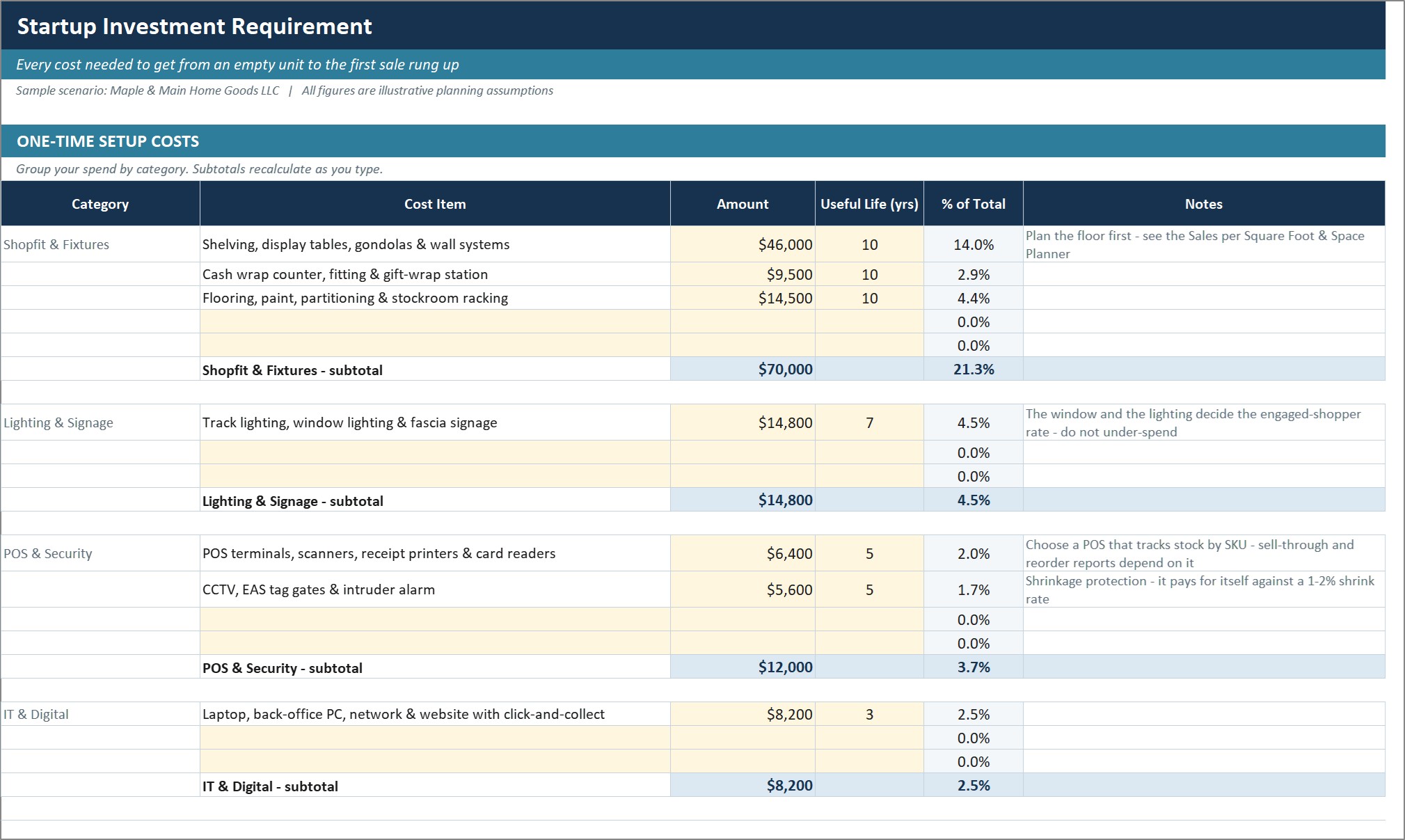
$328,020 in total including a 5% contingency. Opening stock is the largest single line at $118,000, followed by shop fit and fixtures and a $50,000 working capital reserve.
Five-year profit and loss
Revenue grows from $785,150 to $1,493,903. Year 1 is a loss, and the slide says so; contribution margin holds near 39% and every point of profit after that comes from operating leverage.
Working capital and the cash cycle
A shop is paid at the till. Its cash problem is stock, and only stock: days of inventory, supplier credit, the peak line-of-credit draw and the lowest cash balance are laid out in one table.
Break-even
Break-even is stated five ways: revenue ($861k), baskets (17,368), engaged shoppers needed, share of the Year 1 plan and sales per square foot ($359). The two levers that move it most are engaging more of the footfall already walking in, and converting more of them.
Implementation roadmap slide
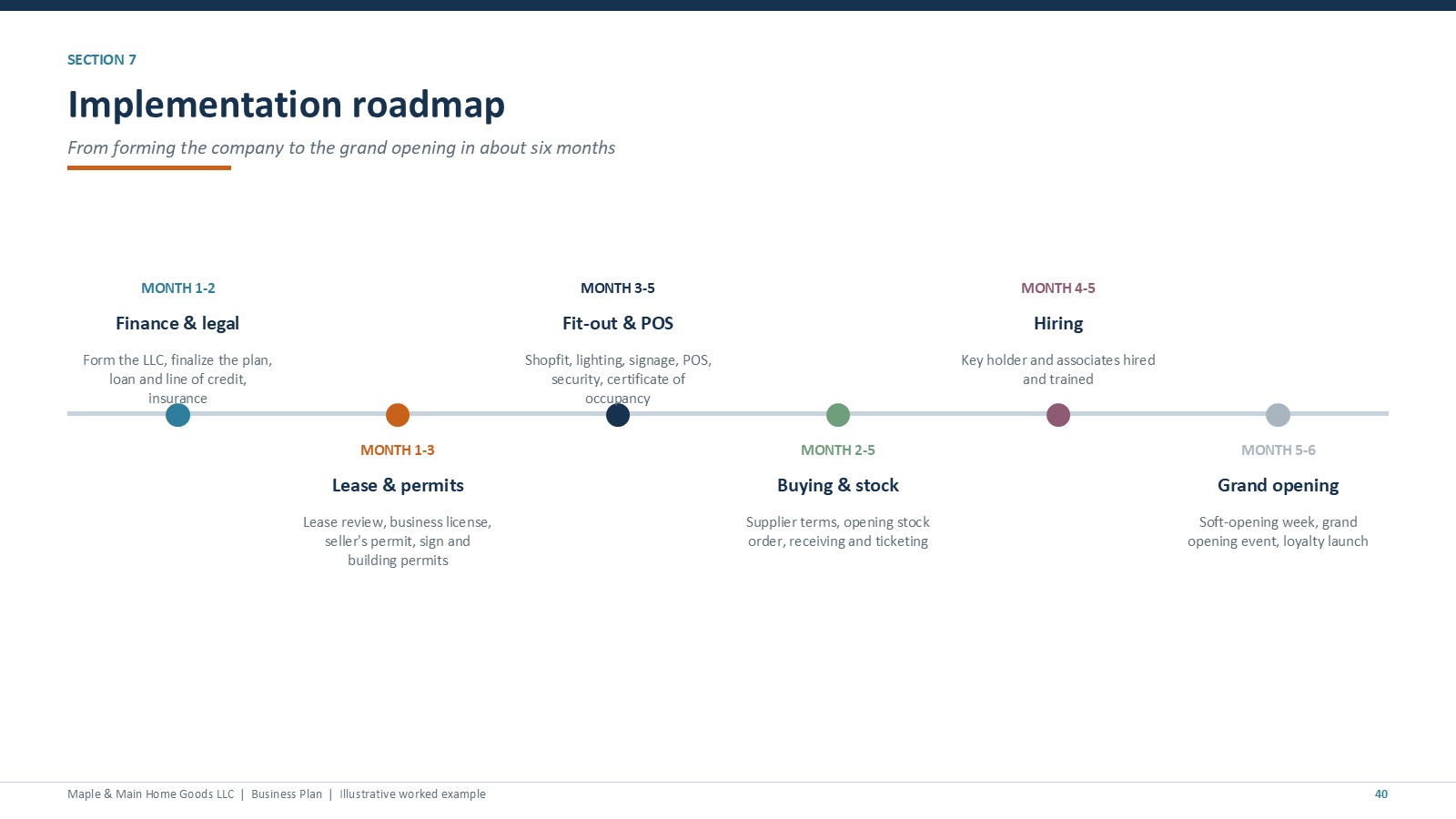
From forming the company to the grand opening in about six months: finance and legal, lease and permits, fit-out and POS, buying and stock, hiring, and the opening week.
Workbook 02: the retail financial model in Excel
Thirteen linked sheets: Instructions, Assumptions, Dashboard, Footfall & Baskets, Revenue Forecast, Basket Cost & COGS, Staffing Costs, Operating Expenses, CapEx & Depreciation, Profit & Loss, Cash Flow, Break-Even and KPI Summary. The Financial Plan Dashboard tells you in one screen whether the plan works.

The Assumptions sheet
Yellow cells are yours, white cells are formulas. Footfall by year, the Year 1 marketing ramp, and the three product families with their share of shoppers, baskets per shopper, basket value, landed cost, bags and gift wrap, shrinkage, card fees and markdown allowance all live here.

Profit and loss, month by month
Year 1 month by month, then Years 1 to 5, with basket cost split from marketing and fixed operating expenses so you can see exactly where the opening-year loss comes from.

Cash flow forecast
Receivables, stock and supplier payables every month, then the working capital line drawn and repaid automatically to hold the minimum cash balance.
Workbook 01: startup cost and funding plan
Every cost from an empty unit to the first sale — shop fit and fixtures, lighting and signage, POS and security, IT and digital — with useful life and share of the total. Subtotals recalculate as you type.
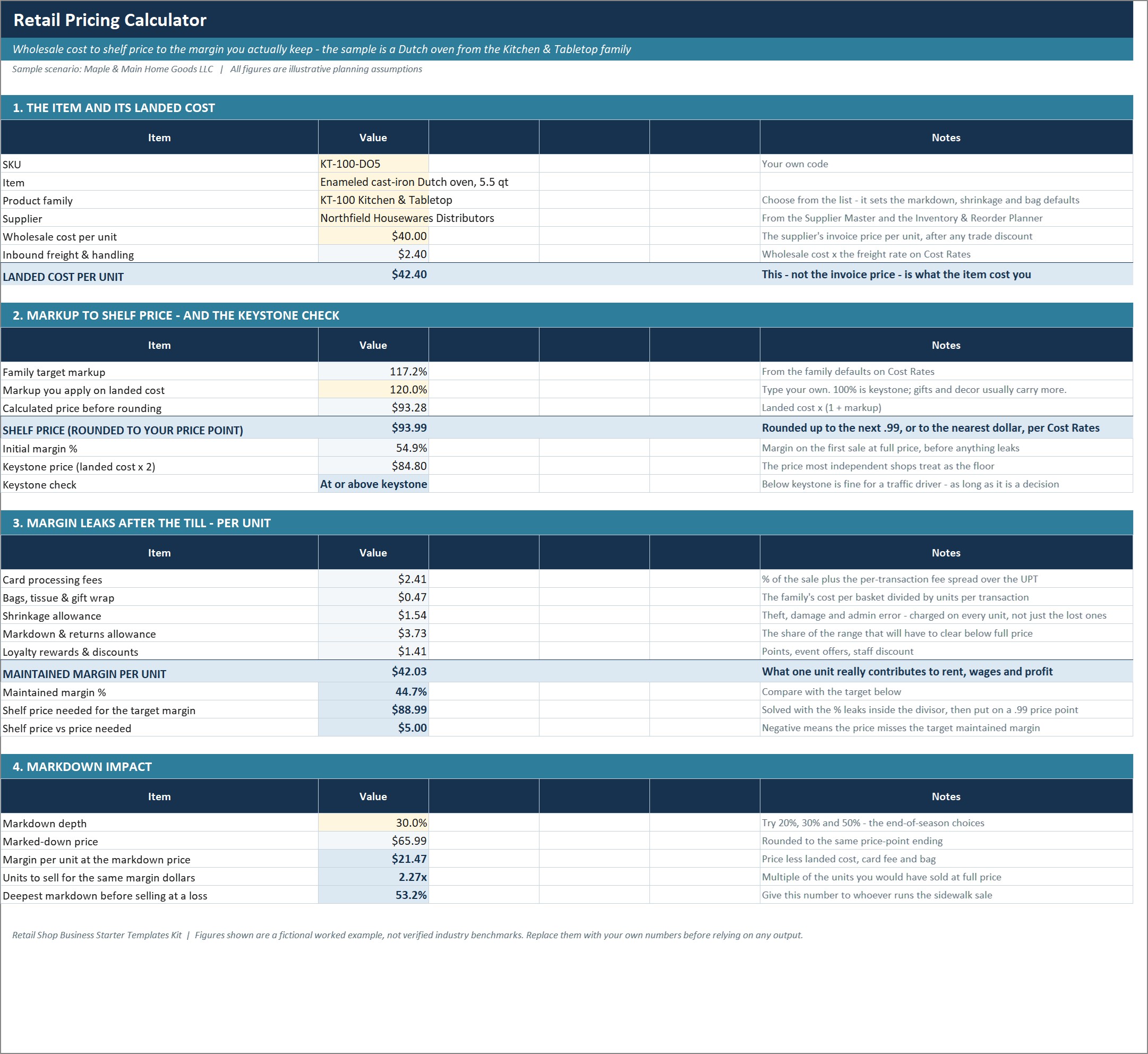
Workbook 05: retail pricing calculator
One item, here a Dutch oven, goes from wholesale cost to a landed cost of $42.40, then to a shelf price of $93.99 with a keystone check. Then the calculator subtracts card fees, bags, shrinkage, markdowns and loyalty, so you see the margin you really keep: $42.03 per unit. It also works as a markup and margin calculator for any line you stock.
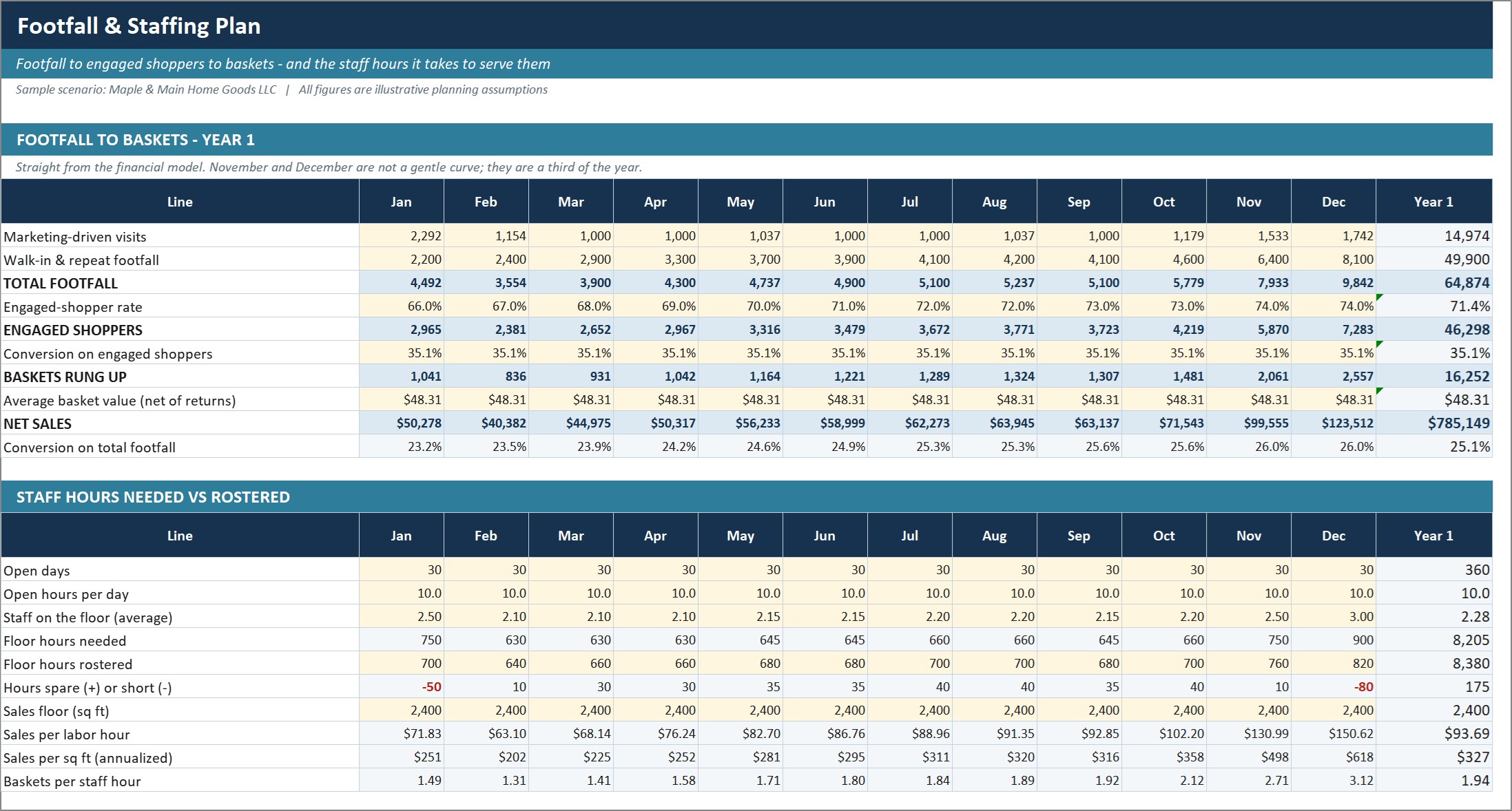
Workbook 07: footfall, conversion and staffing planner
Footfall turns into engaged shoppers and baskets month by month, then staff hours needed are compared with hours rostered. January and December show up short straight away.
Workbook 09: retail shop KPI dashboard
Twelve KPIs against target: sales per square foot, footfall, conversion rate, average basket, units per transaction, gross margin, stock turn, sell-through, markdown, shrinkage, sales per labor hour and loyalty sign-ups. Markdown and shrinkage stand out as off target in the example.
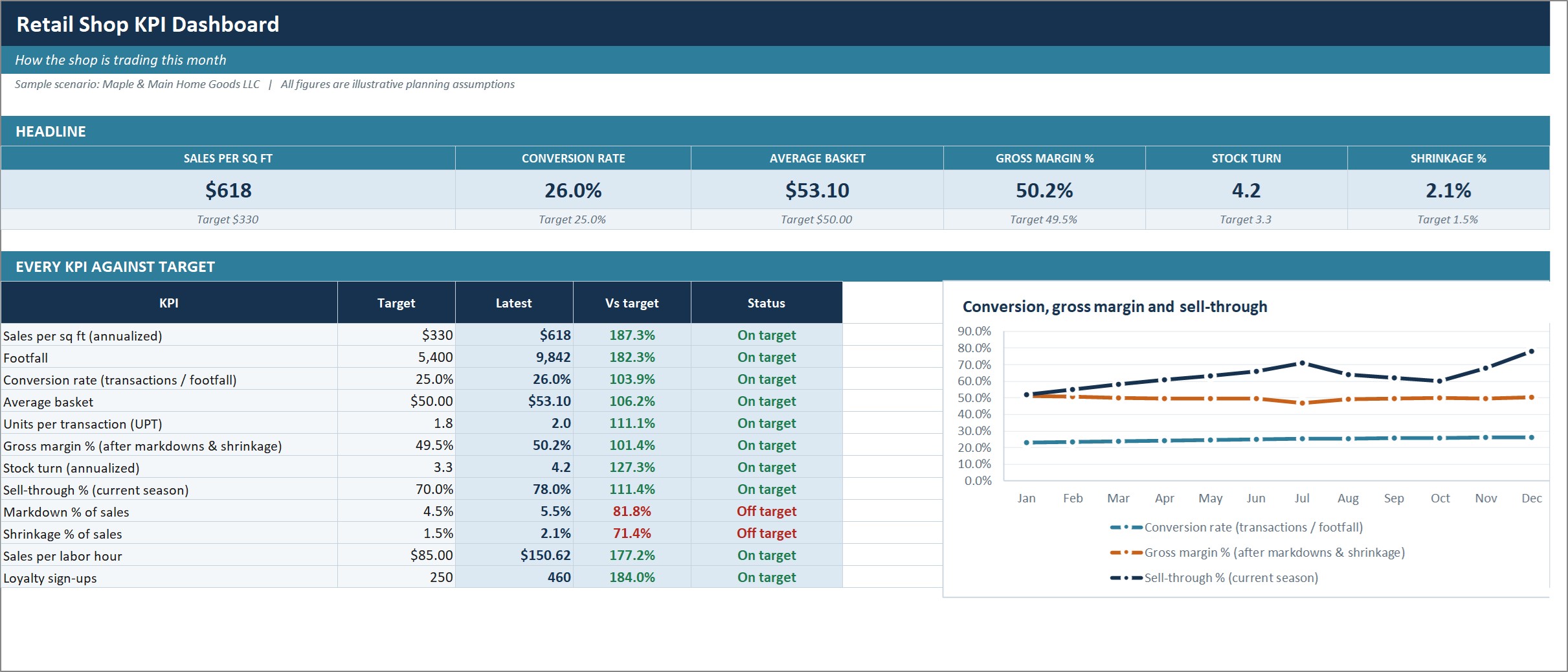
Workbook 10: implementation roadmap and risk register
Every task by phase, owner, start and due date, with status and days remaining that update themselves, plus a risk register and a weekly action list.

The rest of the 26 workbooks
Financial planning: break-even and contribution analysis, loan and working capital planner, expense tracker and petty cash, receivables and payables ageing, budget vs actual, open-to-buy and seasonal buying plan, and daily till reconciliation and cash-up. Sales and marketing: local marketing and promotions plan, invoice and quotation, customer master and enquiry tracker, and a daily footfall and conversion log. Operations: inventory and reorder planner, supplier master and purchase orders, sales per square foot and space planner, stock turn and markdown planner, and a shrinkage and stock count log. People and admin: employee master, attendance and leave, payroll, asset register and depreciation, and a license, permit and compliance tracker.
Word documents, PDF guide and bundled tools
The 13-section Word business plan, a retail shop SOP and quality plan, a six-phase startup checklist, the READ ME, a sheet-by-sheet PDF guide, plus an organization chart, a QC checklist and a financial planning calendar.
Retail Shop Business Starter Templates Kit vs. a Business Plan Writer vs. LivePlan — Feature Comparison
| Feature | This starter kit | Freelance business plan writer | LivePlan / Bizplan |
|---|---|---|---|
| Cost | One-time purchase | $500 – $3,000 per plan | $20 – $50 / month, ongoing |
| Files you own | Excel, PowerPoint, Word | Whatever they send back | Browser only |
| Setup time | Under an hour to your own numbers | 2 – 6 weeks | Several hours of form filling |
| Retail-specific model | Footfall, baskets, shrinkage, markdowns | Depends on the writer | Generic revenue lines |
| Retail pricing calculator | Included | Not included | Not included |
| Tools after opening | Till cash-up, open-to-buy, payroll and more | Not included | Not included |
| Lender-ready presentation | 44 editable slides | Usually a document only | Template export |
Who Should Use This Retail Store Business Plan Template
- Founders opening an independent retail shop — home goods, gifts, boutique, books, toys or similar.
- Shop owners preparing a bank loan, investor or landlord application.
- Existing shopkeepers who want pricing, stock, staffing and cash planning in one place.
- Consultants and bookkeepers who build plans for retail clients.
It is not built for online-only stores — the Ecommerce Store Business Starter Templates Kit is modelled on sessions and fulfilment instead.
Real-World Use Cases
Rachel is opening a gift and stationery shop. She sizes her opening stock and learns that the November and December buy, not the rent, sets her line of credit. She takes the funding plan and five-year model to her bank instead of paying a consultant.
Marcus runs a kitchenware store and wants a second site. The staffing planner shows the months short of rostered hours, and the pricing calculator shows which lines lose their margin once markdowns and shrinkage are counted.
Priya is a bookkeeper with four independent retail clients. She reuses the till reconciliation, budget vs actual and ageing workbooks for each client.
Advantages of the Retail Shop Business Starter Templates Kit
- One story across 35 files — change the assumptions once and the model, dashboard and break-even follow.
- Honest Year 1 that shows the opening loss and the cash it takes to survive it.
- Margin leaks after the till — shrinkage, markdowns, card fees, wrap — are in every basket.
- Operating tools you keep using after opening, not just a plan for the bank.
Opportunities for Improvement
- No live POS link — sales and footfall are typed or pasted in from your till reports.
- Single-site model; a multi-store chain would need one copy per shop or a consolidation sheet.
- The sample figures are illustrative and must be replaced with your own lease, wage and supplier quotes.
Best Practices
- Price one real item in workbook 05 before you trust the model’s margins.
- Test a 10% drop in footfall and check the line-of-credit peak still fits the facility.
- Plan the holiday buy in the open-to-buy workbook before you sign supplier orders.
- Track footfall and conversion daily from opening day — they are the two numbers that move break-even.
Explore Relevant Templates
Once the shop is trading, the Retail Dashboard in Excel and the Retail KPI Dashboard in Excel report on sales and KPIs, and the Retail Staff Duty Calendar in Excel handles rotas. Planning a different business? See the Manufacturing Business Plan Templates Kit.
Frequently Asked Questions
What is included in the Retail Shop Business Starter Templates Kit?
The kit contains 35 files in nine folders: a 44-slide PowerPoint business plan, a 13-section Word plan, 26 numbered Excel workbooks, three ready-made Excel tools, two Word business tools, a READ ME and a PDF guide. Everything is editable, with no subscription.
How long does it take to set up?
Under an hour for the core model. The kit is driven from the Assumptions sheet of the five-year model, so entering footfall, conversion, product families and costs updates baskets, profit, cash flow, break-even and the dashboard automatically.
How does this compare to LivePlan or a business plan writer?
A freelance writer charges $500 to $3,000 and takes two to six weeks. LivePlan is a subscription you lose access to when you stop paying. The kit is a one-time purchase, you keep the files and formulas, and the model is built for a physical shop.
Will it work in my version of Excel?
The workbooks work in Excel 2013 and later, including Microsoft 365. They avoid XLOOKUP and dynamic arrays, and none of the planning workbooks needs macros or add-ins.
Are the figures real industry benchmarks?
No. Maple & Main Home Goods LLC is a fictional shop and every figure is an illustrative planning assumption. The numbers show how a complete plan fits together and must be replaced with your own research.
Can I use it for a boutique or a gift shop?
Yes. Rename the three product families on the Assumptions sheet and set their basket values, costs, shrinkage and markdown allowances; the rest of the kit follows.
About the Author
Built by PK — Microsoft Certified Professional with 15+ years of Excel, Google Sheets and Power BI experience. Founder of NextGenTemplates, reaching 300K+ subscribers across YouTube channels. Every template is hand-built and tested before release.
Conclusion
A retail shop business plan is only as good as the link between the shopper who walks in and the basket that leaves. The Retail Shop Business Starter Templates Kit makes that link explicit, gives you the shop-floor tools to keep using after opening, and costs less than an hour of a consultant’s time.
👉 Click here to purchase the Retail Shop Business Starter Templates Kit
Instant download · One-time payment · No subscription · Lifetime access
🎥 More tutorials: Youtube.com/@PKAnExcelExpert
Last updated: October 2026