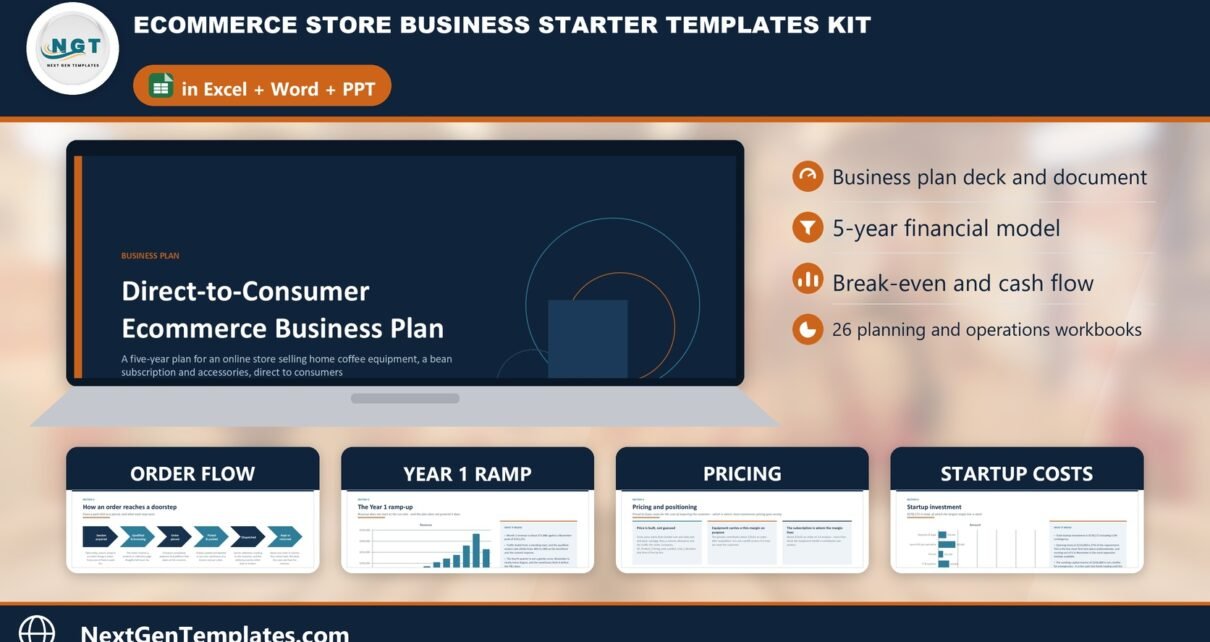
Most online store business plans fail the same way: they open with a revenue number that nobody can trace back to a visitor. The Ecommerce Store Business Starter Templates Kit starts at the other end. It is 35 files in nine folders — a 44-slide PowerPoint business plan, a 13-section Word plan, 26 numbered Excel workbooks, three ready-made tools and a 10-page PDF guide — and the five-year financial model at its centre derives every number from traffic.
That matters because sessions are the real ceiling on an online store. Sessions × qualified-session rate × conversion gives orders; each order carries its landed cost, pick and pack, carriage, payment fees, a returns allowance and the traffic it consumed. In this article I walk through every part of the kit, what each workbook does, and the few decisions that actually decide whether a new store makes money.
Key Features of the Ecommerce Store Business Starter Templates Kit
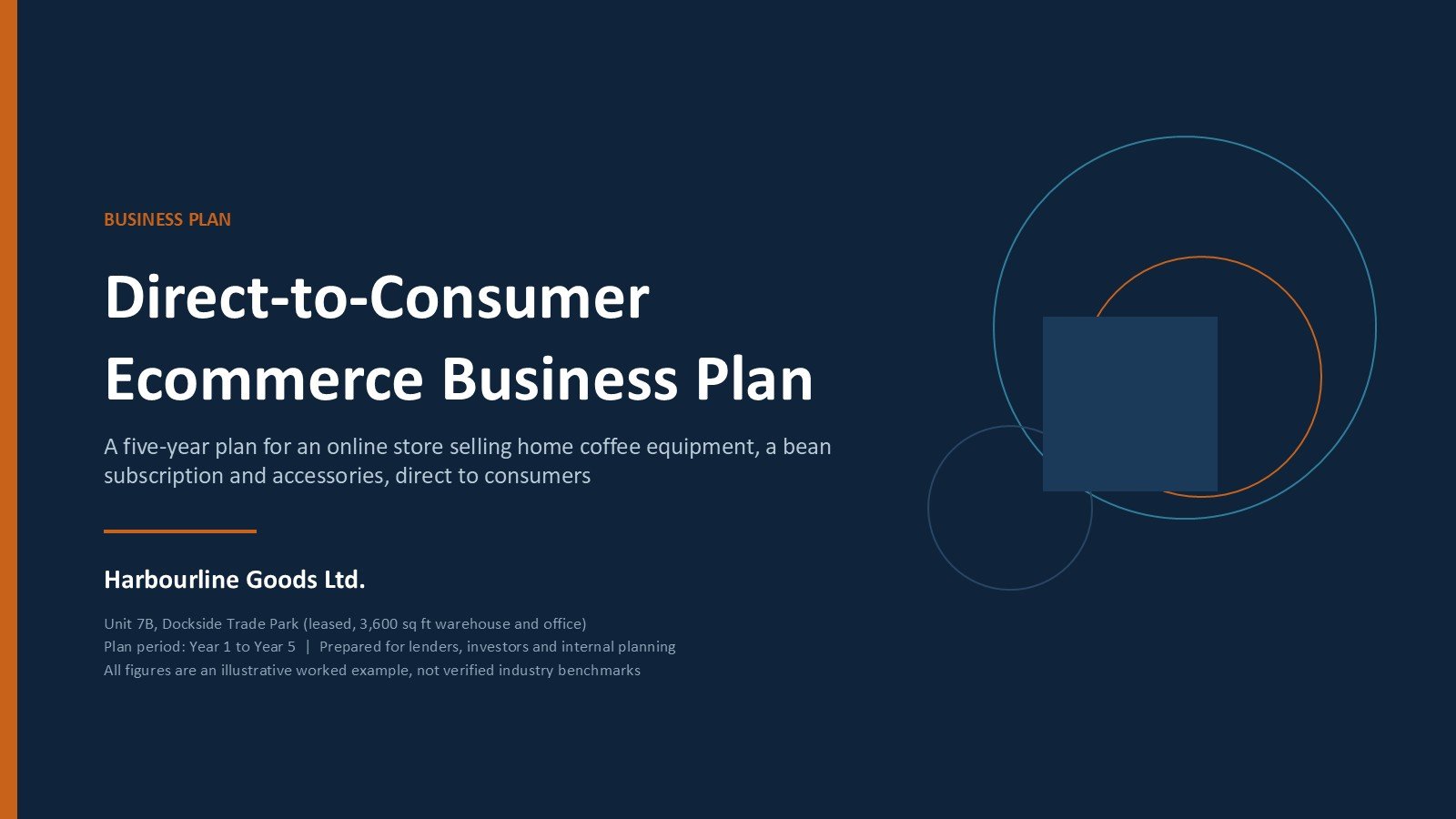
The kit is built around one fictional worked example — Harbourline Goods Ltd., a direct-to-consumer store selling home coffee equipment, a bean subscription and accessories — so the presentation, the Word plan and the workbooks agree with each other. Every figure is an illustrative planning assumption, not an industry benchmark.
- Traffic drives everything. Orders come from sessions and conversion by product family, not from a guessed growth rate.
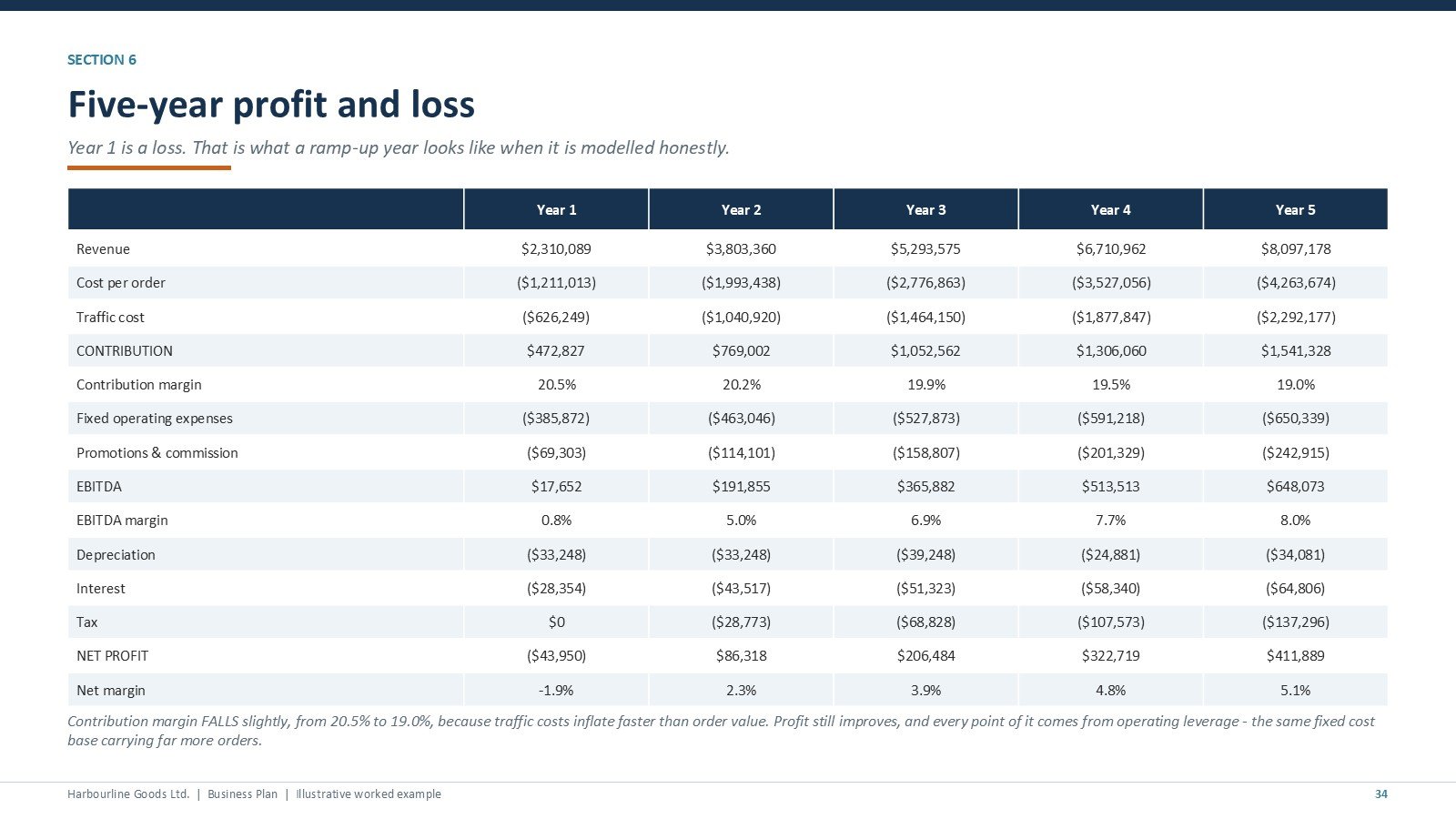
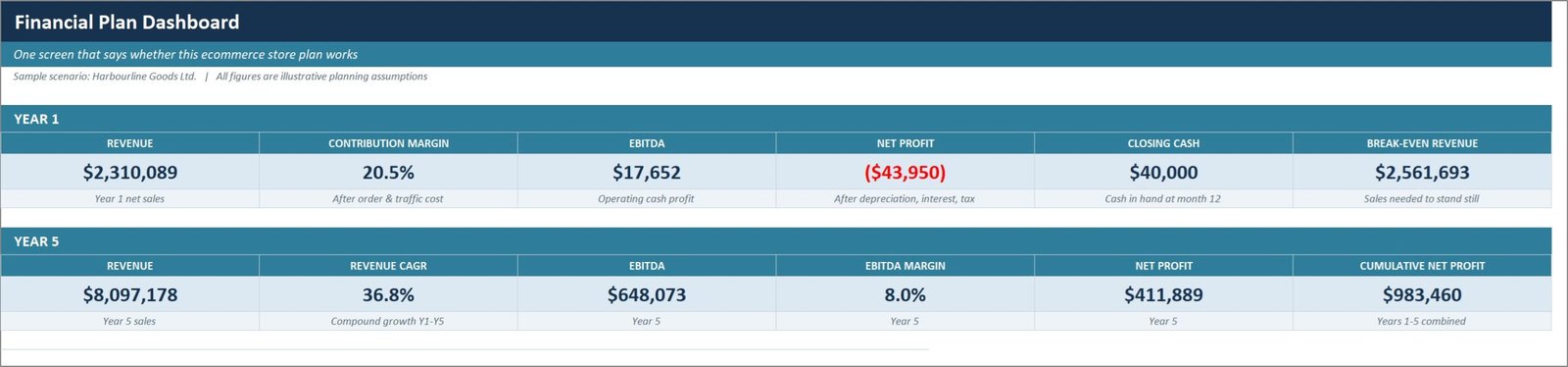
- Year 1 is allowed to lose money. The example reaches $2,310,089 of revenue with $17,652 of EBITDA and a ($43,950) net loss, then reaches $8,097,178 revenue, $648,073 EBITDA (8.0%) and $411,889 net profit by Year 5.
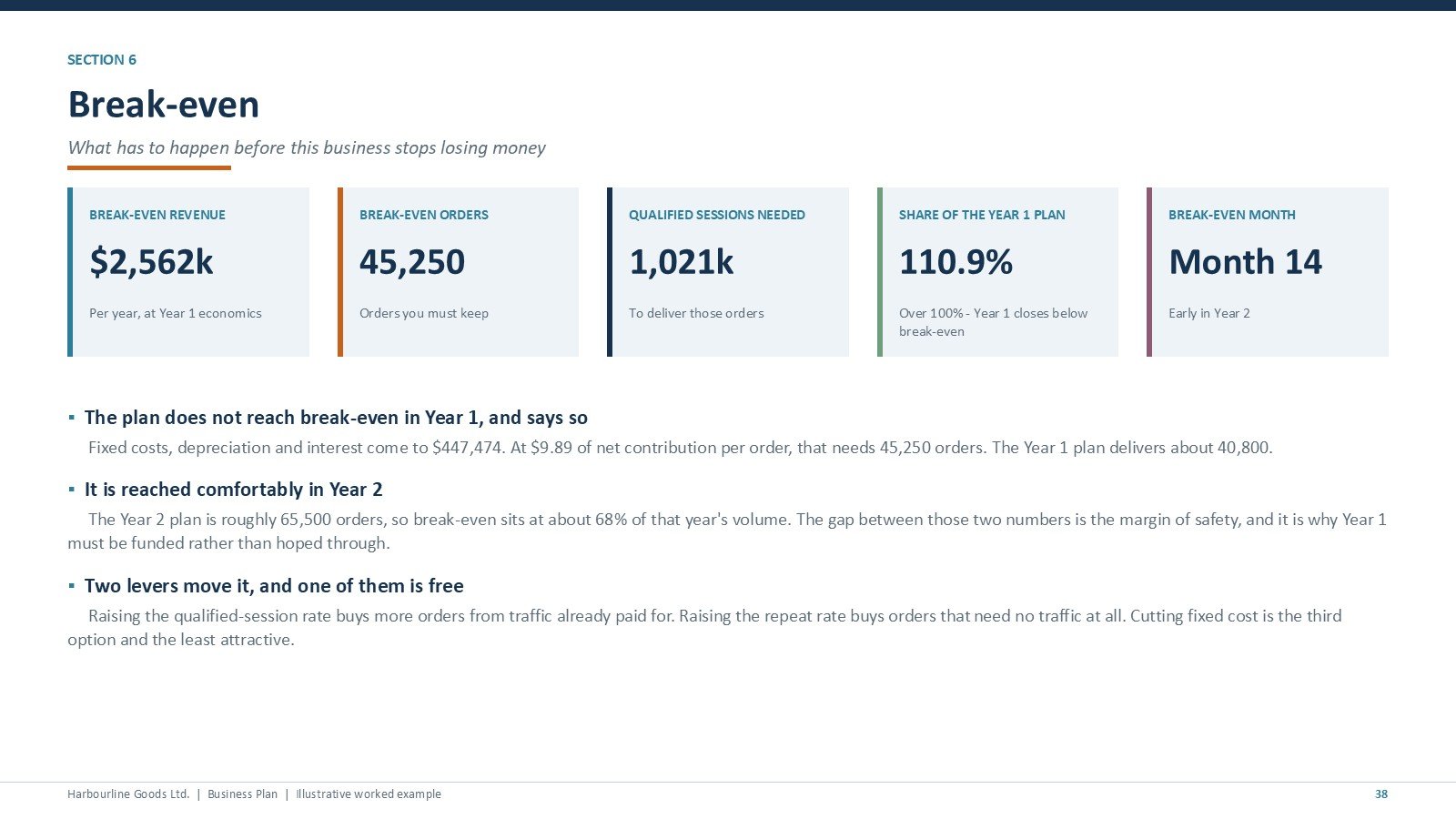
- Break-even is explicit. 45,250 orders a year, $2,561,693 of revenue at Year 1 economics, reached in month 14.
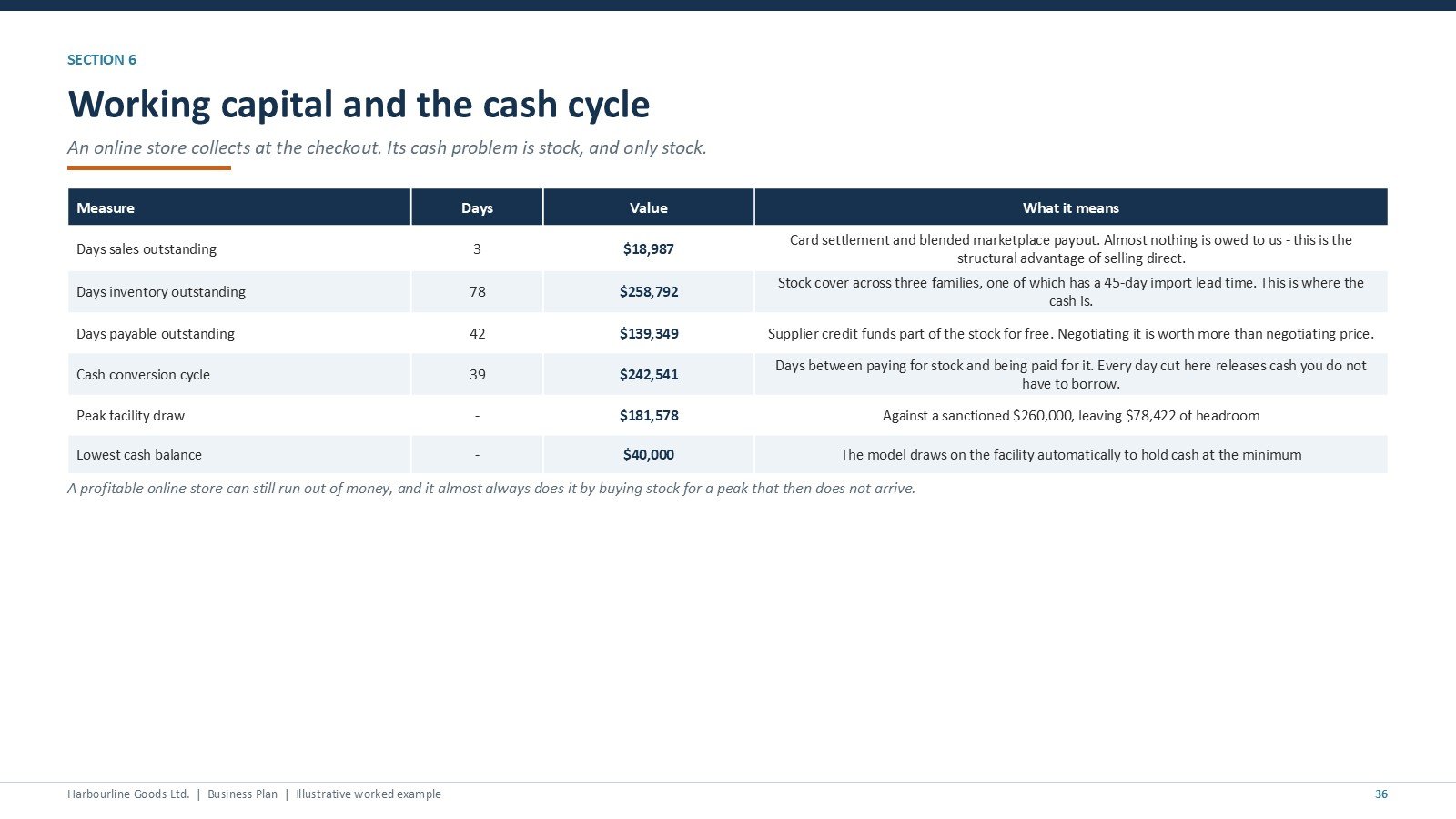
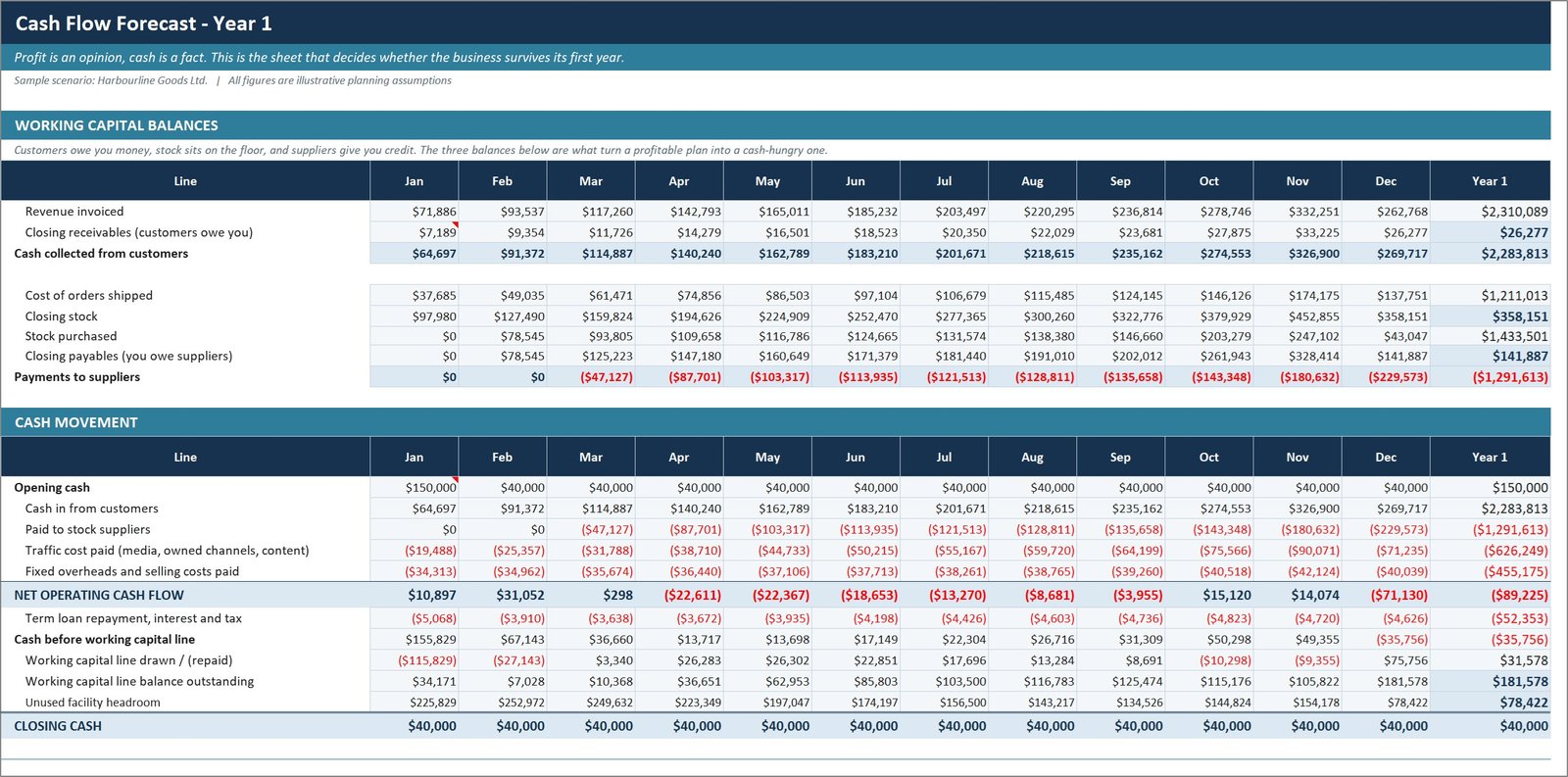
- Stock is modelled as the cash problem it is. 3 days of receivables, 78 days of inventory, 42 days of payables — a 39-day cash conversion cycle funded by a facility that peaks at $181,578 against a $260,000 limit.
- Excel 2010 compatible, zero formula errors. No XLOOKUP, no dynamic arrays, no add-ins.
Every File in the Ecommerce Store Business Starter Templates Kit, Explained
The kit ships in nine folders: presentation, Word plan, financial planning, sales and marketing, operations, people and HR, admin and compliance, business tools and instructions.
The 44-slide PowerPoint business plan
Seven sections: the business, the market, products and operations, sales and marketing, organisation, the financial plan and execution. Charts and tables are native editable PowerPoint objects, 35 slides carry speaker notes, and content slides use a subtle entrance animation.
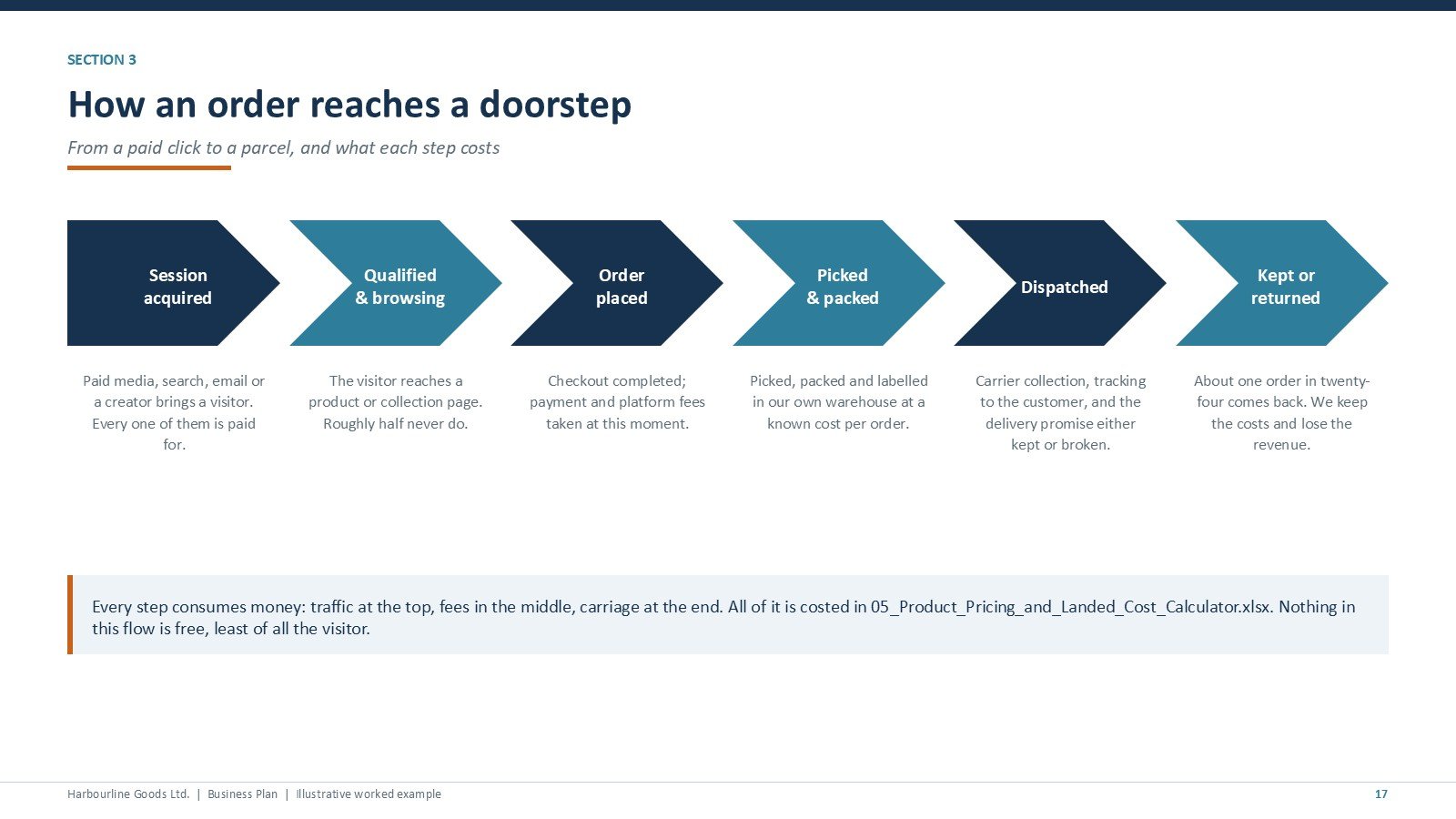
How an order reaches a doorstep
A six-step flow from session acquired to kept or returned. The point of the slide is that every step costs money — traffic at the top, fees in the middle, carriage at the end — and all of it is costed in the pricing calculator.
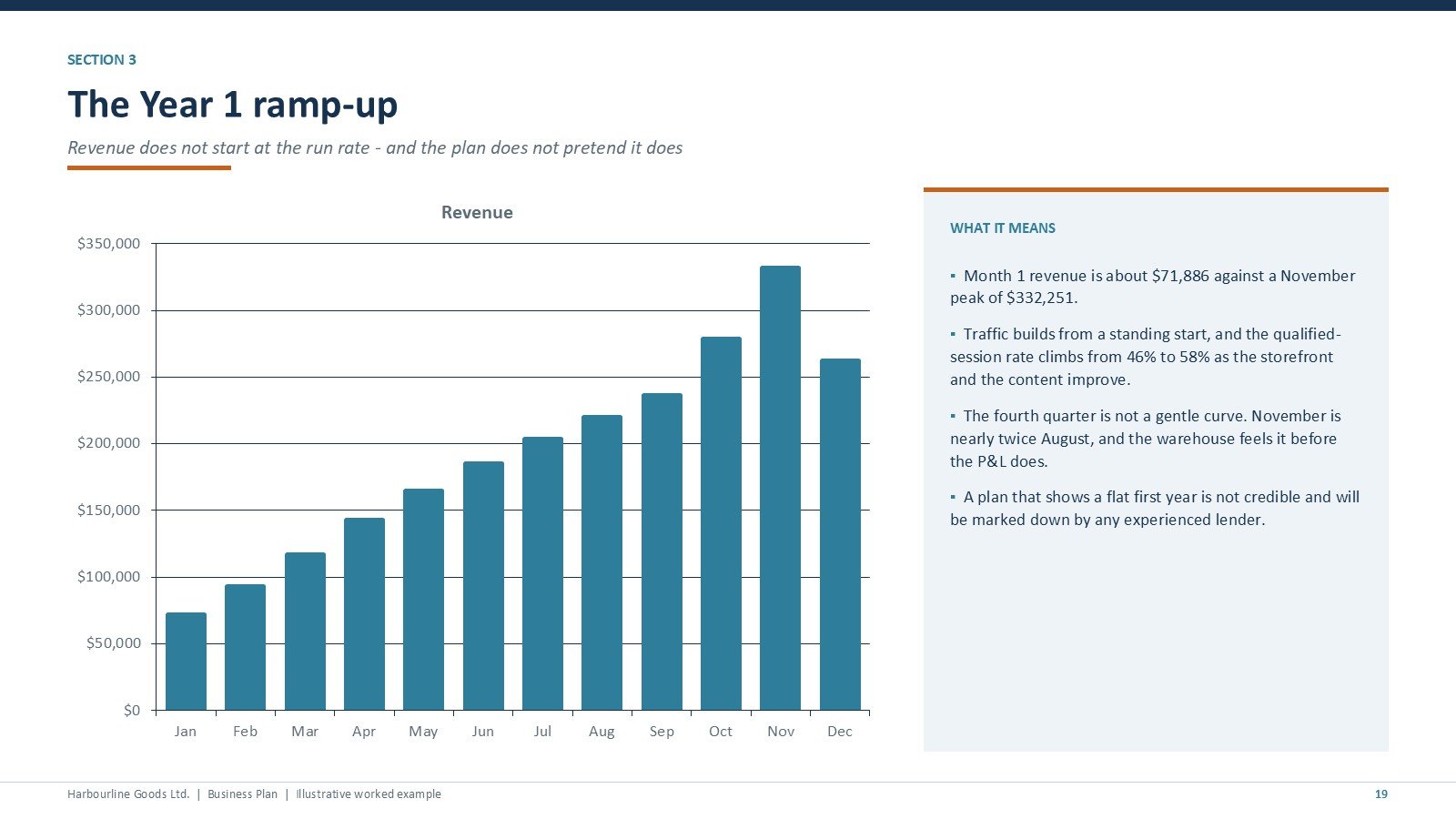
The Year 1 ramp-up
Month 1 revenue is about $71,886 against a November peak of $332,251. The qualified-session rate climbs as the storefront improves, and the fourth quarter is a wall rather than a gentle curve.
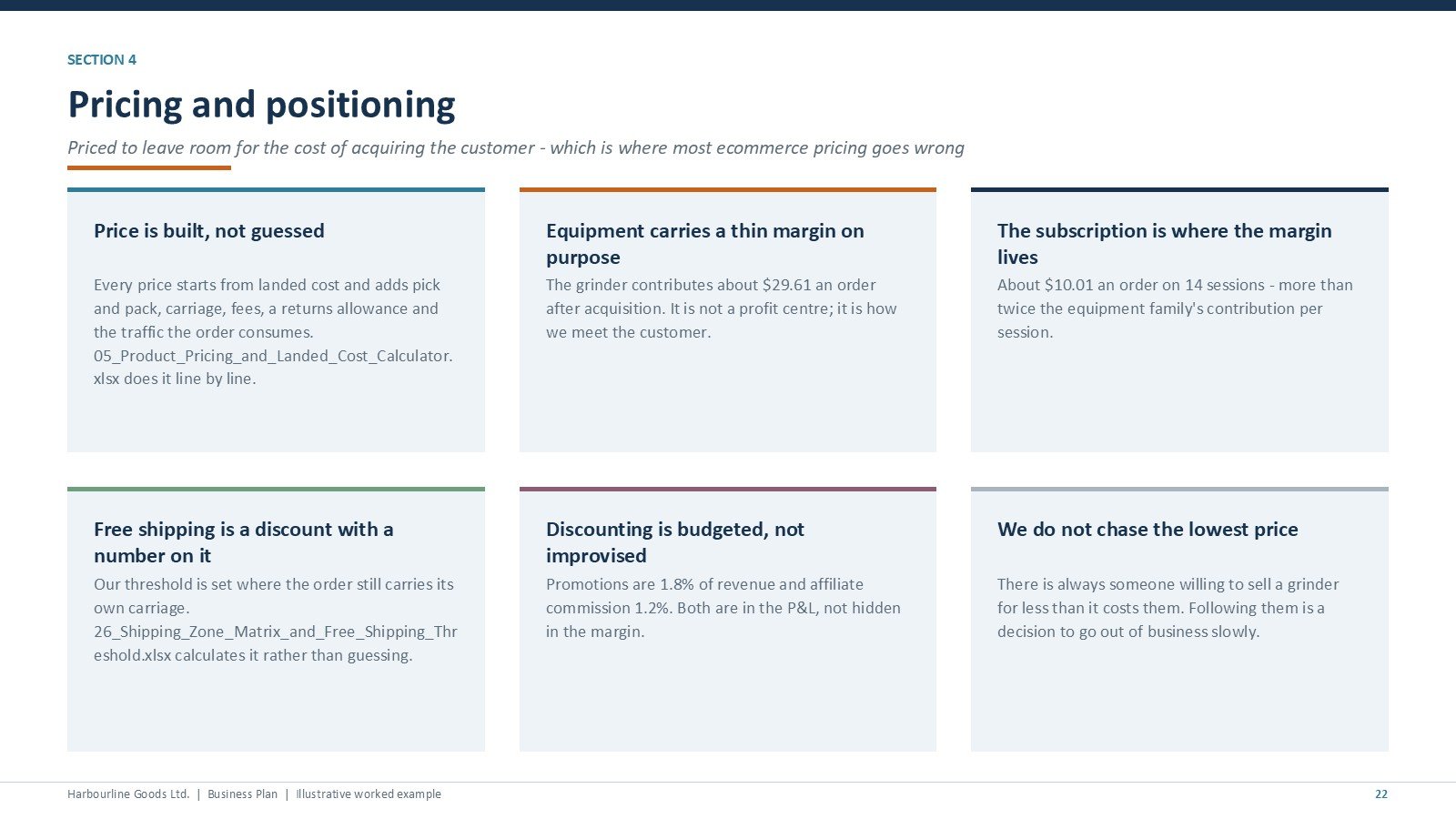
Pricing and positioning
Price is built from landed cost, not guessed. Equipment carries a thin margin on purpose; the subscription is where the margin lives; free shipping is a discount with a number on it.
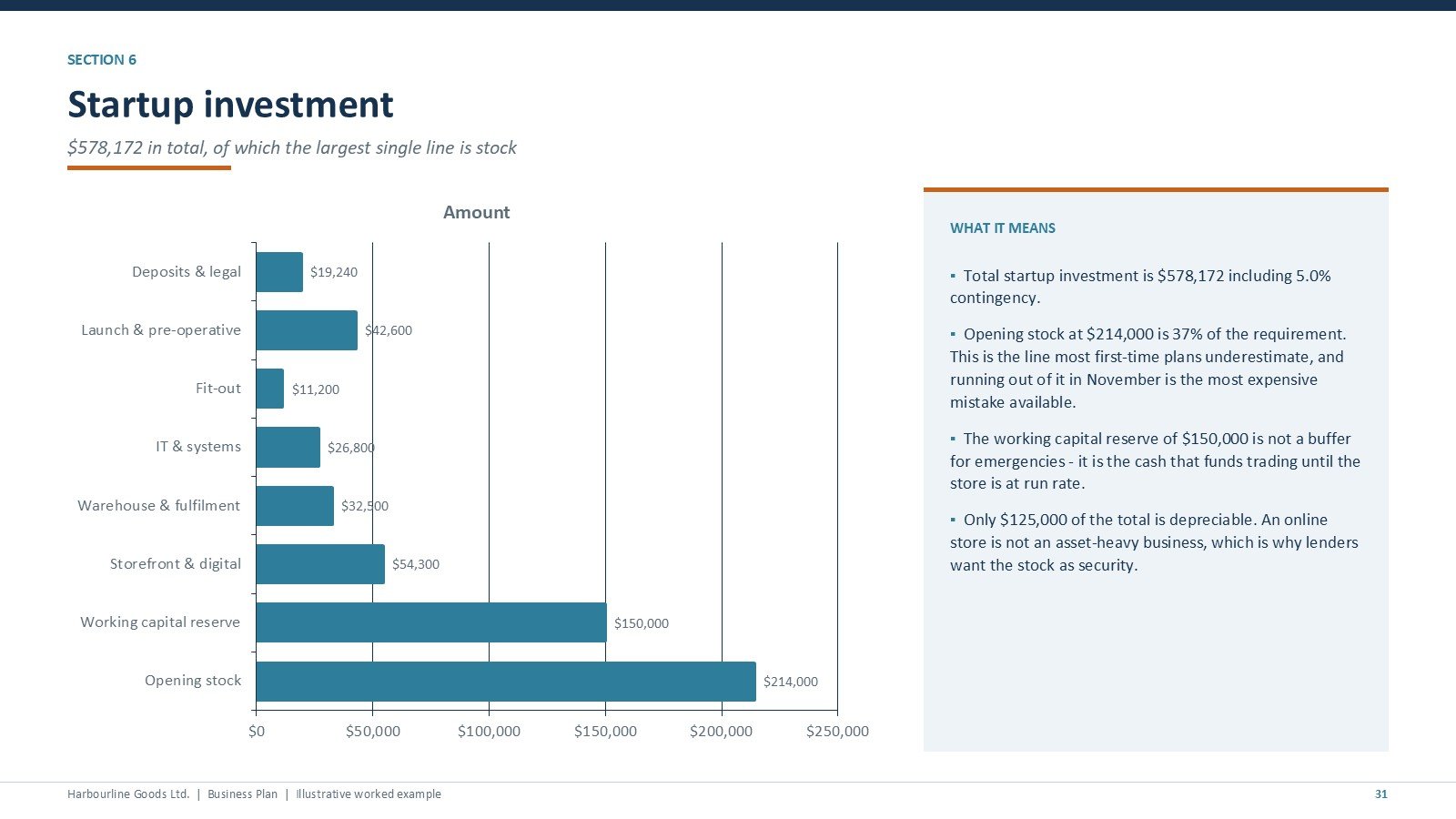
Startup investment
Ecommerce startup costs of $578,172 including a 5% contingency. Opening stock at $214,000 is 37% of the requirement and a $150,000 working capital reserve funds trading until run rate. Funding is equity of $238,172, a $190,000 term loan and $150,000 drawn on a $260,000 facility.
Five-year profit and loss
Revenue, cost per order, traffic cost, contribution, fixed costs, EBITDA, depreciation, interest, tax and net profit. Contribution margin slips from 20.5% to 19.0% because traffic costs inflate faster than order value; profit still improves through operating leverage.
Working capital and the cash cycle
An online store collects at checkout, so its cash problem is stock. The slide sets DSO, DIO and DPO side by side with the peak facility draw and the lowest cash balance.
Break-even
Break-even revenue, orders, qualified sessions needed, the share of the Year 1 plan and the break-even month. Year 1 closes below break-even and the plan says so; Year 2 clears it comfortably.
Implementation roadmap slide
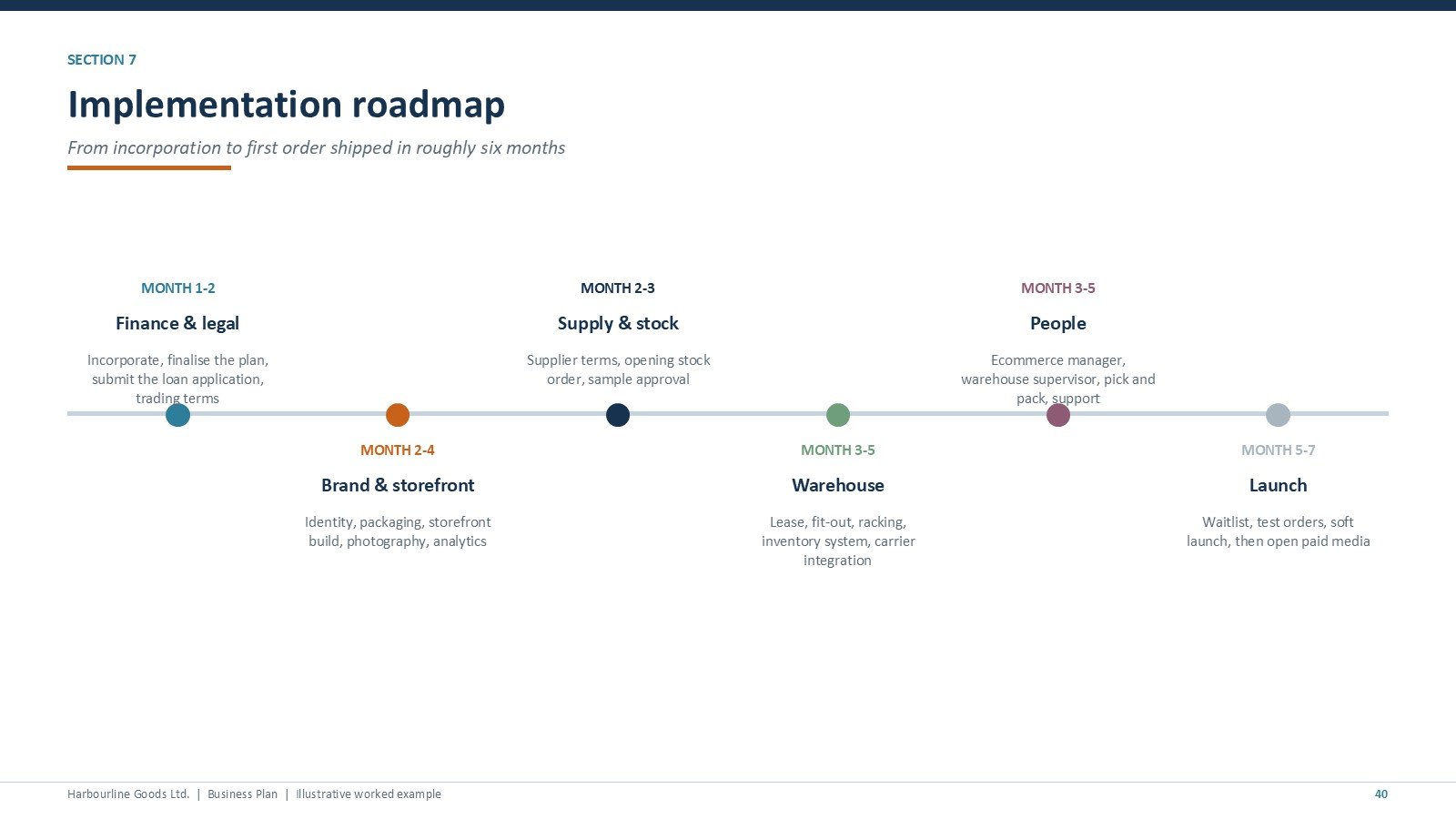
Six phases from incorporation to first order shipped in roughly six months: finance and legal, brand and storefront, supply and stock, warehouse, people and launch.
Workbook 02: the ecommerce financial model in Excel
Thirteen sheets: Instructions, Assumptions, Dashboard, Traffic & Orders, Revenue Forecast, Order Cost & COGS, Staffing Costs, Operating Expenses, CapEx & Depreciation, Profit & Loss, Cash Flow, Break-Even and KPI Summary. The Dashboard answers whether the plan works on one screen.
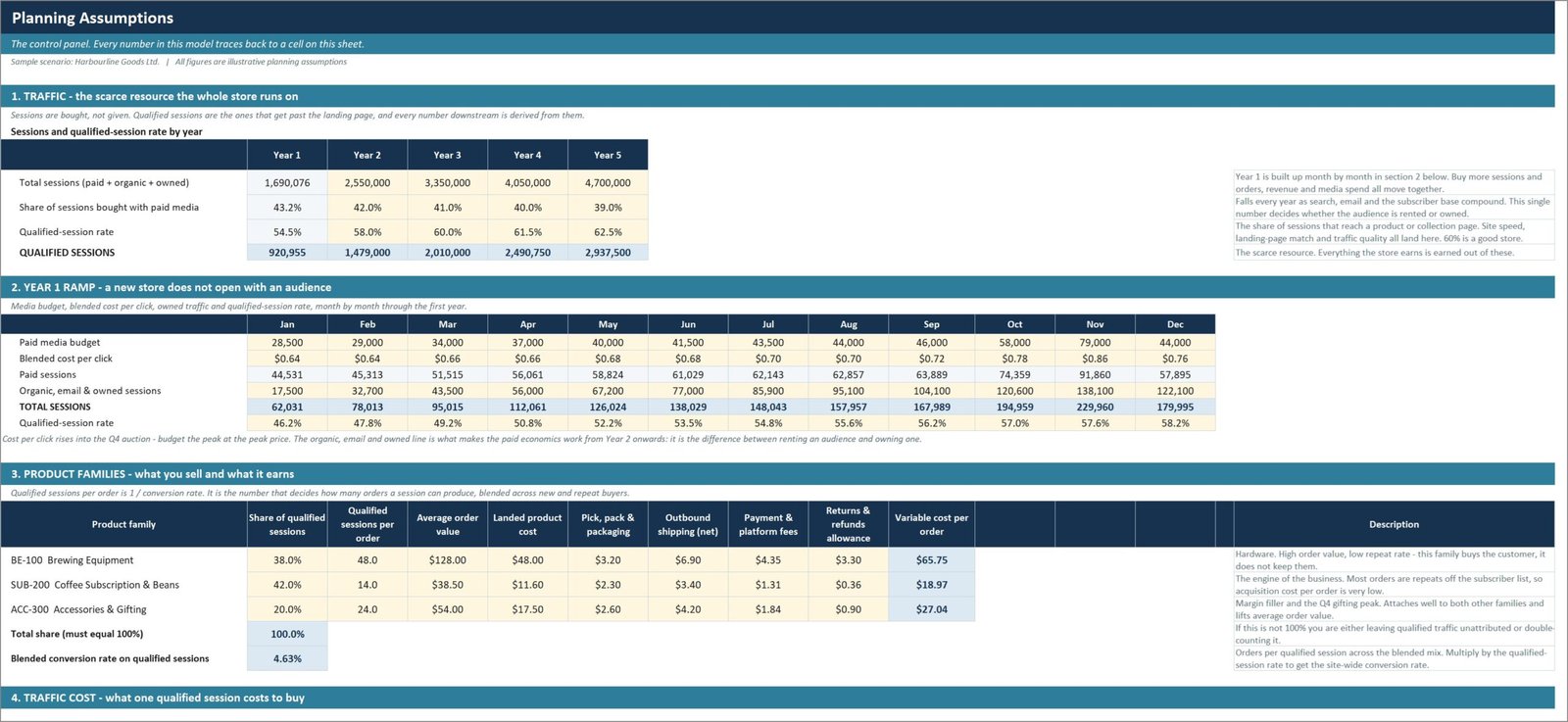
The Assumptions sheet
The control panel. Sessions and qualified-session rate by year, the Year 1 media budget and cost per click month by month, three product families with order value, landed cost, fulfilment, fees and returns allowance.
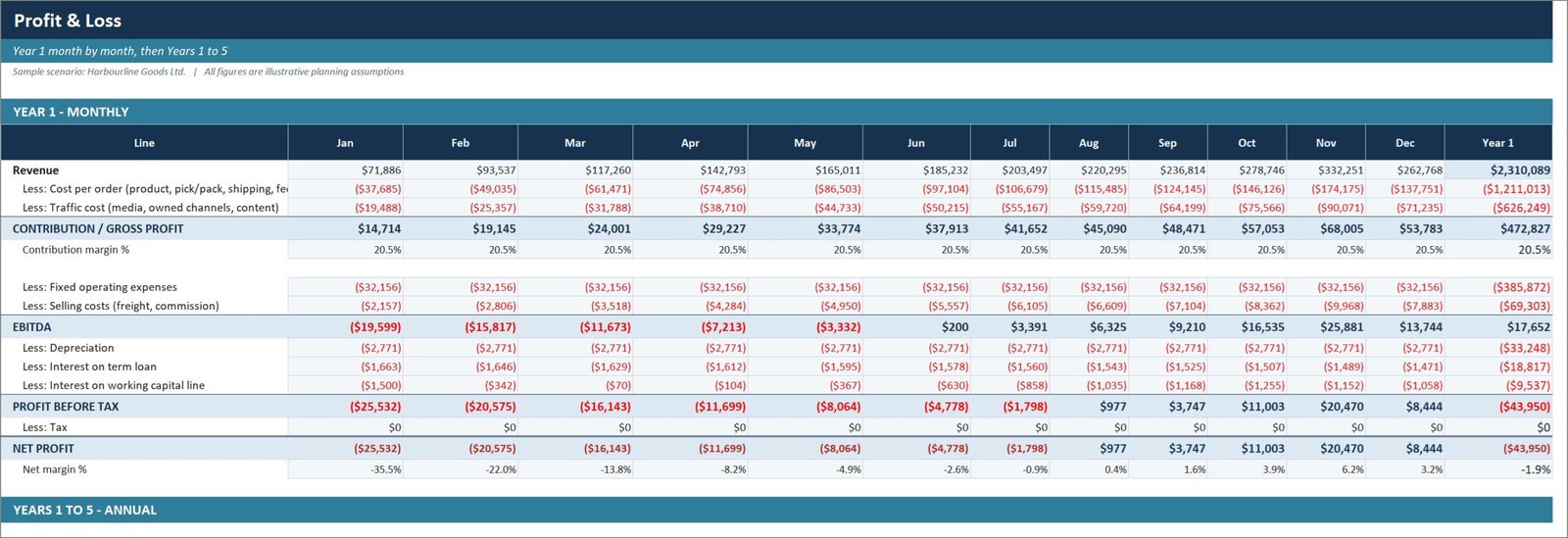
Profit and loss, month by month
Year 1 monthly then Years 1 to 5 annually, with interest split between the term loan and the working capital line.
Cash flow forecast
Receivables, closing stock and supplier payables, then cash movement and an automatic facility draw that holds closing cash at the $40,000 minimum every month.
Workbook 01: startup cost and funding plan
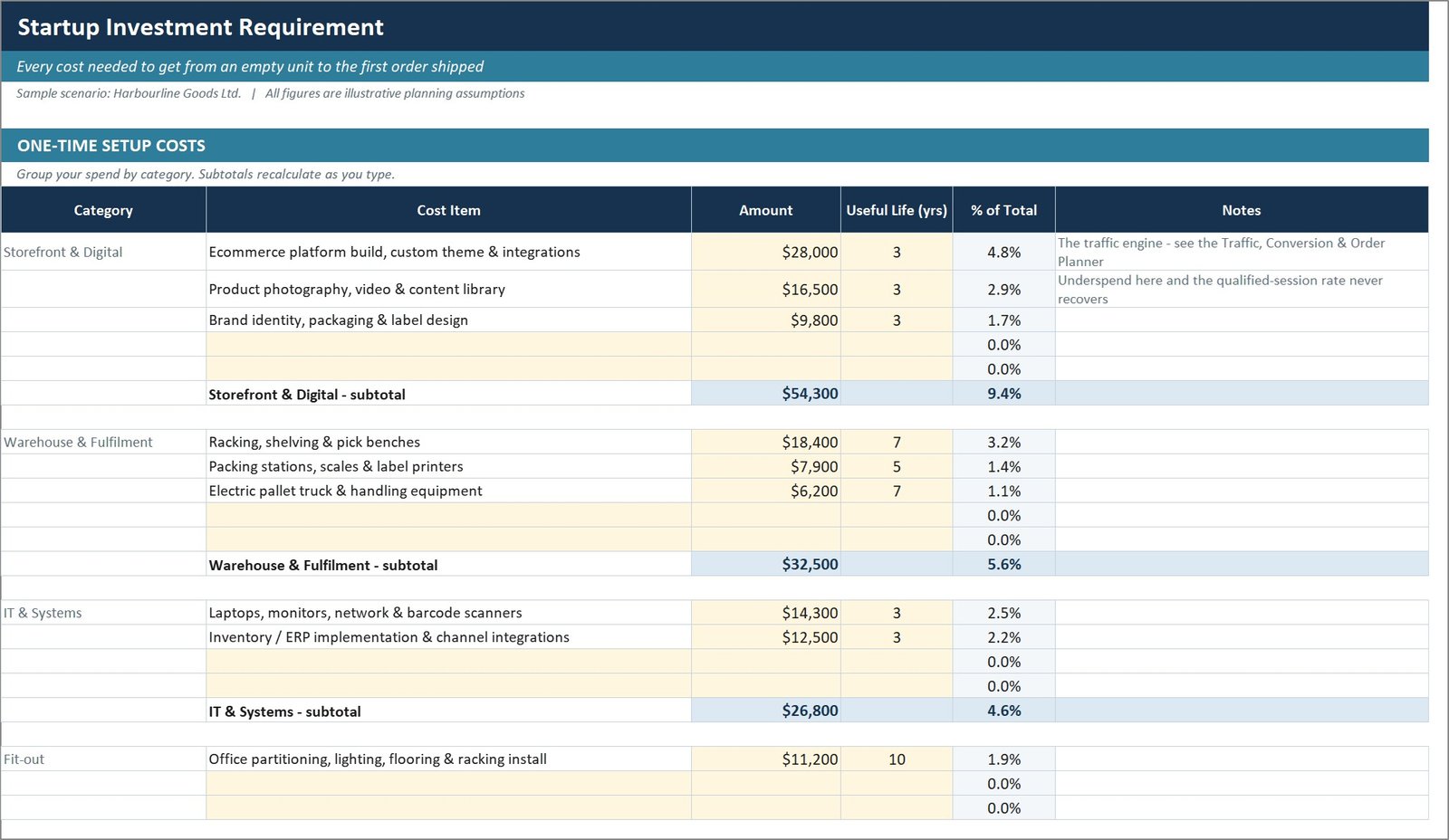
Every cost from an empty unit to the first order shipped, grouped into storefront and digital, warehouse and fulfilment, IT and systems, fit-out and more, with useful life for depreciation, a funding plan and a payment schedule.
Workbook 05: product pricing and landed cost calculator
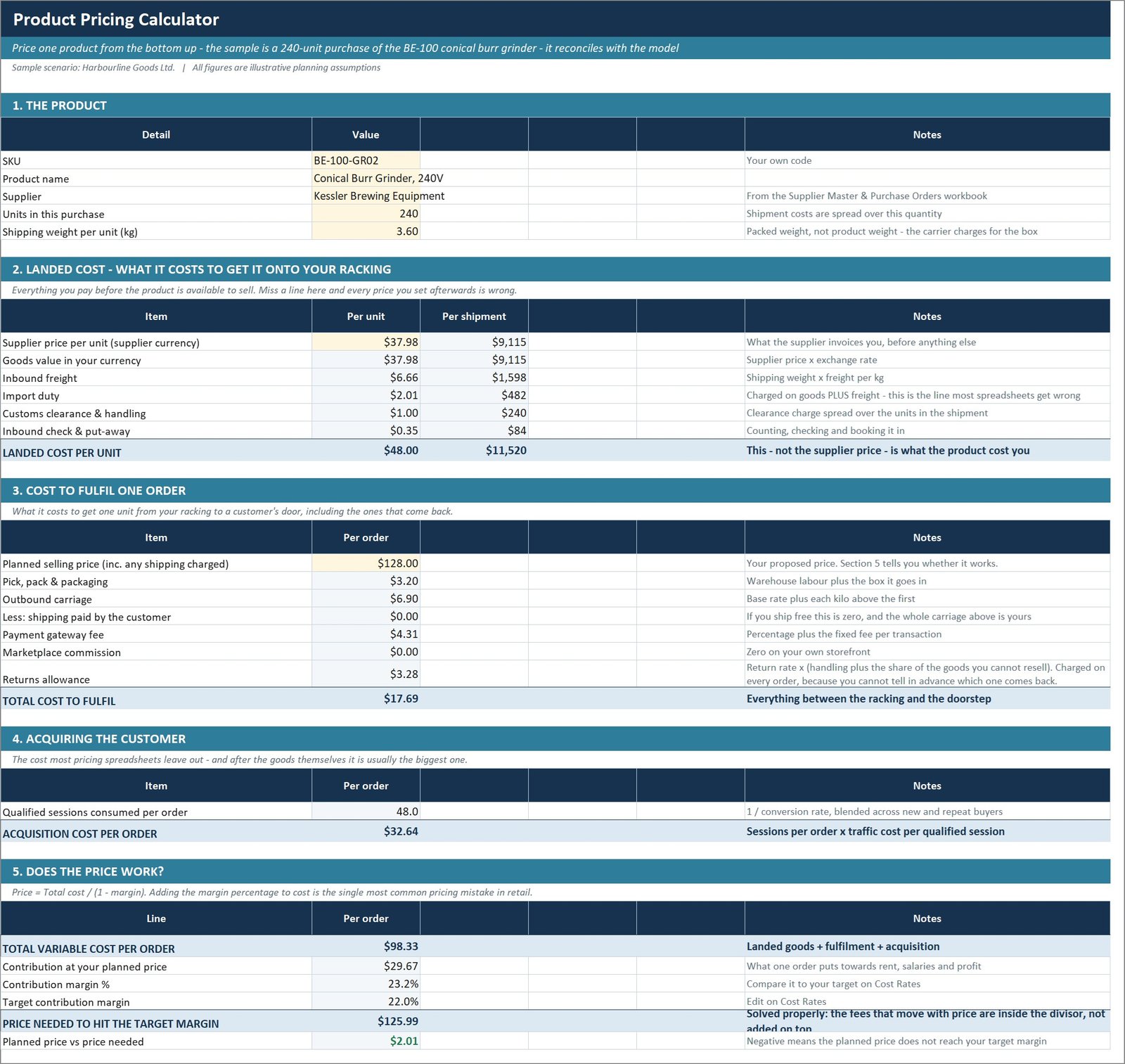
The sample prices a 240-unit purchase of a conical burr grinder: $37.98 supplier price becomes a $48.00 landed cost after freight, duty, clearance and put-away; fulfilment adds $17.69 and acquisition $32.64. At $128 the order contributes $29.67.
Workbook 07: traffic, conversion and order planner
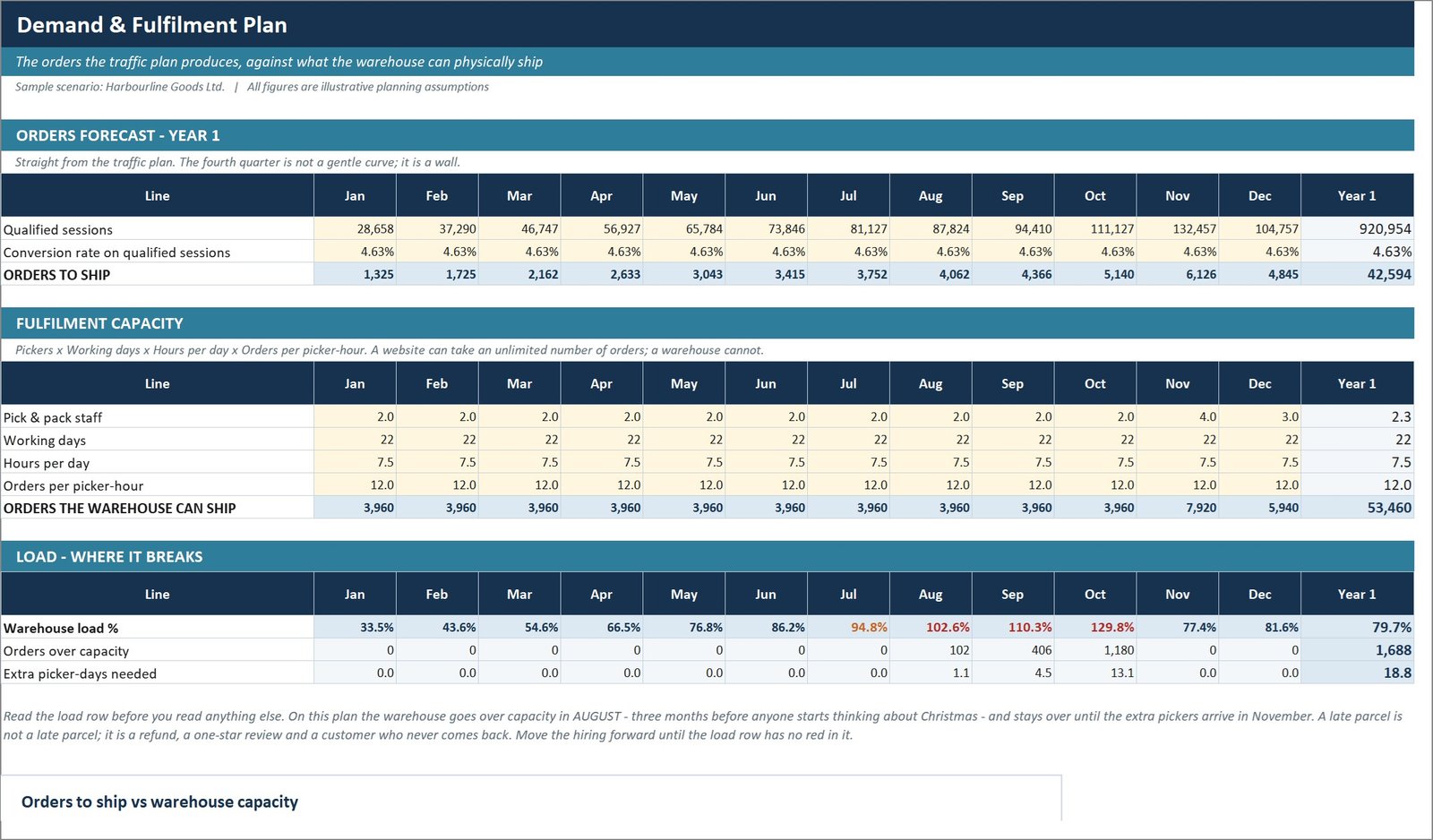
Orders to ship against what the pick-and-pack team can physically ship. In the example the warehouse goes over capacity in August, three months before Christmas, and the sheet says exactly how many extra picker-days are needed.
Workbook 09: ecommerce KPI dashboard
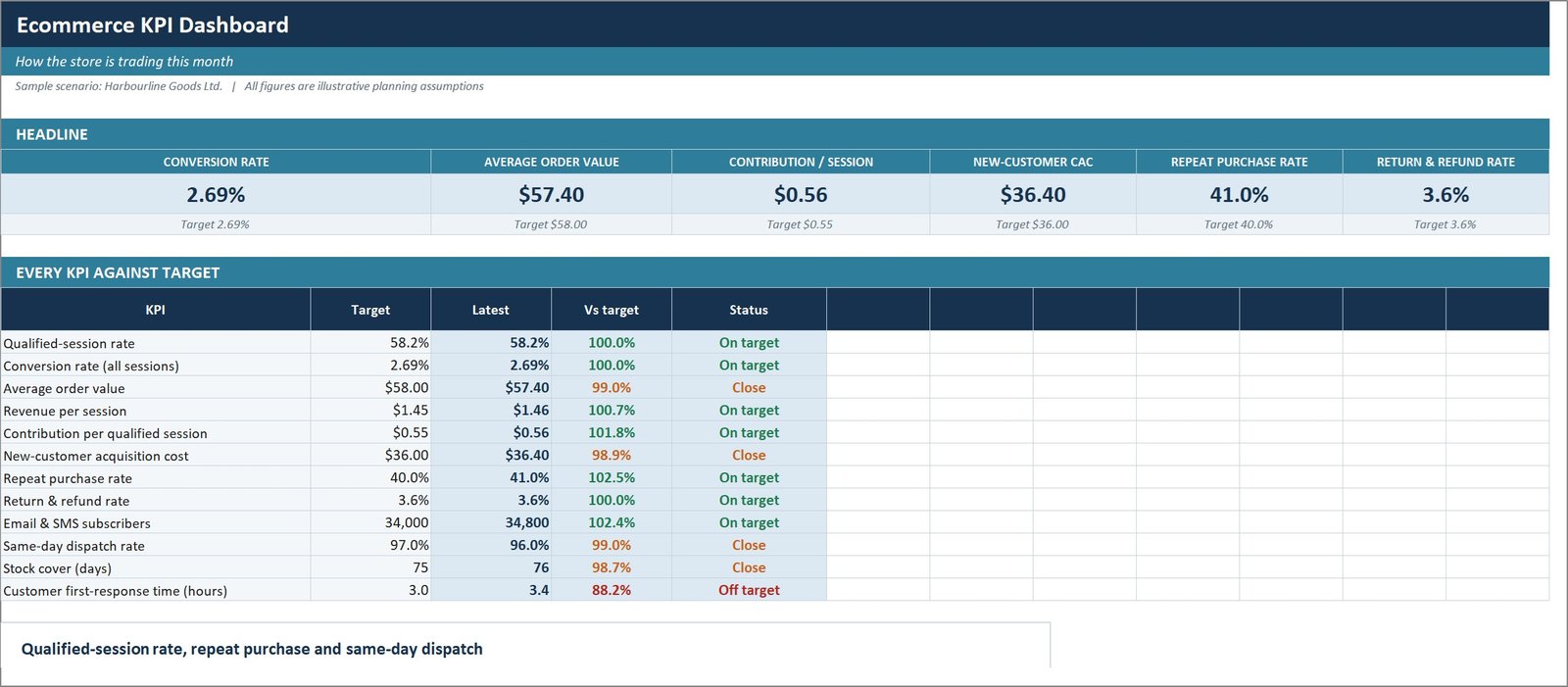
Six headline cards and 12 KPIs against target — conversion rate, average order value, new-customer CAC, repeat purchase rate, return rate, same-day dispatch, stock cover and more — each marked on target, close or off target.
Workbook 10: implementation roadmap and risk register
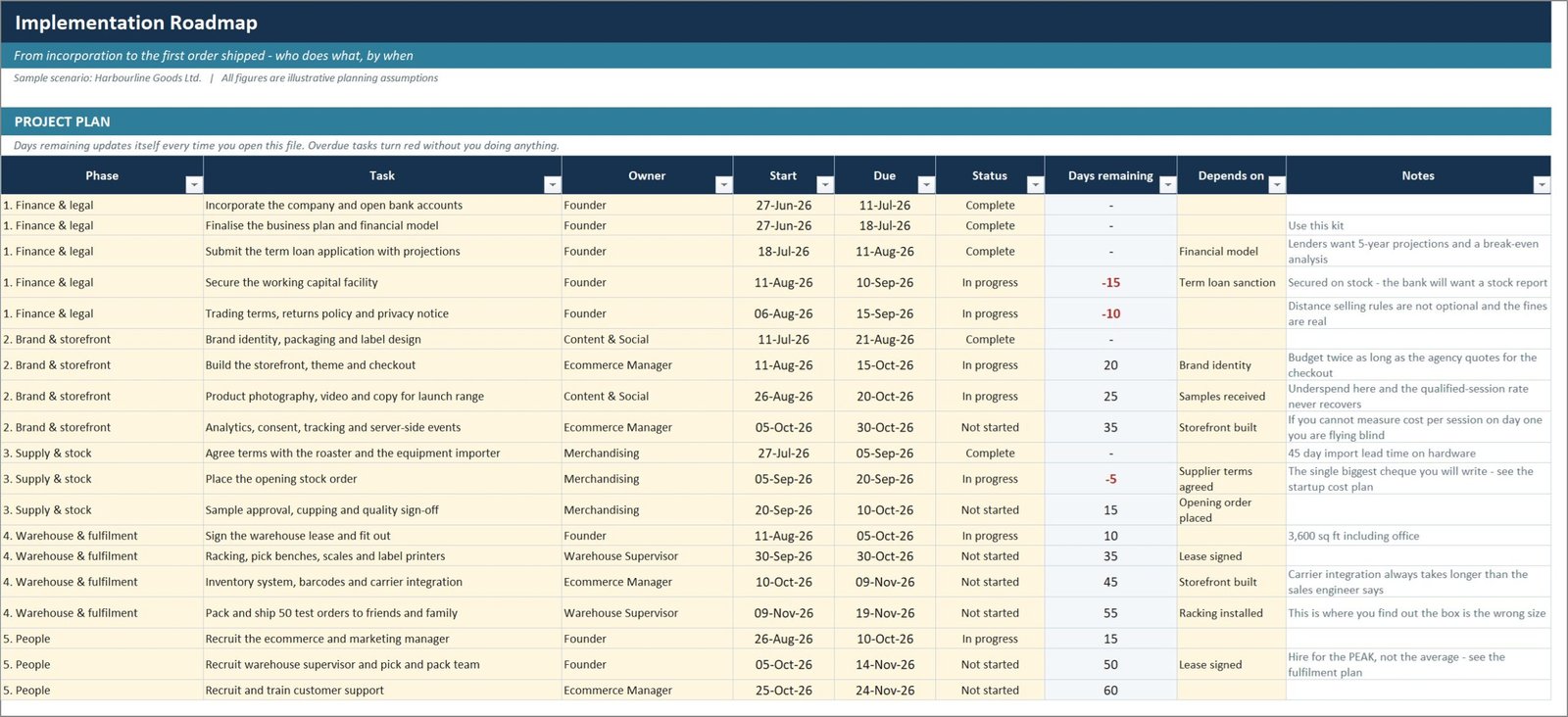
Twenty-nine tasks across the launch phases with owners, dates and dependencies; days remaining update every time you open the file and overdue tasks turn red. Twelve risks are scored for likelihood and impact.
The rest of the 26 workbooks
Break-even and contribution with pessimistic, base and optimistic scenarios; a loan and working capital planner; a marketplace and payment fee calculator comparing own storefront, marketplace, social checkout, wholesale and corporate gifting; SKU profitability after fees, returns and ad spend; an ad spend and ROAS tracker; customer cohorts with repeat rate and LTV:CAC; a channels and marketing plan; inventory and replenishment with safety stock and reorder points; a supplier master and purchase orders; a returns, refunds and damages log; a shipping zone matrix with a free-shipping threshold; plus invoicing, customer records, expenses, ageing, budget vs actual, employees, payroll, assets and compliance.
Word documents, PDF guide and bundled tools
The Word business plan runs to 13 sections. An SOP and quality plan and a startup checklist sit in Business Tools with three ready-made tools: an organisation chart, a quality control checklist and a financial planning calendar. The 10-page PDF guide and a READ ME explain where to start.
Ecommerce Store Business Starter Templates Kit vs. a Business Plan Writer vs. LivePlan — Feature Comparison
| Feature | Ecommerce Store Business Starter Templates Kit | Freelance business plan writer | LivePlan / Bizplan |
|---|---|---|---|
| Cost | $23 one-time | $500 – $3,000 per plan | $20 – $50 / month, ongoing |
| Platform | Excel, PowerPoint, Word – files you own | Whatever they send back | Browser only |
| Setup time | Under an hour | 2 – 6 weeks | Several hours of form filling |
| Ecommerce-specific model | Sessions, conversion, fees, returns, CAC | Depends on the writer | Generic revenue lines |
| Landed cost and pricing tool | Included | Not included | Not included |
| Operations workbooks after launch | Invoicing, inventory, payroll and more | Not included | Not included |
| Keeps working if you stop paying | Yes | Yes | No |
| Year-1 cost | $23 | $500 – $3,000 | $240 – $600 |
| Lender-ready presentation | 44 editable slides | Usually a document only | Template export |
For founders who want an ecommerce financial model in Excel without paying a consultant or renting software forever, the Ecommerce Store Business Starter Templates Kit sits in the sweet spot.
Who Should Use This Template
Perfect for:
- Founders launching a direct-to-consumer online store that holds its own stock
- Small ecommerce brands preparing a bank, investor or grant application
- Existing store owners who need pricing, inventory and cash planning in one place
- Consultants and bookkeepers who build plans for retail and ecommerce clients
Not a fit if:
- You run pure dropshipping or print-on-demand with no stock – the working capital logic assumes you buy inventory
- You need live integration with your store platform – these are Excel files you update
- You expect industry benchmark data rather than a model you populate
- You want the plan written for you – this is a template you complete
Real-World Use Cases
Aisha is launching a specialty tea store. She sizes her opening stock in workbook 01, then discovers from the cash flow that a long import lead time, not her ad budget, decides how big a facility she needs. She takes the funding plan and the five-year model to her bank instead of paying a consultant.
Tom sells outdoor gear on his own store and a marketplace. The fee calculator shows how much of each order every channel keeps, and the SKU profitability workbook shows which products lose money once advertising and returns are counted. He cuts two SKUs and renegotiates a third.
Elena is a bookkeeper with three online retail clients. She reuses the budget vs actual, ageing and cash flow workbooks for each, and starts every new online store business plan from the kit rather than a blank workbook.
Advantages of the Ecommerce Store Business Starter Templates Kit
The clearest advantage is traceability. The deck, the Word plan and the workbooks are built on the same worked example, so the presentation does not say one thing while the spreadsheet says another — the most common way a plan falls apart in a lender meeting.
The second is that it teaches the economics while you use it. Contribution per qualified session ranks products differently from contribution per order. When traffic is the scarce resource, the product to push is the one that earns most per session, not the one with the fattest margin per item. In the example, the subscription earns about $10.01 an order on 14 sessions — more than twice the equipment family’s contribution per session.
Third, cost. A freelance ecommerce business plan template service runs $500 to $3,000 and needs revising the moment an assumption changes; a subscription tool stops working when you stop paying. For background on the formulas involved, Microsoft’s overview of formulas in Excel is a useful companion.
Opportunities for Improvement
There are limits worth stating. The model assumes three product families; running more means inserting rows on the Assumptions sheet and extending the dependent sheets. The working capital facility is modelled month by month for Year 1; later years are annual. The workbooks do not connect to Shopify, WooCommerce or an ad platform — you paste or type your figures. And the example is a stock-holding store; a dropshipper would need to strip out the inventory and facility logic.
Best Practices
- Save a clean copy before you edit. The sample data is the quickest way to see what a formula was meant to do.
- Do the cash flow before the profit forecast. Profitable stores fail on stock, not margin.
- Price from landed cost plus acquisition cost. A price that ignores the traffic an order consumed is a loss you have not noticed yet.
- Plan warehouse capacity for the peak. Check the load row in workbook 07 before you set hiring dates.
- Track repeat rate by cohort. The second order is where ecommerce margin is made.
Explore Relevant Templates
Once the store is trading, pair the kit with a reporting dashboard: the Shopify Store Dashboard in Excel, the Fashion E-commerce KPI Dashboard in Excel and the Ecommerce Conversion Rate KPI Dashboard in Google Sheets. For fulfilment at scale, the E-commerce Order Fulfillment Tracking System Web App is the natural next step, and the Retail & Store Analytics Bundle packs 8 retail templates together.
On this blog, these walkthroughs cover the reporting side: the Dropshipping Dashboard in Excel, the Fashion E-commerce KPI Dashboard in Excel, the Order Fulfillment KPI Dashboard in Excel and the guide to inventory management in Excel. For break-even alone, see the Break-Even Analysis Pack in Excel; for a factory rather than a store, the Manufacturing Business Plan Templates Kit uses the same format.
Frequently Asked Questions
What is included in the Ecommerce Store Business Starter Templates Kit?
The kit contains 35 files in nine folders: a 44-slide PowerPoint business plan, a 13-section Word plan, 26 numbered Excel workbooks, three ready-made Excel tools, two Word business tools, a READ ME and a 10-page PDF guide. Everything is editable, with no subscription.
How long does it take to set up?
Under an hour for the core model. The kit is driven from the Assumptions sheet of the five-year model, so entering traffic, conversion, product families and costs updates orders, profit, cash flow, break-even and the dashboard automatically.
How does this compare to LivePlan or a business plan writer?
A freelance writer charges $500 to $3,000 and takes two to six weeks. LivePlan is a subscription you lose access to when you stop paying. The kit is a one-time $23 purchase, you keep the files and formulas, and the model is ecommerce-specific.
Will it work in my version of Excel?
Yes. The workbooks work in Excel 2010 and later, including Microsoft 365. They avoid XLOOKUP and dynamic arrays so nothing breaks on an older build, and none of the planning workbooks needs macros or add-ins.
Are the figures real industry benchmarks?
No. Harbourline Goods Ltd. is a fictional store and every figure is an illustrative planning assumption. The numbers show how a complete plan fits together and must be replaced with your own research before use.
Can I use it for a dropshipping store?
Partly. The pricing, fee, ad spend, cohort and KPI workbooks apply to any online store. The five-year model assumes you buy and hold stock, so a dropshipper would need to remove the inventory and working capital facility logic.
About the Author
Built by PK — Microsoft Certified Professional with 15+ years of Excel, Google Sheets and Power BI experience. Founder of NextGenTemplates, reaching 300K+ subscribers across YouTube channels. Every template is hand-built and tested before release.
Conclusion
An online store business plan is only as good as the link between the visitor who arrives and the parcel that leaves. The Ecommerce Store Business Starter Templates Kit makes that link explicit, gives you the operating tools to keep using after launch, and costs less than an hour of a consultant’s time.
👉 Click here to purchase the Ecommerce Store Business Starter Templates Kit
Instant download · One-time payment · No subscription · Lifetime access
🎥 More tutorials: Youtube.com/@PKAnExcelExpert
Last updated: September 2026