Harvest records have a habit of living in three places at once – a notebook in the truck, a phone photo of a weighbridge slip, and somebody’s memory. The Harvest Record Data Entry System in Excel puts them in one file. It is a macro-enabled workbook (.xlsm) with a 7-field entry form, 4 live summary cards, a 10-column register and four working VBA buttons, shipped with 10 crops, 7 fields and plots, 5 grade labels and 4 status labels already loaded. This walkthrough covers all four sheets, what the buttons actually do, where the template fits against a Google Sheets log or paid farm software, and what it deliberately does not do.
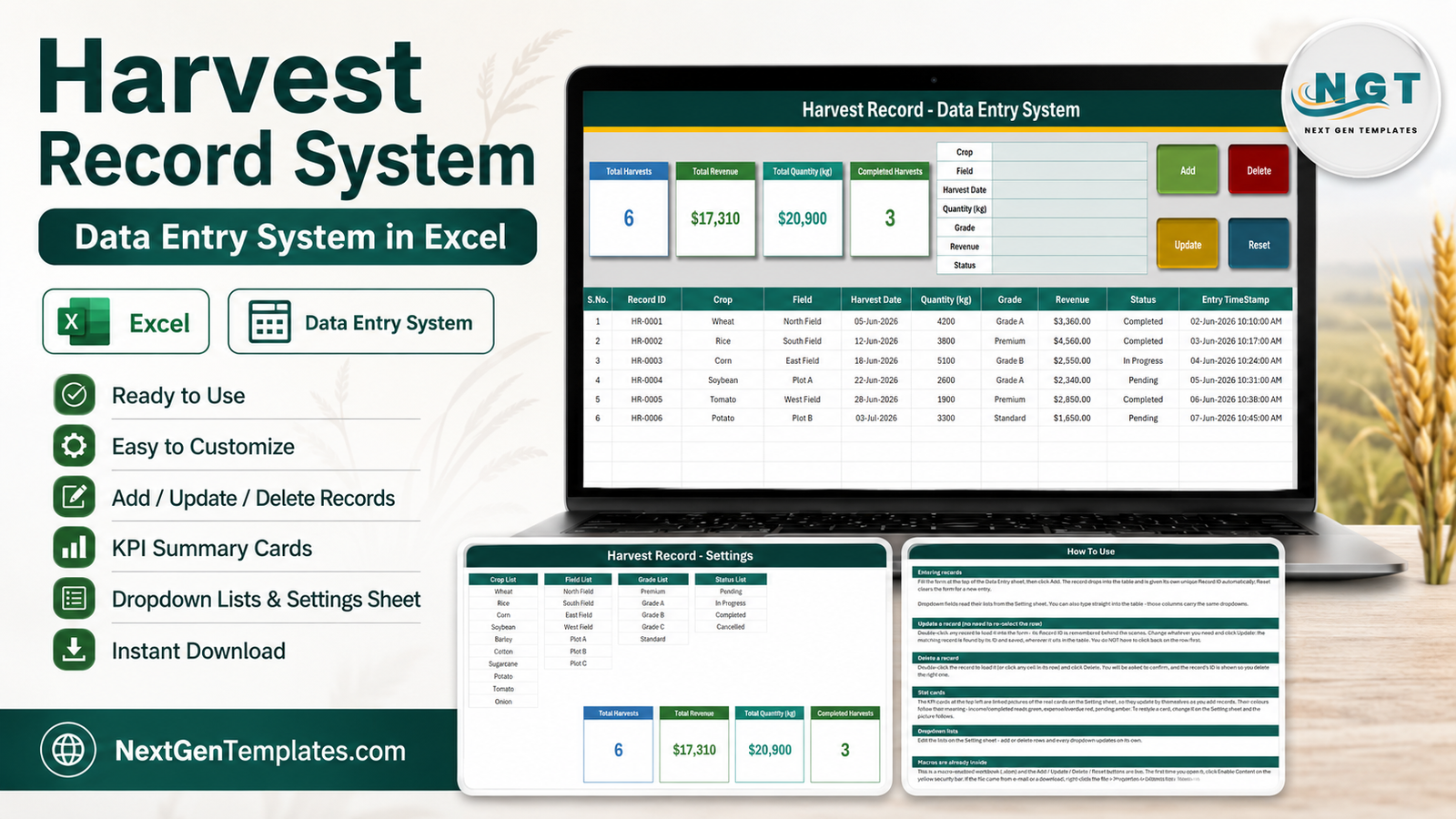
Key Features of the Harvest Record Data Entry System in Excel
- 7 form fields – Crop, Field, Harvest Date, Quantity (kg), Grade, Revenue and Status, all in one block at the top of the Data Entry sheet.
- 4 VBA buttons – Add, Update, Delete and Reset, each wired to a real macro rather than a formula trick.
- Automatic Record IDs – HR-0001, HR-0002 and onward, plus a dated Entry TimeStamp on every row.
- 4 summary cards – Total Harvests, Total Revenue, Total Quantity (kg) and Completed Harvests, recalculating as the register grows.
- A 10-column register – S.No., Record ID, Crop, Field, Harvest Date, Quantity (kg), Grade, Revenue, Status, Entry TimeStamp.
- 4 editable dropdown lists – crops, fields and plots, grades and statuses, all plain cells on the Setting sheet.
- Dual entry – use the form, or type straight into the table; both carry the same validation.
- A How To Use sheet inside the file – six sections, no separate manual.
- Offline and one-file – nothing syncs anywhere unless you put the workbook in a synced folder yourself.
Sheet-by-Sheet Explanation
The workbook has four sheets. Three of them are shown below; the fourth is a short closing page.
1. Data Entry
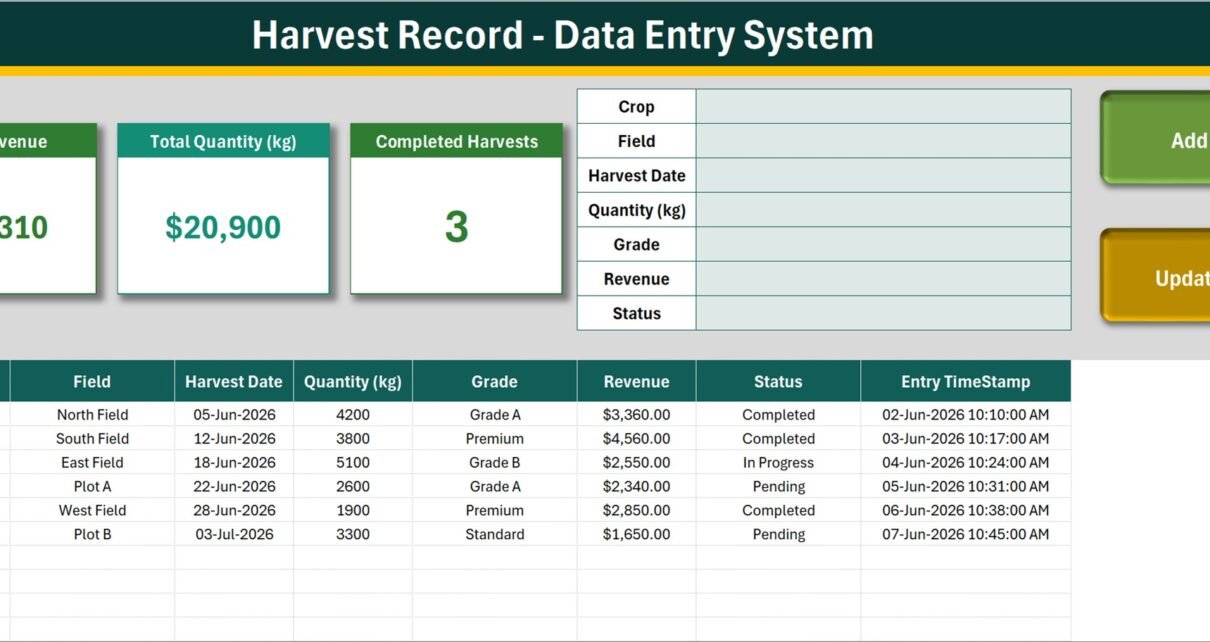
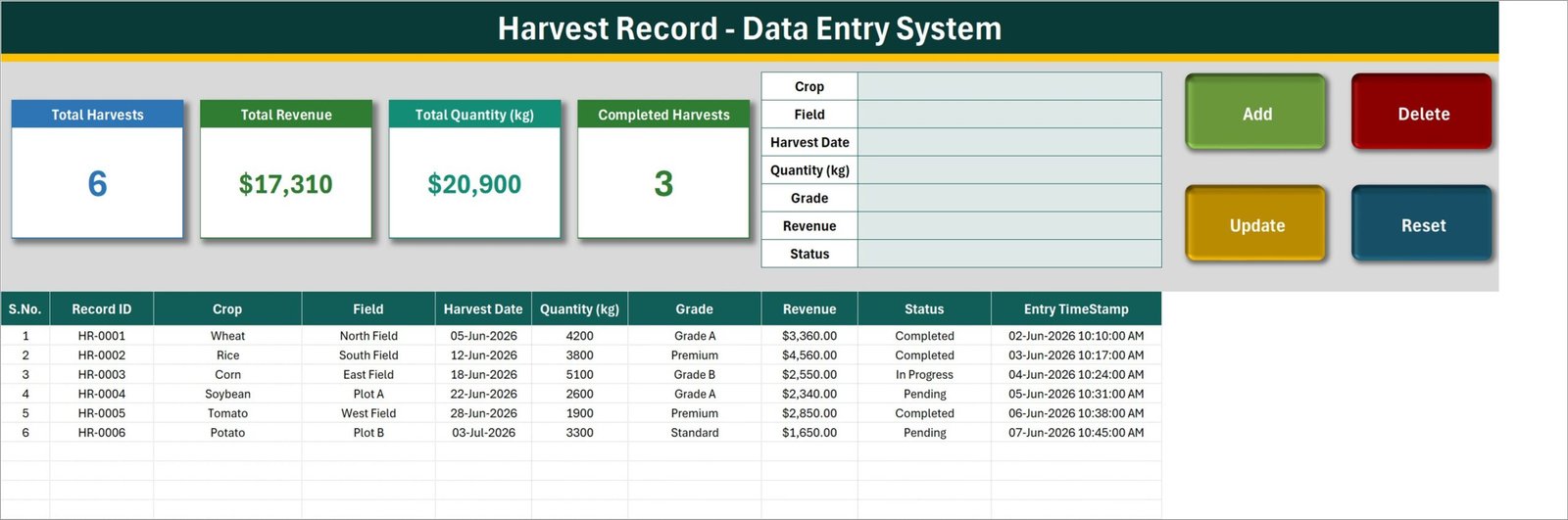
This is where the work happens. Four colour-coded cards run across the top left – Total Harvests, Total Revenue, Total Quantity (kg) and Completed Harvests. To their right sits the 7-field form, and to the right of that the four buttons: Add and Delete on the top row, Update and Reset underneath. The register fills the lower half of the sheet.
The six rows you can see – HR-0001 Wheat off North Field through HR-0006 Potato off Plot B – are demo data shipped with the template, not real farm figures. They exist so the cards have something to add up: in the screenshot they read 6 harvests, $17,310 revenue, 20,900 kg and 3 completed. Delete them before you start your own records.
2. Setting
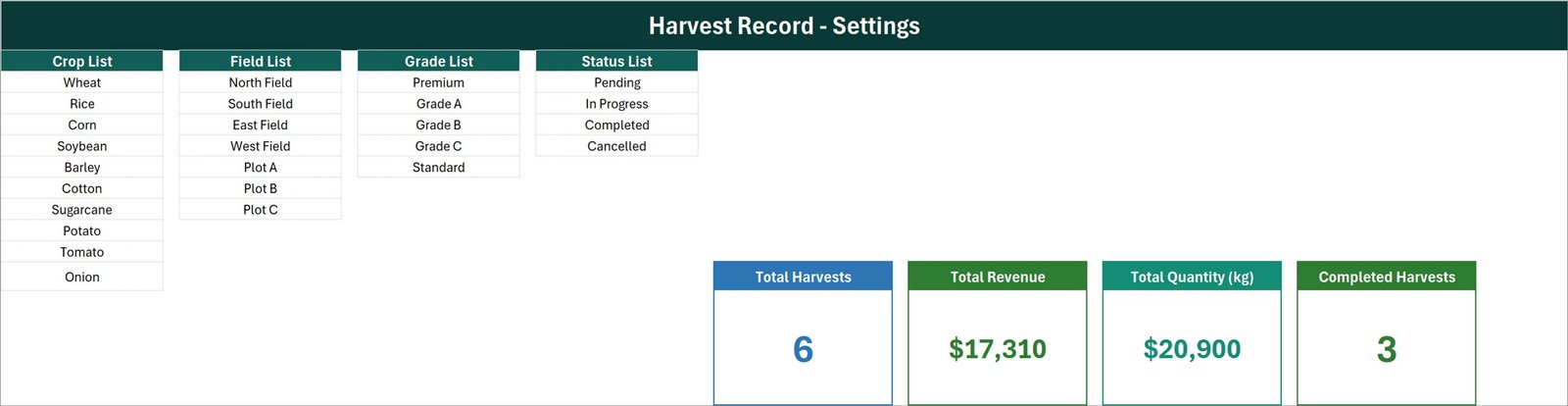
Four lists and four master cards. Crop List holds Wheat, Rice, Corn, Soybean, Barley, Cotton, Sugarcane, Potato, Tomato and Onion. Field List holds North Field, South Field, East Field, West Field, Plot A, Plot B and Plot C. Grade List holds Premium, Grade A, Grade B, Grade C and Standard. Status List holds Pending, In Progress, Completed and Cancelled.
The four summary cards on this sheet are the originals; the ones on the Data Entry sheet are linked pictures of them. That is a neat trick worth knowing – restyle a card here (colour, font, border) and the Data Entry sheet inherits the change without you touching it.
3. Instructions (How To Use)
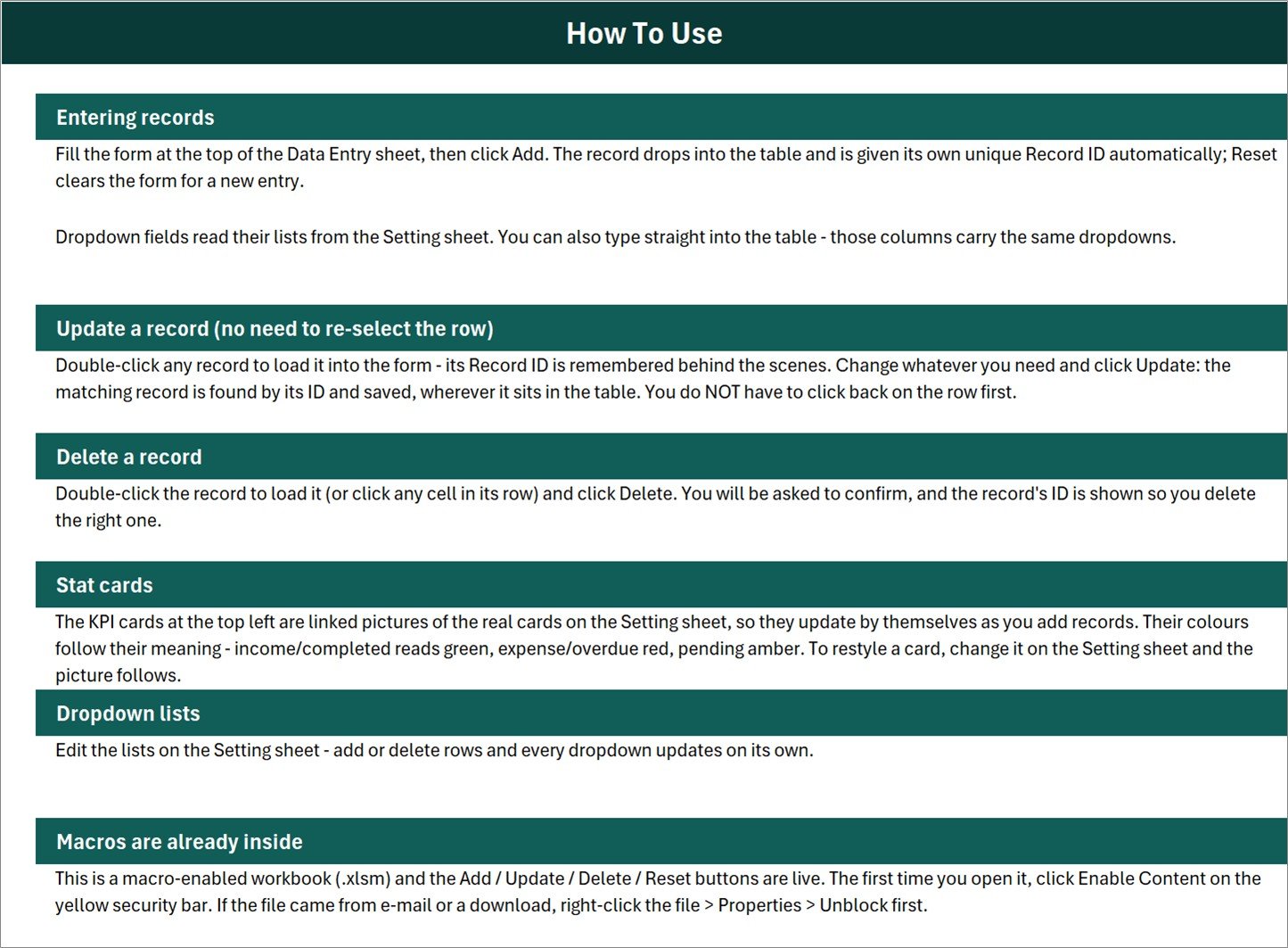
Six sections, written plainly: Entering records, Update a record (no need to re-select the row), Delete a record, Stat cards, Dropdown lists, and Macros are already inside. The last one matters most for first-time users – it explains the yellow Enable Content bar and the right-click, Properties, Unblock step Windows applies to macro files that arrive by e-mail or download. Microsoft documents the same behaviour in its own guide to enabling or disabling macros in Microsoft 365 files.
4. Get More Templates
A short closing sheet linking back to the NextGenTemplates catalogue and the YouTube tutorials. There is nothing to configure on it, which is why it has no screenshot here.
Harvest Record System vs. a Google Sheets Log vs. Paid Farm Software – Feature Comparison
| Harvest Record System (Excel) | Google Sheets harvest log | Paid farm-management SaaS | |
|---|---|---|---|
| Cost | $6.99 once | Free, but you build it | Monthly per-user subscription |
| Platform | Desktop Excel (.xlsm) | Browser | Browser and mobile app |
| Setup time | Minutes | Hours of formulas and validation | Onboarding process |
| Real-time collaboration | No | Yes | Yes |
| Mobile access | No – VBA is desktop only | Yes | Yes |
| Customizable dropdowns | Yes – all four lists | Yes | Often higher tiers only |
| Share with a link | No – send the file | Yes | Yes |
| Year-1 cost at 5 users | $6.99 total | $0 plus your time | Five subscriptions |
| One-click Add / Update / Delete | Yes | Only with Apps Script | Yes |
| Works offline | Yes | No | No |
Who Should Use This Template
It suits a smallholder or family farm that wants each load off each field written down once, properly, with a date and a grade against it. It suits a market gardener logging crates by crop and grade before they go out. It suits a farm manager running several fields and plots who needs a single register rather than six part-filled spreadsheets. And it suits anyone stepping up from a paper notebook who wants structure without a subscription.
It is the wrong tool if several people must edit at the same time, if you need it on a phone in the field, or if you want forecasting and analytics rather than a record. It is also not a food-safety, traceability, organic or GAP certification system: it keeps your own records, and it produces nothing intended to satisfy a certification scheme, a subsidy or grant application, or a pesticide or chemical-residue requirement.
Real-World Use Cases
The weekly grade split. A vegetable grower logs every crate by crop, plot and grade as it leaves the packhouse. On Friday she sorts the register by Grade and sees exactly how much moved as Premium versus Standard – her own numbers, not an estimate.
Harvest still in progress. A mixed arable farm sets Status to Pending while a field is still being cut and switches it to Completed when the field is clear. The Completed Harvests card then means something specific rather than being a count of rows.
Two people, one laptop. A family holding keeps the workbook in a synced folder. Whoever finishes a harvest opens it, clicks Add and closes it. The Entry TimeStamp column shows who logged what and when, without any account system.
Reconciling with the buyer. When a buyer’s statement disagrees with what went out, the register – crop, field, date, quantity, grade, revenue – is the document that settles it.
Advantages of the Harvest Record Data Entry System in Excel
- Nothing to learn. If you can fill a form and click a button, you can run it. The VBA is already written.
- Editing is safe. Update finds the record by its ID, so a sorted or filtered table cannot make you overwrite the wrong row.
- Delete asks first and shows the Record ID it is about to remove.
- The summary cards are free. They maintain themselves; there is no refresh step and no pivot table to rebuild.
- Your data stays yours. One .xlsm file on your own machine – no account, no upload, no vendor.
- One payment. $6.99, unlimited records, unlimited seasons.
Opportunities for Improvement
Three honest limitations. First, VBA means desktop Excel only – the buttons are dead in Excel for the web, on mobile, and in Google Sheets, and the file cannot be co-edited by two people at once. Second, it is a register, not an analysis tool: there are no charts, no season-over-season comparison and no cost side, so profitability per field is something you would build yourself or take from a farm dashboard. Third, a small cosmetic point worth knowing before you open it – in the shipped build the Total Quantity (kg) card displays its number with a currency symbol, so 20,900 kg reads as $20,900. It is a number-format setting on the Setting sheet card and takes a moment to correct; it does not affect any calculation.
Two additions most users make in their first hour: a Season or Year column so several harvests years can live in one file, and a simple cost column beside Revenue if you want margin rather than income.
Best Practices
- Set up the Setting sheet before you enter anything. Your crops, your field names, your grade labels. Changing them later is fine but leaves older records reading in the old vocabulary.
- Delete the six demo rows first so your first real card totals are honest.
- Use Status consistently. Pending while cutting, Completed when the field is clear, Cancelled if a harvest never happened – otherwise the Completed Harvests card drifts.
- Log on the day. The Entry TimeStamp records when you typed it, not when you harvested, so a week-late entry looks accurate but is not.
- Keep one file per farm, not per season. The register handles thousands of rows, and one file makes comparison possible later.
- Back it up. A macro-enabled workbook in a synced folder is a single point of failure; keep a dated copy at the end of each season.
- Never re-use a Record ID. Let the macro assign them.
Explore Relevant Templates
- Harvest Record Data Entry System in Excel – the template covered in this article.
- Livestock Register Data Entry System in Excel – the same build for animals.
- Poultry Egg Production Data Entry System in Excel – daily egg collection records.
- Agriculture and Farm Dashboard in Excel – charts and KPIs for the data you collect.
- Farm Management KPI Dashboard in Excel – a wider farm scorecard.
Frequently Asked Questions
Does the Harvest Record Data Entry System work in Google Sheets?
No. The Add, Update, Delete and Reset buttons run VBA, which only executes in desktop Microsoft Excel on Windows or Mac. Excel for the web and Excel mobile will open the file but the buttons will not run.
Why do I have to enable macros?
Because the buttons are macros. Excel blocks them by default on any file it did not create locally. Click Enable Content on the yellow bar the first time; if the file arrived by e-mail or download, right-click it, choose Properties and tick Unblock before opening.
Can I add my own crops and field names?
Yes – that is step one. All four lists are plain cells on the Setting sheet. Type over them, add rows or delete rows and every dropdown updates itself, on both the form and the table columns.
How many harvest records can it hold?
There is no built-in limit. The register grows down the sheet and the four summary cards recalculate across whatever is in it.
Is the data in the screenshots real?
No. The six records (HR-0001 to HR-0006) are demo data supplied with the template so the cards and buttons have something to work on. Delete them before entering your own.
Will this satisfy an organic or food-safety audit?
No. It is a private record-keeping workbook. It makes no claim about traceability schemes, organic or GAP certification, subsidy or grant eligibility, or pesticide and residue requirements, and nothing it produces is an audit or certification document.
Can I edit the VBA myself?
Yes. The project is not locked away from you – open the Visual Basic editor with Alt+F11 and the Add, Update, Delete and Reset routines are there to read and adapt.
About the Author
Built by PK – Microsoft Certified Professional with 15+ years of Excel, Google Sheets, and Power BI experience. Founder of NextGenTemplates, reaching 300K+ subscribers across YouTube channels. Every template is hand-built and tested before release.
Conclusion
The Harvest Record Data Entry System in Excel does one job and does it without ceremony: it takes seven fields about a harvest and turns them into a permanent, ID-stamped row in a register that adds itself up. No subscription, no login, no internet. Spend the first five minutes on the Setting sheet putting your own crops and fields in, delete the demo rows, and every load from then on is one form and one click.
You can get the Harvest Record Data Entry System in Excel here for $6.99. For step-by-step Excel and VBA walkthroughs, subscribe to youtube.com/@PKAnExcelExpert.