Parent-Teacher Meeting Calendar in Excel gives school administrators, class teachers and front-office teams a practical way to organise parent meetings, open house days, review sessions and academic events inside Microsoft Excel for Windows desktop. It is a macro-enabled workbook, so the Add, Update, Delete and Show Events buttons all require macros to be enabled. For a school that would rather keep scheduling in a local file than open another monthly software account, it is a focused one-time download.
Before anything else, the important boundary: this is an administrative scheduling template only. It does not send invitations, reminders, emails, SMS or notifications to parents or staff, and it integrates with no school management system, booking platform or calendar service. It is not a student record, a report card, an attendance register or any assessment of a child, and it offers no educational, safeguarding, pastoral or legal advice.
Click here to purchase Parent-Teacher Meeting Calendar in Excel
Key Features of Parent-Teacher Meeting Calendar in Excel
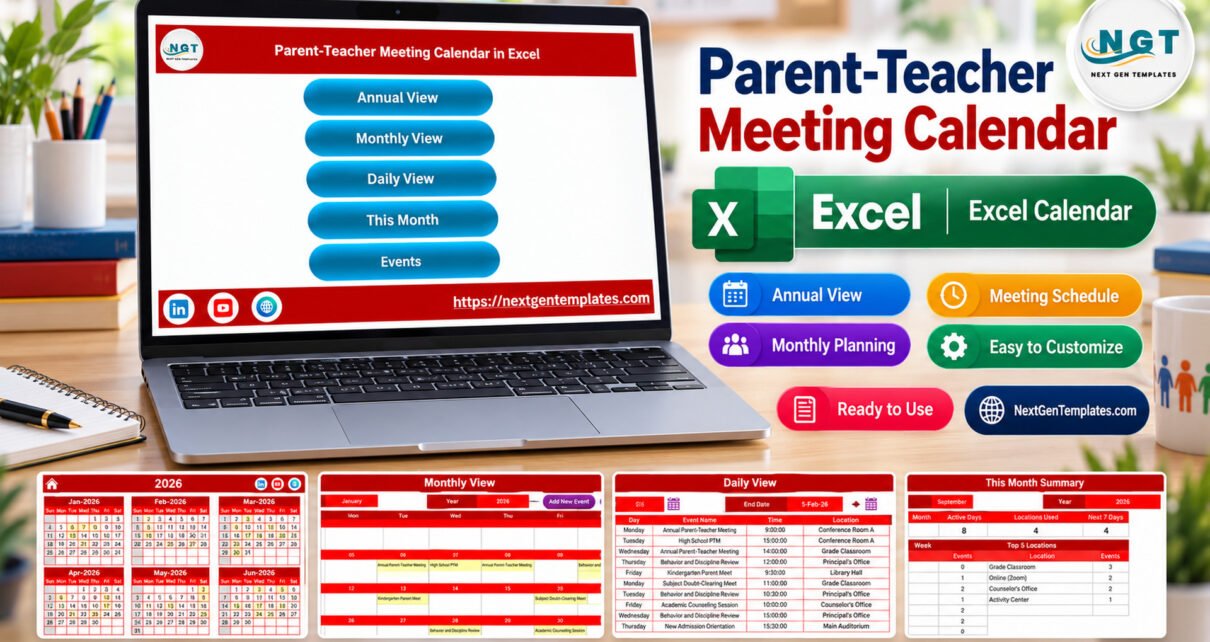
- Seven sheets: Home, Annual View, Monthly View, Daily View, This Month, Events and Setting.
- Annual calendar view that prints all twelve months of the chosen year on a single screen, with event days tinted and your chosen rest days shaded.
- Monthly planning view for one-month coordination, with the event name written into the day cell.
- Daily event list for any Start Date to End Date range you pick, useful when reception needs tomorrow’s schedule on paper.
- This Month summary with counts for events this month, active days, locations used and the next seven days, plus breakdowns by day of week and by location.
- Events register with ID, date, day, event name, time, location and description columns.
- VBA-powered controls for adding, updating, deleting and showing events, plus a data-entry form that fills the weekday automatically from the date.
- Five colour themes (Default, Blue, Red, Black and Orange) and a year list running from 2021 to 2051.
Template Pages Explanation
Home Sheet
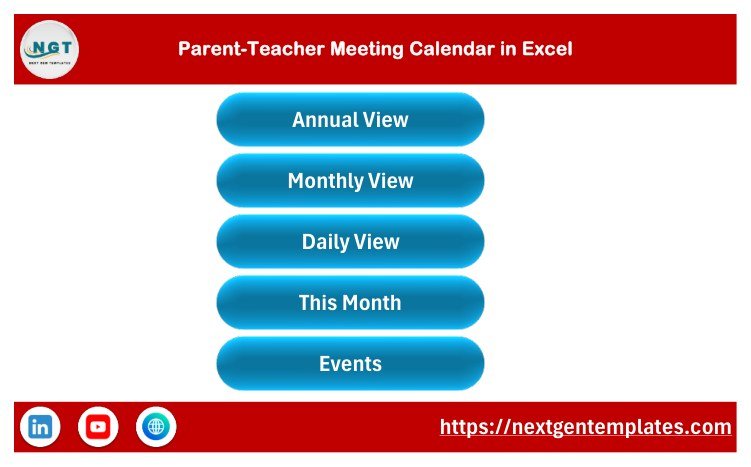
The Home sheet is the starting point. Five buttons move you to Annual View, Monthly View, Daily View, This Month and the Events register without hunting through sheet tabs.
Annual View Sheet
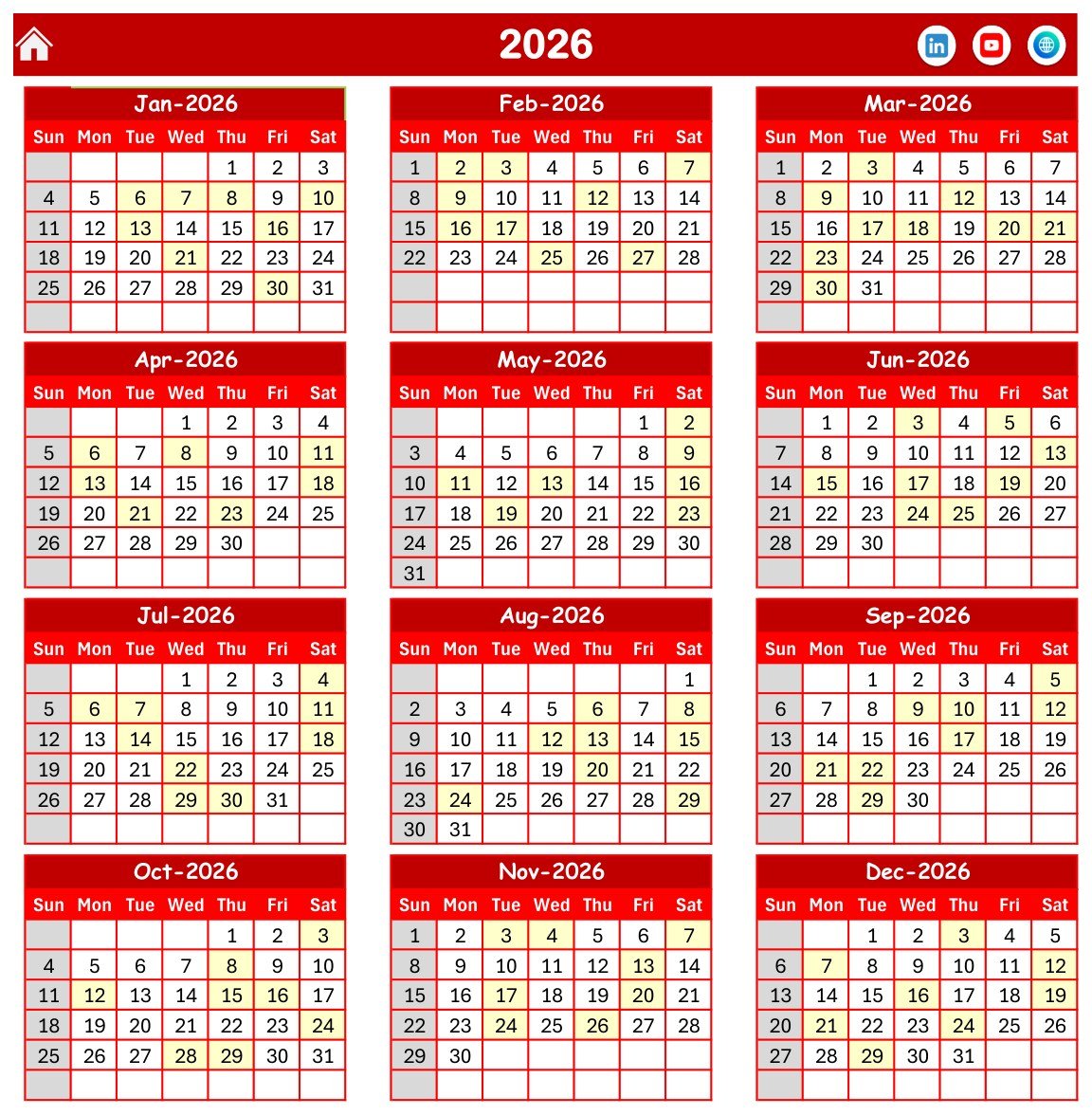
Annual View is the main planning screen. It lays out the whole year in a three-by-four grid of months and picks up the year, start month, week start day, highlight days and colour theme you set on the Setting sheet. It is the right screen for spotting which months are already meeting-heavy.
Monthly View Sheet
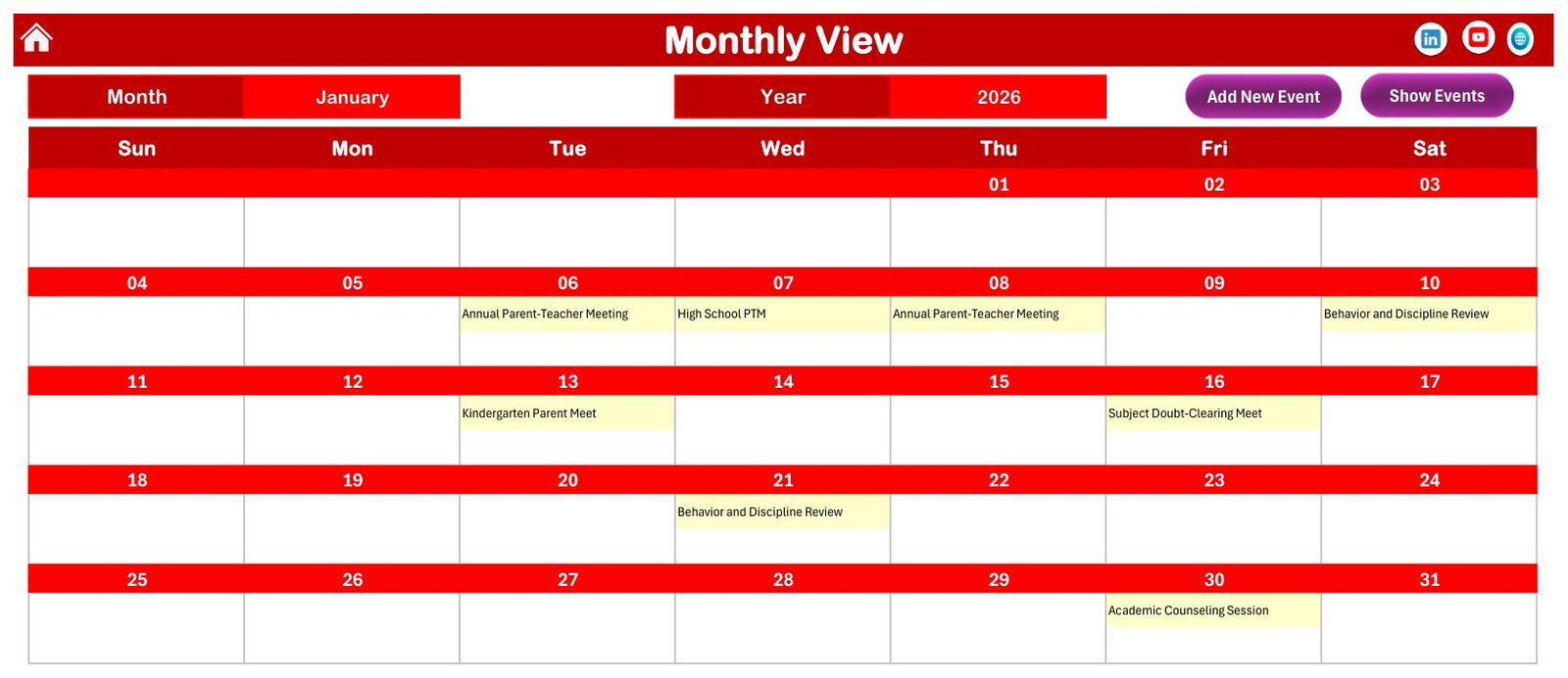
Monthly View focuses on one month and writes the event name straight into the day cell. Only the first event for a date is shown inline; where a date carries more than one, the cell adds a “+N more” cue so you know to open the full list. This sheet is formula-driven, so it reflects changes to the Events register immediately.
Daily View Sheet
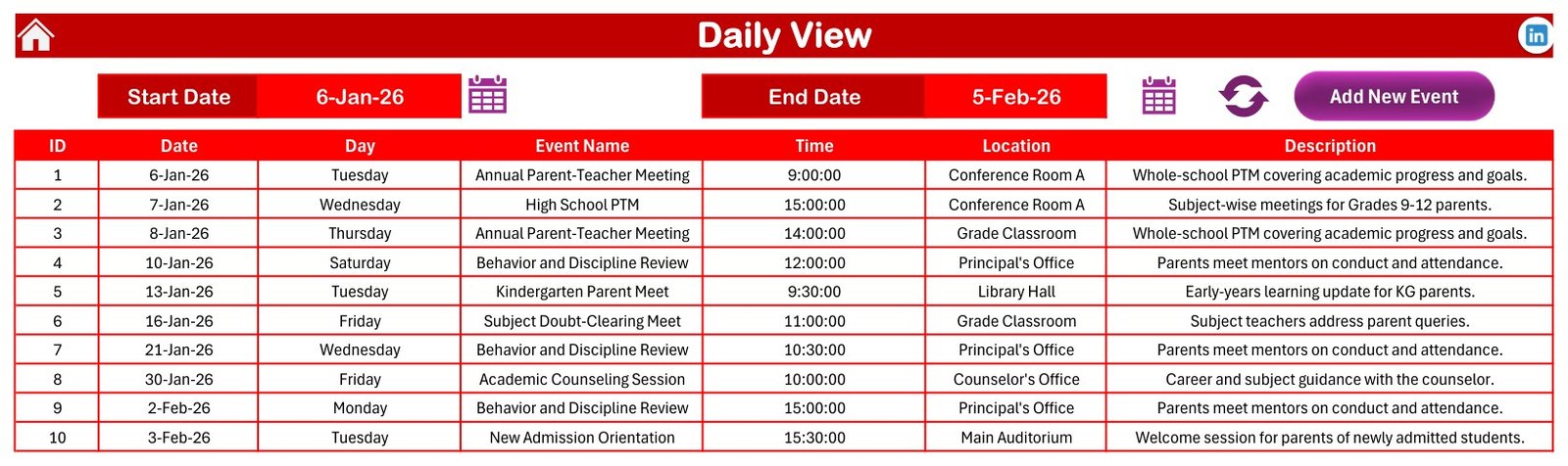
Daily View lists every event between two dates you choose, showing ID, date, weekday, event name, time, location and description. This is the most useful screen for a reception desk. Note that it is refreshed by the workbook’s macros rather than by live formulas, so use the refresh control after editing the register by hand.
This Month Sheet
This Month is a one-page summary of the selected month: four headline counts, a table of events by day of week, a table of events by location, and the month’s event list. In the shipped sample it reports September 2026 with eight events across eight active days and four locations, and both breakdown tables add up to those eight.
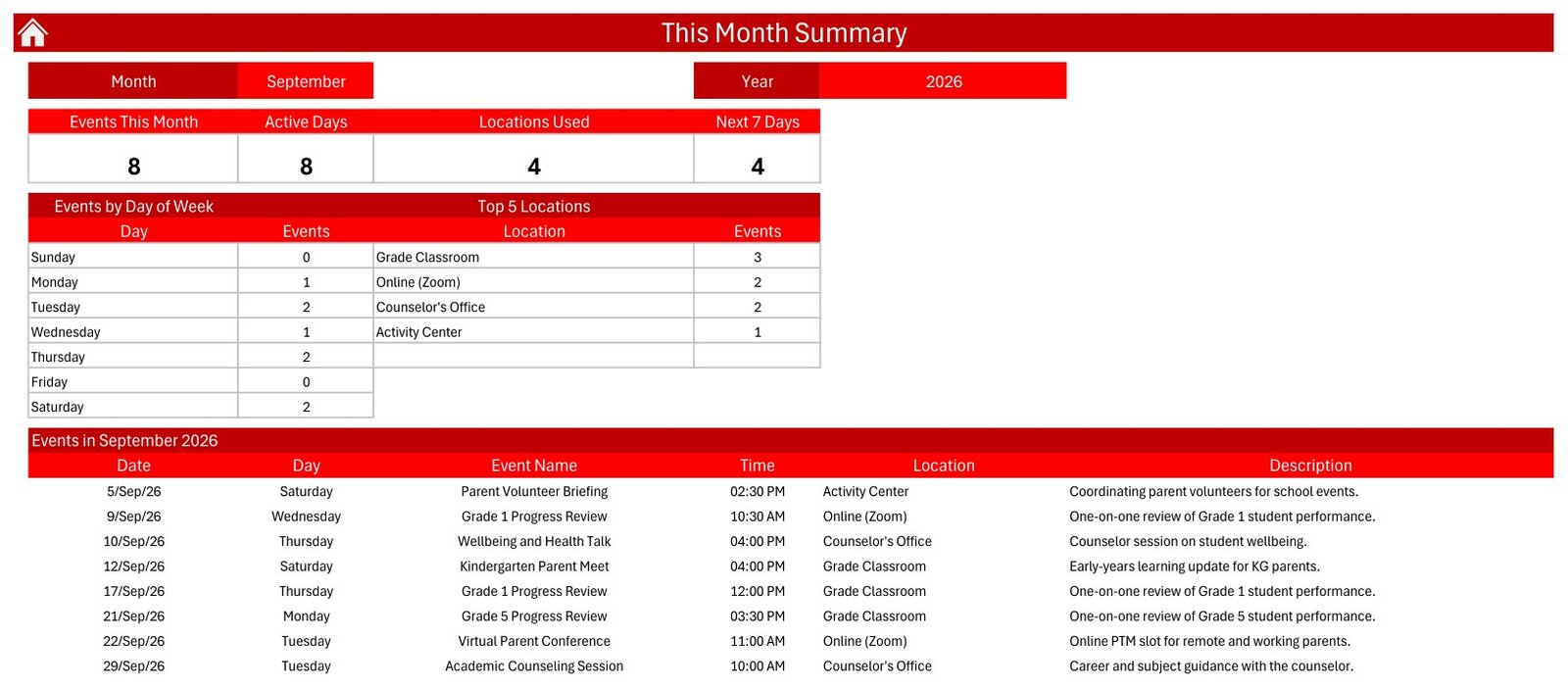
Events Sheet
The Events sheet is the source register that every other view reads from. Add New Record, Update Record and Delete Record sit above the table, and the entry form handles one event at a time.
About the Sample Data – All of It Is Demo Data
The workbook ships with 100 sample event rows, and every one of them is invented demo data. They are dated across calendar year 2026, eight or nine to a month in all twelve months, using 24 event names, 8 locations and start times between 09:00 and 16:00. No real school, pupil, parent or member of staff is represented anywhere in the file. The rows exist so the Annual, Monthly, Daily and This Month views have something to draw. Delete them before you enter anything real.
Data Protection: A Caveat Worth Reading Twice
As soon as you type real names into this workbook, you are handling personal data about children and the adults around them. A line in the Description column about how a pupil is getting on is personal data too, and most data protection regimes treat information about children as deserving extra care.
The template gives you no encryption, no access control, no audit trail and no retention rules. Establishing a lawful basis, keeping the file secure, limiting who can open it and deleting it when it is no longer needed are entirely your responsibility as the buyer. A sensible pattern used by many schools is to keep only a slot, a room and a class code in the calendar, and to leave anything substantive about a child in the pupil-record system that is actually designed to hold it. If your school has a data protection officer, involve them before the file is populated.
Parent-Teacher Meeting Calendar in Excel vs. a Shared Cloud Calendar vs. School SaaS
| Feature | This Excel workbook | Shared cloud calendar | Paid school SaaS |
|---|---|---|---|
| Cost | One-time template purchase | Free or bundled with a workspace plan | Recurring subscription |
| Platform | Excel desktop for Windows | Browser and mobile | Browser and mobile app |
| Offline access | Yes, local workbook | Limited | Usually limited |
| Macro event forms | Included | Not applicable | Varies by system |
| Sends reminders or invitations | No | Yes | Yes |
| Parent-facing booking | No | Limited | Often included |
| Concurrent multi-user editing | No | Yes | Yes |
| Full control of the layout | Yes, it is an ordinary workbook | No | Usually restricted |
Who Should Use This Template
It fits principals, academic coordinators, class teachers, administrative assistants and reception teams who manage meeting slots by hand today, and small tuition centres or training providers that want a structured event calendar in Excel.
It is not a replacement for a live booking portal, a student information system, an automated reminder platform or a multi-user scheduling application. Because it is macro-enabled it belongs on Microsoft Excel for Windows desktop with macros permitted by your organisation. Mac is not claimed: the file depends on VBA and has not been verified on Excel for Mac.
Real-World Use Cases
Parent meeting week: a coordinator enters the slots, rooms and neutral administrative notes for each teacher, then works from Monthly View through the week.
Daily reception schedule: the front desk sets Daily View to tomorrow and prints the list with times and rooms.
Academic review planning: the principal uses Annual View to keep parent meetings clear of exam days, staff training and school events.
Advantages of Parent-Teacher Meeting Calendar in Excel
- Familiar environment: nobody has to learn a new platform.
- One-time cost: no per-user subscription.
- Offline control: the file works without an internet connection.
- Structured register: easier to maintain than scattered notes or one sheet per term.
- Macro-assisted workflow: the form reduces direct sheet editing and fills the weekday for you.
Opportunities for Improvement
The template sends no reminders, syncs to no phone, accepts no online bookings and supports no simultaneous cloud editing. Two smaller points are worth knowing: This Month and Daily View are macro-refreshed snapshots rather than live formulas, so a row typed directly into the Events sheet will not appear on them until you refresh; and the “Top 5 Locations” heading on This Month is a fixed label that lists however many locations were actually used, which is four in the shipped September sample. Neither is a fault, but both surprise people who expect everything to recalculate the instant they type.
Best Practices
- Enable macros only after confirming the workbook came from your own trusted download.
- Delete all 100 demo rows before entering real data.
- Keep one file owner to avoid version conflicts.
- Prefer neutral entries: a slot, a room and a class code rather than a remark about a child.
- Back up the workbook before each meeting cycle, and agree how long you will keep it.
- Review Annual View before committing to monthly schedules.
For Microsoft’s guidance on enabling macros safely, see enable or disable macros in Microsoft 365 files. For another Excel scheduling example on this site, see the Monthly Timesheet Calendar in Excel walkthrough.
Related Templates
A Google Sheets edition, Parent-Teacher Meeting Calendar in Google Sheets (product ID 94829), is being prepared and is not published yet, so it is named here rather than linked. It is a genuinely different build rather than a port of this one: it uses 16 event types and 29 locations, where this Excel edition uses 24 event types and 8 locations. School Fee Due Calendar in Excel (product ID 95083) is also being prepared. Published Excel calendars can be browsed under Excel calendar templates and education templates.
Frequently Asked Questions
Does this send meeting invitations or reminders?
No. The workbook sends nothing at all: no invitations, no reminders, no email, no SMS, no WhatsApp and no push notifications. It does not sync with Outlook, Google Calendar or any booking platform. Inviting parents stays a manual job for your office.
Does Parent-Teacher Meeting Calendar in Excel require macros?
Yes. The workbook is macro-enabled, and the buttons and the entry form need macros allowed in Excel for Windows desktop.
Are the sample events real?
No. All 100 rows are demo data. No real school, pupil, parent or staff member appears in the file.
Can I store pupils’ and parents’ names in it?
The columns are free text, so technically yes. But that makes you the controller of personal data about children, with no security or retention features in the file to help you. Check your school’s data protection policy first.
Is this a student record, report card or attendance register?
No. It schedules meetings. It does not grade, rank, assess or track any child, and it must not be used as evidence of a pupil’s progress or conduct.
Can multiple staff members edit it at the same time?
No. Treat it as a single-owner file. For simultaneous collaboration, use a cloud scheduling system.
What is included in the download?
The ZIP contains the macro-enabled Excel workbook and the Excel Calendar user manual in PDF form.
Will it work in Excel Online?
No. Excel for the web does not run VBA the way desktop Excel does. Use Microsoft Excel for Windows desktop.
About the Author
Built by PK – Microsoft Certified Professional with 15+ years of Excel, Google Sheets and Power BI experience. Founder of NextGenTemplates, reaching 300K+ subscribers across YouTube channels. Every template is hand-built and tested before release.
Conclusion
Parent-Teacher Meeting Calendar in Excel is a sensible choice when a school wants a local, editable, macro-enabled workbook for parent meetings and school scheduling. It keeps annual, monthly, daily, summary and register views in one file while staying honest about its limits: no web booking, no automated reminders, no cloud collaboration, and no claim to be anything other than an administrative calendar. Visit youtube.com/@PKAnExcelExpert for Excel tutorials.