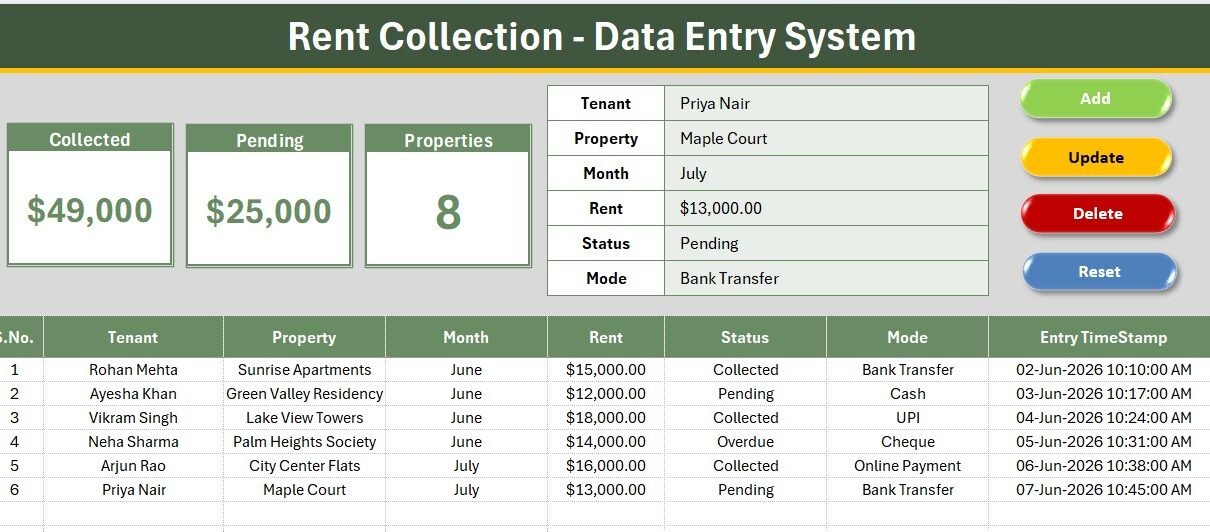
Landlords tracking rent by memory or a plain notebook lose an average of several hours a month chasing down who paid and who didn’t. The Rent Collection Data Entry System in Excel replaces that guesswork with 6 tracked fields per payment — Tenant, Property, Month, Rent, Status, and Mode — rolled into 3 live KPI cards: Collected, Pending, and Properties. The included sample data shows $49,000 Collected and $25,000 Pending across 6 logged payments, so you can see the math working before you type a single row of your own.
Most independent landlords and small property offices still track rent in a plain spreadsheet with no validation, no status tracking, and no clear view of what’s still owed. This Excel data entry form fixes that with a proper VBA-powered form, a validated Status dropdown, and automatic Collected-versus-Pending math — without a monthly property-management subscription.
Key Features of the Rent Collection Data Entry System in Excel
The system tracks 6 fields per rent payment and turns them into 3 live KPI cards, all wired with formulas rather than manual totals:
- Status-linked KPI math — The Collected and Pending cards are SUMIF formulas that key off the Status dropdown, so logging a payment as “Collected” or “Pending” updates both totals instantly, with zero manual recalculation.
- Live Properties count — The Properties card reads directly from the managed-property list on the Setting sheet, so it always reflects exactly how many buildings or units are registered in the system.
- Dropdown-validated entry — Property, Month, Status, and Mode are wired to named-range dropdown lists on the Setting sheet, keeping the data clean across hundreds of rows with zero free-text typos.
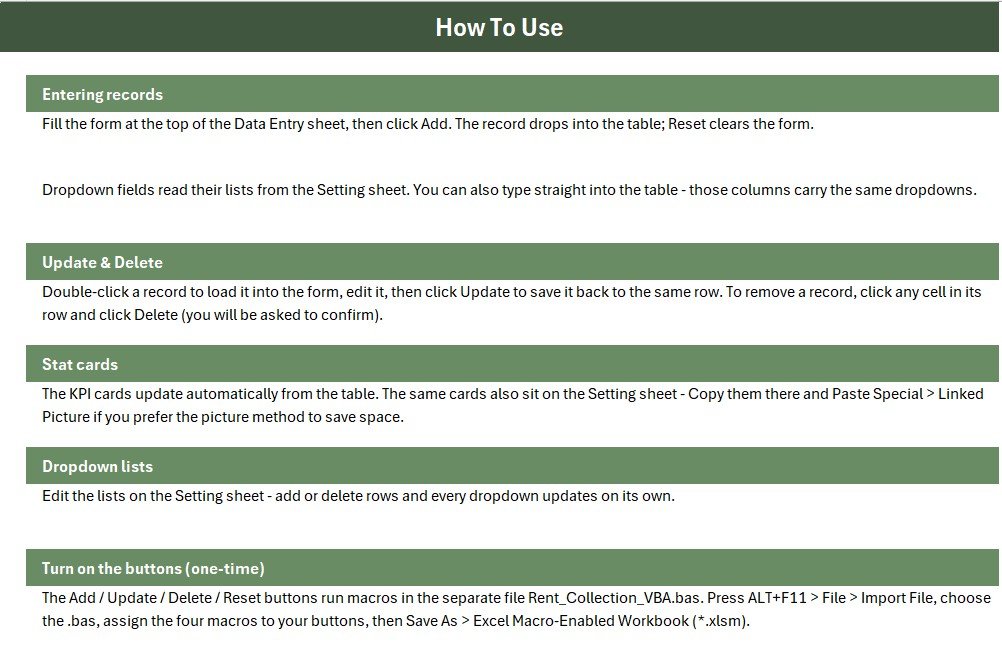
- One-click VBA buttons — Four colour-coded button cells run Add, Update, Delete, and Reset macros, so front-desk staff can log a rent payment in under 10 seconds without touching a formula.
- Auto S.No and timestamp — Every row gets an automatic serial number and an Entry TimeStamp column, giving landlords a built-in audit trail of exactly when each payment was recorded.
Template Structure
The workbook ships with four sheets, each serving a distinct role in the day-to-day workflow.
Data Entry Dashboard
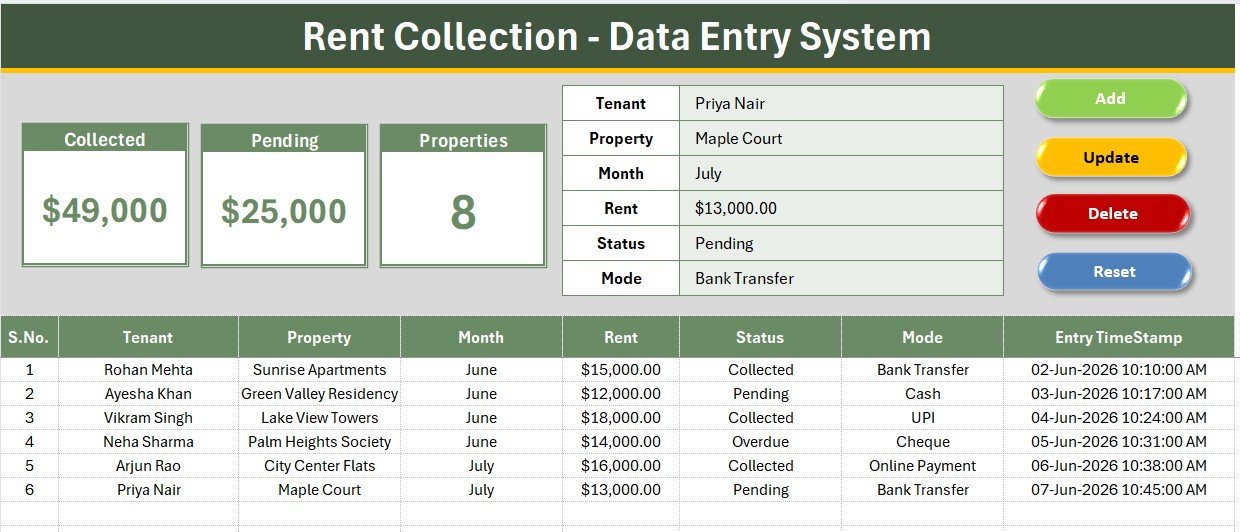
The main working sheet. Three KPI cards — Collected, Pending, Properties — sit above a tinted input form with dropdown-driven fields, and below that a records table tracking S.No, Tenant, Property, Month, Rent, Status, Mode, and an Entry TimeStamp.
Setting Sheet
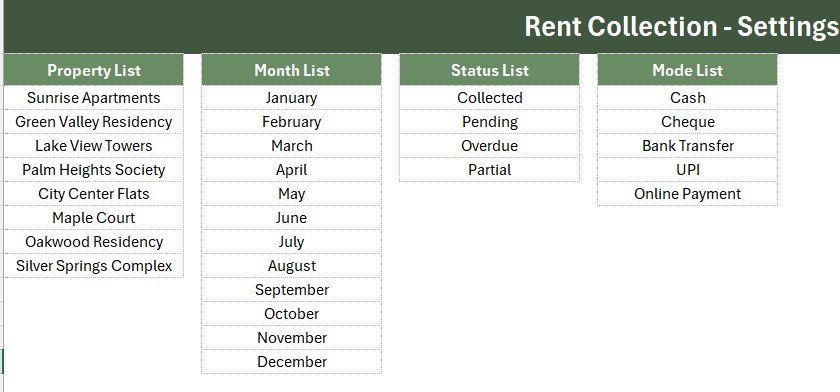
Holds the master dropdown lists for Property, Month, Status, and Mode, plus a duplicate set of the KPI cards positioned so you can Copy → Paste Special → Linked Picture onto a separate summary sheet or printout.
Instructions Sheet
A plain-language walkthrough of importing the VBA module, wiring the four buttons to their macros, and saving the workbook as a macro-enabled file — written for non-technical users with zero coding background.
Rent Collection Data Entry System in Excel vs. Google Sheets Rent Tracker vs. Paid Property Management SaaS — Feature Comparison
| Feature | Rent Collection Data Entry System | Google Sheets Rent Tracker | Buildium / AppFolio |
|---|---|---|---|
| Cost | $5.99 one-time | Free-$10 one-time | $50-$400+ / month |
| Platform | Microsoft Excel | Google Sheets (browser) | Cloud SaaS |
| Setup time | Under 10 minutes | Under 10 minutes | Days-weeks onboarding |
| Real-time team collaboration | Single-file, shared drive | ✅ Native | ✅ Native |
| Mobile access | Excel mobile app | ✅ Browser-based | ✅ Dedicated app |
| Customizable fields | ✅ Full VBA control | Formula-based only | Limited to plan tier |
| Share with link | File share / email | ✅ One click | ✅ Tenant portal |
| Year-1 cost at 5 users | $5.99 total | $0-$50 | $600-$4,800+ |
| Status-based Collected/Pending totals | ✅ Built-in | Manual formula setup | ✅ Built-in |
For landlords and small property managers who want automatic Collected/Pending totals without a monthly SaaS bill, the Rent Collection Data Entry System in Excel sits in the sweet spot between a plain spreadsheet and a full property-management platform.
Who Should Use This Template
Perfect for:
- Independent landlords managing 3-20 rental units or properties on the side
- Small property management offices still tracking rent by hand or in a plain, unformatted spreadsheet
- Accountants and bookkeepers who need a quick monthly rent-roll record for landlord clients
Not a fit if:
- You run a large property management firm needing tenant portals, online rent payment, or automated late fees
- Your team needs real-time multi-user cloud editing — the Google Sheets equivalent handles that better
Real-World Use Cases
Priya manages 8 rental flats across two neighborhoods as a side business. Every month she logs each tenant’s rent status through the form in under a minute, then checks the Pending KPI card before making her collection calls — all without paying for a property-management subscription she’d barely use.
Arjun runs a small bookkeeping practice serving three landlord clients. He keeps one workbook per client, uses the Status dropdown to separate Collected from Overdue rent, and exports the records table each month as part of his clients’ own accounting records.
Meera co-owns a duplex with her brother and splits rent-tracking duties. She uses the Mode field to reconcile which payments came in by bank transfer versus cash, so their shared ledger always matches their bank statement.
Advantages of the Rent Collection Data Entry System in Excel
The biggest advantage is time: a landlord juggling a handful of units saves the 10-15 minutes per month it typically takes to manually total up who’s paid and who hasn’t, since the Collected and Pending cards do that math automatically. The dropdown validation also removes the small but constant errors that creep into free-text spreadsheets — a “Paid” typed one month and “paid” the next breaks a manual SUMIF, but a locked dropdown never does. And because it’s a one-time $5.99 purchase rather than a subscription, the cost pays for itself against even a single month of a $50+/month SaaS plan.
Opportunities for Improvement
Being transparent about the trade-offs: this is a single-file Excel workbook, so real-time multi-user editing isn’t native the way it is in a cloud tool — teams sharing a file over a network drive can still hit save-conflict issues. It also has no tenant-facing portal or online payment collection built in, so tenants still pay by whatever method your Mode dropdown lists, and you’re the one logging it. For a landlord who wants tenants paying and viewing their own rent history online, a dedicated SaaS platform will do more, at a much higher recurring cost.
Best Practices
Start by replacing the sample Property list on the Setting sheet with your actual buildings or units before entering any real payments — the Properties KPI reads directly from that list. Keep the Status values consistent (Collected, Pending, Overdue, Partial) since the KPI formulas match on exact text. Save the workbook as .xlsm right after importing the VBA module so the Add/Update/Delete/Reset buttons keep working after you close and reopen the file.
Explore Relevant Templates
This Rent Collection system pairs naturally with other NextGenTemplates property tools. The Real Estate & Property Bundle saves 66% across 7 property templates if you need broader portfolio reporting alongside day-to-day rent tracking.
- Lead Tracker Data Entry System in Excel — the same VBA data-entry pattern applied to a sales pipeline
- Service Booking Data Entry System in Excel — for service businesses managing appointments instead of rent
- Real Estate Investment Trusts (REITs) KPI Dashboard in Excel — for portfolio-level reporting once you outgrow single-property tracking
Frequently Asked Questions
What does the Rent Collection Data Entry System in Excel track?
It tracks 6 fields per payment — Tenant, Property, Month, Rent, Status, and Mode — and rolls them into 3 live KPI cards: Collected, Pending, and Properties.
How does this compare to Buildium or AppFolio?
Buildium and AppFolio charge $50-$400+ per month with tenant portals and online payments included. The Rent Collection Data Entry System in Excel costs $5.99 once for manual rent tracking, with no recurring fee.
How long does setup take?
Under 10 minutes. Import the included VBA module, assign the four buttons, save as .xlsm, and start logging payments against your own property list.
Can I add more properties or tenants later?
Yes. Add property names to the Property list on the Setting sheet, and both the dropdown and the Properties KPI card update automatically — no formula edits needed.
Does the workbook work without enabling macros?
You can view and read the records table without macros enabled, but the Add, Update, Delete, and Reset buttons require macros, since they run the included VBA module.
Is this a one-time purchase or a subscription?
It’s a one-time payment with lifetime access. The Rent Collection Data Entry System in Excel has no subscription fee and no per-user cost.
Can I track multiple payment modes per tenant?
Yes. Each row is logged independently, so a tenant who pays by bank transfer one month and cash the next simply gets two separate rows with different Mode values.
About the Author
Built by PK — Microsoft Certified Professional with 15+ years of Excel, Google Sheets, and Power BI experience. Founder of NextGenTemplates, reaching 300K+ subscribers across YouTube channels. Every template is hand-built and tested before release.
Conclusion
For landlords and small property offices who want the Collected-versus-Pending math handled automatically without paying a monthly SaaS bill, the Rent Collection Data Entry System in Excel is a fast, low-cost way to get organized. Click here to Purchase the Rent Collection Data Entry System in Excel.
✅ Instant download · One-time payment · No subscription
Last updated: July 2026