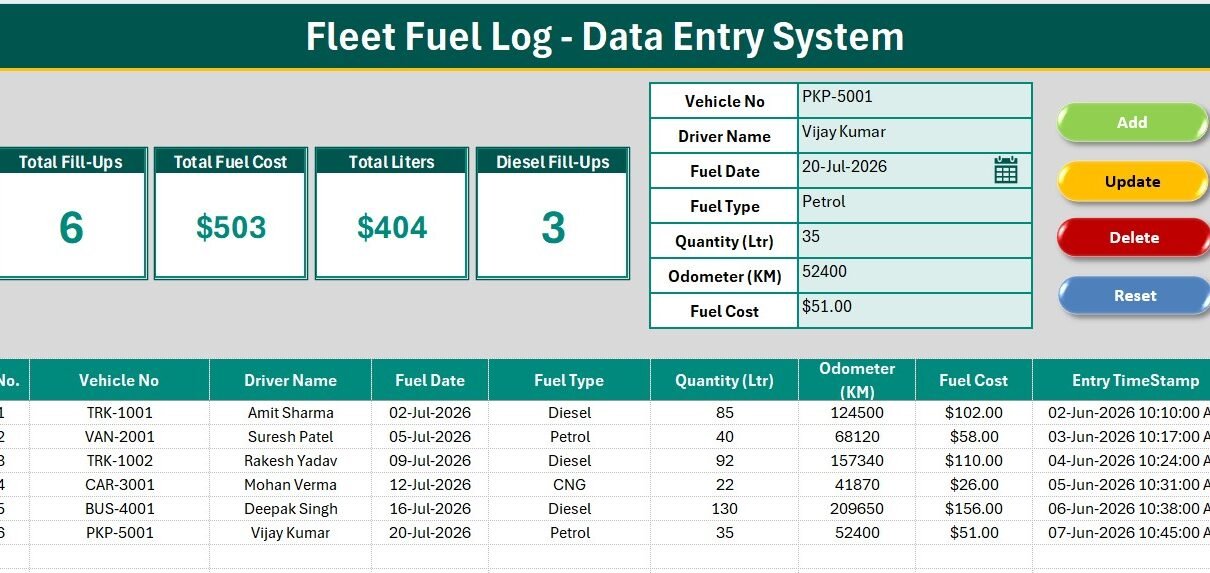
The Fleet Fuel Log Data Entry System in Excel captures 7 fields for every fill-up — Vehicle No, Driver Name, Fuel Date, Fuel Type, Quantity in litres, Odometer reading and Fuel Cost — and drives 4 live KPI cards from those rows: Total Fill-Ups, Total Fuel Cost, Total Liters and Diesel Fill-Ups. Four VBA macros handle the entire workflow, 3 dropdowns keep vehicle numbers and fuel types consistent, and 6 sample fill-ups ship pre-loaded so the cards show real numbers the moment you open the file.
Most small fleets do not have a fuel problem, they have a record-keeping problem. Pump slips pile up in a drawer, the diesel figure gets typed into a fresh sheet every month, and by the time anyone asks which truck is drinking more than it should, the trail has gone cold. This fuel log data entry system replaces that with a single form, a single table and four buttons — no telematics subscription, no per-vehicle licence, and nothing leaving your machine.
Key Features of the Fleet Fuel Log Data Entry System
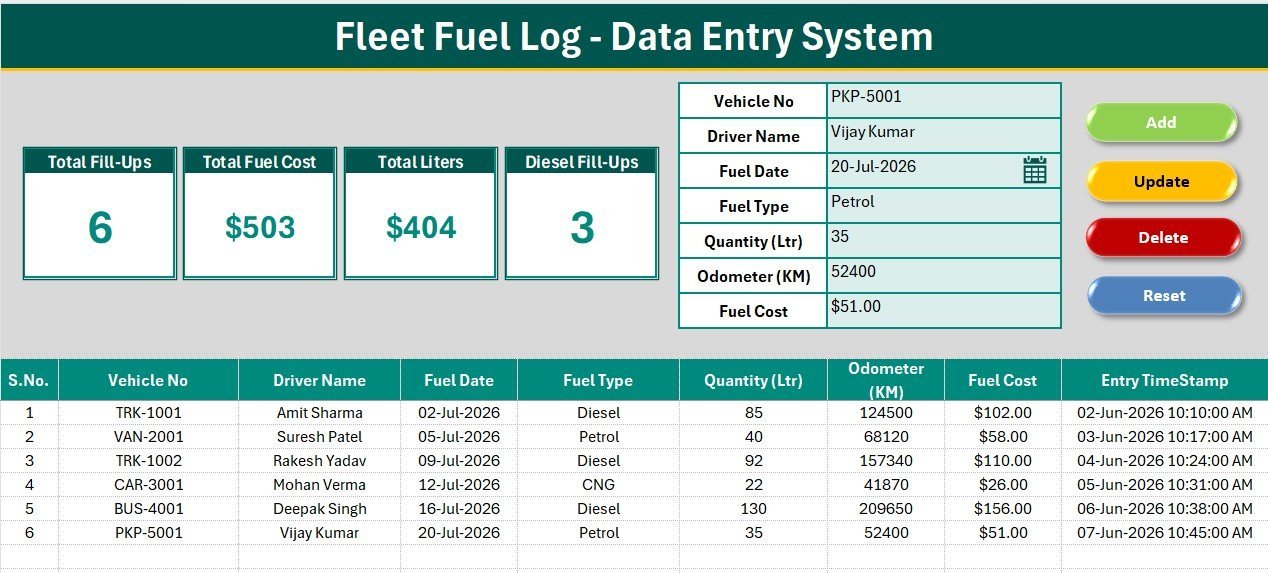
- 7-field fuel entry form. Vehicle No, Driver Name, Fuel Date, Fuel Type, Quantity (Ltr), Odometer (KM) and Fuel Cost. The odometer column is the one people forget to include — without it you can log spend, but you can never work out mileage.
- 4 live KPI cards. Total Fill-Ups, Total Fuel Cost, Total Liters and Diesel Fill-Ups sit on a grey dashboard panel above the form. They run on COUNTA, SUM and COUNTIF pointed straight at the records table, so there is no pivot to refresh.
- Four one-click VBA macros. Add_Record writes the form to the next empty row, Update_Record edits the selected row, Delete_Record removes it after a confirmation prompt, Reset_Form clears the inputs.
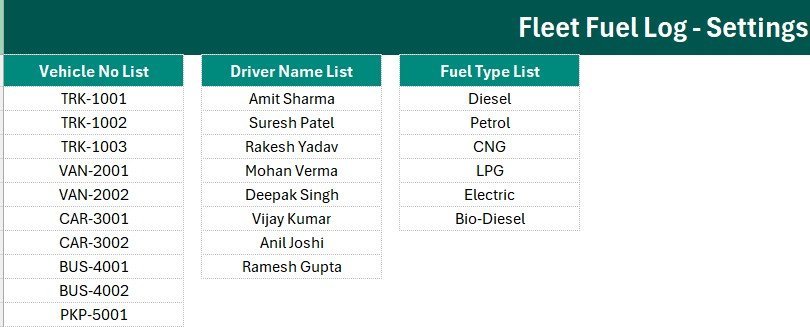
- 3 editable dropdowns. 10 vehicle numbers across TRK, VAN, CAR, BUS and PKP series, 8 driver names, and 6 fuel types — Diesel, Petrol, CNG, LPG, Electric and Bio-Diesel. All three live on the Setting sheet as named ranges.
- Auto serial number and Entry TimeStamp. Serial numbers renumber themselves as rows come and go, and each saved fill-up is date-time stamped. That timestamp is what makes the log usable in a fuel-card reconciliation.
- Runs entirely offline. No account, no API key, no internet. The workbook sits on your drive.
Sheets Explanation
Sheet 1: Data Entry
This is the sheet you actually work in. The dark teal heading bar sits at the top with a gold divider under it; below that, a grey panel holds the four KPI cards on the left and the seven-field form with its three dropdowns on the right. The Add, Delete, Update and Reset button cells form a 2×2 block, and the records table begins at row 15 with auto S.No, currency-formatted Fuel Cost and the Entry TimeStamp column at the far right.
Sheet 2: Setting
The control sheet. The three dropdown source lists live here as named ranges wired into the form’s data validation, so adding a new registration number or a new fuel type makes it appear in the form immediately. A duplicate set of the four KPI cards also sits on this sheet, which you can copy and paste as a Linked Picture into a monthly report or an email without breaking the formulas.
Sheet 3: Instructions
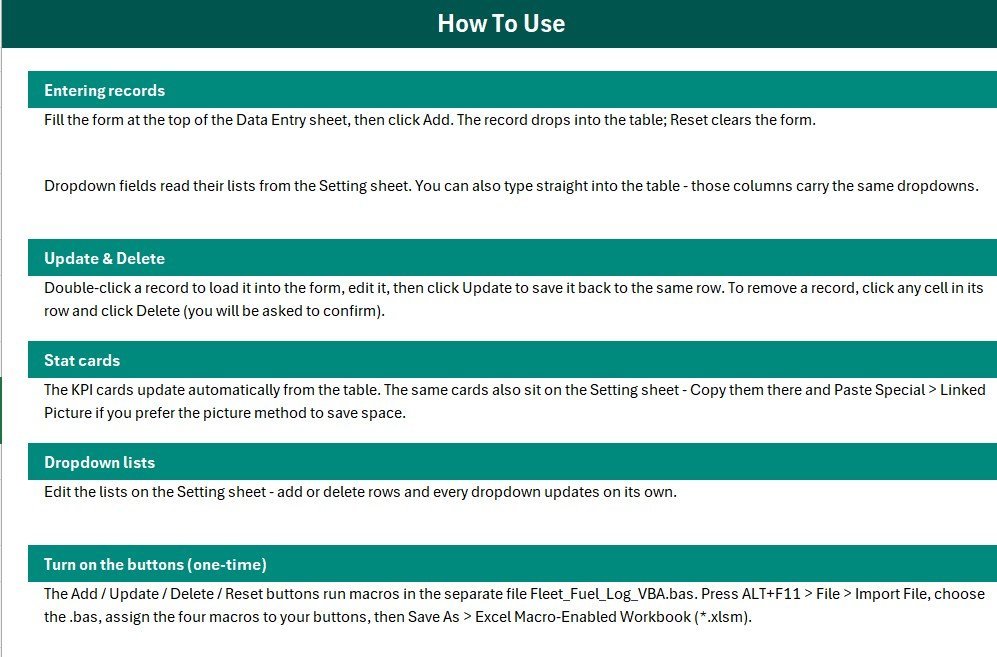
The one-time activation guide, written for someone who has never opened the VBA editor. It covers importing the module, drawing the four buttons over the coloured cells, assigning the macros, and saving the file as a macro-enabled workbook. It also explains how to extend the dropdown lists and how the Linked Picture trick works.
Sheet 4: Get More Templates
A short index into the rest of the NextGenTemplates catalogue for when the fuel log becomes one piece of a larger fleet stack — trackers, dashboards and the logistics bundles.
Fleet Fuel Log vs. Google Sheets Fuel Tracker vs. Fleetio / Samsara — Feature Comparison
| Feature | Fleet Fuel Log (Excel) | Google Sheets fuel tracker | Fleetio / Samsara |
|---|---|---|---|
| Cost | $5.99 one-time | $6.99 one-time | $4-$40 per vehicle / month |
| Platform | Microsoft Excel, offline | Browser, Google account required | Cloud only, account required |
| Setup time | Under 10 minutes | Under 10 minutes | Days to weeks of vehicle onboarding |
| One-click entry form | Yes — 4 VBA macros | Apps Script sidebar | Yes, via mobile app |
| Real-time team collaboration | Shared drive or co-authoring | Yes, native | Yes |
| Mobile capture at the pump | No | Browser only | Yes |
| Data stays on your machine | Yes | No — stored in Google Drive | No — vendor cloud |
| Editable fields and dropdowns | Fully editable | Fully editable | Fixed schema, paid tiers to extend |
| Year-1 cost for 10 vehicles | $5.99 total | $6.99 total | $480-$4,800 |
For fleets that want a clean, auditable fuel log without paying per vehicle per month for telematics features they never touch, the Fleet Fuel Log Data Entry System in Excel sits in the sweet spot.
Who Should Use This Template
Perfect for:
- Transport and logistics owners running roughly 5 to 50 vehicles who currently track diesel in a notebook
- Fleet supervisors who need a fuel record that survives a fuel-card or GST audit
- School bus, ambulance, delivery van and taxi operators reimbursing drivers against pump slips
- Office staff and accountants who would rather fill a form than type into a grid
Not a fit if:
- You need live GPS, geofencing or telematics-fed litre readings — that is genuinely a Samsara or Fleetio job
- Your drivers must log fill-ups from a phone at the forecourt; this is a desktop Excel file
- You are on Excel for Mac with macros blocked by IT policy, since the four buttons depend on VBA
- You want fleet-wide analytics out of the box rather than a clean data capture layer
Real-World Use Cases
Ravi runs a 14-truck haulage business in Kanpur. Slips used to accumulate in a shoebox until his accountant chased him at month end. He now logs each fill-up as it happens, and because the odometer reading sits in the same row as the litres, he can subtract the previous reading for that truck and see consumption per kilometre. That is how he caught two trucks whose usage had crept up 18% — a pattern he would never have spotted in a stack of paper, and one he was not willing to pay $40 per vehicle per month to be told about.
Meera administers transport at a school with 9 buses. Each fill-up goes in against the bus number and driver name from the dropdowns. At month end she copies the Setting-sheet KPI cards as a Linked Picture into the trustees’ transport report, and the Entry TimeStamp column ends any dispute about when a slip was actually handed in.
Farhan manages a 22-vehicle delivery fleet that now mixes diesel, CNG and two electric vans. The Fuel Type dropdown lets all three sit in one table instead of three separate sheets, and the Diesel Fill-Ups card gives him a single number for how much of the fleet has genuinely moved off diesel this quarter.
Advantages of the Fleet Fuel Log Data Entry System
The obvious advantage is cost. A 10-vehicle fleet on an entry-level telematics plan will spend somewhere between $480 and $4,800 in year one; this workbook is $5.99 once, forever. But the more useful advantage is structural. Because the form enforces the same 7 fields every time, and because three of those fields are dropdowns rather than free text, you end up with a table that is actually analysable — no “TRK1001” in one row and “Truck 1001” in the next.
The dropdowns are ordinary Excel data validation pointed at named ranges, which is worth knowing because it means you can extend them without touching any code. If you want to understand the mechanics, Microsoft’s own reference on the Excel VBA object model and its getting started with VBA in Office guide cover everything the four macros in this file do.
Time is the third advantage. Adding a fill-up is one form and one click rather than scrolling to the bottom of a sheet, and the KPI cards mean nobody has to build a summary at month end — the totals are already sitting at the top of the sheet.
Opportunities for Improvement
Being straight about the limits: this is a data capture tool, not an analytics platform. There are no charts in the workbook, no mileage column calculated for you, and no per-vehicle breakdown page. Those are deliberate omissions to keep the file fast and easy to extend, but if you want visuals you will either add a pivot yourself or pair it with a dashboard.
It is also desktop-only and single-user in practice. Two people can work on it via co-authoring on OneDrive, but the VBA buttons behave best with one person entering data at a time. If several supervisors at different depots need to log fuel simultaneously, the Google Sheets route is genuinely the better fit. And because the file relies on macros, a locked-down corporate Excel install may block the four buttons entirely — worth checking before you buy.
Best Practices
- Replace all three dropdown lists on the Setting sheet before your first real entry, and delete the 6 sample rows so the KPI cards start from zero.
- Enter the odometer reading every single time, even when you are in a hurry. One missing reading breaks the distance calculation for that vehicle across two periods.
- Keep one workbook per financial year rather than letting the table run to tens of thousands of rows.
- Add a helper column for mileage once you have a few weeks of data: subtract the previous odometer reading for the same vehicle, then divide by litres.
- Back the file up weekly. It is a local file, which is the point, but that also means there is no vendor cloud to restore from.
Explore Relevant Templates
- Fleet Fuel and Mileage Tracker in Google Sheets — the browser-based sibling, with mileage and cost-per-km charts built in.
- Vehicle Reservation Tracker in Excel — allocate and book vehicles before they reach the pump.
- Vehicle Movement Register Management System Web App — a multi-user gate-in / gate-out register for when a workbook is no longer enough.
- Trucking and Logistics Dashboard in Power BI — point it at your accumulated fuel log for fleet-level analytics.
- Save 30%: the Logistics Manager Toolkit bundles 8 fleet and logistics templates in one download.
If you like this format, the same engine powers our other entry systems: the Purchase and GRN Data-Entry System in Excel, the Payroll Data Entry System in Excel, the Employee Master and Record Data Entry System in Excel and the Online Class Tracker Data Entry System in Excel.
Frequently Asked Questions
What fields does the Fleet Fuel Log Data Entry System capture?
The Fleet Fuel Log Data Entry System in Excel captures 7 fields per fill-up: Vehicle No, Driver Name, Fuel Date, Fuel Type, Quantity in litres, Odometer reading in kilometres and Fuel Cost. Three are dropdowns, and every saved row also receives an automatic serial number and an entry time stamp.
Do I need to know VBA to use it?
No. The Fleet Fuel Log Data Entry System ships with the VBA already written in a separate module file. You import it once via ALT+F11, assign the four macros to the coloured button cells, and save as .xlsm. The Instructions sheet walks through all three steps and no coding is required.
How long does setup take?
Under 10 minutes. Importing the module and assigning the four macros takes about five minutes; swapping the sample vehicle numbers, driver names and fuel types on the Setting sheet takes a few more. The 6 pre-loaded sample rows let you confirm the KPI cards work before deleting them.
Can I work out mileage or cost per kilometre from this log?
Yes. Because the Fleet Fuel Log Data Entry System stores the odometer reading beside litres and cost, you can add a column that subtracts the previous odometer reading for the same vehicle to get distance travelled, then divide by litres for mileage or by cost for cost per kilometre.
How does this compare to Fleetio or Samsara?
Fleetio and Samsara charge roughly $4 to $40 per vehicle per month and bundle GPS, maintenance scheduling and driver apps. The Fleet Fuel Log Data Entry System is a $5.99 one-time Excel file that handles the fuel-logging part offline. For a 10-vehicle fleet that is $5.99 against $480 or more in the first year.
Can more than one person use it at the same time?
Not comfortably. The Fleet Fuel Log Data Entry System is a desktop Excel file and the VBA buttons work best with one person entering data. If several depots need to log fuel simultaneously, use the Fleet Fuel and Mileage Tracker in Google Sheets instead.
Does it work on Excel for Mac?
The formulas and dropdowns work everywhere, but the four Add, Update, Delete and Reset buttons depend on VBA, which some Mac and locked-down corporate Excel installations restrict. If macros are blocked in your environment, you can still use the records table manually.
About the Author
Built by PK — Microsoft Certified Professional with 15+ years of Excel, Google Sheets and Power BI experience. Founder of NextGenTemplates, reaching 300K+ subscribers across YouTube channels. Every template is hand-built and tested before release. Subscribe at Youtube.com/@PK-AnExcelExpert for step-by-step walkthroughs.
Conclusion
If your fuel records currently live in a drawer, the fix is not a telematics contract — it is a form that takes ten seconds to fill and a table that stays consistent. The Fleet Fuel Log Data Entry System in Excel gives you both, plus four KPI cards that answer the month-end question before anyone asks it.
👉 Click here to Purchase the Fleet Fuel Log Data Entry System in Excel
Instant download · One-time payment · No subscription
Last updated: July 2026