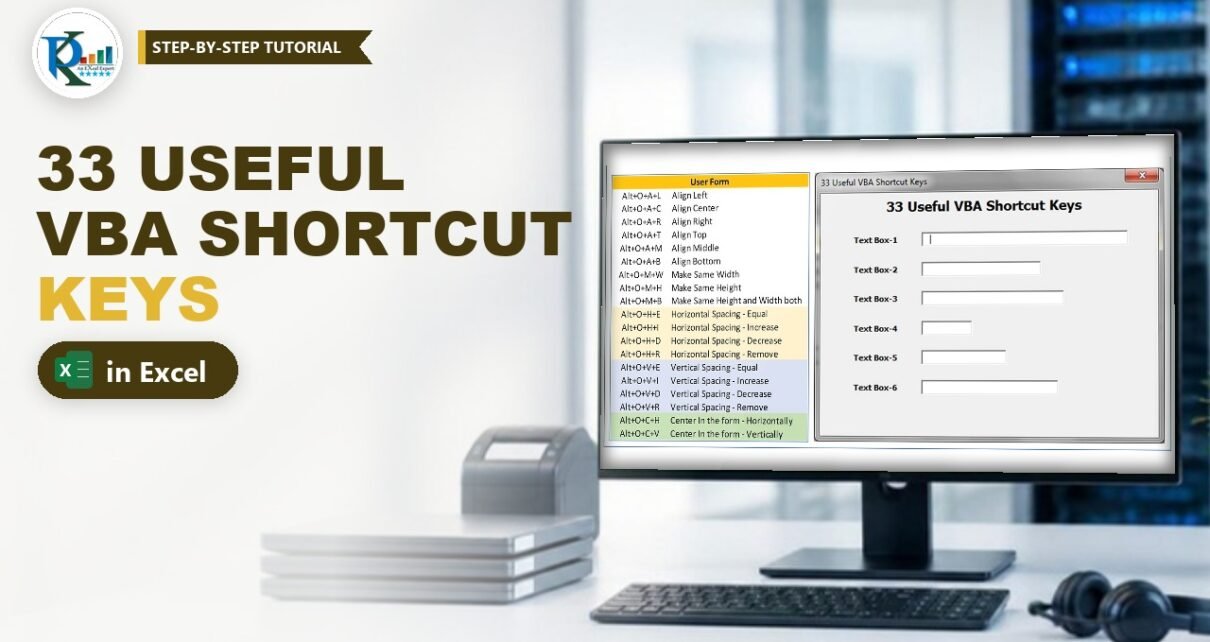
These 33 useful VBA shortcut keys help you write, test and debug macros faster and lay out UserForms in seconds instead of minutes. Below you will find all 33 in one table, grouped as in PK’s practice file (Ctrl keys, Alt keys, function keys and UserForm design keys), each explained with the example from the video.

⬇️ Download the VBA Shortcut Keys Sheet
ZIP (22 KB) · .xlsm with the shortcut list and demo macros · enable macros to try the examples
Watch the Video Tutorial
In the video PK demonstrates every shortcut live in the VBA editor, from Ctrl + Space on a worksheet variable to centring a title label on a UserForm.
What You Will Learn
- 5 Ctrl shortcuts for IntelliSense, the Project Explorer, the Immediate window and moving between modules.
- 3 Alt shortcuts to jump into the editor and insert modules and UserForms.
- 6 function-key shortcuts to run, step through and debug code.
- 19 UserForm shortcuts to align, resize, space and centre controls.
All 33 Useful VBA Shortcut Keys
A plus sign means hold the keys together. A comma means press the keys one after another: the Alt sequences open the editor’s menus by their underlined letters, so you press Alt, release it, then tap the letters.
| # | Shortcut | What it does | Menu command |
|---|---|---|---|
| With Ctrl | |||
| 1 | Ctrl + Space | Auto complete the word you are typing | Edit > Complete Word |
| 2 | Ctrl + J | Show the IntelliSense list of properties and methods | Edit > List Properties/Methods |
| 3 | Ctrl + R | Show the Project Explorer | View > Project Explorer |
| 4 | Ctrl + G | Show the Immediate window | View > Immediate Window |
| 5 | Ctrl + Tab | Move between open modules and UserForms | No menu item |
| With Alt | |||
| 6 | Alt + F11 | Toggle between Excel and the Visual Basic Editor | View > Microsoft Excel |
| 7 | Alt, I, M | Insert a new module | Insert > Module |
| 8 | Alt, I, U | Insert a new UserForm | Insert > UserForm |
| Function keys | |||
| 9 | F4 | Show the Properties window | View > Properties Window |
| 10 | F5 | Run the current macro or UserForm | Run > Run Sub/UserForm |
| 11 | F8 | Run the code step by step | Debug > Step Into |
| 12 | F9 | Toggle a breakpoint on the current line | Debug > Toggle Breakpoint |
| 13 | Ctrl + Shift + F9 | Clear all breakpoints | Debug > Clear All Breakpoints |
| 14 | Shift + F2 | Jump to the procedure under the cursor | View > Definition |
| UserForm design (select the controls first) | |||
| 15 | Alt, O, A, L | Align left | Format > Align > Lefts |
| 16 | Alt, O, A, C | Align center | Format > Align > Centers |
| 17 | Alt, O, A, R | Align right | Format > Align > Rights |
| 18 | Alt, O, A, T | Align top | Format > Align > Tops |
| 19 | Alt, O, A, M | Align middle | Format > Align > Middles |
| 20 | Alt, O, A, B | Align bottom | Format > Align > Bottoms |
| 21 | Alt, O, M, W | Make same width | Format > Make Same Size > Width |
| 22 | Alt, O, M, H | Make same height | Format > Make Same Size > Height |
| 23 | Alt, O, M, B | Make same height and width | Format > Make Same Size > Both |
| 24 | Alt, O, H, E | Horizontal spacing: make equal | Format > Horizontal Spacing > Make Equal |
| 25 | Alt, O, H, I | Horizontal spacing: increase | Format > Horizontal Spacing > Increase |
| 26 | Alt, O, H, D | Horizontal spacing: decrease | Format > Horizontal Spacing > Decrease |
| 27 | Alt, O, H, R | Horizontal spacing: remove | Format > Horizontal Spacing > Remove |
| 28 | Alt, O, V, E | Vertical spacing: make equal | Format > Vertical Spacing > Make Equal |
| 29 | Alt, O, V, I | Vertical spacing: increase | Format > Vertical Spacing > Increase |
| 30 | Alt, O, V, D | Vertical spacing: decrease | Format > Vertical Spacing > Decrease |
| 31 | Alt, O, V, R | Vertical spacing: remove | Format > Vertical Spacing > Remove |
| 32 | Alt, O, C, H | Center in the form horizontally | Format > Center in Form > Horizontally |
| 33 | Alt, O, C, V | Center in the form vertically | Format > Center in Form > Vertically |
The menu command column is an addition for reference, checked against Microsoft’s VBA editor menu documentation. The shortcuts and descriptions come from PK’s practice file and video.
Ctrl Shortcuts: Write Code Faster
Ctrl + Space: auto complete
Start typing a word and press Ctrl + Space. If only one match exists, VBA completes it; otherwise it shows the matching list. In the video PK declares Dim sh As Worksheet, types sh.ra and presses Ctrl + Space, and VBA fills in Range because it is the only property that starts with ra.
Ctrl + J: IntelliSense list
Ctrl + J opens the drop-down list of properties and methods at the cursor.
Ctrl + R and Ctrl + G: Project Explorer and Immediate window
If the Project Explorer is missing, Ctrl + R brings it back so you can see every module and UserForm. Ctrl + G opens the Immediate window at the bottom. PK’s example sets x = 5, y = 6 and z = 7, pauses the code, then types this in the Immediate window:
?x+yIt prints 11. The question mark means print the result.
Ctrl + Tab: move between modules and UserForms
With several code windows open, Ctrl + Tab cycles through them, including UserForms.
Alt Shortcuts: Open the Editor and Insert Objects
Alt + F11 switches from Excel to the VBA editor and back again. Inside the editor, Alt, I, M inserts a new module (PK’s Module4 appears instantly in the demo) and Alt, I, U inserts a new UserForm. Both are Insert-menu sequences: Alt opens the menu bar, I opens Insert, and M or U picks the item.
Function Keys: Run and Debug Your Macros
F4 and F5: properties and run
Select a UserForm or control and press F4 to open its Properties window. Click inside a macro and press F5 to run it. PK’s demo macro from the practice file:
Sub VBA_Shortcut_Keys()


Dim sh As Worksheet


Set sh = ActiveSheet


Dim x, y, z As Integer


x = 5


y = 6


z = 7


MsgBox x + y + z


End Sub
Press F5 and the message box shows 18.
F8, F9 and Ctrl + Shift + F9: step through and breakpoints
F8 runs the code one line at a time; the yellow line shows what runs next. F9 puts a breakpoint on the line where the cursor is, so F5 runs until that line and stops. Press F5 again to continue to the next breakpoint. Ctrl + Shift + F9 removes every breakpoint at once.
Shift + F2: jump to a procedure
The practice file has a second macro that calls the first:
Sub test()


Call VBA_Shortcut_Keys


End Sub
Click on VBA_Shortcut_Keys inside test and press Shift + F2. The editor jumps straight to that procedure’s code, even when it lives in another module.
UserForm Shortcuts: Design Forms in Seconds
These 19 shortcuts all come from the editor’s Format menu (Alt, O). First select two or more controls on the UserForm (drag a box around them, or Ctrl + click), then press the sequence.
Align: Alt, O, A + L, C, R, T, M or B
PK selects several text boxes of different widths and presses Alt, O, A, L: they line up on the left. C, R, T, M and B align centres, rights, tops, middles and bottoms. The editor lines up the other controls with the one that has the white grab handles, the reference control.
Make same size: Alt, O, M + W, H or B
Alt, O, M, W gives the selected controls the same width, H the same height and B both. In the video PK makes them the same width first, then aligns them left.
Horizontal and vertical spacing: Alt, O, H or V + E, I, D or R
Alt, O, H, E makes the gaps between controls equal. I increases the gap evenly each time you press it, D decreases it and R removes it so the controls touch. Swap H for V for the same four commands on a vertical stack of controls.
Center in form: Alt, O, C + H or V
PK adds a title label and presses Alt, O, C, H to centre it horizontally on the form. Press it again after resizing the form. Alt, O, C, V centres vertically.
Bonus Shortcuts Worth Knowing
Addition, not in the original list. These come from Microsoft’s documentation of the VBA editor menus:
- Ctrl + Shift + F2: go back to your last position after Shift + F2.
- Shift + F8: step over a called procedure; Ctrl + Shift + F8: step out of it.
- Ctrl + F8: run to the cursor.
- Ctrl + Break: stop a running macro.
Common Errors & Fixes
- The Alt, O shortcuts do nothing. Select the controls on the UserForm first, and make sure the form designer (not a code window) is active.
- Alt + I + M held together does not work. Press the keys in sequence: Alt, then I, then M.
- F5 runs the wrong macro or asks for a name. Click inside the procedure you want first. If the cursor is outside any procedure, VBA shows the macro list.
- Alt + F11 does nothing on a laptop. The F keys may be media keys. Hold Fn as well, or switch the Fn lock.
Tips
- Learn the menu letters, not the full sequence: A for Align, M for Make Same Size, H and V for spacing, C for Center.
- Watch out in the demo line
Dim x, y, z As Integer: only z is an Integer, while x and y are Variants. WriteDim x As Integer, y As Integer, z As Integerwhen every variable needs the type. (Addition.) - Microsoft documents the editor’s Debug menu commands and shortcuts, including breakpoints and stepping.
Want It Ready-Made?
If you would rather start from a finished, macro-ready workbook than build every tool yourself, browse the Excel VBA tools on NextGenTemplates.com.
Related Tutorials
- Excel shortcut keys: free 8-chapter keyboard course
- VBA InputBox vs Application.InputBox
- Multilevel dependent drop-down in a VBA UserForm
- Login form for an Excel VBA application
- Loop through worksheets, sheets and charts in VBA
FAQ
What is the shortcut to open the VBA editor in Excel?
Press Alt + F11. Press it again in the editor to go back to Excel.
How do I run VBA code line by line?
Click inside the macro and press F8. Each press runs the highlighted yellow line and moves to the next one.
How do I align controls on a VBA UserForm quickly?
Select the controls, then press Alt, O, A followed by L, C, R, T, M or B for left, center, right, top, middle or bottom.
Why does Ctrl + Space not complete my code?
It completes only when a single match exists. With several matches it shows the list, so type more letters or pick from the list.
About the Author
PK is a Microsoft Excel expert and trainer and the founder of PK: An Excel Expert and NextGenTemplates.com. He has been teaching Excel, VBA and Power BI since 2016 on his YouTube channel.
Conclusion
These 33 useful VBA shortcut keys cover the whole workflow: Ctrl + Space and Ctrl + J while you write, F5, F8 and F9 while you test, and the Alt, O sequences that turn UserForm design from slow dragging into a few keystrokes. Download the practice file, open the editor with Alt + F11 and try each one on PK’s demo macro and UserForm.