Managing team activities, project deadlines, meetings, and performance-related events requires proper planning and visibility. However, many teams still rely on scattered spreadsheets, emails, and manual notes to manage their schedules. As a result, important events often get missed, deadlines become unclear, and team coordination becomes difficult.
Therefore, organizations need a structured system that allows them to organize events, track team schedules, and manage activities efficiently.
This is exactly where the Team Performance Event Calendar in Excel becomes extremely useful.
The Team Performance Event Calendar in Excel is a ready-to-use Excel template designed to organize and manage team events in a structured calendar format. Moreover, it allows teams to monitor activities through annual, monthly, and daily views, making event tracking simple and efficient.
Because Excel provides automation, dynamic calendars, and structured event tracking, teams can easily monitor schedules, track events, and improve coordination across departments.
In this comprehensive guide, we will explore everything about the Team Performance Event Calendar in Excel, including its features, structure, benefits, best practices, and frequently asked questions.
Click to buy Team Performance Event Calendar In Excel
What is a Team Performance Event Calendar in Excel?
A Team Performance Event Calendar in Excel is a structured planning tool that helps organizations manage team-related events, meetings, performance reviews, project milestones, and activities in one centralized calendar system.
Instead of managing events across multiple platforms, this Excel template consolidates all events into a single organized calendar.
As a result, managers and team members can easily:
- Track upcoming meetings
- Monitor project deadlines
- Schedule training sessions
- Manage performance review events
- Organize team activities
- Track event details in a structured database
Furthermore, because the calendar provides multiple views and automation, users can quickly analyze upcoming events and stay organized.
Why Do Teams Need an Event Calendar?
Modern teams work on multiple tasks, projects, and events simultaneously. However, without a structured event management system, teams often struggle with scheduling and coordination.
Therefore, using a Team Performance Event Calendar provides several important benefits.
Teams often face these common problems:
- Missing important meetings or deadlines
- Difficulty tracking project milestones
- Poor coordination between departments
- Confusion regarding event schedules
- Lack of centralized event information
However, when teams use a structured event calendar, they can easily organize activities and maintain better communication.
As a result, productivity increases and operational confusion decreases.
Key Features of the Team Performance Event Calendar in Excel
The Team Performance Event Calendar in Excel includes multiple worksheets designed to provide easy navigation, event management, and clear visualization.
This ready-to-use template contains five structured worksheets that allow users to manage events effectively.
Home Sheet – Central Navigation Page
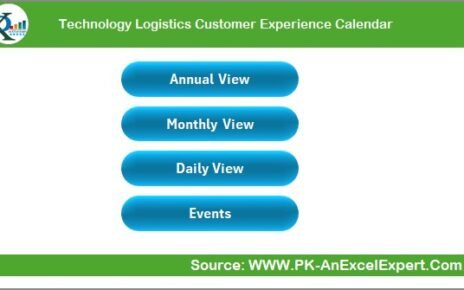
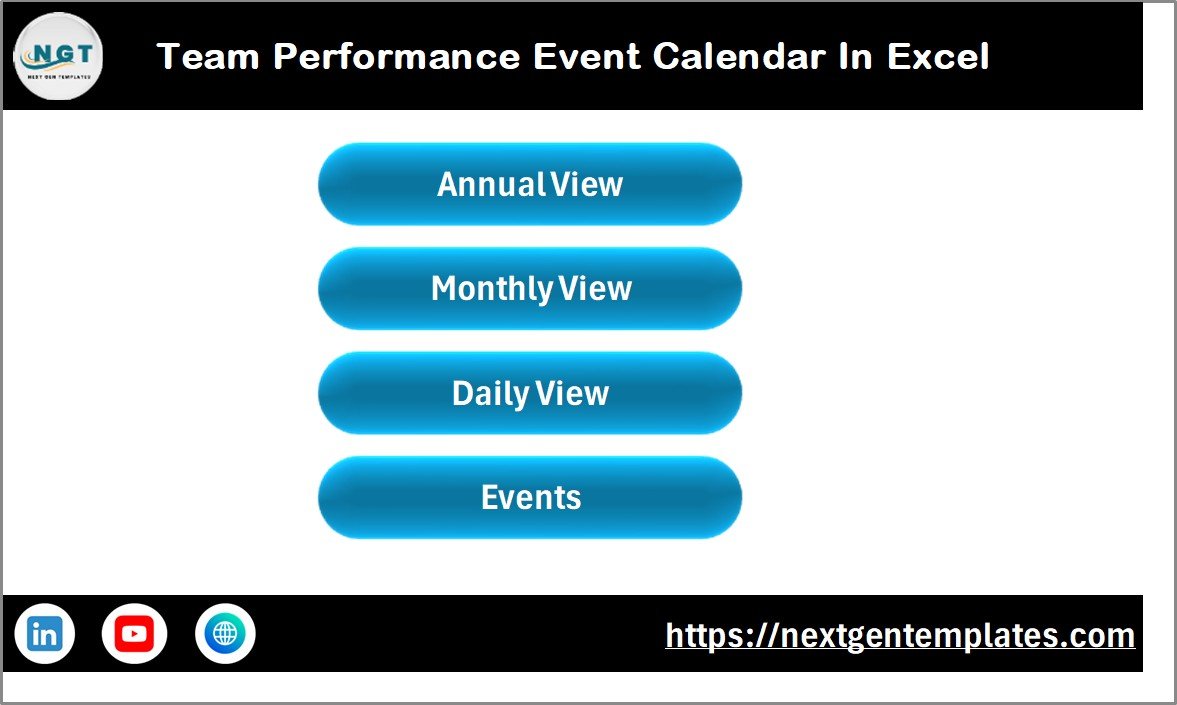
The Home Sheet works as the main navigation hub of the calendar template.
Instead of manually navigating through worksheets, users can quickly jump to the required calendar view using the navigation buttons.
The Home sheet contains four navigation buttons:
- Annual View
- Monthly View
- Daily View
- Events
Because this sheet acts as an index page, users can quickly access any section of the calendar without searching through multiple sheets.
As a result, navigation becomes faster and more user-friendly.
Click to buy Team Performance Event Calendar In Excel
Annual View Sheet – Full Year Calendar Overview
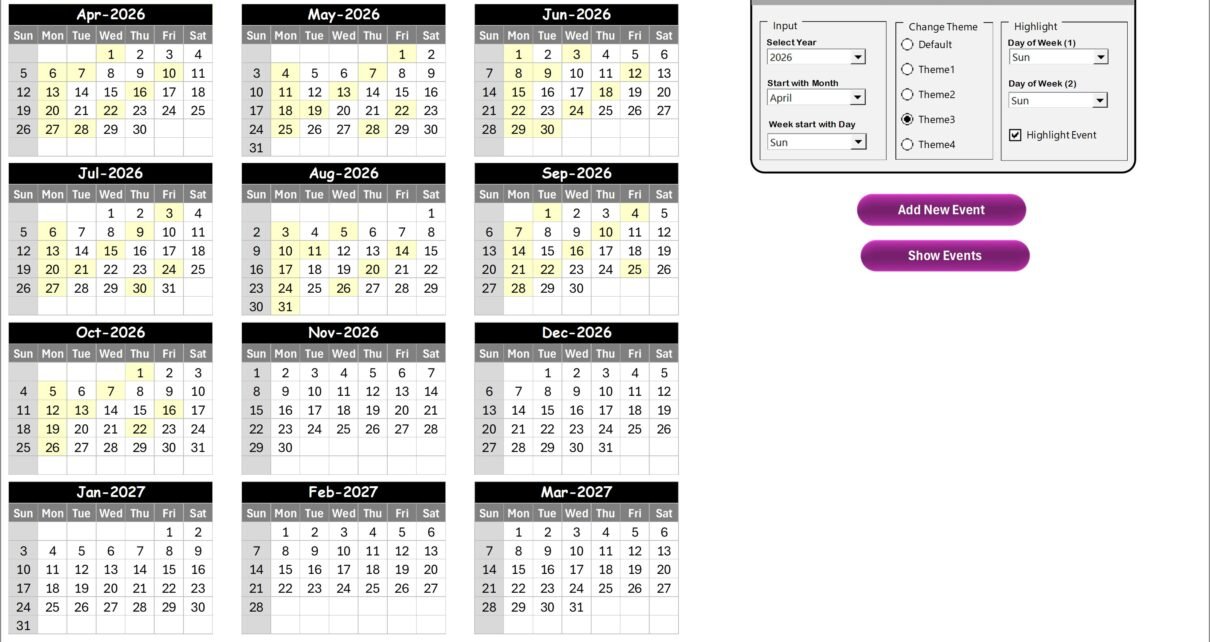
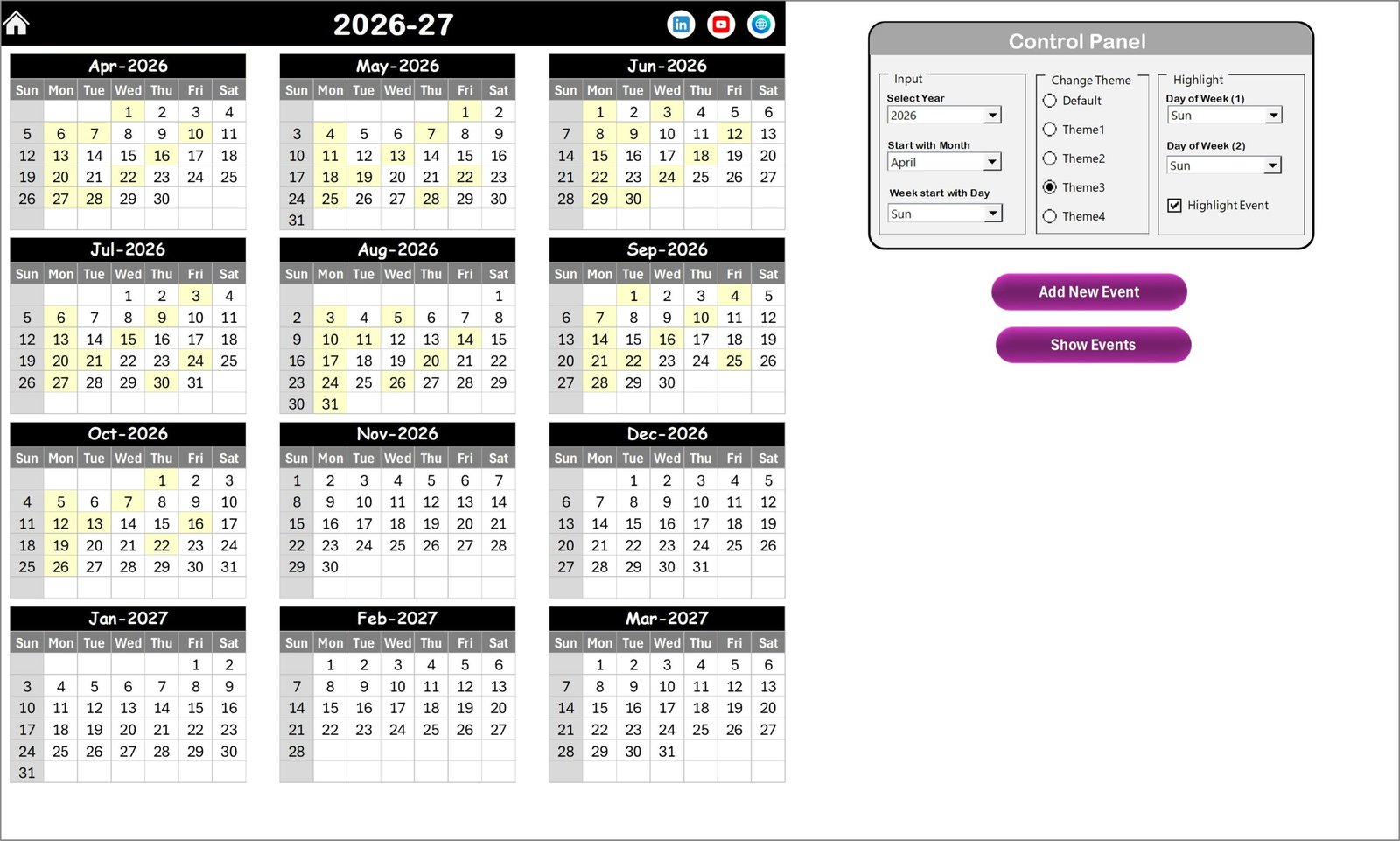
The Annual View Sheet displays the complete calendar for 12 months in a single page.
Therefore, users can quickly see all events and activities throughout the year.
This sheet also includes a powerful Control Panel that allows users to customize the calendar settings.
Control Panel Features
The control panel contains three important groups that allow customization of the calendar.
Input Group
The Input Group allows users to configure the calendar structure.
Users can easily:
- Select the Year
- Change the starting month
- Modify the starting day of the week
Because of this flexibility, the calendar can adapt to different planning needs.
Change Theme Group
The Change Theme Group allows users to apply different color themes to the entire workbook.
The template provides five color themes.
Therefore, users can select the theme that matches their preferences or company branding.
Highlight Group
The Highlight Group helps users emphasize specific days of the week.
For example:
- Highlight Saturday
- Highlight Sunday
As a result, weekends or specific days can easily stand out in the calendar.
Additionally, the template includes a Highlight Events checkbox. When enabled, it highlights events in yellow color within the annual calendar.
Therefore, important events become easy to identify.
Add New Event Button
The Add New Event button allows users to quickly schedule a new event.
How it works:
- Select a date in the calendar
- Click Add New Event
- Fill the event information in the form
- Click Submit
After submission, the event automatically appears on the selected date.
Therefore, adding events becomes quick and simple.
Show Event Button
The Show Event button allows users to view the list of events scheduled for a selected date.
Instead of searching manually, users can instantly see all event details.
This feature helps teams quickly review upcoming activities.
Click to buy Team Performance Event Calendar In Excel
Monthly View Sheet – Detailed Monthly Calendar
The Monthly View Sheet displays a detailed calendar for a selected month.
Users can choose the Month and Year from the top control panel. After selection, the calendar automatically updates.
This dynamic functionality allows teams to review schedules month by month.
Event Display in Monthly View
The calendar displays one event per date directly on the calendar.
However, if a particular date contains multiple events, the calendar shows a message:
“More than 1…”
This indicates that multiple events exist on that date.
Users can then click the Show Event button to view all event details.
Monthly View Buttons
The Monthly View sheet includes two main buttons.
Add New Event Button
This button allows users to add a new event for the selected date.
Users simply:
- Select the date
- Click Add New Event
- Enter event information
- Click Submit
The event automatically appears on the calendar.
Show Event Button
This button displays the list of events scheduled on the selected date.
Therefore, users can easily review event details without searching manually.

Click to buy Team Performance Event Calendar In Excel
Daily View Sheet – Event Details by Date Range
The Daily View Sheet provides a detailed list of events within a selected date range.
This view is extremely helpful when users want to analyze upcoming events or review past activities.
How Daily View Works
Users can select the Start Date and End Date at the top of the sheet.
After selecting the date range, users simply click the Refresh button.
The calendar then displays all events within that period.
Because of this feature, users can quickly filter and review event information.
Add New Event from Daily View
The Daily View sheet also includes an Add New Event button.
Users can directly add a new event using the form.
After submission, the event gets recorded in the event database.
Click to buy Team Performance Event Calendar In Excel
Events Sheet – Event Database
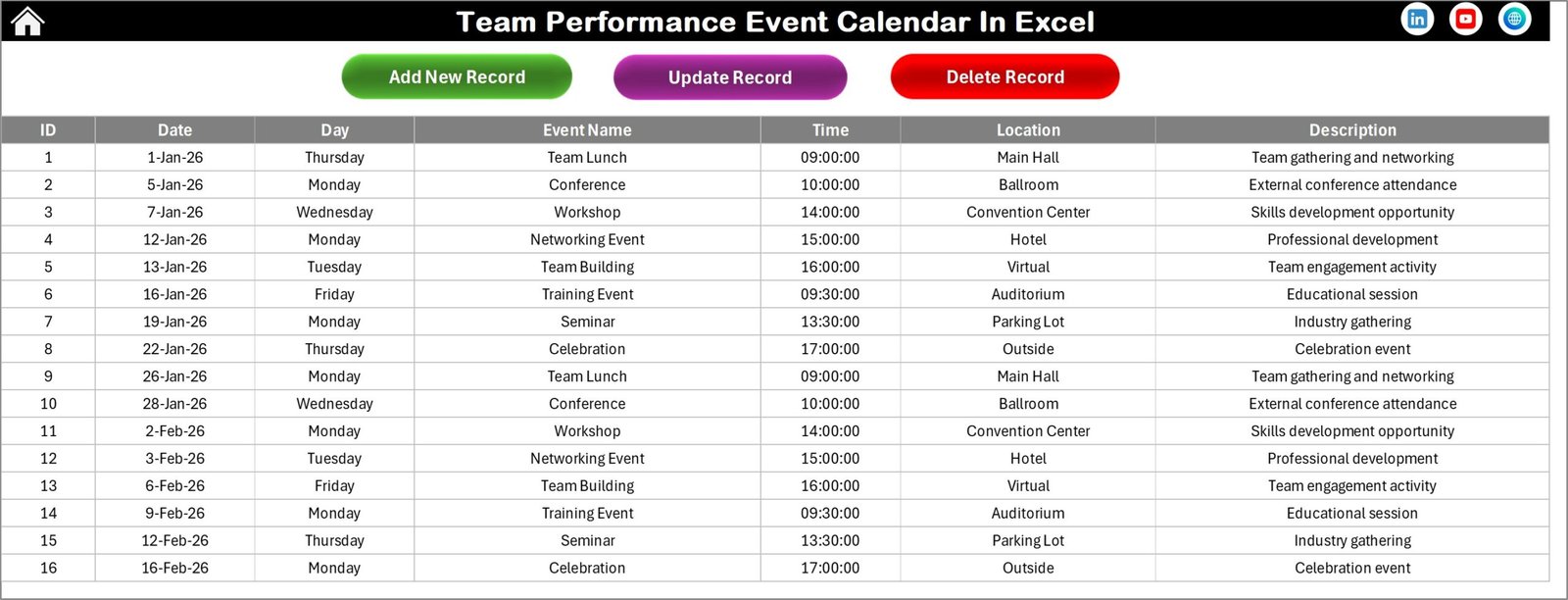
The Events Sheet acts as the central database of the calendar.
All event information gets stored in this worksheet.
Therefore, the calendar automatically retrieves data from this database to display events in different calendar views.
Event Data Fields
The Events sheet captures the following details:
- ID – Auto-generated unique number
- Date – Event date
- Day – Day of the event (Sunday, Monday, etc.)
- Event Name – Name of the event
- Time – Event time
- Location – Event location
- Description – Short description of the event
Because of this structured data storage, the template maintains organized event records.
Database Management Buttons
The Events sheet also includes three important buttons for database management.
Add New Record
The Add New Record button allows users to create a new event.
When users click the button:
- The event form opens
- Users enter event details
- Click Submit
The new event automatically gets added to the database.
Update Existing Record
The Update Existing Record button allows users to modify event information.
Users simply:
- Select the ID of the event
- Click Update Existing Record
- Modify event details
- Click Submit
The updated information gets saved immediately.
Delete Record
The Delete Record button allows users to remove an event.
Users only need to select the event ID and click Delete Record.
The event will be permanently removed from the database.
Click to buy Team Performance Event Calendar In Excel
Advantages of Team Performance Event Calendar in Excel
Using a Team Performance Event Calendar in Excel provides many benefits for organizations.
- Centralized Event Management
Teams can store all event information in one organized system.
Therefore, users do not need multiple tools or spreadsheets.
- Better Team Coordination
When teams can view upcoming events easily, coordination becomes much smoother.
As a result, meetings and activities become well organized.
- Improved Time Management
The calendar helps teams track deadlines, meetings, and project events effectively.
Therefore, teams can prioritize tasks better.
- Easy Event Tracking
The template allows users to track events using annual, monthly, and daily views.
This flexibility improves visibility.
- User-Friendly Interface
Because the template uses buttons and forms, users can easily navigate and manage events.
Even beginners can use it without difficulty.
- Customizable Themes and Settings
Users can customize the calendar layout, color themes, and highlight settings.
Therefore, the calendar can match organizational preferences.
Best Practices for the Team Performance Event Calendar
Using the calendar effectively requires following some best practices.
- Maintain Consistent Event Data
Always enter accurate event information.
Clear event names and descriptions help teams understand the purpose of each event.
- Regularly Update the Calendar
Teams should update the calendar whenever new events are scheduled.
Therefore, the calendar always reflects the latest schedule.
- Use Clear Event Descriptions
Short descriptions help users understand event objectives quickly.
For example:
- Team Meeting
- Client Presentation
- Project Review
Clear naming improves visibility.
- Highlight Important Events
Use the Highlight Event feature to emphasize critical events.
This helps teams identify priority events quickly.
- Review the Calendar Frequently
Managers should review the calendar weekly or monthly.
Regular review ensures proper event planning.
- Use the Daily View for Event Analysis
The Daily View sheet helps teams review upcoming schedules.
Therefore, users can prepare in advance.
Who Can Benefit from This Calendar?
Many organizations and professionals can benefit from the Team Performance Event Calendar in Excel.
Project Managers
Project managers can track milestones, meetings, and deadlines.
HR Teams
HR departments can schedule performance reviews and training events.
Team Leaders
Team leaders can monitor team activities and work schedules.
Corporate Teams
Corporate teams can manage internal meetings and collaboration events.
Small Businesses
Small businesses can manage operations and events efficiently.
Conclusion
The Team Performance Event Calendar in Excel provides a simple yet powerful solution for managing team schedules and events.
Because the template offers annual, monthly, and daily views, users can easily monitor upcoming activities and track event details. Moreover, the built-in event forms and database management features make event scheduling quick and efficient.
In addition, the customizable settings, color themes, and highlighting options make the calendar flexible for different organizations.
Therefore, teams can improve planning, coordination, and productivity by using this structured calendar system.
If your team struggles with managing events or tracking activities, this Excel calendar can help organize schedules and improve overall workflow.
Frequently Asked Questions (FAQs)
What is a Team Performance Event Calendar?
A Team Performance Event Calendar is a structured scheduling tool used to organize team activities, meetings, and events in a centralized calendar.
Why should teams use an Excel event calendar?
Teams should use an Excel event calendar because it provides organized scheduling, event tracking, and improved team coordination.
Can I customize the calendar settings?
Yes. The template allows users to customize the year, starting month, themes, and highlight settings.
Can I track multiple events on the same date?
Yes. If multiple events exist on a date, the calendar displays a message indicating more events.
Users can then view the full list using the Show Event button.
Is the calendar suitable for business teams?
Yes. The template works perfectly for businesses, project teams, HR departments, and small organizations.
Visit our YouTube channel to learn step-by-step video tutorials
Watch the step-by-step video tutorial:
Click to buy Team Performance Event Calendar In Excel