Inventory plays a critical role in almost every organization. Whether you manage a warehouse, retail store, manufacturing unit, or distribution center, accurate inventory records directly affect profitability and operational efficiency. However, many businesses still struggle to monitor inventory audits properly.
Teams often use handwritten notes, emails, or scattered spreadsheets to track audit activities. As a result, audit tasks get missed, responsibilities become unclear, and discrepancies remain unresolved. Consequently, businesses face stock losses, inaccurate financial reporting, and compliance risks.
Therefore, organizations increasingly adopt structured tools that simplify audit monitoring. One practical and cost-effective solution is the Inventory Audit Monitoring Checklist in Excel.
This ready-to-use template helps businesses organize audit tasks, monitor progress, assign responsibilities, and ensure accountability — all within a familiar Excel environment.
In this comprehensive article, you will learn:
-
What an Inventory Audit Monitoring Checklist is
-
Why businesses need it
-
Template structure and features
-
Benefits and advantages
-
Implementation steps
-
Best practices for audit monitoring
-
Frequently asked questions
What Is an Inventory Audit Monitoring Checklist in Excel?
An Inventory Audit Monitoring Checklist in Excel is a structured task-tracking system designed to manage inventory audit activities using a checklist format.
Instead of tracking audit actions across multiple documents, teams record all audit tasks in one centralized workbook. Each checklist item represents a specific audit activity that must be completed during the inventory verification process.
Because Excel supports formulas, drop-downs, and progress tracking, users can easily monitor audit completion status in real time.
As a result, businesses improve audit accuracy and operational control.
Click to Purchases Inventory Audit Monitoring Checklist in Excel
Why Do Businesses Need an Inventory Audit Monitoring Checklist?
Inventory audits ensure that physical stock matches system records. However, audits involve multiple steps such as verification, counting, documentation, reconciliation, and reporting.
Without a structured checklist:
-
Audit steps get skipped
-
Deadlines get missed
-
Accountability becomes unclear
-
Errors increase
-
Audit completion tracking becomes difficult
On the other hand, a monitoring checklist provides clarity and control.
Moreover, it helps teams follow a standardized audit process every time.
Click to Purchases Inventory Audit Monitoring Checklist in Excel
Key Features of Inventory Audit Monitoring Checklist in Excel
This ready-to-use template includes two structured worksheets, designed for simplicity and efficiency.
1️⃣ Inventory Audit Monitoring Checklist Sheet (Main Sheet)
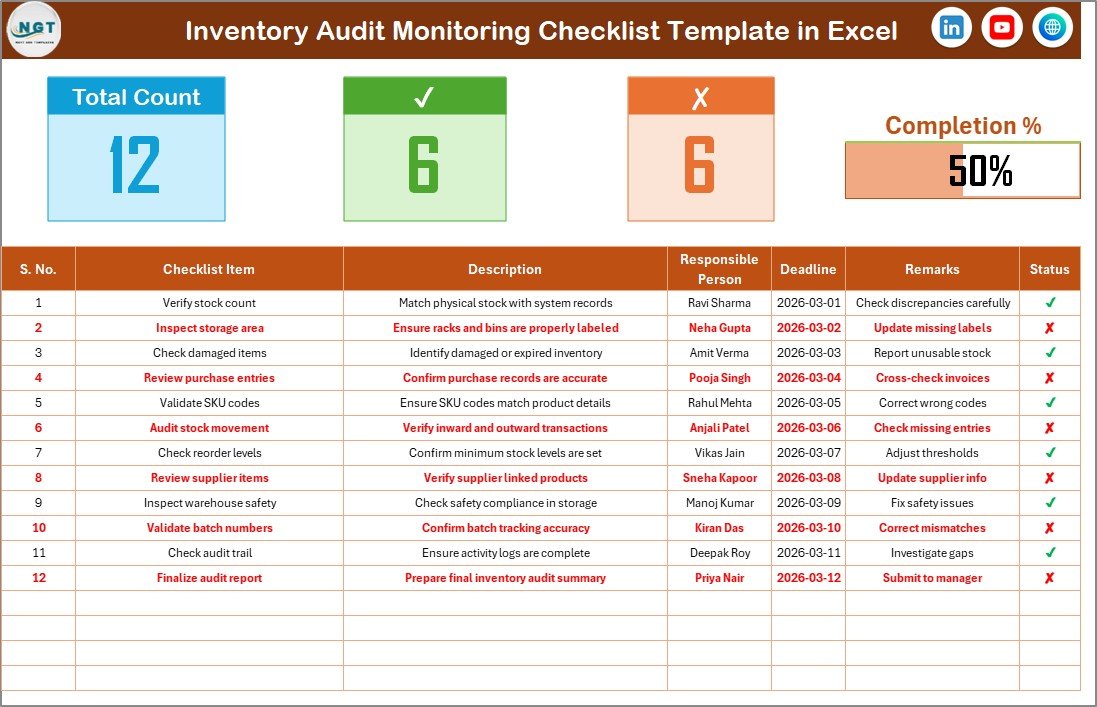
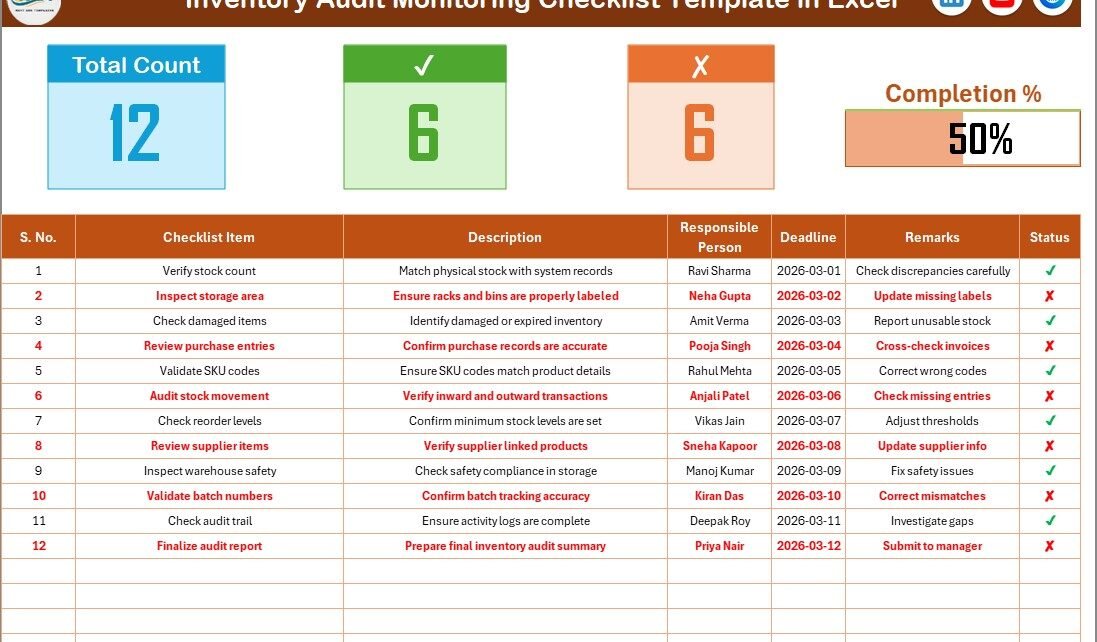
This is the primary working sheet where users capture all audit activities.
Top Section – Audit Summary Dashboard
The top section provides quick audit progress insights, including:
-
Total Count – Total checklist items
-
Checked Count – Completed tasks
-
Crossed Count – Pending or failed tasks
-
Progress Bar – Visual completion percentage
Therefore, managers instantly understand audit progress without reviewing each row.
Checklist Table – Task Monitoring Area
The checklist table forms the core of the template.
Users simply update the Status column using:
✔ Completed
✘ Pending / Not Completed
The template automatically updates progress indicators.
Columns Included:
-
Serial No. – Task sequence number
-
Checklist Item – Audit task name
-
Description – Brief explanation of task
-
Responsible Person – Assigned employee
-
Deadline – Completion due date
-
Remarks – Notes or observations
-
Status – ✔ or ✘ indicator
Because responsibilities remain clearly assigned, accountability improves significantly.
Click to Purchases Inventory Audit Monitoring Checklist in Excel
2️⃣ List Sheet – Drop-Down Management

The List sheet stores unique values for responsible persons.
Purpose of This Sheet
-
Maintains standardized employee names
-
Creates dropdown selection in main checklist
-
Prevents typing errors
-
Ensures data consistency
As a result, reporting becomes cleaner and more reliable.
How Does the Inventory Audit Monitoring Checklist Work?
The workflow remains simple and practical:
-
Add audit checklist items.
-
Assign responsible persons.
-
Set deadlines.
-
Perform audit activities.
-
Update status using ✔ or ✘.
-
Monitor progress through the dashboard section.
Because the system updates automatically, managers always see real-time audit status.
Click to Purchases Inventory Audit Monitoring Checklist in Excel
What Inventory Audit Activities Can You Track?
The checklist can include various audit stages.
Pre-Audit Activities
-
Audit planning
-
Stock freeze confirmation
-
Audit team assignment
-
Documentation preparation
Physical Verification Tasks
-
Warehouse counting
-
Barcode scanning
-
Location verification
-
Batch validation
Reconciliation Activities
-
System vs physical comparison
-
Variance identification
-
Adjustment approvals
Reporting Tasks
-
Audit summary preparation
-
Management review
-
Compliance documentation
Tracking all activities ensures a complete audit process.
Click to Purchases Inventory Audit Monitoring Checklist in Excel
Advantages of Inventory Audit Monitoring Checklist in Excel
✅ Centralized Audit Tracking
All audit tasks remain organized in one file.
✅ Improved Accountability
Assigned responsibilities increase ownership.
✅ Real-Time Progress Monitoring
Progress bars provide instant visibility.
✅ Easy Implementation
No technical knowledge required.
✅ Error Reduction
Dropdown lists prevent data inconsistencies.
✅ Better Compliance Management
Structured audits support regulatory requirements.
✅ Cost-Effective Solution
Excel eliminates the need for expensive audit software.
Click to Purchases Inventory Audit Monitoring Checklist in Excel
How to Implement the Inventory Audit Monitoring Checklist Successfully?
Step 1: Define Audit Scope
Identify locations, products, and audit objectives.
Step 2: Create Checklist Items
Break audits into small actionable tasks.
Step 3: Assign Responsibilities
Allocate tasks to team members clearly.
Step 4: Set Realistic Deadlines
Ensure achievable timelines.
Step 5: Monitor Progress Daily
Review completion status regularly.
Step 6: Record Observations
Use remarks column for findings.
Step 7: Review Final Results
Evaluate audit outcomes and corrective actions.
Click to Purchases Inventory Audit Monitoring Checklist in Excel
Best Practices for the Inventory Audit Monitoring Checklist
To maximize effectiveness, follow these best practices:
-
Keep checklist items clear and simple
-
Update status immediately after task completion
-
Review progress during audit meetings
-
Avoid duplicate checklist entries
-
Use consistent naming for responsible persons
-
Maintain audit documentation backup
-
Analyze recurring audit issues
Following these practices ensures smoother audits.
Common Inventory Audit Challenges and Solutions
Challenge: Missed Audit Tasks
Solution: Use checklist tracking with deadlines.
Challenge: Lack of Accountability
Solution: Assign responsible persons clearly.
Challenge: Manual Progress Tracking
Solution: Use automated progress bar indicators.
Challenge: Data Entry Errors
Solution: Implement dropdown lists.
Who Can Use This Template?
The Inventory Audit Monitoring Checklist benefits:
-
Warehouse Managers
-
Inventory Controllers
-
Retail Store Managers
-
Manufacturing Supervisors
-
Internal Audit Teams
-
Finance Departments
-
Compliance Officers
Because the template remains flexible, any industry handling inventory can use it.
Click to Purchases Inventory Audit Monitoring Checklist in Excel
How Excel Makes Audit Monitoring Efficient
Excel provides powerful features such as:
-
Conditional formatting
-
Data validation dropdowns
-
Progress tracking formulas
-
Easy customization
-
Quick reporting
Therefore, businesses achieve professional audit monitoring without complex systems.
Future Enhancements You Can Add
You can enhance the checklist further by adding:
-
Audit category filters
-
Department-wise tracking
-
Automated reminders
-
Dashboard charts
-
Audit scoring system
-
Power BI integration
These improvements support advanced audit analytics.
Conclusion
The Inventory Audit Monitoring Checklist in Excel offers a simple yet powerful solution for managing inventory audits efficiently. Instead of relying on scattered tracking methods, businesses gain a structured system that improves visibility, accountability, and audit accuracy.
Moreover, the template ensures teams follow standardized audit procedures while monitoring progress in real time. Because Excel remains accessible and customizable, organizations of all sizes can implement this solution quickly.
Ultimately, consistent audit monitoring leads to better inventory control, reduced losses, and stronger operational performance.
Click to Purchases Inventory Audit Monitoring Checklist in Excel
Frequently Asked Questions (FAQs)
What is an Inventory Audit Monitoring Checklist?
It is an Excel-based checklist used to track inventory audit tasks, responsibilities, and completion status.
Who should use this checklist?
Warehouse teams, auditors, inventory managers, and finance departments can use it.
Do I need advanced Excel skills?
No. The template works with simple updates like selecting ✔ or ✘.
Can I customize checklist items?
Yes. You can modify or add audit tasks anytime.
How does the progress bar work?
It automatically calculates completion percentage based on checklist status.
Can small businesses use this template?
Yes. It works perfectly for small and medium businesses.
How often should inventory audits be conducted?
Most organizations conduct audits monthly, quarterly, or annually depending on operations.
Click to Purchases Inventory Audit Monitoring Checklist in Excel
Visit our YouTube channel to learn step-by-step video tutorials