Managing office space leasing operations requires continuous monitoring of occupancy, lease renewals, rental revenue, tenant retention, and property utilization. However, many commercial real estate companies still rely on manual reports and scattered spreadsheets. As a result, managers often struggle to track leasing performance efficiently.
Therefore, organizations increasingly adopt data-driven dashboards to monitor key performance indicators in real time. One of the most effective solutions for this purpose is the Office Space Leasing KPI Dashboard in Power BI.
The Office Space Leasing KPI Dashboard in Power BI is a ready-to-use analytical tool that helps leasing managers, property managers, commercial real estate firms, and facility management teams track important leasing metrics in a structured way. Moreover, this dashboard transforms raw leasing data into visual insights that support faster and smarter decisions.
Because Power BI offers interactive visuals, automated calculations, and dynamic filtering, users can easily analyze leasing performance across multiple KPIs, compare actual results with targets, and monitor trends over time.
In this article, you will learn everything about the Office Space Leasing KPI Dashboard in Power BI, including its structure, key features, benefits, best practices, and frequently asked questions.
Click to buy Office Space Leasing KPI Dashboard in Power BI
What is an Office Space Leasing KPI Dashboard in Power BI?
An Office Space Leasing KPI Dashboard in Power BI is a business intelligence dashboard that tracks the most important leasing performance indicators for office properties.
Instead of reviewing multiple reports, leasing teams can monitor KPIs in a centralized visual dashboard. Consequently, managers can identify trends quickly, measure leasing efficiency, and improve property performance.
Typically, this dashboard tracks KPIs such as:
- Occupancy Rate
- Lease Renewal Rate
- Average Rental Revenue
- Tenant Retention Rate
- Vacancy Duration
- Lease Conversion Rate
- Leasing Pipeline Performance
- Revenue per Square Foot
Because the dashboard displays both MTD (Month-to-Date) and YTD (Year-to-Date) metrics, managers can evaluate short-term and long-term leasing performance simultaneously.
Why Do Property Managers Need a Leasing KPI Dashboard?
Commercial real estate operations involve multiple properties, tenants, lease contracts, and revenue streams. Therefore, tracking leasing performance manually becomes difficult.
However, a structured KPI dashboard simplifies the entire process.
Common Challenges Without a Dashboard
Many organizations face the following issues:
- Lack of centralized leasing data
- Time-consuming manual reporting
- Difficulty comparing targets vs actual performance
- Limited visibility into leasing trends
- Poor decision-making due to delayed insights
Therefore, companies implement Power BI dashboards to transform complex leasing data into clear and actionable insights.
Key Features of the Office Space Leasing KPI Dashboard in Power BI
The Office Space Leasing KPI Dashboard provides a complete view of leasing performance. Moreover, it organizes information into structured pages for easier analysis.
This Power BI dashboard contains three main pages:
- Summary Page
- KPI Trend Page
- KPI Definition Page
Let us explore each page in detail.
Summary Page – The Main Leasing Performance Overview
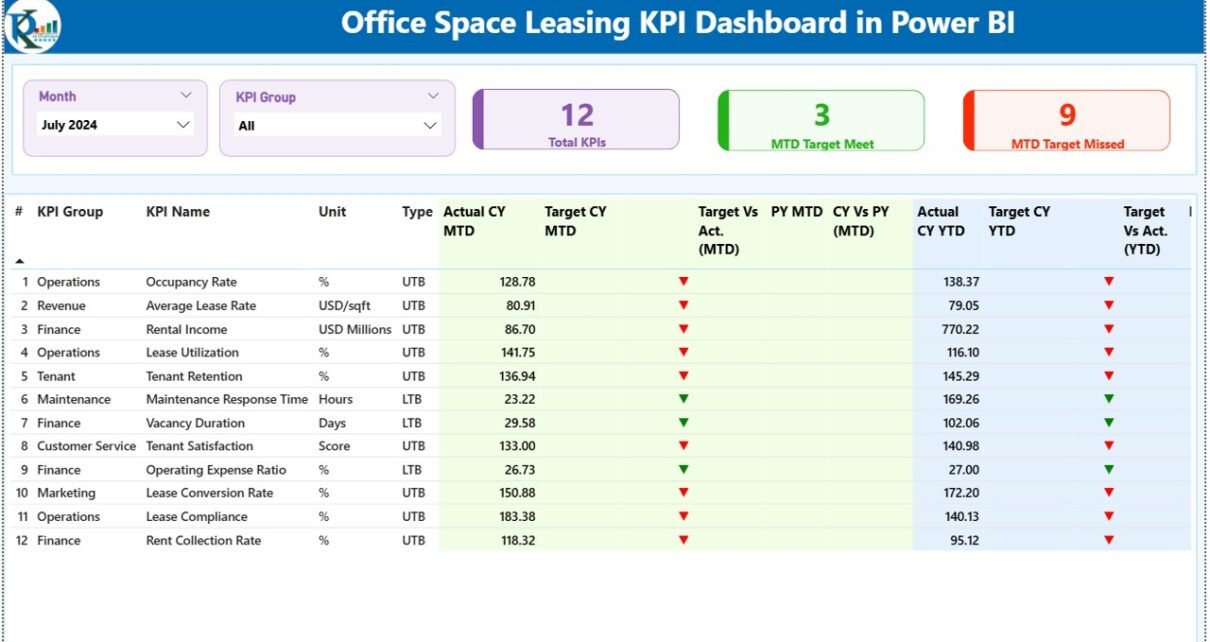
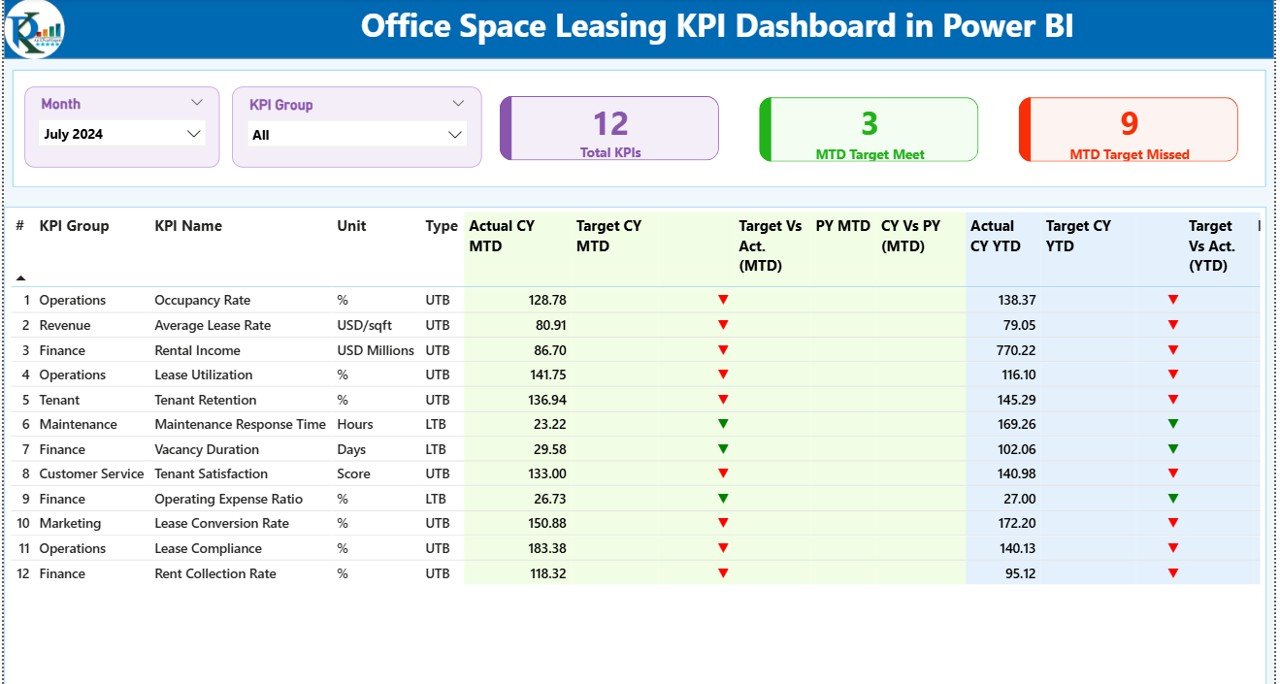
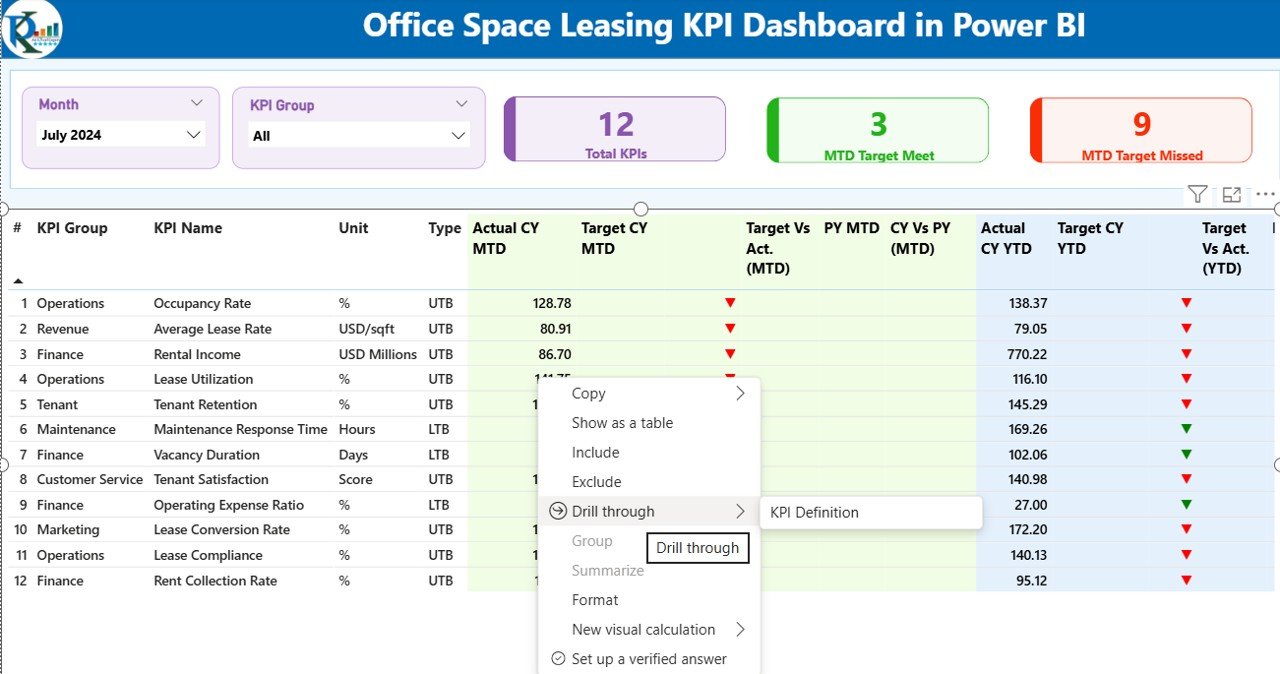
The Summary Page serves as the main interface of the dashboard. Here, users can quickly evaluate overall leasing performance.
At the top of the page, the dashboard displays two important slicers:
- Month Slicer
- KPI Group Slicer
Because these slicers allow dynamic filtering, users can analyze leasing metrics for a specific time period or KPI category.
KPI Summary Cards
At the top of the dashboard, three KPI cards provide a quick snapshot of leasing performance:
- Total KPIs Count – Displays the total number of KPIs tracked in the dashboard.
- MTD Target Meet Count – Shows the number of KPIs that achieved their monthly targets.
- MTD Target Missed Count – Displays the KPIs that failed to meet targets.
These summary cards help managers understand overall leasing performance instantly.
Detailed KPI Table in the Dashboard
Below the KPI cards, the dashboard presents a detailed KPI table that includes several performance indicators.
Each column provides valuable insights for decision-makers.
KPI Identification Fields
- KPI Number – Unique identifier for each KPI.
- KPI Group – Category of the KPI such as Financial, Operational, or Leasing Efficiency.
- KPI Name – Name of the performance metric.
- Unit – Measurement unit used for the KPI.
- Type – Indicates whether the KPI is Lower the Better (LTB) or Upper the Better (UTB).
MTD Performance Metrics
The dashboard displays several MTD indicators to evaluate short-term performance.
- Actual CY MTD – Current Year Month-to-Date actual value.
- Target CY MTD – Target value for the current month.
- MTD Icon – Displays visual indicators:
- ▲ Green Arrow = Target achieved
- ▼ Red Arrow = Target missed
Target vs Actual (MTD)
This column shows the percentage comparison between actual performance and the target.
Formula used:
Actual MTD / Target MTD
Therefore, users can easily evaluate KPI performance against targets.
Previous Year Comparison (MTD)
- PY MTD – Previous Year Month-to-Date value.
- CY vs PY (MTD) – Compares current performance with last year.
Formula used:
Current Year MTD / Previous Year MTD
Because of this comparison, managers can analyze year-over-year leasing growth.
YTD Performance Metrics
The dashboard also tracks long-term leasing performance.
- Actual CY YTD – Current Year Year-to-Date value.
- Target CY YTD – Year-to-Date target value.
- YTD Icon – Shows performance status using green and red arrows.
Target vs Actual (YTD)
Formula used:
Actual YTD / Target YTD
This metric helps leasing managers measure long-term progress toward annual goals.
Previous Year Comparison (YTD)
- PY YTD – Previous Year Year-to-Date value.
- CY vs PY (YTD) – Shows comparison between current year and previous year performance.
Formula used:
Current Year YTD / Previous Year YTD
As a result, organizations can track leasing performance growth over time.
Click to buy Office Space Leasing KPI Dashboard in Power BI
KPI Trend Page – Performance Trend Analysis
The KPI Trend Page helps users analyze leasing performance trends.
On this page, the dashboard displays two combo charts:
- MTD Trend Chart
- YTD Trend Chart
These charts compare the following values:
- Current Year Actual
- Previous Year Actual
- Target Value
Because of these comparisons, users can easily identify performance gaps and growth trends.
KPI Selection Slicer
A slicer on the left side allows users to select a specific KPI.
Once selected, the dashboard automatically updates the charts.
Therefore, leasing managers can analyze trends for individual KPIs quickly.
Click to buy Office Space Leasing KPI Dashboard in Power BI
KPI Definition Page – Drill-Through KPI Details
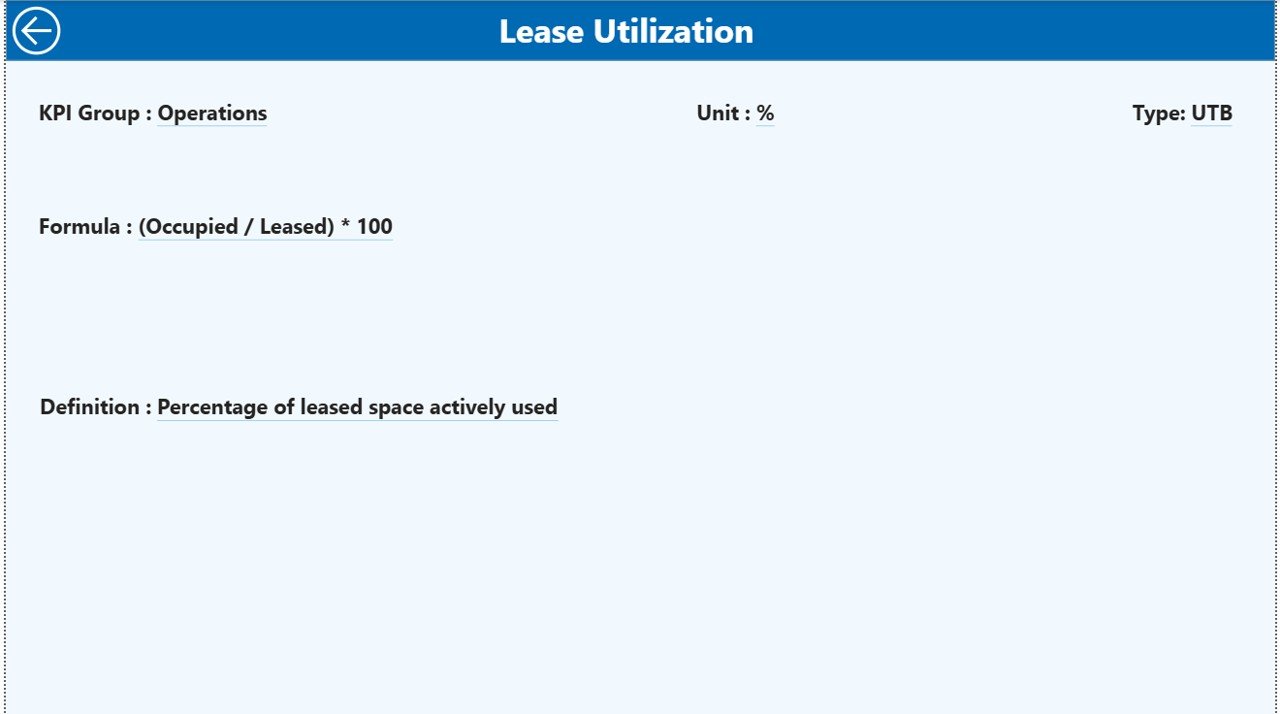
The KPI Definition Page provides detailed explanations of each KPI.
This page remains hidden and works as a drill-through page.
From the Summary Page, users can drill through to view additional KPI details such as:
- KPI Formula
- KPI Definition
- KPI Measurement Unit
- KPI Category
- KPI Type (LTB or UTB)
To return to the main page, users simply click the Back Button located at the top left corner.
Click to buy Office Space Leasing KPI Dashboard in Power BI
Excel Data Source for the Power BI Dashboard
The dashboard uses Excel as the data source.
Users only need to update three worksheets in the Excel file.
After updating the data, Power BI automatically refreshes the visuals.
Input Actual Sheet
This worksheet stores actual KPI values.
Users must enter:
- KPI Name
- Month (First date of the month)
- MTD Value
- YTD Value
Because this sheet captures real leasing performance data, it acts as the primary input for analysis.
Click to buy Office Space Leasing KPI Dashboard in Power BI
Input Target Sheet
This worksheet stores KPI target values.
Users must enter:
- KPI Name
- Month
- MTD Target
- YTD Target
Therefore, the dashboard can compare actual performance against expected goals.
KPI Definition Sheet
This worksheet stores KPI metadata.
Users must enter the following information:
- KPI Number
- KPI Group
- KPI Name
- Unit
- KPI Formula
- KPI Definition
- KPI Type (LTB or UTB)
Because of this structure, the dashboard becomes easier to maintain and update.
Advantages of Office Space Leasing KPI Dashboard in Power BI
Organizations benefit greatly from implementing a leasing KPI dashboard.
- Centralized Leasing Performance Monitoring
The dashboard consolidates leasing metrics into a single interface. Therefore, managers no longer need to review multiple reports.
- Faster Decision-Making
Real-time data visualization allows managers to identify problems quickly. As a result, they can take corrective action faster.
- Improved Leasing Strategy
The dashboard highlights performance gaps. Consequently, leasing teams can optimize pricing strategies, marketing campaigns, and tenant retention efforts.
- Better Target Tracking
Managers can easily compare actual performance with targets. Therefore, organizations maintain better control over leasing objectives.
- Historical Trend Analysis
The dashboard compares current performance with previous year data. Because of this, managers can track growth and identify long-term trends.
- Easy Data Management
Users only need to update the Excel input file. After refreshing the dashboard, Power BI automatically updates all visuals.
Opportunities for Improvement in Leasing Performance Monitoring
Although the dashboard provides strong analytical capabilities, organizations can improve leasing performance further.
Possible Improvements
- Integrate CRM or property management software
- Automate data refresh using Power BI Service
- Add predictive analytics for occupancy forecasting
- Include geographic property analysis
- Track tenant satisfaction metrics
These improvements can significantly enhance leasing intelligence.
Best Practices for the Office Space Leasing KPI Dashboard
Organizations should follow certain best practices to maximize the value of the dashboard.
- Define Clear KPIs
Start by selecting meaningful leasing metrics. Avoid tracking too many indicators.
- Maintain Data Accuracy
Always validate Excel data before refreshing Power BI. Clean data ensures reliable insights.
- Update Data Regularly
Update KPI data monthly or weekly. Frequent updates improve decision-making.
- Use Consistent KPI Definitions
Maintain standardized KPI formulas and definitions across the organization.
- Train Leasing Teams
Ensure leasing managers understand how to interpret dashboard insights.
- Use Visual Indicators
Conditional formatting and icons help managers identify performance status quickly.
Who Can Benefit from This Dashboard?
Several professionals can benefit from the Office Space Leasing KPI Dashboard in Power BI.
Key Users
- Commercial Real Estate Companies
- Property Managers
- Leasing Managers
- Facility Management Teams
- Real Estate Investors
- Property Asset Managers
Because the dashboard simplifies leasing analytics, it supports better strategic planning.
Conclusion
The Office Space Leasing KPI Dashboard in Power BI provides a powerful solution for monitoring leasing performance in commercial real estate.
Instead of relying on manual reports, organizations can track KPIs in a structured and interactive dashboard. Moreover, the dashboard enables users to compare actual performance with targets, evaluate year-over-year growth, and analyze leasing trends.
Because the dashboard connects with Excel data sources, organizations can easily update and maintain their leasing data.
Therefore, companies that adopt this dashboard gain better visibility, faster decision-making, and improved leasing performance.
In today’s competitive real estate market, a data-driven leasing strategy plays a crucial role in maximizing property utilization and rental revenue.
Frequently Asked Questions (FAQs)
What is a leasing KPI dashboard?
A leasing KPI dashboard is a visual tool that tracks key performance indicators related to property leasing such as occupancy rate, rental revenue, and lease renewal rate.
Why should companies use Power BI for leasing analytics?
Power BI provides interactive visuals, automated calculations, and powerful data analysis capabilities. Therefore, it helps organizations monitor leasing performance more efficiently.
What data does the dashboard require?
The dashboard requires three Excel sheets:
- Actual KPI data
- Target KPI data
- KPI definitions
What does MTD and YTD mean in KPI reporting?
- MTD (Month-to-Date) shows KPI performance for the current month.
- YTD (Year-to-Date) shows cumulative KPI performance for the entire year.
Can organizations customize the KPI dashboard?
Yes. Organizations can add or modify KPIs based on their leasing strategy, property portfolio, and operational goals.
Is this dashboard suitable for large real estate portfolios?
Yes. The dashboard can analyze leasing performance across multiple properties and portfolios.
Click to buy Office Space Leasing KPI Dashboard in Power BI
Visit our YouTube channel to learn step-by-step video tutorials
Watch the step-by-step video tutorial: