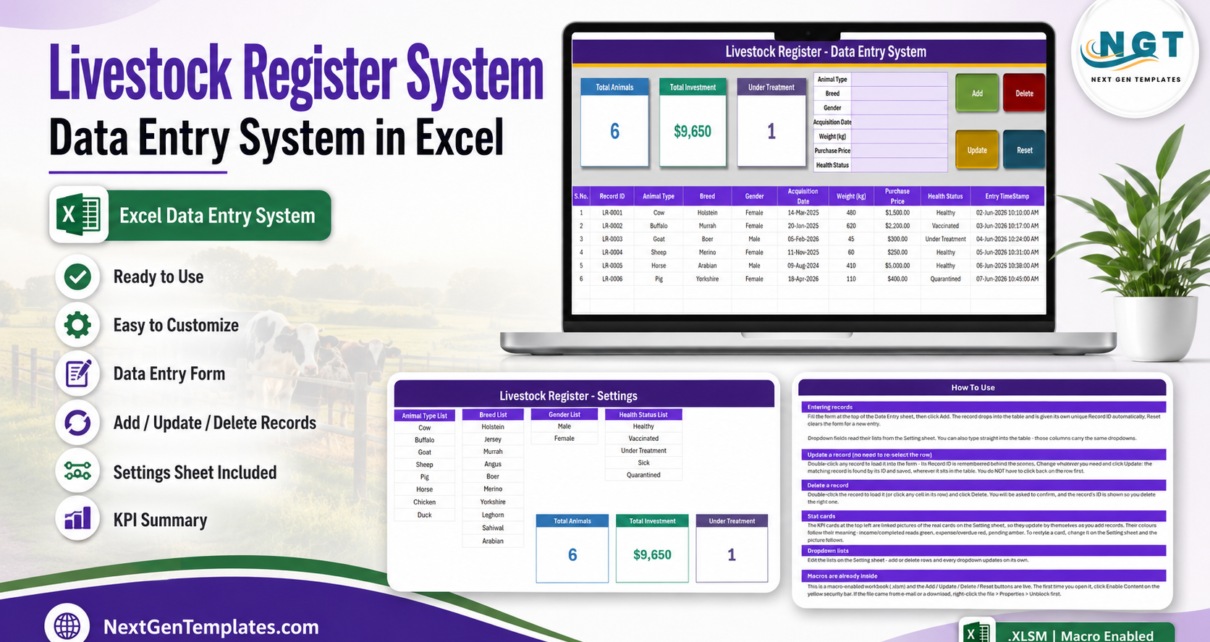
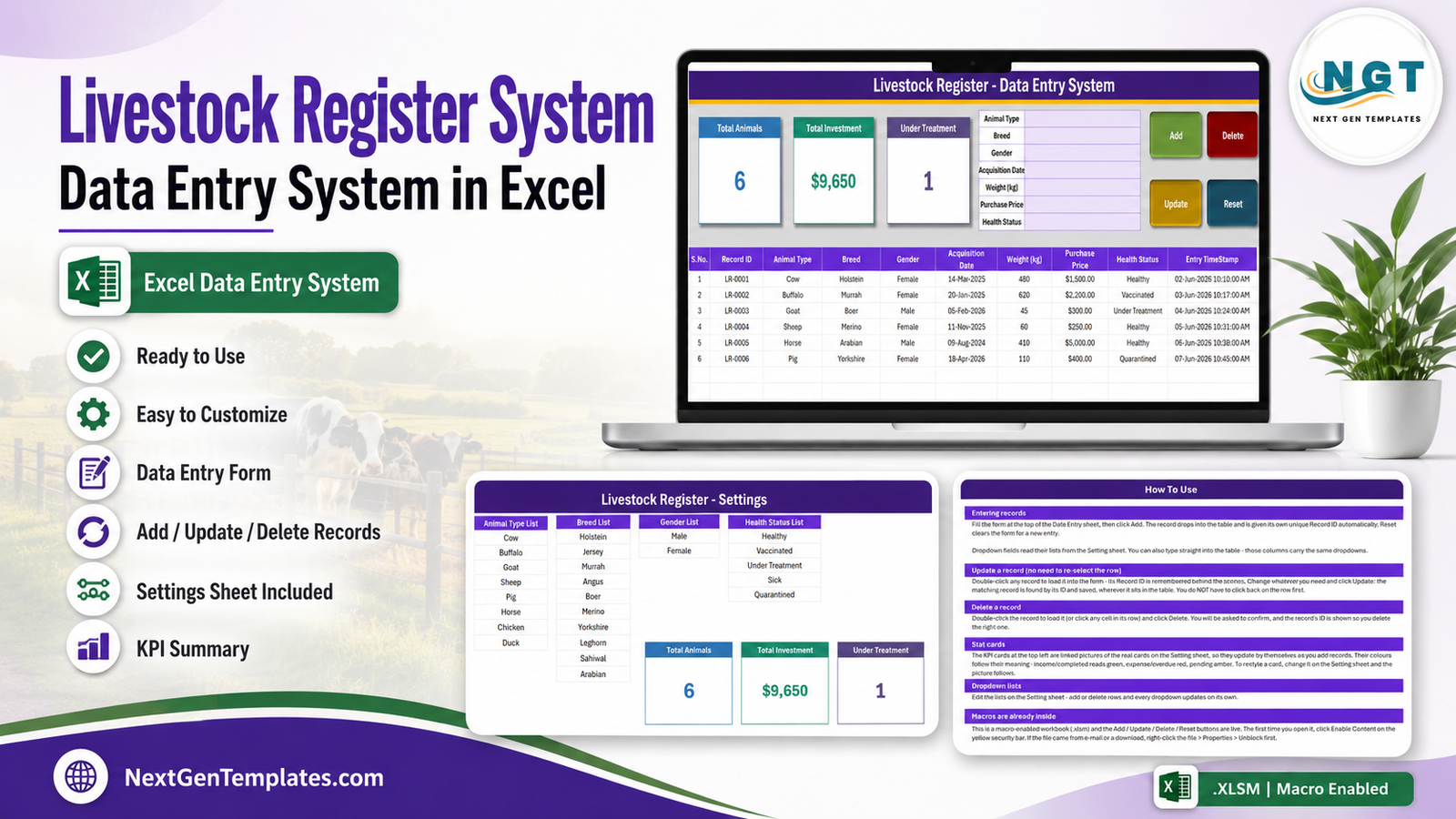
Most small farms still keep their animal records in three places at once: a notebook in the shed, a folder of purchase slips, and somebody’s memory. The Livestock Register Data Entry System in Excel collapses all three into one macro-enabled workbook – a 7-field entry form, four working buttons, three summary cards and a 10-column register where every animal carries its own Record ID and entry timestamp. It ships with 8 animal types, 10 breeds, 2 gender values and 5 health-status labels already loaded, across 4 sheets, for a one-time $6.99 (regular $11.99).
This post walks through what is actually in the file, where it beats a browser spreadsheet, where it does not, and how to get your own register running in about five minutes. Everything shown in the screenshots is sample data that ships with the workbook, not real farm figures.
Key Features of the Livestock Register Data Entry System in Excel
- Seven fields, one panel. Animal Type, Breed, Gender, Acquisition Date, Weight (kg), Purchase Price and Health Status sit together next to the buttons. No pop-up userform, no scrolling to find the next box.
- Add, Update, Delete and Reset are real VBA macros. Add writes the record and returns the form to a clean state, Update saves an edit back to the matching row, Delete asks for confirmation and shows the Record ID it is about to remove, and Reset clears the form.
- Record IDs and timestamps are generated for you. Every animal gets an LR-0001 style ID plus an Entry TimeStamp column, so two Merino ewes of the same weight never blur into one another.
- Three summary cards that keep themselves current. Total Animals counts the register, Total Investment sums the Purchase Price column, and Under Treatment counts the rows currently carrying that status label.
- Double-click to edit. Load a record into the form by double-clicking it. The workbook holds its ID behind the scenes, so Update finds the right row even after you have sorted or filtered the table.
- Every dropdown is yours to change. All four lists live on the Setting sheet; add, delete or rename entries and the form and table columns follow immediately.
- A How To Use sheet inside the workbook. Six short blocks covering entry, editing, deleting, the cards, the lists and macro security.
- One file, offline, no account. A single .xlsm on your own disk. No add-ins, no sign-in, no monthly bill.
Sheet-by-Sheet Walkthrough
The workbook has four sheets and each one does a single job.
Data Entry – where the work happens
The main screen. Three summary cards run along the top left, the seven-field form sits in the middle, the four buttons stack to the right, and the register spreads underneath with ten columns: S.No., Record ID, Animal Type, Breed, Gender, Acquisition Date, Weight (kg), Purchase Price, Health Status and Entry TimeStamp. The six demonstration rows are LR-0001 through LR-0006 and exist purely so the layout is not shown empty – delete them before your first real entry.
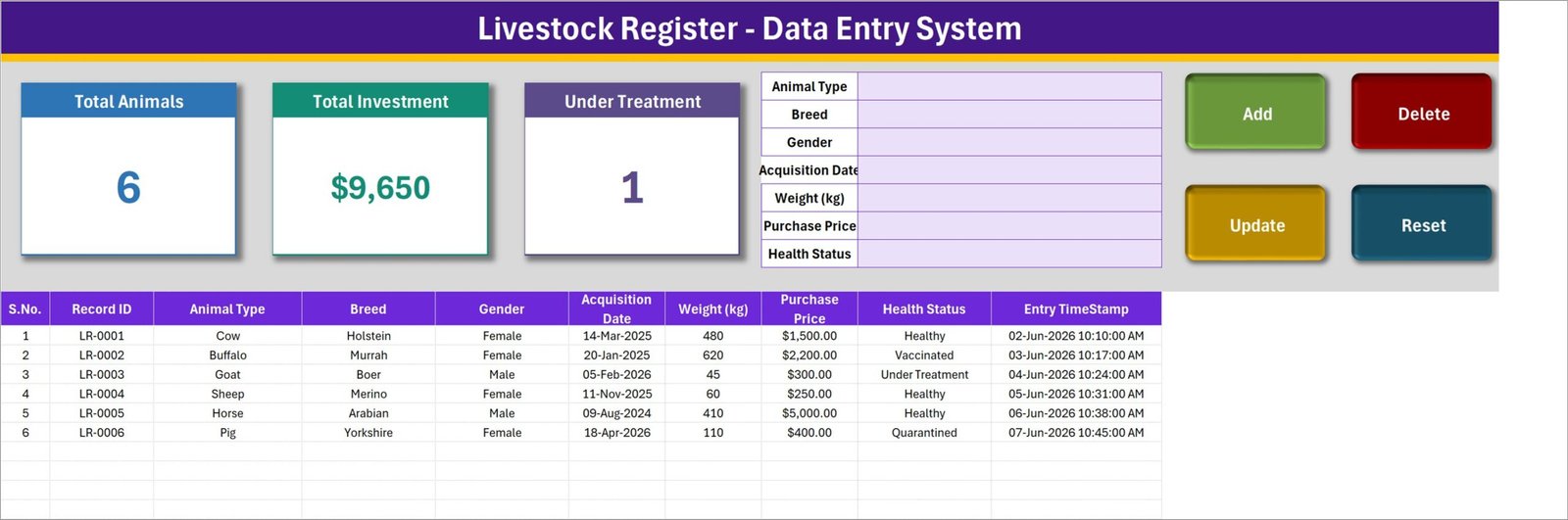
One design decision worth calling out: the register columns carry the same data-validation dropdowns as the form. If you would rather paste in fifty rows from an existing sheet than click Add fifty times, you can, and the values stay consistent.
Setting – the four lists and the master cards
This sheet is the control panel. Animal Type List holds Cow, Buffalo, Goat, Sheep, Pig, Horse, Chicken and Duck. Breed List holds Holstein, Jersey, Murrah, Angus, Boer, Merino, Yorkshire, Leghorn, Sahiwal and Arabian. Gender List holds Male and Female. Health Status List holds Healthy, Vaccinated, Under Treatment, Sick and Quarantined.
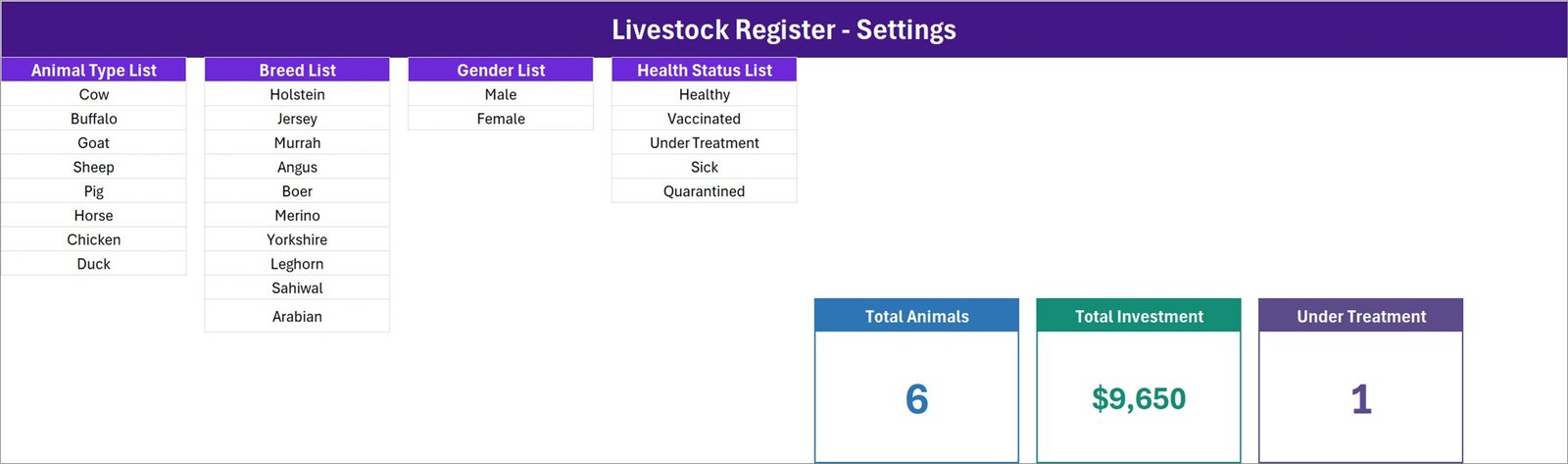
The master versions of the three summary cards also live here. The cards you see on the Data Entry sheet are linked pictures of these, which is why restyling a card here restyles it there – a neat trick worth stealing for your own builds.
How To Use – the manual, shipped inside the file
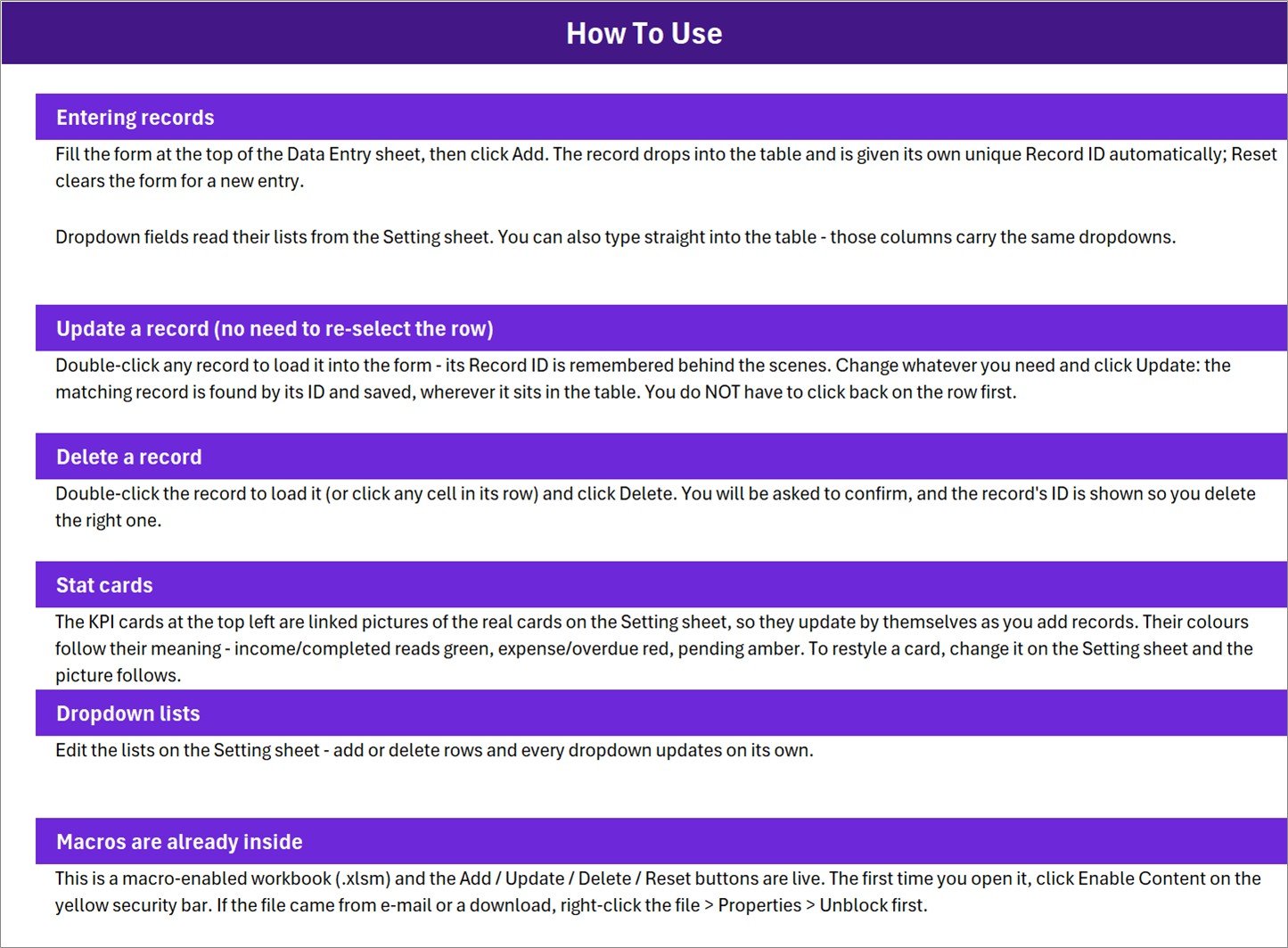
Six blocks: entering records, updating a record without re-selecting the row, deleting safely, how the stat cards refresh themselves, editing the dropdown lists, and macro security. The last block is the one people skip and then e-mail about, so read it first.
Get More Templates
A short closing sheet with links back to the catalogue and the YouTube channel. There is no screenshot of it because there is nothing to configure – it is a signpost, not a feature.
Livestock Register in Excel vs. Google Sheets vs. Paid Farm-Management SaaS – Feature Comparison
| This template (Excel + VBA) | Google Sheets equivalent | Paid farm-management SaaS | |
|---|---|---|---|
| Cost | $6.99 one-time | Free, but you build it | $25-$80 per user per month |
| Platform | Desktop Excel (Windows) | Browser | Browser and mobile app |
| Setup time | Under 5 minutes | 2-6 hours to build the form | Days, plus onboarding |
| Real-time team collaboration | No – single file | Yes | Yes |
| Mobile access | View only | Yes | Yes |
| Customizable fields | Yes – edit the Setting sheet | Yes, if you rebuild it | Only within the vendor’s model |
| Share with link | No – send the file | Yes | Yes |
| Year-1 cost at 5 users | $6.99 | $0 plus your build time | $1,500-$4,800 |
| Works offline | Yes | Limited | Usually not |
| Where your data lives | Your own disk | Your Google account | The vendor’s servers |
Who Should Use This Template
It suits anyone who needs a clean, searchable list of animals and what each one cost: smallholders and family farms, hobby breeders keeping a few dozen head, agricultural colleges teaching record-keeping, farm bookkeepers reconciling purchases at year end, and hostel or research units that simply need an accurate inventory of animals on site.
It is the wrong tool if several people must edit the register simultaneously – Excel files do not merge – or if the person entering data is standing in a field with a phone. It is also not a herd-health, breeding or scheme-reporting system. The workbook records the values you type and counts them; it does not advise on animal care, and it does not submit anything to any registry or programme.
Real-World Use Cases
A 40-head mixed smallholding. Ravi kept purchase slips in a folder and estimated his outlay from memory. Each animal now goes in once, and the Total Investment card produces the figure his accountant asks for every March without a single formula being written.
An agricultural college classroom. Maria hands every student a copy, has them rewrite the Setting sheet to match the college’s own stock, and asks for twenty records. The exercise fits one class period, and the Record ID column makes the lesson about why row numbers are not identifiers almost teach itself.
A small poultry and goat unit. Tom filters the register by Animal Type at month end, checks the Under Treatment count against his own notes, and pastes the table into the owner’s report. No exports, no logins, nothing to renew.
Advantages of the Livestock Register Data Entry System in Excel
- It starts working immediately. Unzip, enable macros, delete six sample rows, and you are entering real records.
- Identity is handled properly. Auto Record IDs and timestamps mean edits and deletions target the right animal even after the table has been re-sorted a dozen times.
- The lists are data, not code. Changing your breeds does not mean touching VBA – it means typing on the Setting sheet.
- The summary cards are honest arithmetic. Count, sum and conditional count over the register. Nothing hidden, nothing to refresh manually.
- You own the file. Back it up, copy it, e-mail it, keep it on a USB stick. There is no service to lose access to.
- It costs less than a bag of feed. $6.99 once, against $1,500 or more per year for a five-seat SaaS subscription.
Opportunities for Improvement
Being straight about the limits saves refund requests.
- Single-user by design. Two people editing two copies produces two registers. Pick one custodian, or move to a shared platform.
- Windows desktop Excel only. Excel for the web and Google Sheets will open the file and show the sheets, but the buttons are inert because neither runs VBA. Mac Excel handles VBA unevenly and some workplaces block macros entirely by policy.
- No charts. The register is a table with three cards. If you want trends by breed, cost per kilogram or month-on-month movement, pair it with a dashboard template.
- No photos or documents. There is no attachment column for ear-tag pictures or purchase invoices; you would need to add one yourself.
- Health Status is a label, not logic. Nothing reminds you about anything. The card simply counts how many rows read Under Treatment right now.
Best Practices
- Unblock before you open. Right-click the extracted .xlsm, choose Properties, tick Unblock, then open it. Files downloaded from the internet arrive with a mark-of-the-web that suppresses macros – see Microsoft’s guidance on enabling or disabling macros in Microsoft 365 files.
- Rewrite the Setting sheet first. Get your own animal types, breeds and status labels in before you enter records, so you never have to re-label rows later.
- Delete the samples on day one. The six LR- rows and the $9,650 total are demo data. Leaving them in quietly corrupts every card you look at.
- Use one status vocabulary and stick to it. Five labels is plenty. The moment somebody types a sixth freehand, the Under Treatment count stops matching reality.
- Keep the file in a synced folder and version it. One file is the entire system, so a monthly copy named with the date is a complete backup.
- Enter the animal on the day it arrives. The Entry TimeStamp records when you typed it, not when the animal came – the Acquisition Date column is the one that carries that meaning.
Explore Relevant Templates
- Livestock Register Data Entry System in Excel – the template this post is about.
- Agriculture and Farm Dashboard in Excel – charts, slicers and trends once the register has some history in it.
- Farm Management KPI Dashboard in Excel – a KPI view over yields, costs and margins.
- Agriculture and Farm Dashboard in Power BI – the same picture in Power BI Desktop.
- Bar Stock Register Data Entry System in Excel and Gift Register Data Entry System in Excel – the same form-and-register engine on other topics.
- Employee Document Data Entry System in Excel and Class Schedule Data Entry System in Excel – two more from the same line.
Frequently Asked Questions
Do I have to enable macros?
Yes. The four buttons are VBA procedures, so click Enable Content on the yellow security bar the first time you open the workbook. If no bar appears, close the file, right-click it, open Properties and tick Unblock.
Will it run in Google Sheets or Excel for the web?
No. Neither runs VBA. Both will display the sheets, but Add, Update, Delete and Reset will do nothing. Use desktop Microsoft Excel on Windows.
Can I add my own animal types, breeds and status labels?
Yes – that is the intended workflow. All four lists are on the Setting sheet, and the form and register columns read straight from them.
How many animals can the register hold?
There is no built-in ceiling. It is an ordinary Excel table and will hold thousands of rows comfortably.
Are the figures in the screenshots real?
No. The six records, the weights and the $9,650 total are sample data included so the layout is not shown empty.
Can I edit a record after saving it?
Yes. Double-click the row to load it into the form, change what you need and click Update. Matching happens on the Record ID, so the correct row is saved even if the table has been re-sorted.
Does the workbook give any animal-health guidance?
No. Health Status is simply a label you pick from your own list, and the Under Treatment card counts how many rows carry it. There is no veterinary, breeding or animal-health advice in the file, and it does not report to any scheme or registry.
About the Author
Built by PK – Microsoft Certified Professional with 15+ years of Excel, Google Sheets, and Power BI experience. Founder of NextGenTemplates, reaching 300K+ subscribers across YouTube channels. Every template is hand-built and tested before release.
Conclusion
A livestock register does not need to be complicated. It needs to be one list, with one row per animal, that somebody actually keeps up to date. The Livestock Register Data Entry System in Excel gives you that in four sheets: a seven-field form with four working buttons, a ten-column register with automatic IDs and timestamps, four editable dropdown lists and three summary cards that never need refreshing. It is a desktop Excel file with macros, it is single-user, and it is honest about both.
If that matches how your farm actually works, get the Livestock Register Data Entry System in Excel for $6.99 – one payment, instant download, lifetime access. For step-by-step Excel and VBA walkthroughs, subscribe at youtube.com/@PKAnExcelExpert.