
The Digital Curriculum Startups Dashboard in Excel gives curriculum founders, EdTech operators, education investors, and portfolio analysts a ready-made way to review startup performance from one editable workbook. It brings together revenue, cost, net profit, licenses, active learners, learning quality, module completion, learner activation, renewal %, profit margin %, and regional performance across 5 dashboard pages.
Curriculum startups often collect data from sales records, learning platforms, spreadsheets, customer success notes, and finance exports. When those numbers stay scattered, teams can miss basic signals: which curriculum type is profitable, which region has strong renewal, which customer segment activates, and which platform supports better completion. This Excel dashboard creates a practical reporting layer that can be refreshed without building every pivot and chart manually.
Key Features of Digital Curriculum Startups Dashboard in Excel
- 5 executive KPI cards: Total Revenue, Net Profit, Total Licenses, Total Active Learners, and Avg. Learning Quality.
- 5 dashboard pages: Overview Page, Curriculum Mix, Startup Growth, Learner Funnel, and Renewal Health.
- 16 analytical chart views: Compare records, licenses, active learners, revenue, cost, curriculum type, startup, delivery platform, region, status, month, quarter, and year.
- Slicer-based filtering: Use Excel slicers to filter dashboard views quickly during operating reviews, investor updates, and product planning meetings.
- Data and Support sheets: Add your records in the Data sheet and keep the Support sheet hidden while it powers the pivot tables behind the charts.
- Editable Excel workbook: Adjust fields, labels, colors, formulas, and chart layouts to match your own curriculum startup reporting model.
If you are new to slicers, Microsoft has a useful guide on how to use slicers to filter Excel data.
Dashboard Pages Explanation
1. Overview Page
The Overview Page is the executive summary of the workbook. The top cards show Total Revenue, Net Profit, Total Licenses, Total Active Learners, and Avg. Learning Quality, giving leaders a quick read on commercial scale, learner engagement, and quality.
Total Records by Status shows how curriculum startup records are distributed across operating or lifecycle states. This helps teams understand whether activity is concentrated in active, pending, renewed, cancelled, or other status groups.
Total Licenses vs Total Active Learners by Region compares access sold against actual learner usage by geography. It helps operators identify regions where license adoption is strong and regions where activation support may be needed.
Total Revenue vs Total Cost by Month shows monthly financial movement. This chart helps finance teams watch whether cost is rising faster than revenue or whether operating leverage is improving.
Total Revenue vs Total Cost by Curriculum Type compares curriculum categories from a financial view. It helps product managers see which curriculum types contribute stronger economics.

Digital Curriculum Startups Dashboard in Excel
2. Curriculum Mix
The Curriculum Mix page focuses on product content, customer segments, delivery platforms, and startup-level revenue contribution.
Module Completion % by Curriculum Type shows which curriculum categories learners complete more consistently. It can guide content improvement, instructional design, and learner support priorities.
Total Licenses vs Total Active Learners by Customer Segment compares licensed access with actual learner engagement across segments. This helps customer success teams find segments where purchased access is underused.
Avg. Learning Quality by Delivery Platform compares quality scores across delivery platforms. It helps teams understand whether web, mobile, blended, cohort-based, or other delivery models are supporting better learner experiences.
Total Revenue by Startup ranks startup revenue contribution. It is useful for portfolio reviews, founder updates, and identifying which businesses drive most of the financial result.

Curriculum Mix
3. Startup Growth
The Startup Growth page is built for growth, acquisition, activation, and profitability review.
Renewal % by Startup shows how well each startup retains customers or learners over time. A high renewal rate can indicate stronger product fit, better support, or more recurring value.
Total Licenses by Acquisition Channel shows where licensed users are coming from. This helps marketing and partnerships teams compare channel contribution and decide where to invest.
Learner Activation % by Customer Segment shows which segments convert access into active usage. It is useful for onboarding planning and customer success prioritization.
Profit Margin % by Region compares financial efficiency across regions. It helps leadership separate high-revenue markets from truly profitable markets.

Startup Growth
4. Learner Funnel
The Learner Funnel page connects learner progress, active usage, yearly renewal, and platform-level completion.
Total Completed Modules by Month tracks completed learning activity over time. This helps teams identify active learning periods and months where completion slows down.
Total Active Learners by Adoption Band groups active learners by adoption level. It helps customer success teams understand whether users are deeply engaged or only lightly active.
Renewal % by Year shows long-term retention movement. It helps leaders see whether renewal performance is improving or weakening across reporting years.
Module Completion % by Delivery Platform compares completion across platforms. It can reveal whether certain delivery formats support stronger learner progress.

Learner Funnel
5. Renewal Health
The Renewal Health page focuses on retention, status mix, quarterly profitability, and regional net profit.
Renewal % by Region shows geographic renewal patterns. It helps teams see where customers continue and where churn risk may need investigation.
Renewal % by Status compares renewal by record status. This can help connect operating status with customer retention outcomes.
Profit Margin % by Quarter shows margin trend across quarters. It helps finance teams understand whether business efficiency is improving during the year.
Net Profit by Region compares bottom-line contribution across regions. This is useful when revenue alone does not show the full cost and profit story.
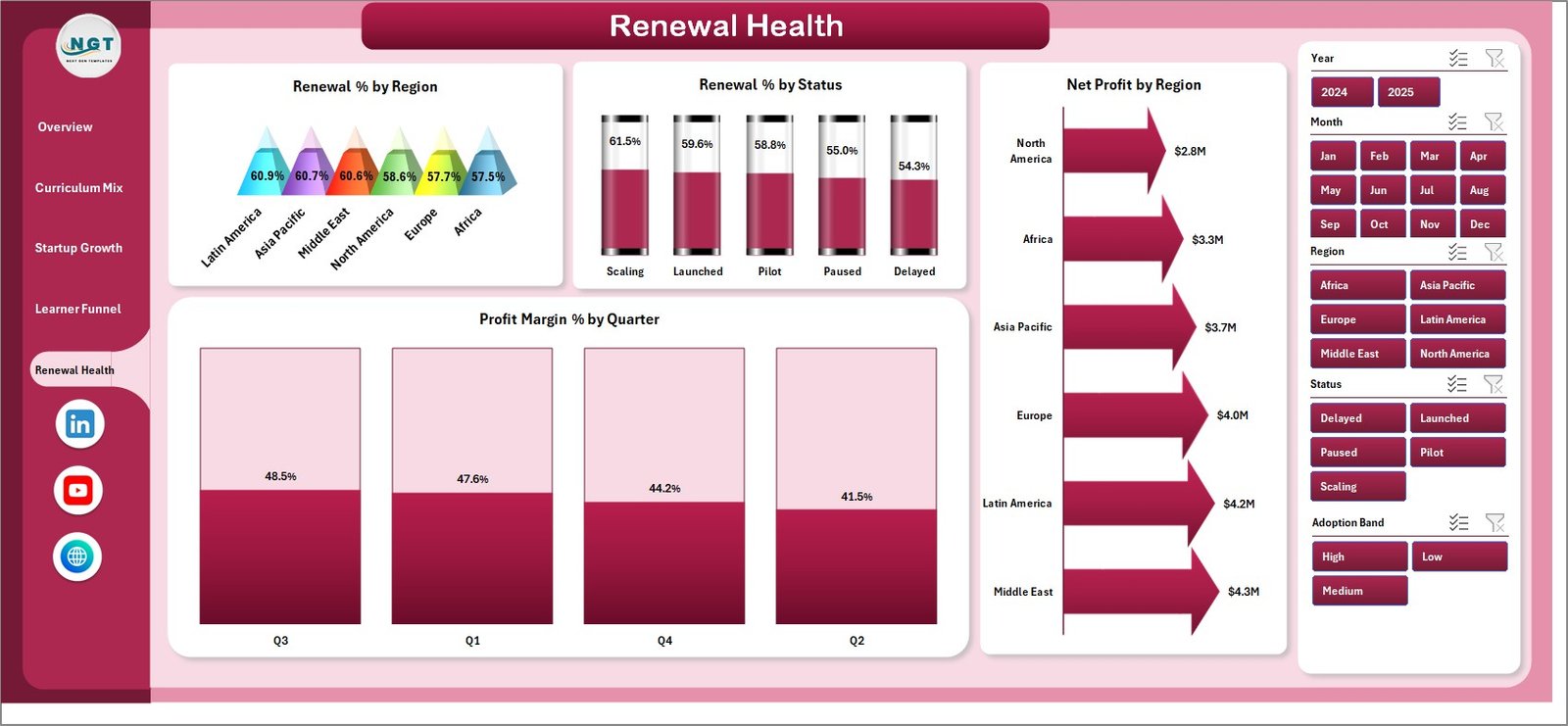
Renewal Health
6. Data Sheet Tab
The Data sheet is where the source records are stored. Replace the sample rows with your own curriculum startup records, keep the same column format, and refresh the workbook. This structure makes the dashboard reusable for monthly reporting, portfolio tracking, and management review.

Data Sheet tab
7. Support Sheet Tab
The Support sheet contains multiple pivot tables used to create the dashboard dynamically. After changing the Data sheet, open the Data tab in the Excel Ribbon and click Refresh All. All pivots and connected charts refresh together. You can keep this sheet hidden during day-to-day use.

Support sheet tab
Digital Curriculum Startups Dashboard in Excel vs. Google Sheets vs. Paid CRM/SaaS – Feature Comparison
| Feature | This Excel Dashboard | Google Sheets Alternative | Paid CRM/SaaS |
|---|---|---|---|
| Cost | $17.99 one-time | Template cost or manual build | Monthly or annual subscription |
| Platform | Microsoft Excel desktop | Browser-based spreadsheet | Vendor-hosted cloud app |
| Setup time | Replace data and refresh | Build formulas, pivots, charts, and filters | Implementation and onboarding |
| Real-time team collaboration | Possible through OneDrive or shared drive | Native collaboration | Usually included |
| Mobile access | Excel mobile app for review | Google Sheets mobile app | Usually included |
| Customizable fields | Fully editable workbook | Editable if formulas are maintained | Limited by vendor settings |
| Share with link | Possible through OneDrive permissions | Native link sharing | Login controlled |
| Year-1 cost at 5 users | $17.99 total plus Excel licensing you already use | Template cost plus build time | Often hundreds or thousands |
| Curriculum startup reporting | Built in across 5 pages | Must be designed | Usually generic unless customized |
Who Should Use This Template
This template is useful for digital curriculum founders, EdTech startup operators, curriculum product managers, online learning platform teams, education investors, accelerator analysts, customer success teams, and consultants who need an Excel-based reporting layer for licenses, active learners, module completion, learner activation, learning quality, renewal, revenue, cost, and profit.
It is not a replacement for an LMS, CRM, billing system, student information system, or live product analytics tool. It works best when your data is already approved and ready to paste into Excel for periodic reporting.
Real-World Use Cases
Ana, EdTech founder: Ana uses the Overview and Startup Growth pages before investor calls to explain revenue, net profit, licenses, active learners, activation, and renewal.
Rahul, curriculum product manager: Rahul reviews Module Completion % by Curriculum Type and Delivery Platform to decide where course design and learner support need attention.
Maya, portfolio analyst: Maya compares Total Revenue by Startup, Renewal % by Startup, Profit Margin % by Region, and Net Profit by Region to prepare monthly portfolio notes.
Advantages of Digital Curriculum Startups Dashboard in Excel
- Faster reporting: The dashboard pages, KPI cards, charts, and slicers are already structured.
- Clear startup view: Revenue, cost, profit, learners, licenses, renewal, activation, and quality are visible in one workbook.
- Affordable ownership: The template is a one-time purchase instead of a recurring SaaS subscription.
- Flexible editing: You can adjust fields, labels, formulas, and visuals based on your reporting model.
- Excel familiarity: Teams that already use Excel can adopt it without waiting for a BI implementation.
Opportunities for Improvement
The dashboard is intentionally Excel-based and manual-refresh. That makes it affordable and easy to customize, but it does not provide live API refresh, role-based login, automated alerts, or LMS-level learner management. Larger teams may later connect exports to Power Query, Power BI, or a governed data warehouse if they need scheduled refresh and controlled permissions.
Best Practices
- Keep the Data sheet column structure consistent when adding new records.
- Refresh all pivots after each data update before reviewing the dashboard.
- Use the same date, region, status, and curriculum type definitions across all records.
- Validate revenue, cost, learner, and license data before presenting the dashboard.
- Keep the Support sheet hidden for clean viewing, but do not delete it.
- Save a backup copy before making major layout or formula changes.
Explore Relevant Templates
Related templates include Coding Bootcamps Dashboard in Excel, Tutoring Business Dashboard in Google Sheets, and Career Mentorship Platforms Dashboard in Power BI. You can also browse all Excel dashboard templates on NextGenTemplates.
Frequently Asked Questions
What does this Excel dashboard track?
It tracks revenue, cost, net profit, licenses, active learners, learning quality, module completion, learner activation, renewal %, profit margin %, regions, startups, curriculum types, delivery platforms, customer segments, and status.
How many pages are included?
The workbook includes 5 dashboard pages: Overview Page, Curriculum Mix, Startup Growth, Learner Funnel, and Renewal Health. It also includes Data and Support sheets.
Do I need macros or VBA?
No. The template uses Excel charts, slicers, and pivot tables. You refresh it from the Excel Data tab.
Can I use my own data?
Yes. Replace the sample records in the Data sheet with your own data while keeping the same column format, then click Refresh All.
Can I customize the workbook?
Yes. You can edit chart titles, colors, fields, labels, and formulas if you are comfortable working in Excel.
Is this a live LMS or CRM connector?
No. It is an Excel reporting template. It does not connect directly to an LMS, CRM, payment system, or product analytics platform.
What Excel version should I use?
Use Microsoft Excel desktop with PivotTable and slicer support, ideally Excel 2016 or later or Microsoft 365.
About the Author
Built by PK – Microsoft Certified Professional with 15+ years of Excel, Google Sheets, and Power BI experience. Founder of NextGenTemplates, reaching 300K+ subscribers across YouTube channels. Every template is hand-built and tested before release.
Conclusion
The Digital Curriculum Startups Dashboard in Excel is a practical reporting template for teams that want clearer curriculum startup analytics without building an Excel dashboard from zero. It combines KPI cards, slicers, pivot-powered charts, source data structure, and multi-page analysis for revenue, cost, profit, licenses, learners, renewals, completion, activation, and learning quality.
Click here to purchase the Digital Curriculum Startups Dashboard in Excel
Visit our YouTube channel for Excel dashboard tutorials: YouTube.com/@PK-AnExcelExpert
Last updated: June 2026


