Managing a modern telehealth operation means juggling numbers from every direction — appointment revenue, no-show rates, doctor productivity, specialty mix, channel performance, and patient demographics. Spreadsheets help, but rebuilding the same PivotTables every week is tedious, and paid telehealth BI platforms can easily run $140 to $700 per provider per month. The Telehealth Dashboard in Excel closes that gap with a one-time $17.99 purchase that gives small clinics and virtual-care startups a 5-page, 16-chart dashboard powered entirely by Excel PivotTables and slicers.
In this post, I’ll walk through what’s inside the Telehealth Dashboard in Excel, how it compares to Power BI and paid SaaS alternatives, who it’s designed for, and how to set it up in under 10 minutes.
Key Features of the Telehealth Dashboard in Excel
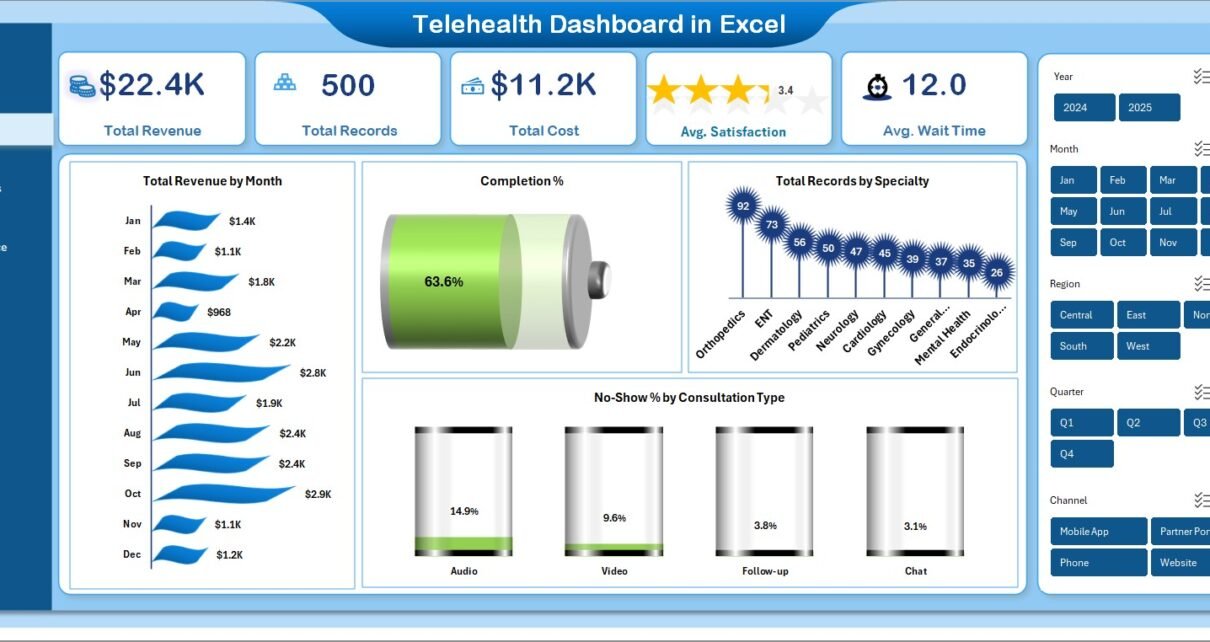
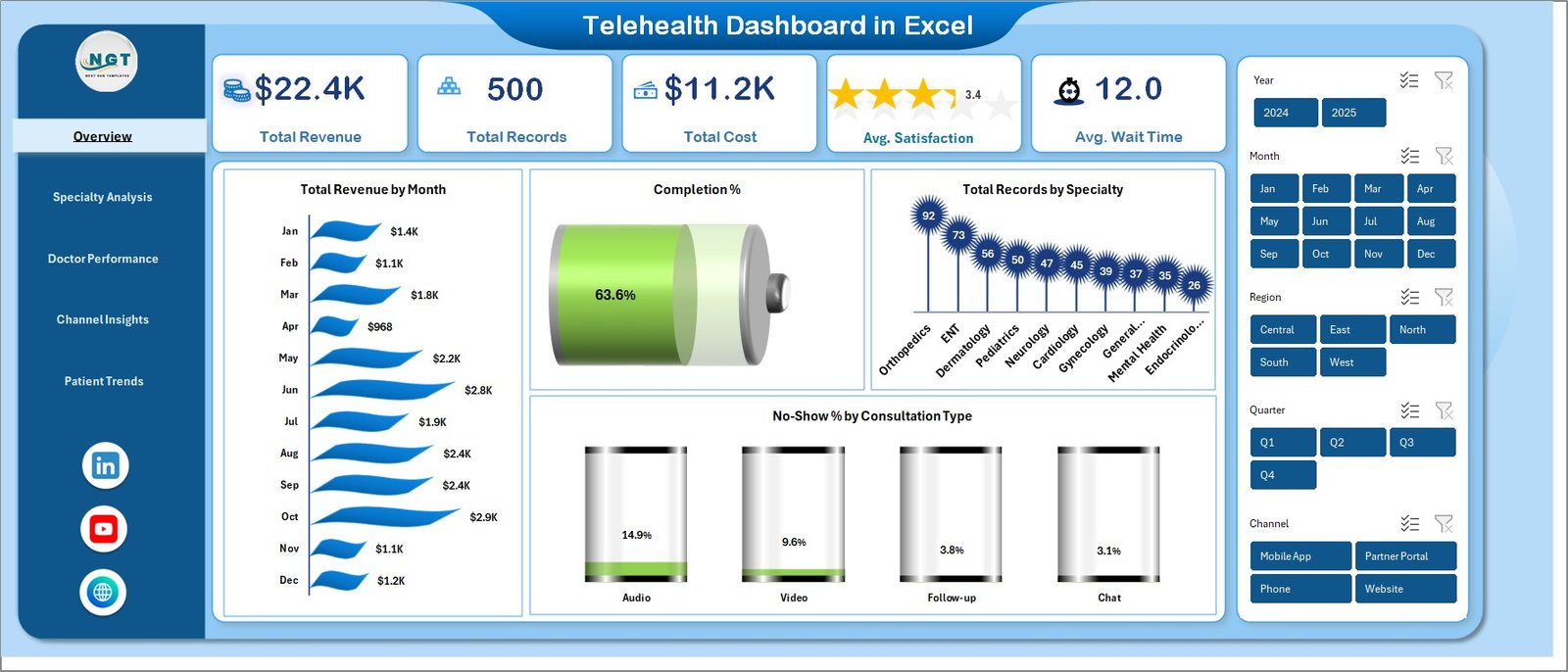
The Telehealth Dashboard in Excel tracks 5 headline KPIs — Total Revenue, Total Records, Total Cost, Avg. Satisfaction, and Avg. Wait Time — across 5 interactive pages. Every visual is driven by a PivotTable on a hidden Support sheet, so updating the raw Data sheet and clicking Refresh All propagates changes across every chart. No formula rewriting, no broken links, no macros.
The workbook is fully unprotected. You can rebrand chart colors, add custom KPIs, insert new slicers, or add new columns to the Data sheet and extend the dashboard. It runs 100% offline in Microsoft Excel 2016, 2019, 2021, and Microsoft 365 on Windows and Mac — no internet connection, no add-ins, and no per-user fees ever.
For a deeper dive into PivotTable-driven dashboards, Microsoft’s PivotTable documentation is a good primer.
Dashboard Pages Explanation
1 — Overview Page
The top of this sheet shows the 5 KPI cards. Four main charts sit underneath — Total Revenue by Month, Completion % by Appointments, Total Records by Specialty, and No-Show % by Consultation Type. Slicers on the right let you filter the entire page by specialty, consultation type, or channel in one click.
2 — Specialty Analysis
This sheet drills into profitability and efficiency by medical specialty. You get a combo Total Revenue vs. Total Cost by Specialty chart, Avg. Consultation Minutes by Specialty, and Resolution % by Specialty. Useful for identifying which specialties are most profitable per consultation minute.
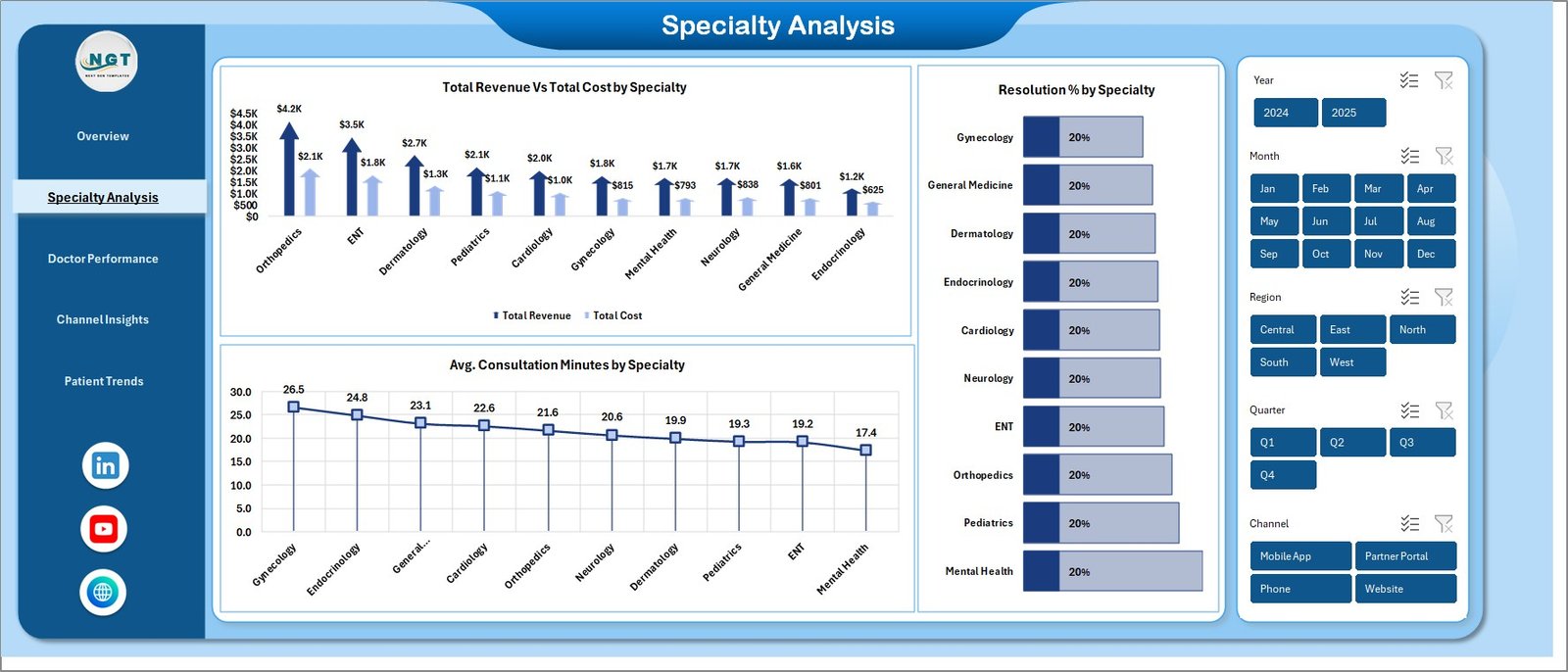
Specialty Analysis page
3 — Doctor Performance
Three provider-level charts — Total Revenue by Doctor Name, Avg. Consultation Minutes by Doctor Name, and Resolution % by Doctor Name. This is the page clinic operations leads use for individual coaching and quarterly performance reviews.
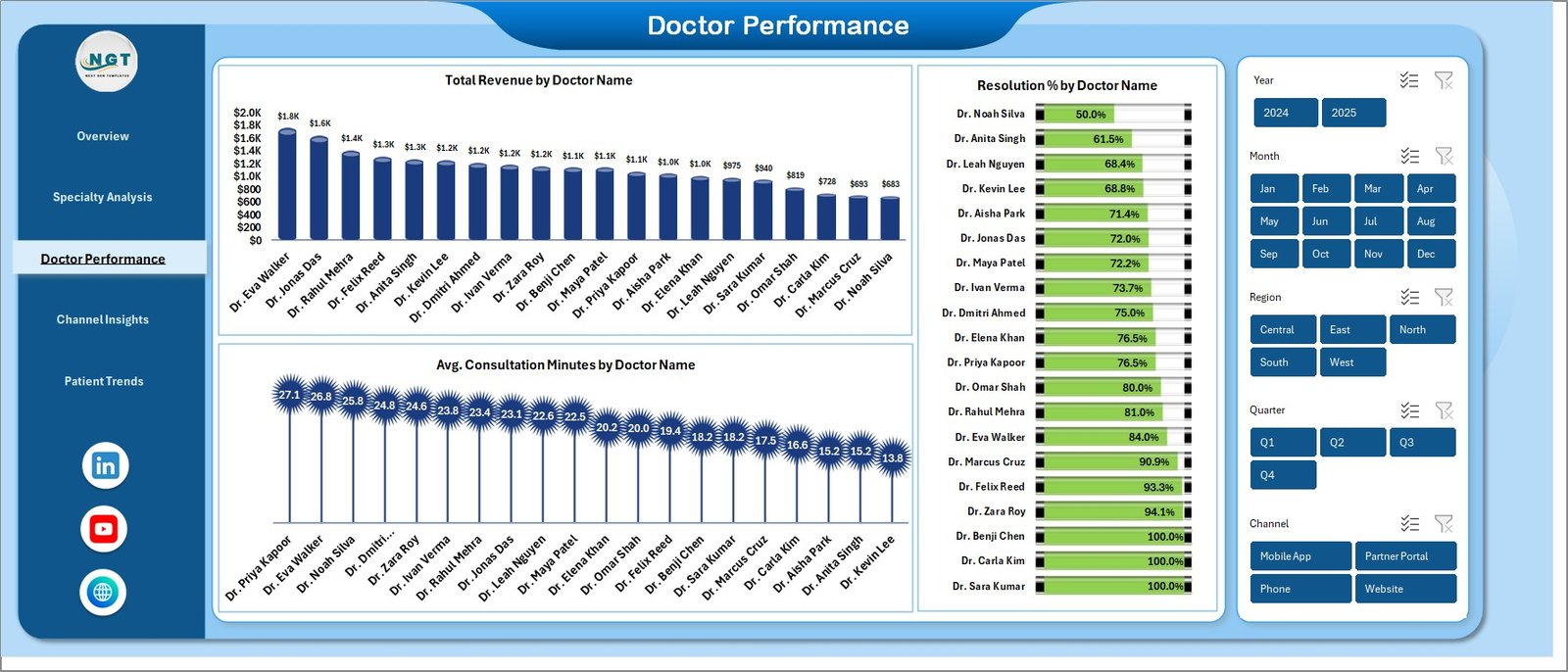
Doctor Performance page
4 — Channel Insights
Shows Total Records by Channel, Total Records by Device, Avg. Revenue Per Appointment by Channel, and Total Revenue by Consultation Type. If you’re running paid acquisition or comparing app vs. web vs. phone bookings, this is where the ROI picture lives.
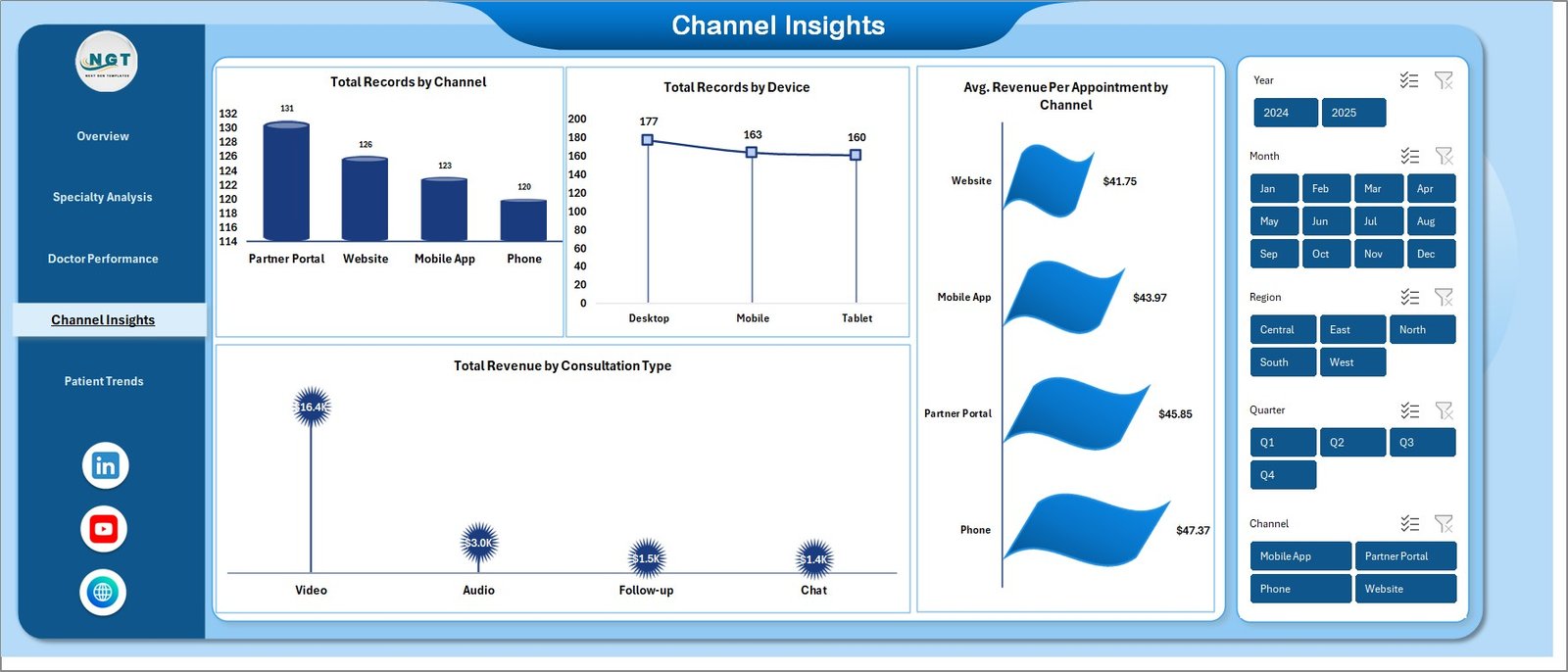
Channel Insights page
5 — Patient Trends
Demographic and payer view: Total Records by Patient Type, Total Records by Age Group, and Total Revenue by Insurance Type. Especially useful for investor decks and board reporting — payer mix is often the first question external stakeholders ask.
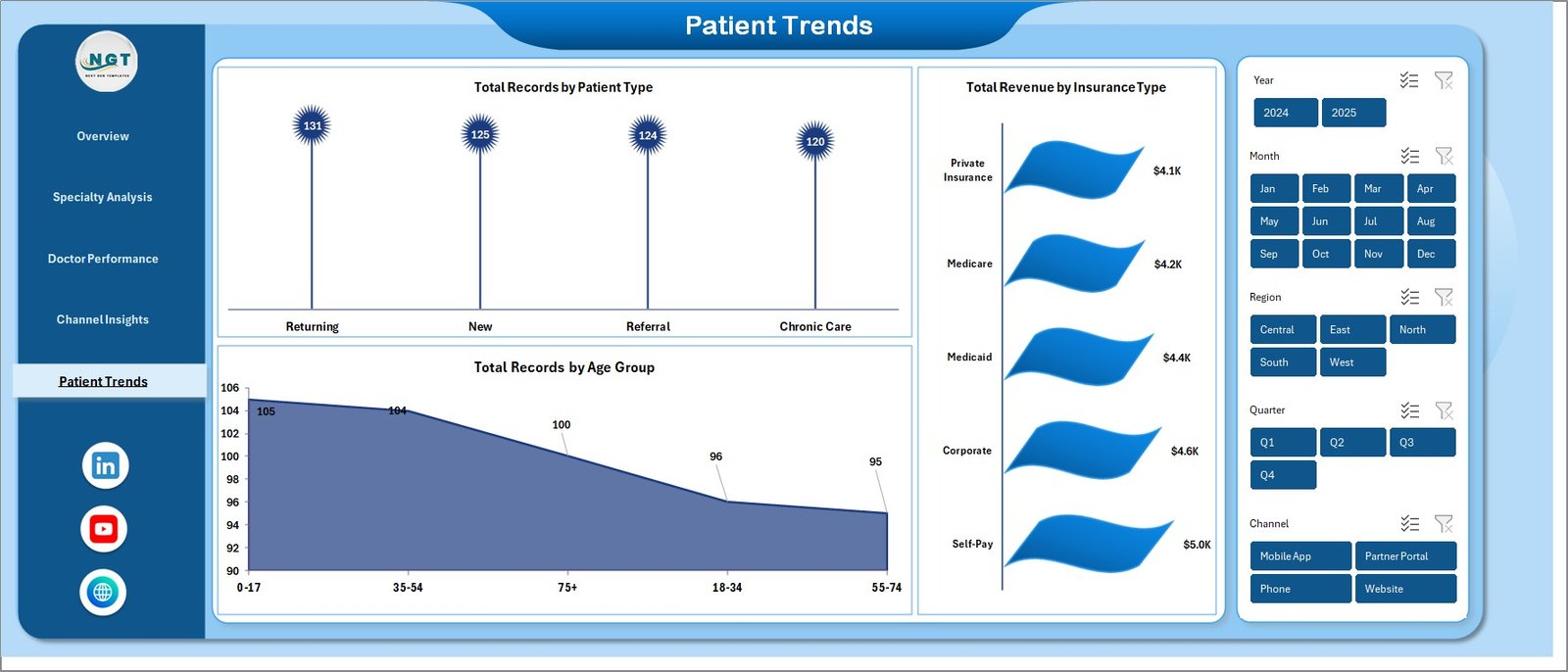
Patient Trends page
6 — Data Sheet
The raw input sheet. Replace the sample rows with your own telehealth appointment records — keep the column headers intact and the PivotTables will pick everything up after a refresh.

7 — Support Sheet
Holds every PivotTable that drives the visible charts. After you update the Data sheet, go to the Data tab in the Excel Ribbon and click Refresh All — every pivot and every chart recalculates. You can hide this sheet in production.

Telehealth Dashboard in Excel vs. Power BI vs. Paid Telehealth SaaS — Feature Comparison
| Feature | Telehealth Dashboard in Excel | Power BI Telehealth Dashboard | Paid Telehealth SaaS (Athenahealth / Kareo) |
|---|---|---|---|
| Cost | $17.99 one-time | $11.99–$17.99 one-time | $140–$700 / provider / month |
| Platform | Microsoft Excel (offline) | Power BI Desktop + optional Pro | Cloud SaaS, vendor-hosted |
| Setup time | Under 10 minutes | 15–20 minutes | 2–6 weeks |
| Works offline | ✅ | ⚠️ Limited | ❌ Internet required |
| Share with link | Email the .xlsx | Power BI Pro seat required | ✅ Built-in |
| Per-user fees | ✅ None | ~$10 / user / month | $140+ / provider / month |
| Year-1 cost (5 providers) | $17.99 | ~$600 | $8,400–$42,000 |
| Best for | Small clinics, telehealth startups | Multi-clinic BI teams | Large hospital systems |
For telehealth clinics that want daily KPI visibility without a five-figure analytics bill, the Telehealth Dashboard in Excel sits in the sweet spot.
Who Should Use This Template
Perfect for:
- Telehealth startups and virtual-care clinics with 2–50 providers
- Multi-specialty practice managers running hybrid in-person and video consultations
- Digital health ops leads reporting specialty revenue and doctor productivity to investors
- Healthcare consultants building client-ready telehealth performance decks
Not a fit if:
- You need HIPAA-audited, FHIR/HL7-integrated BI (use Epic, Cerner, or Athenahealth BI)
- You need real-time streaming from an EHR — this dashboard is refresh-based
- You don’t have Excel 2016+ — try the Telemedicine Platforms KPI Dashboard in Power BI instead
Real-World Use Cases
Dr. Priya runs a 12-provider virtual cardiology and dermatology clinic. She uses the Telehealth Dashboard in Excel every Monday to pull last week’s completion rate, no-show percentage, and revenue-by-specialty numbers for her leadership stand-up — replacing a $280/month Kareo analytics add-on her clinic was paying before.
Marcus is a healthcare operations consultant. He rebuilds this dashboard for each of his four telehealth clients every quarter, dropping their appointment exports into the Data sheet and delivering specialty and doctor-level performance decks in under an hour — work that used to take him a full afternoon in Tableau.
Leena is the founder of a two-person telehealth startup. She uses the Patient Trends page to show investors how her payer mix and age-group distribution are shifting month over month, without paying for a BI seat she can’t yet justify.
Advantages of the Telehealth Dashboard in Excel
Three benefits stand out. First, cost — $17.99 once versus $8,400+ per year for comparable paid SaaS at 5 providers. Second, speed — you can go from a raw appointment export to a fully formatted leadership report in about 10 minutes. Third, flexibility — because the workbook is unprotected, you can add pivot fields, custom KPIs, or branded chart colors without fighting a vendor’s configuration UI.
Data stays entirely on your machine. No cloud sync, no telemetry, no external connections — important for healthcare data privacy even outside of formal HIPAA environments. Store it on an encrypted drive or internal SharePoint like any other .xlsx.
Opportunities for Improvement
The dashboard is refresh-based, not real-time — so if you want live intra-day KPI monitoring, you’ll need Power BI with a streaming dataset or a paid BI platform. It also doesn’t include EHR integration or automated data ingestion; you’ll need to export appointments from your EHR and paste them into the Data sheet each refresh cycle. For solo practitioners or teams under 3 providers, the 5-page structure may be more than you need — the Telehealth KPI Scorecard in Excel is a leaner alternative for monthly MTD/YTD reviews.
Best Practices
Keep the Data sheet structure consistent — don’t rename columns or reorder them, because every PivotTable references columns by name. When you add new columns, append them to the right of the existing ones, then drag them into the appropriate PivotTable on the Support sheet. Click Refresh All after every Data-sheet edit, even small ones, to catch errors early. For monthly reporting, save a dated copy of the workbook (e.g., “Telehealth_Dashboard_2026_04.xlsx”) so you can compare month-over-month trends without re-deriving them.
Explore Related Templates
💎 Save 38% with the Healthcare & Hospital Management Bundle — 8 premium healthcare templates in one package.
Related products worth exploring:
- Medical Practice Dashboard in Excel — for in-person clinic operations
- Pharmacy Dashboard in Excel — for pharmacy revenue and inventory
- Telehealth KPI Scorecard in Excel — MTD/YTD scorecard alternative
- Hospital Patient Flow Dashboard in Google Sheets
Also available as: Telemedicine Platforms KPI Dashboard in Power BI. Browse all Excel Dashboard Templates.
Frequently Asked Questions
What KPIs does the Telehealth Dashboard in Excel track?
The Telehealth Dashboard in Excel tracks 5 headline KPIs — Total Revenue, Total Records, Total Cost, Avg. Satisfaction, and Avg. Wait Time — plus 16 drill-down charts covering specialty revenue, doctor performance, no-show %, channel mix, and patient demographics. All metrics refresh automatically after you update the Data sheet.
How long does setup take?
Setup takes under 10 minutes. Download the .zip, open the .xlsx in Excel, paste your appointment data into the Data sheet in the same column format, and click Refresh All on the Data tab. Every card, chart, and slicer in the Telehealth Dashboard in Excel updates automatically.
How does this compare to paid telehealth SaaS like Athenahealth or Kareo?
The Telehealth Dashboard in Excel is a one-time $17.99 purchase with unlimited users, versus $140–$700 per provider per month for cloud SaaS. For small-to-mid telehealth clinics that don’t need EHR integration or HIPAA-audited hosting, the Excel dashboard delivers 80% of the same reporting at less than 1% of the year-one cost.
Do I need macros or special add-ins?
No macros, no add-ins, no internet connection. The Telehealth Dashboard in Excel runs on standard Excel PivotTables, charts, and slicers — everything works in Microsoft Excel 2016, 2019, 2021, and Microsoft 365 on Windows and Mac.
Can I customize the charts and add my own KPIs?
Yes — the workbook is unprotected. You can change chart colors to match your brand, add new pivot fields on the Support sheet, insert new slicers, or add extra columns to the Data sheet. Click Refresh All after any Data-sheet change.
Is my patient data safe?
Nothing leaves your computer. The Telehealth Dashboard in Excel is a standalone .xlsx file that runs 100% offline. No telemetry, no cloud sync, no external data connections. Store it on an encrypted drive or internal SharePoint like any other Excel workbook.
About the Author
Built by PK — Microsoft Certified Professional with 15+ years of Excel, Google Sheets, and Power BI experience. Founder of NextGenTemplates, reaching 300K+ subscribers across YouTube channels. Every template is hand-built and tested before release.
Conclusion
The Telehealth Dashboard in Excel is designed for telehealth clinics and virtual-care startups that need a clear, refresh-driven view of revenue, no-show rates, specialty performance, and patient demographics — without the monthly BI subscription bill. At $17.99 one-time, it pays for itself the first week you skip a $280/month analytics add-on.
👉 Click here to Purchase the Telehealth Dashboard in Excel
✅ Instant download · One-time payment · No subscription · Lifetime access
Visit our YouTube channel for step-by-step video tutorials: Youtube.com/@PK-AnExcelExper