Bridge construction projects involve complex planning, strict safety regulations, budget management, and continuous monitoring of performance indicators. However, many construction companies still rely on scattered spreadsheets, manual reporting, and delayed data analysis. As a result, project managers often struggle to track progress, monitor productivity, and identify performance issues early.
Therefore, organizations increasingly use KPI dashboards to monitor construction performance in a structured way. A well-designed KPI dashboard helps managers analyze key performance indicators, track project progress, and improve decision-making.
That is exactly where the Bridge Construction KPI Dashboard in Excel becomes an essential project management tool.
This ready-to-use Excel dashboard allows construction teams to track performance metrics such as project progress, safety compliance, cost efficiency, productivity, and operational performance in one centralized location. Instead of reviewing multiple reports, managers can analyze all bridge construction KPIs through a single interactive dashboard.
In this detailed guide, you will learn:
-
What a Bridge Construction KPI Dashboard is
-
Why bridge construction projects require KPI tracking
-
Key features of the Excel dashboard template
-
Advantages of using this dashboard
-
Best practices for implementation
-
Frequently asked questions
Let’s explore everything step by step.
Click to Purchases Bridge Construction KPI Dashboard in Excel
What Is a Bridge Construction KPI Dashboard in Excel?
A Bridge Construction KPI Dashboard in Excel is a structured performance monitoring tool designed to track key performance indicators related to bridge construction projects.
Instead of collecting information manually from different project reports, this dashboard consolidates all KPI data into one centralized Excel interface. As a result, project managers, engineers, and construction teams can monitor project performance efficiently.
The dashboard provides insights into important project metrics such as:
-
Construction progress
-
Budget utilization
-
Safety incidents
-
Labor productivity
-
Equipment utilization
-
Project delays
-
Material usage efficiency
Moreover, the Excel dashboard automatically compares Actual values, Target values, and Previous Year performance, which helps teams evaluate whether the project performs according to expectations.
Because the dashboard uses interactive elements such as drop-down selections, trend charts, and conditional formatting indicators, users can easily analyze monthly and yearly project performance.
Why Do Bridge Construction Projects Need KPI Dashboards?
Bridge construction projects involve multiple stakeholders, complex timelines, and significant financial investments. Therefore, project managers need a reliable system to monitor performance indicators regularly.
Without proper KPI tracking, construction projects often face:
-
Cost overruns
-
Delays in project completion
-
Safety incidents
-
Poor resource allocation
-
Low productivity
However, when organizations implement KPI dashboards, they gain clear visibility into project performance.
For example, a Bridge Construction KPI Dashboard allows managers to:
-
Monitor progress in real time
-
Compare performance against targets
-
Identify risks early
-
Improve operational efficiency
-
Make data-driven decisions
Consequently, construction teams can complete projects faster while maintaining quality and safety standards.
Click to Purchases Bridge Construction KPI Dashboard in Excel
Key Features of the Bridge Construction KPI Dashboard in Excel
This Bridge Construction KPI Dashboard template includes several interactive features that simplify project performance tracking.
The dashboard consists of seven worksheets, each designed for a specific purpose.
1. Home Sheet – Navigation Panel
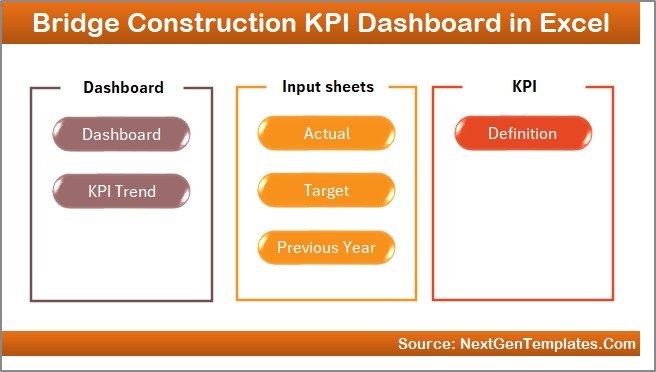
The Home Sheet acts as the index page of the dashboard.
Instead of searching for different worksheets manually, users can navigate easily through the dashboard.
Key features include:
-
Six navigation buttons
-
Quick access to important dashboard pages
-
Easy user interface for faster navigation
Therefore, the Home Sheet improves usability and saves time while navigating through the dashboard.
Click to Purchases Bridge Construction KPI Dashboard in Excel
2. Dashboard Sheet – Main KPI Monitoring Page
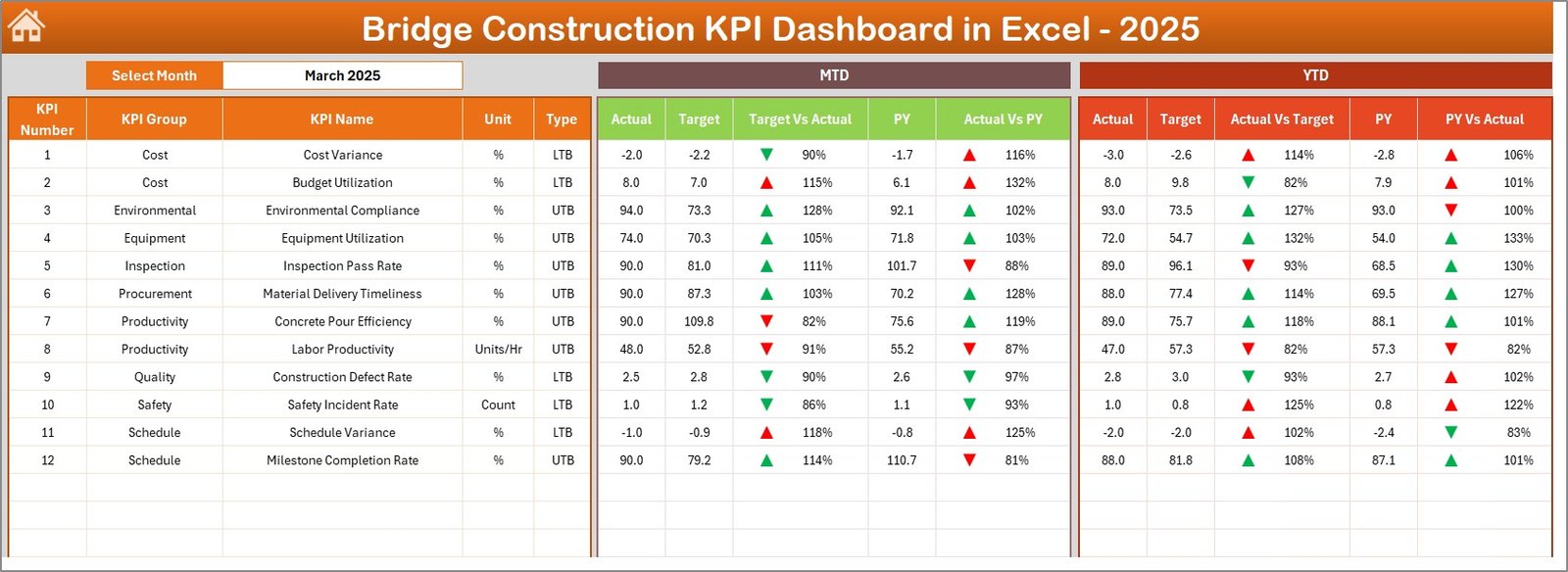
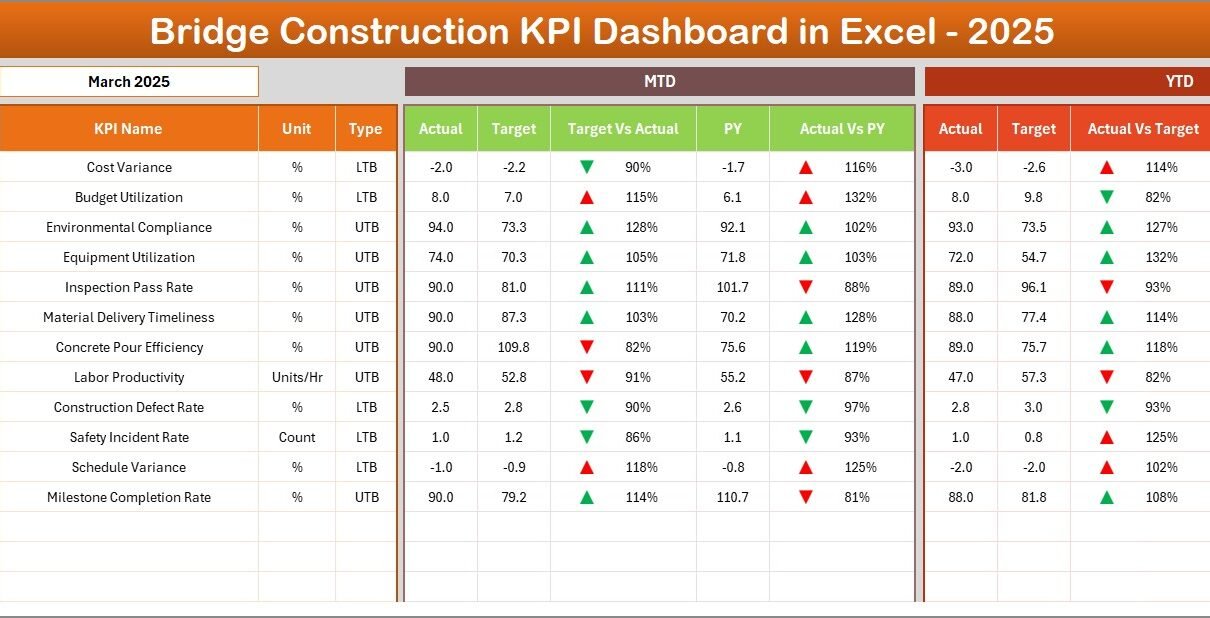
The Dashboard Sheet serves as the central analytics page of the KPI dashboard.
This page displays a comprehensive overview of all key performance indicators related to bridge construction.
Interactive Month Selection
Users can select the month from the drop-down list in cell D3. Once the user selects a month, the dashboard automatically updates all KPI metrics for that selected period.
Performance Comparison Metrics
The dashboard displays the following comparisons:
-
MTD Actual vs Target
-
MTD Actual vs Previous Year
-
YTD Actual vs Target
-
YTD Actual vs Previous Year
These comparisons help project managers evaluate performance accurately.
Conditional Formatting Indicators
The dashboard also includes visual indicators such as:
-
Up arrows for positive performance
-
Down arrows for negative performance
-
Color indicators for quick insights
As a result, managers can identify performance improvements or issues immediately.
Click to Purchases Bridge Construction KPI Dashboard in Excel
3. KPI Trend Sheet – Performance Trend Analysis
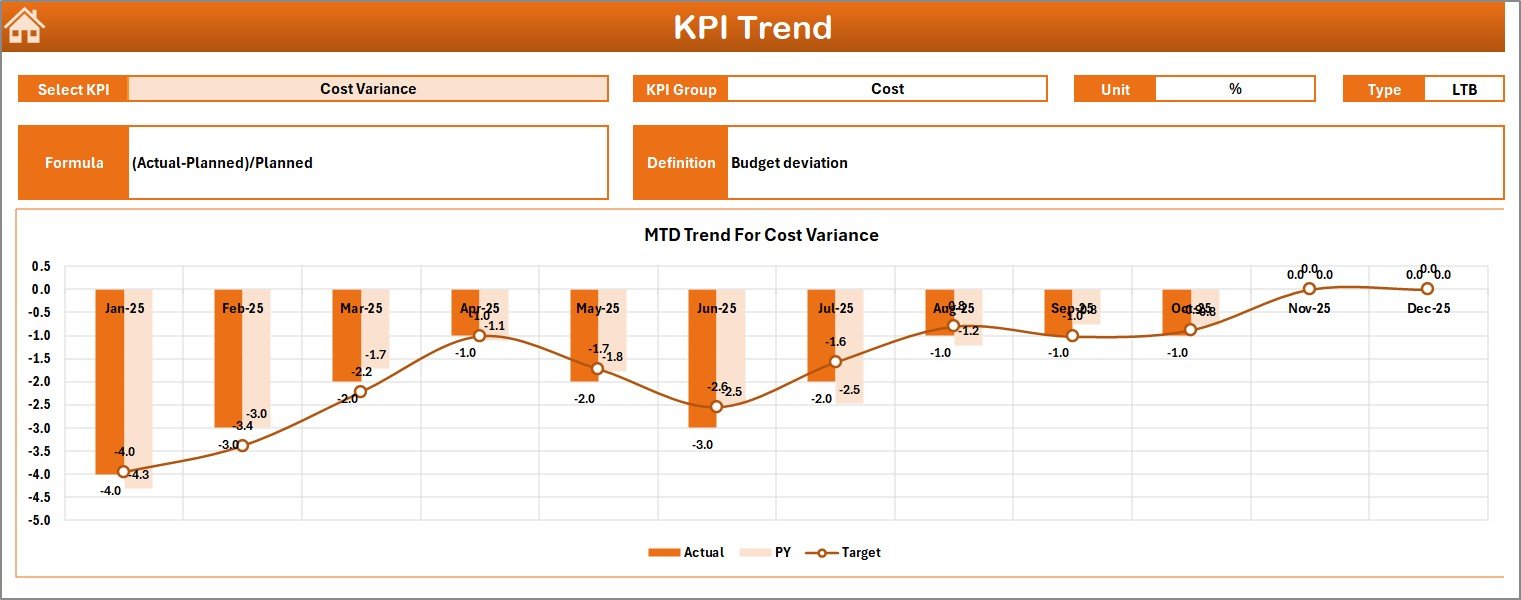
The KPI Trend Sheet allows users to analyze KPI performance trends over time.
Users can select a specific KPI from the drop-down menu in cell C3.
Once selected, the dashboard displays detailed KPI information such as:
-
KPI Group
-
KPI Unit
-
KPI Type (Lower the Better or Upper the Better)
-
KPI Formula
-
KPI Definition
Trend Charts
The sheet also includes two important charts:
-
MTD Trend Chart
-
YTD Trend Chart
These charts compare:
-
Actual values
-
Target values
-
Previous year values
Therefore, project managers can analyze whether KPI performance improves or declines over time.
Click to Purchases Bridge Construction KPI Dashboard in Excel
4. Actual Numbers Input Sheet – Data Entry Page
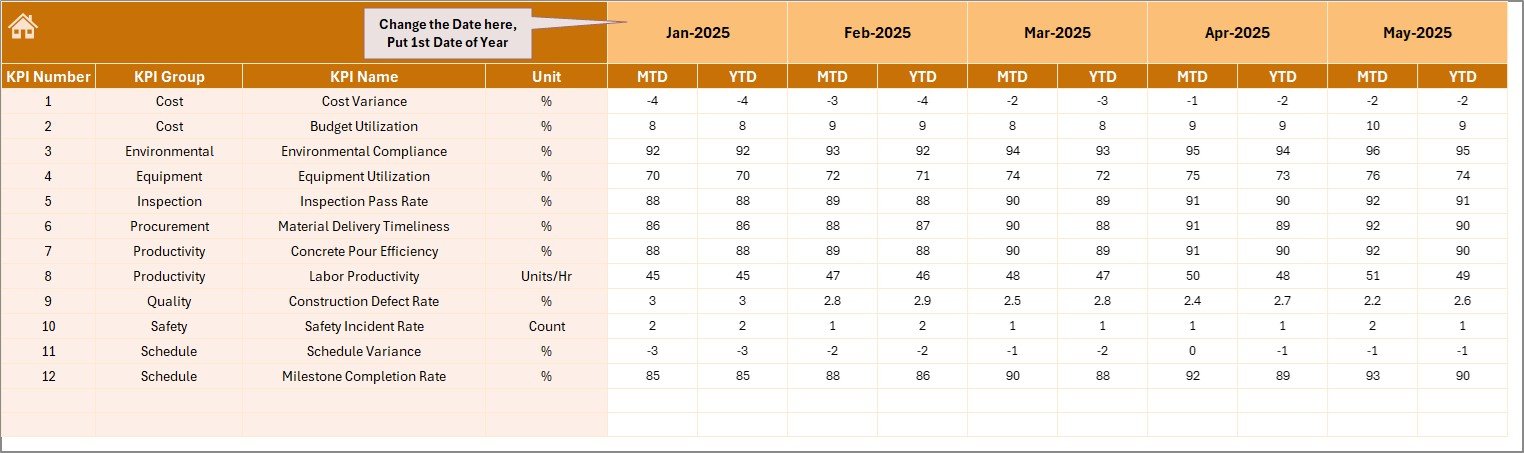
The Actual Numbers Input Sheet is where users enter the actual performance data for each KPI.
Users can change the starting month using cell E1, which defines the first month of the year.
Key features include:
-
Monthly data entry system
-
MTD (Month-to-Date) values
-
YTD (Year-to-Date) values
-
Organized data entry format
Once users input the data, the dashboard automatically updates all charts and metrics.
5. Target Sheet – KPI Target Planning
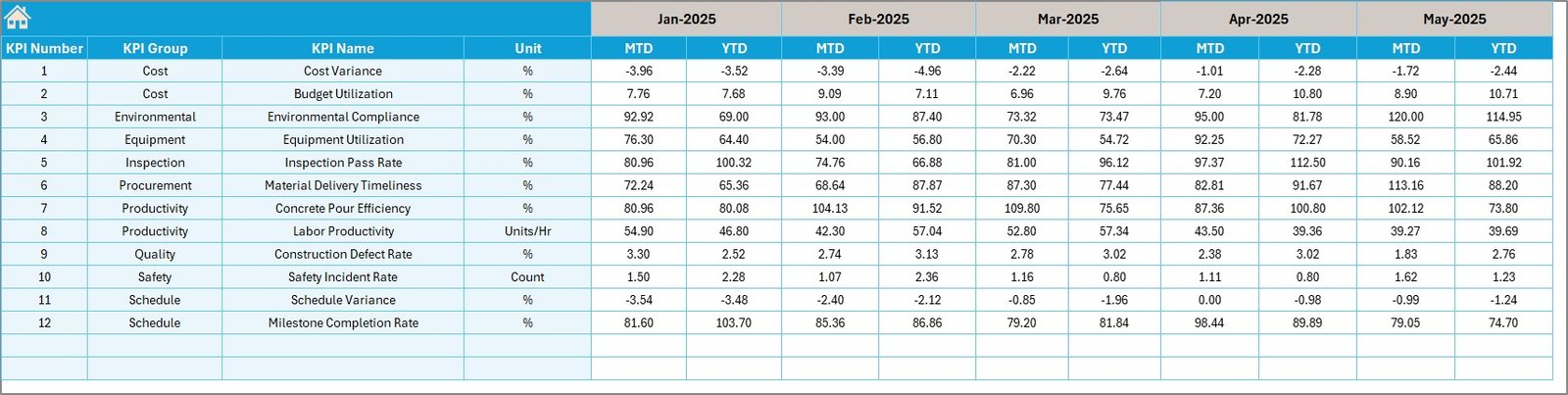
The Target Sheet helps organizations define their KPI targets.
Users can enter:
-
Monthly MTD targets
-
Monthly YTD targets
-
KPI performance expectations
By comparing targets with actual performance, managers can determine whether the project remains on track.
Click to Purchases Bridge Construction KPI Dashboard in Excel
6. Previous Year Numbers Sheet – Historical Performance Comparison
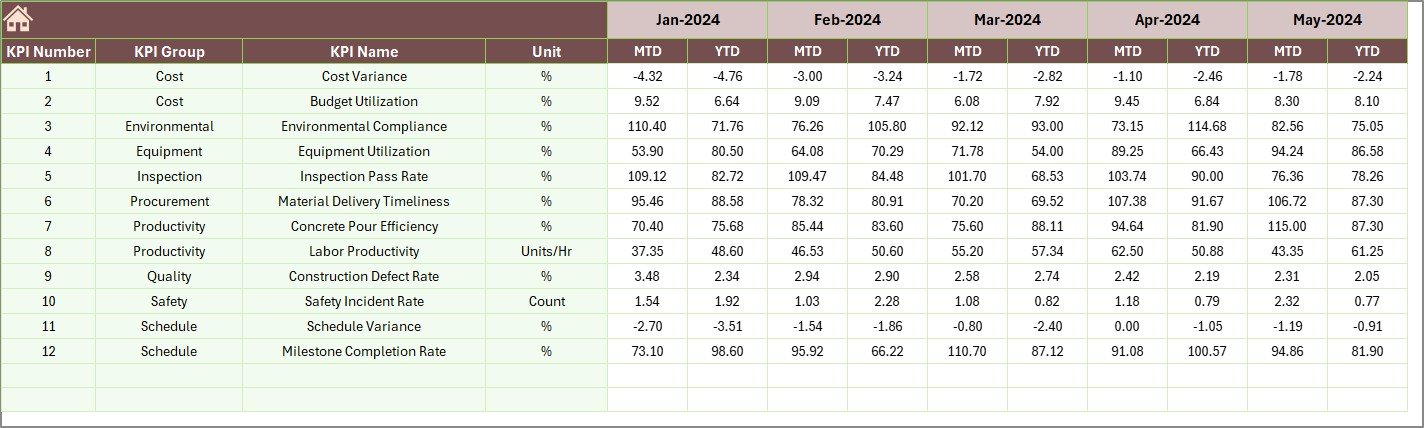
The Previous Year Numbers Sheet allows users to input historical data.
This sheet contains KPI performance numbers from the previous year.
By comparing historical performance with current performance, project managers can:
-
Evaluate improvement
-
Identify recurring issues
-
Understand long-term performance trends
Therefore, historical comparison provides valuable insights for strategic planning.
7. KPI Definition Sheet – KPI Management
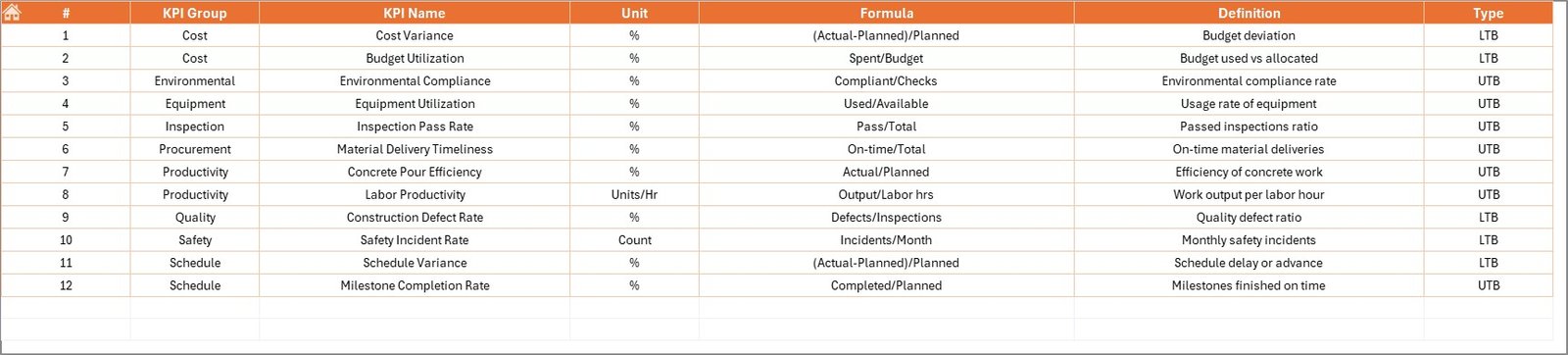
The KPI Definition Sheet acts as the master database of the dashboard.
In this sheet, users define the following KPI information:
-
KPI Name
-
KPI Group
-
Unit of Measurement
-
KPI Formula
-
KPI Definition
Because all KPI details are stored in one place, the dashboard becomes easier to manage and update.
Click to Purchases Bridge Construction KPI Dashboard in Excel
Advantages of Bridge Construction KPI Dashboard in Excel
Organizations gain several benefits when they implement a KPI dashboard for bridge construction projects.
Below are some key advantages.
1. Centralized Performance Monitoring
The dashboard consolidates all KPI information into a single interface.
Therefore, project managers can review performance data without searching through multiple reports.
2. Improved Decision Making
When managers analyze performance metrics clearly, they can make faster and better decisions.
Consequently, teams can address project issues before they become major problems.
3. Real-Time Performance Tracking
Because the dashboard updates automatically after data entry, users can monitor project performance in real time.
This allows managers to react quickly to project risks.
4. Easy Performance Comparison
The dashboard compares:
-
Actual vs Target
-
Actual vs Previous Year
As a result, teams can evaluate project efficiency accurately.
5. Improved Project Transparency
When teams use KPI dashboards, all stakeholders gain clear visibility into project performance.
Therefore, communication between project managers, engineers, and executives improves significantly.
Click to Purchases Bridge Construction KPI Dashboard in Excel
Best Practices for Using the Bridge Construction KPI Dashboard
To get the best results from this dashboard, organizations should follow several best practices.
1. Define Clear KPIs
First, organizations should select KPIs that directly reflect project performance.
Examples include:
-
Construction completion rate
-
Cost variance
-
Safety incident rate
-
Equipment utilization
Clearly defined KPIs improve performance monitoring.
2. Update Data Regularly
Teams should update dashboard data regularly.
Monthly updates ensure that the dashboard always reflects the latest project status.
3. Train Team Members
Project managers should train team members to use the dashboard effectively.
Training ensures that employees understand how to input data and interpret KPI results.
4. Monitor Trends Instead of Single Values
Instead of focusing on individual data points, managers should analyze trends.
Trend analysis provides better insights into project performance.
5. Use the Dashboard for Strategic Planning
Managers should use the dashboard not only for monitoring but also for planning.
Historical trends help organizations improve future project planning.
Click to Purchases Bridge Construction KPI Dashboard in Excel
How Does This Dashboard Improve Bridge Construction Project Management?
A structured KPI dashboard transforms the way construction teams manage projects.
For example, managers can quickly answer important questions such as:
-
Are we meeting project deadlines?
-
Are costs exceeding planned budgets?
-
Is labor productivity improving?
-
Are safety incidents decreasing?
-
Is project progress aligned with targets?
Because the dashboard provides instant insights, teams can make proactive decisions instead of reactive ones.
Therefore, the dashboard significantly improves project management efficiency.
Conclusion
Bridge construction projects require careful monitoring, accurate reporting, and strong performance management. However, manual reporting systems often create delays and confusion.
The Bridge Construction KPI Dashboard in Excel solves these problems by providing a structured and interactive performance monitoring system.
This dashboard allows project managers to:
-
Track project performance
-
Monitor KPIs
-
Analyze trends
-
Compare targets with actual results
-
Improve decision-making
Moreover, the dashboard’s interactive design makes it easy for teams to analyze large amounts of data quickly.
Therefore, organizations that implement this KPI dashboard can significantly improve project efficiency, reduce risks, and deliver bridge construction projects successfully.
Click to Purchases Bridge Construction KPI Dashboard in Excel
Frequently Asked Questions (FAQs)
What is a KPI dashboard in construction projects?
A KPI dashboard in construction projects is a visual reporting tool that tracks important performance indicators such as cost, productivity, safety, and project progress.
It helps managers analyze project performance and make data-driven decisions.
Why should bridge construction companies use KPI dashboards?
Bridge construction companies should use KPI dashboards because they improve performance monitoring, enhance decision-making, and help teams identify project risks early.
Can Excel handle construction KPI dashboards effectively?
Yes, Microsoft Excel is a powerful tool for building KPI dashboards.
Excel supports charts, formulas, conditional formatting, and interactive features that allow users to track and analyze performance metrics efficiently.
What KPIs are commonly used in bridge construction projects?
Common KPIs include:
-
Construction progress percentage
-
Cost variance
-
Schedule variance
-
Safety incident rate
-
Labor productivity
-
Equipment utilization rate
Is this dashboard suitable for large infrastructure projects?
Yes, the Bridge Construction KPI Dashboard can support both small and large infrastructure projects. Organizations can customize KPIs based on project requirements.
Click to Purchases Bridge Construction KPI Dashboard in Excel
Visit our YouTube channel to learn step-by-step video tutorials