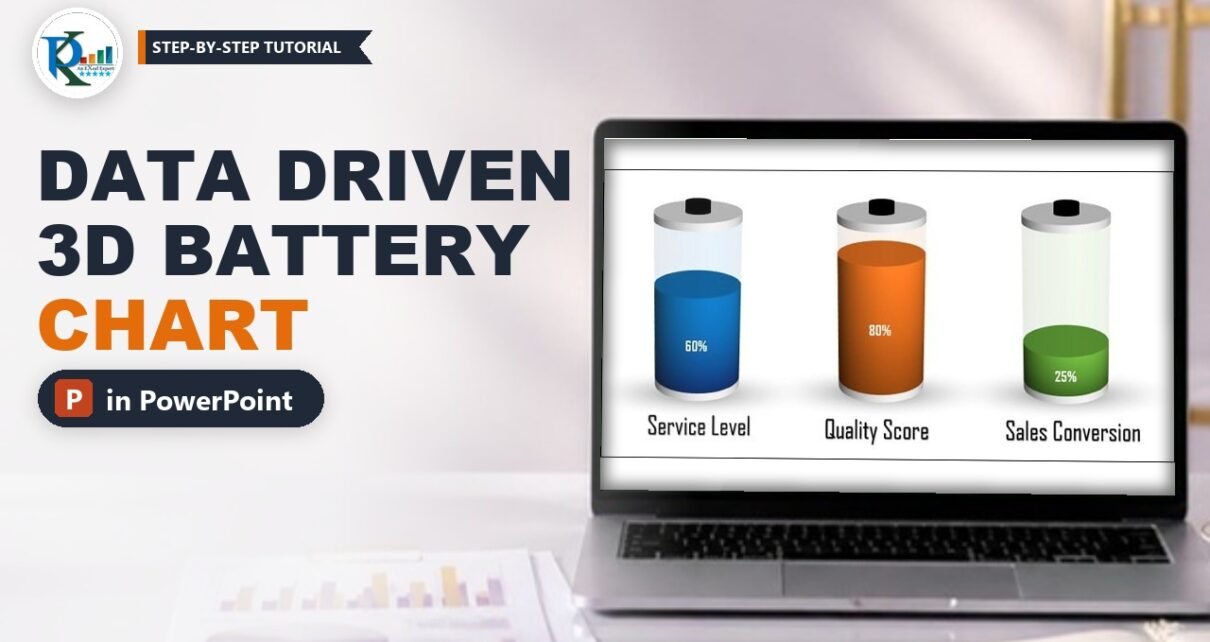
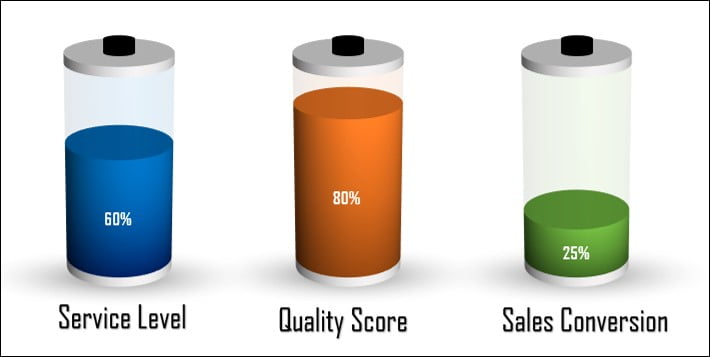
A data driven 3D battery chart in PowerPoint shows a percentage as the charge level of a glass battery, so anyone in the room can read a KPI at a glance. Because the battery is a real PowerPoint chart and not a drawing, you change the number with Edit Data and the fill level moves by itself. In this tutorial you build one from a 3-D stacked column chart, then copy it to make three batteries for Service Level, Quality Score and Sales Conversion. The free template is below so you can follow along.
⬇️ Download the 3D Battery Chart Template
One slide with three editable charts · .pptx (no macros) · 80 KB
Watch the Video Tutorial
In the video I build the first battery from a blank slide, then duplicate it twice and only change the data and colours.
What You Will Build
- A glass battery made from a single 3-D stacked cylinder column.
- A coloured charge level that follows the value you type in Edit Data.
- A see-through empty part calculated by a formula, so the battery always totals 100%.
- Grey caps and a black terminal that make the column look like a real battery.
- Three KPI batteries in blue, orange and green, ready for a business review slide.
How the Battery Chart Works
The whole battery is one stacked column with four series, stacked from bottom to top:
- Lower Cap – a fixed 5% in grey, the bottom of the battery.
- Your KPI (Service Level) – the charge, for example 75%.
- Transparent Area – the empty part:
100% minus the KPI, shown in a very light, see-through colour. - Upper Cap – another fixed 5% in grey at the top.
The KPI and the transparent area always add up to 100%, so the battery body never changes height. Only the line between the coloured and the clear part moves.
Build the Data Driven 3D Battery Chart in PowerPoint
Step 1: Add a slide and a title bar
Press Ctrl+M for a new slide and delete the placeholders. Go to Insert → Shapes → Rectangle, draw a bar across the top and pick a style from Format → Shape Styles. Add a title with Insert → WordArt (I typed Performance Summary), make it white and bold and place it on the bar.
Step 2: Insert a 3-D stacked column chart
Go to Insert → Chart → Column and choose 3-D Stacked Column. PowerPoint opens a small data sheet with sample numbers.
Step 3: Enter the battery data
Delete the extra categories so only one row is left, and set up four series. In the video the sheet looks like this:
| B: Lower Cap | C: Service Level | D: Transparent Area | E: Upper Cap | |
|---|---|---|---|---|
| A2: Service Level | 5% | 75% | =100%-C2 |
5% |
Type your real KPI in C2. The formula in D2 fills the rest of the battery. In the download file the data is an Excel table, so the same formula reads =100%-Table1[Service Level]; it does exactly the same job. Close the data sheet.
Step 4: Fix the value axis
Right-click the vertical axis → Format Axis. Set Minimum to 0 and Maximum to 1.1. The column totals 110% (5% + 100% + 5%), so a maximum of 1.1 makes the battery fill the chart height. The download file uses 1.2, which leaves a little room above the top cap for the terminal; either works.
Step 5: Remove the chart clutter
Click the Chart Elements (+) button and untick the axes, chart title, gridlines and legend. Only the column should be left. Resize the chart to a tall, narrow shape.
Step 6: Turn the column into a cylinder
Right-click the column → Format Data Series. Under Series Options:
- Column shape: Cylinder
- Gap Width: 0%
- Gap Depth: 0%
A gap width of 0 makes the cylinder as wide as the chart allows, so it looks like a fat battery and not a thin bar.
Step 7: Set the 3-D rotation
Right-click the chart → 3-D Rotation. In the video I set X Rotation to 0° and Y Rotation to 10°. X at 0 keeps the battery facing you; a small Y angle tilts it so you can see the round top of each layer. The download file uses a Y rotation of 20° for a slightly deeper top view.
Step 8: Colour the four parts
- Lower Cap and Upper Cap: select each one, Fill → Solid fill and pick the same light grey.
- Service Level: Solid fill in blue, then switch to Gradient fill and choose a dark variation, which gives the glossy 3D look.
- Transparent Area: Solid fill in the same blue, with Transparency around 85% (the template uses 90%). This is the glass of the empty part.
Step 9: Add the battery terminal
Go to Insert → Shapes and under Flowchart pick Magnetic Disk (the small cylinder shape). Draw a small one on top of the upper cap, fill it black and set Shape Outline to No Outline.
Step 10: Show the percentage
Right-click the Service Level part → Add Data Labels. Make the label white, bold and a little bigger. In the template the label uses Agency FB, size 18, with a 0% number format. Add the metric name under the battery with WordArt.
The template also places a soft grey oval under each battery as a floor shadow. It is a plain ellipse with a gradient fill and is optional.
Step 11: Group and duplicate
Select the chart, the terminal and the name, right-click → Group. Press Ctrl+D twice to make two copies and line them up.
Step 12: Change the data and colours for each KPI
For the second battery, right-click the chart → Edit Data, rename the series to Quality Score and type its value. Then recolour the KPI series (I used orange, Accent 2, with a dark gradient) and give the Transparent Area the same orange with 85% transparency. Do the same for the third battery (Sales Conversion) in green, and update the WordArt names.
Update the Battery Values
This is the part you will use every month. Right-click a battery → Edit Data, type the new percentage in the KPI cell and close the sheet. The formula recalculates the empty part and the charge level and label update at once. In the video I change the first battery from 65% to 85% this way.
Common Errors and Fixes
These notes are general PowerPoint guidance, added to help you troubleshoot. They are not from the video.
The battery gets taller or shorter when the value changes
The Transparent Area is a typed number instead of the =100%-C2 formula. Put the formula back so the two parts always total 100%.
The top cap is cut off
The axis maximum is set to Auto or below 1.1. Set it to 1.1 or 1.2 in Format Axis.
The battery shows several thin columns
The data sheet still has extra rows or the series are plotted by row. Keep a single category row, or use Chart Design → Switch Row/Column.
Tips
These tips are additions to the video.
- Use colours that mean something: green for on target, orange for watch, red for below target.
- Keep values between 0% and 100%; a value above 100% makes the transparent part negative and breaks the shape.
- Save one finished battery as a template slide so you can paste it into any deck.
- If the data sheet will not open, check the chart is not linked to a moved workbook. Microsoft explains the options in Change the data in an existing chart.
Want It Ready-Made?
If you like this style, the Data Driven 3D Container Chart in PowerPoint uses the same data-driven idea in a different shape, and the Stunning Battery Chart brings the battery look to Excel. Browse all PowerPoint chart templates on NextGenTemplates.com.
Related Tutorials
- Animated filled spheres in PowerPoint
- Animated target vs actual sales chart in PowerPoint
- Data-driven Gantt chart in PowerPoint with conditional formatting
- Candle infographic chart in Excel
Frequently Asked Questions
What does data driven mean in a PowerPoint chart?
The shape is a real chart with its own data sheet. When you change a number in Edit Data, the chart redraws, so you never have to resize shapes by hand.
Which chart type is used for the battery?
A 3-D Stacked Column chart with one category and four series, a cylinder column shape and a gap width of 0.
How is the empty part of the battery calculated?
The Transparent Area series is 100 percent minus the KPI value, so the charge and the empty part always add up to the full battery. Step 3 shows the formula.
Why are the caps set to 5 percent?
The two grey 5 percent series form the bottom and top of the battery. They are fixed, so only the coloured charge level changes with your data.
Can I use this battery chart in Excel too?
Yes. The same 3-D stacked column technique works in Excel because both programs use the same chart engine.
About the Author
PK is a Microsoft Excel expert and trainer and the founder of PK: An Excel Expert and NextGenTemplates.com. He has been teaching Excel, VBA, Power Query, Power BI and PowerPoint visuals since 2016 on his YouTube channel.
Conclusion
A data driven 3D battery chart in PowerPoint is just a stacked cylinder column in disguise: two fixed grey caps, your KPI, and a see-through remainder calculated by a formula. Build one battery, group it, duplicate it, and you have a clean KPI slide that updates in seconds through Edit Data. Download the template, change the numbers and colours, and use it in your next business review.