In today’s business environment, organizations must operate responsibly while meeting environmental regulations and sustainability goals. Governments enforce strict compliance standards, stakeholders expect transparency, and customers prefer environmentally responsible companies. Therefore, businesses need structured systems to monitor environmental performance consistently.
However, many organizations still track environmental compliance using scattered spreadsheets, emails, or manual reporting methods. As a result, teams struggle to monitor key metrics, identify compliance risks, and take timely corrective actions.
To solve this challenge, we have created the Environmental Compliance KPI Scorecard in Excel — a ready-to-use, structured, and easy-to-manage template designed to track environmental performance indicators efficiently.
In this comprehensive guide, you will learn everything about the Environmental Compliance KPI Scorecard in Excel, including its structure, features, benefits, implementation steps, best practices, and frequently asked questions.
Click to buy Environmental Compliance KPI Scorecard in Excel
What Is an Environmental Compliance KPI Scorecard in Excel?
An Environmental Compliance KPI Scorecard in Excel is a performance tracking system that helps organizations measure, monitor, and analyze environmental compliance metrics using predefined Key Performance Indicators (KPIs).
Instead of manually reviewing reports, companies can monitor environmental performance through a centralized scorecard. Consequently, management gains clear visibility into compliance status, risk areas, and improvement opportunities.
Moreover, Excel provides flexibility, automation, and visualization features that make compliance tracking simple even for non-technical users.
Why Do Organizations Need Environmental Compliance Tracking?
Environmental compliance affects multiple operational areas. For example:
- Waste management
- Emission monitoring
- Energy consumption
- Water usage
- Regulatory reporting
- Sustainability initiatives
Without structured tracking, companies often face:
- Missed compliance deadlines
- Regulatory penalties
- Poor audit readiness
- Inefficient reporting processes
Therefore, a KPI scorecard becomes essential for proactive environmental management.
What Are Environmental Compliance KPIs?
Environmental Compliance KPIs measure how well an organization follows environmental regulations and sustainability standards.
These KPIs help businesses:
- Monitor environmental impact
- Ensure legal compliance
- Improve operational efficiency
- Support ESG reporting
- Drive sustainability initiatives
Examples of Environmental Compliance KPIs
Some commonly tracked KPIs include:
- Carbon Emission Level
- Waste Recycling Rate
- Water Consumption per Unit
- Energy Efficiency Ratio
- Compliance Audit Score
- Hazardous Waste Disposal Rate
- Environmental Incident Frequency
- Regulatory Compliance Percentage
- Air Quality Compliance Index
- Environmental Training Completion Rate
Because these indicators provide measurable insights, organizations can take corrective actions quickly.
Overview of the Environmental Compliance KPI Scorecard in Excel
This ready-to-use Excel template simplifies environmental monitoring through structured worksheets and automated calculations.
The template contains four worksheets, each designed for a specific purpose.
Scorecard Sheet – The Main Performance Dashboard
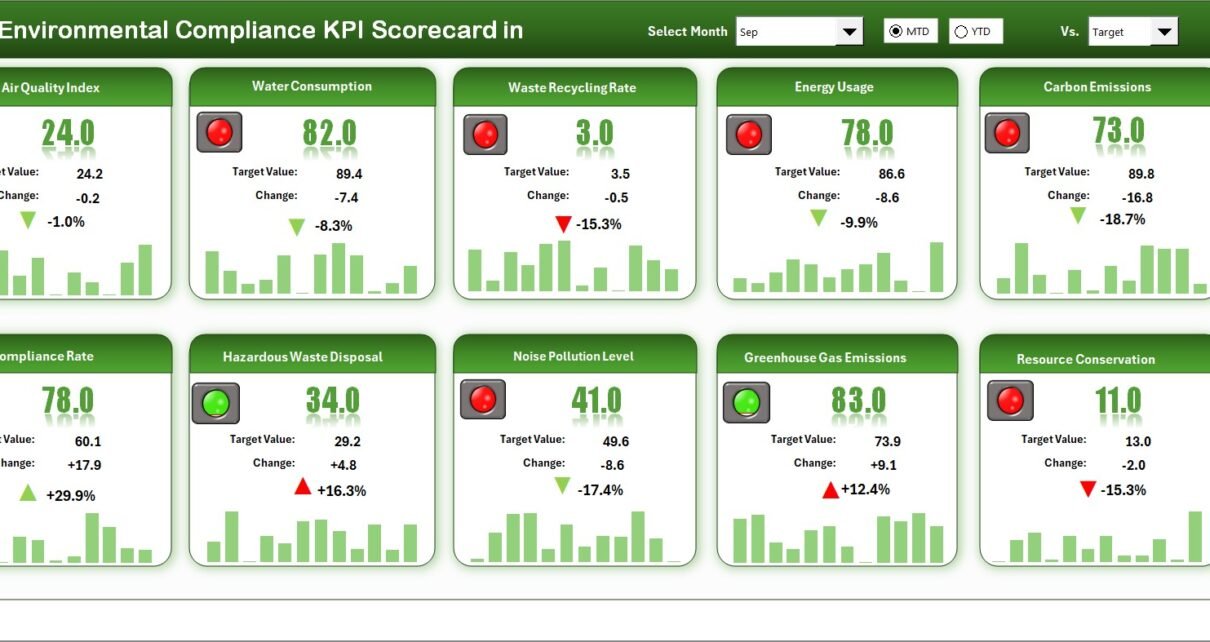
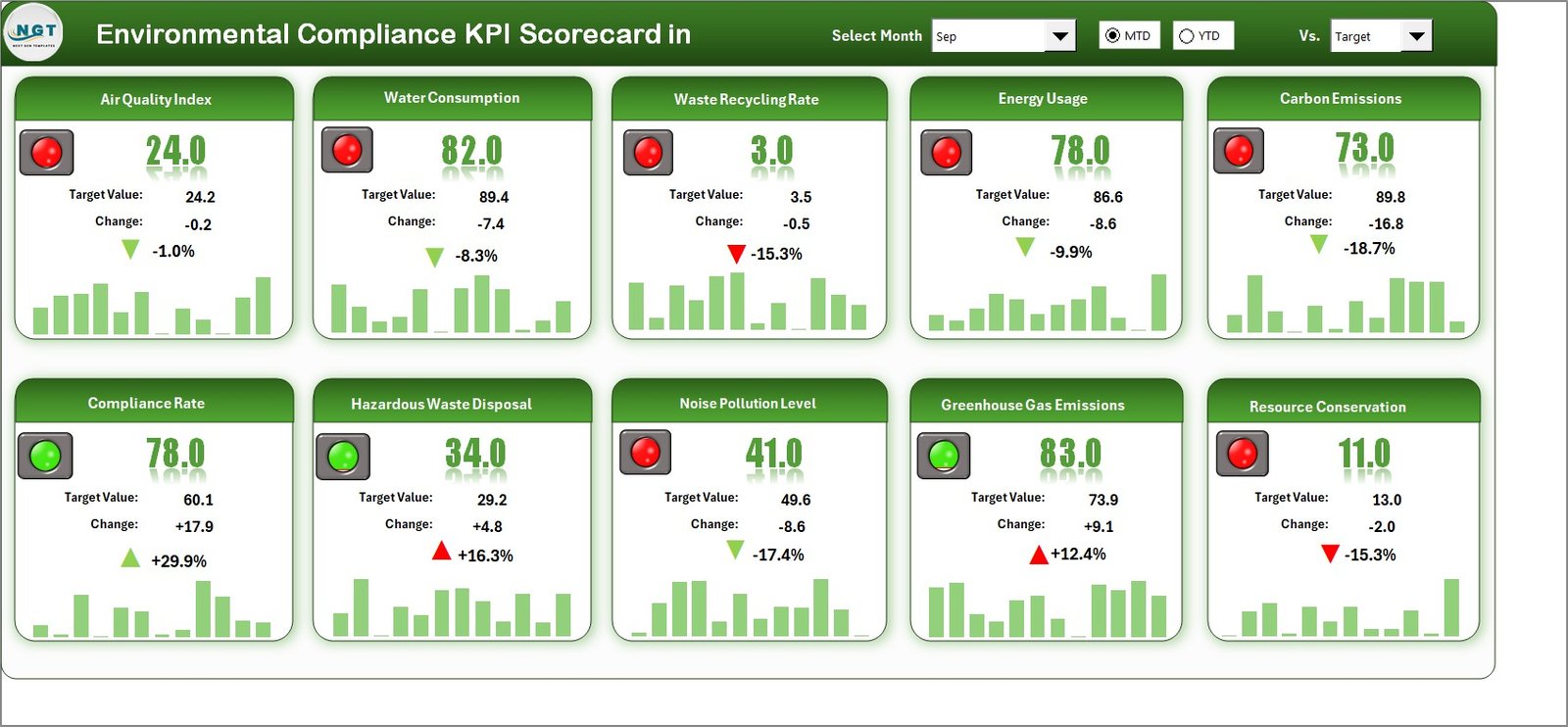
The Scorecard Sheet acts as the central interface where users analyze KPI performance instantly.
Key Features
- Dropdown Menus
- Select Month
- Choose MTD (Month-to-Date)
- Choose YTD (Year-to-Date)
- Actual vs Target Comparison
- Compare real performance against planned targets.
- Identify gaps immediately.
- Visual Performance Indicators
- Color-coded status indicators
- Conditional formatting highlights performance levels.
- Comprehensive KPI Overview
- Displays all KPI details in one view.
- Shows MTD and YTD comparisons.
- 10 KPIs Displayed Together
- Enables quick executive-level review.
Because all performance metrics appear in one place, decision-makers can evaluate compliance instantly.
Click to buy Environmental Compliance KPI Scorecard in Excel
KPI Trend Sheet – Performance Analysis Over Time
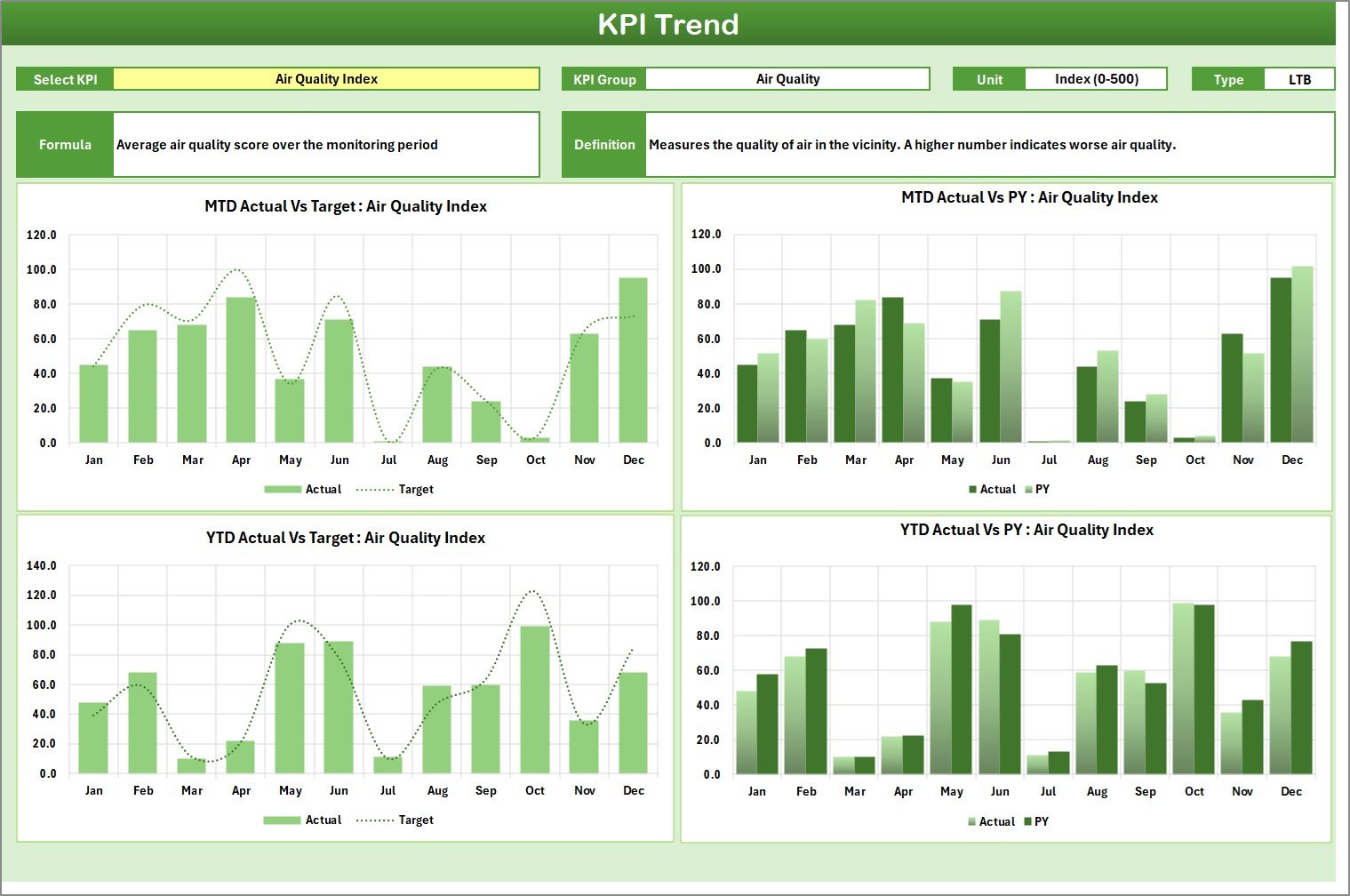
While the scorecard provides a snapshot, organizations also need trend analysis. Therefore, the KPI Trend Sheet helps users understand performance changes over time.
Key Functionalities
- KPI selection dropdown available in Cell C3
- Displays KPI information such as:
- KPI Group
- Unit of Measurement
- KPI Type (LTB or UTB)
- Formula
- KPI Definition
Trend Visualization
The sheet includes trend charts showing:
- Actual performance
- Target values
- Previous Year (PY) performance
- MTD and YTD comparisons
As a result, users can identify patterns, seasonal changes, and long-term improvements.
Click to buy Environmental Compliance KPI Scorecard in Excel
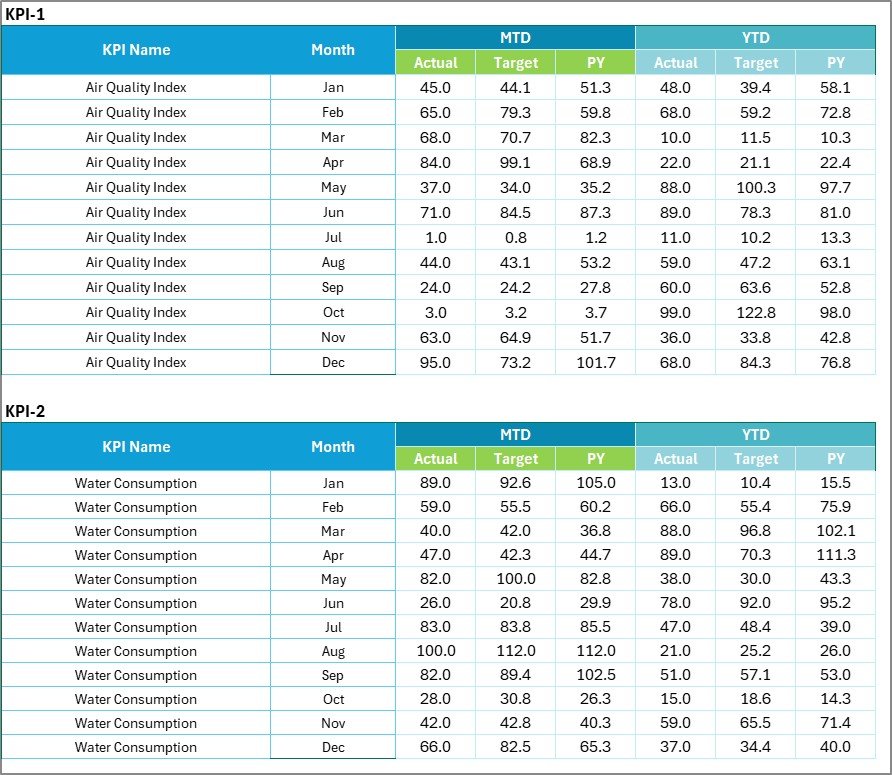
Input Data Sheet – Centralized Data Entry
The Input Data Sheet serves as the data backbone of the scorecard.
Main Capabilities
- Enter actual KPI values
- Record target metrics
- Update performance regularly
- Maintain historical data
Since all calculations depend on this sheet, users can simply update data and watch the dashboard refresh automatically.
Moreover, structured data entry reduces reporting errors significantly.
Click to buy Environmental Compliance KPI Scorecard in Excel
KPI Definition Sheet – Standardizing KPI Framework
The KPI Definition Sheet ensures consistency across performance tracking.
Information Captured
- KPI Name
- KPI Group
- Unit
- Formula
- KPI Definition
Because every KPI includes a definition and formula, teams avoid confusion and maintain reporting accuracy.

Click to buy Environmental Compliance KPI Scorecard in Excel
How Does the Environmental Compliance KPI Scorecard Work?
The workflow remains simple and user-friendly.
Step-by-Step Process
- Define KPIs in the KPI Definition sheet.
- Enter targets and actual values in the Input Data sheet.
- Select month and view type (MTD/YTD).
- Analyze performance in the Scorecard sheet.
- Review trends in the KPI Trend sheet.
Therefore, organizations can move from raw data to actionable insights quickly.
Advantages of Environmental Compliance KPI Scorecard in Excel
Organizations gain several benefits when they implement this scorecard.
Improved Compliance Monitoring
- Track regulatory performance continuously.
- Identify compliance gaps early.
Better Decision Making
- Visual insights help managers act faster.
- Data-driven strategies improve sustainability outcomes.
Centralized Reporting
- Store all environmental KPIs in one location.
- Reduce fragmented reporting systems.
Time Savings
- Automated calculations eliminate manual reporting.
- Quick performance reviews save management time.
Audit Readiness
- Maintain accurate historical records.
- Prepare compliance reports easily.
Cost Reduction
- Prevent fines and penalties.
- Optimize resource consumption.
Why Use Excel for Environmental KPI Tracking?
Many organizations wonder whether they should invest in expensive software. However, Excel offers powerful advantages.
Key Reasons
- Easy to use
- Widely available
- Customizable
- Cost-effective
- Flexible reporting
- Compatible with existing systems
Additionally, teams already understand Excel, so training requirements remain minimal.
What Analysis Can You Perform Using This Scorecard?
The Environmental Compliance KPI Scorecard supports multiple analytical perspectives.
Performance Analysis
- Target vs Actual comparison
- Compliance achievement rate
- KPI success tracking
Trend Analysis
- Monthly improvement tracking
- Year-over-year comparison
- Seasonal performance patterns
Risk Analysis
- Identify underperforming KPIs
- Detect compliance risks early
Strategic Analysis
- Evaluate sustainability initiatives
- Support ESG reporting
How to Implement the Environmental Compliance KPI Scorecard Successfully?
Successful implementation requires structured planning.
Step 1: Identify Environmental Objectives
Define sustainability goals aligned with regulations.
Step 2: Select Relevant KPIs
Choose measurable indicators relevant to operations.
Step 3: Define Targets
Set realistic and achievable performance targets.
Step 4: Assign Responsibilities
Ensure accountability for each KPI.
Step 5: Update Data Regularly
Maintain accurate reporting cycles.
Step 6: Review Trends Monthly
Analyze results and plan corrective actions.
Best Practices for the Environmental Compliance KPI Scorecard
Following best practices ensures maximum value.
Keep KPIs Simple
Avoid tracking too many indicators.
Update Data Consistently
Regular updates maintain dashboard accuracy.
Use Clear Definitions
Standardize formulas and KPI meanings.
Focus on Actionable Metrics
Track indicators that drive decisions.
Conduct Monthly Reviews
Discuss results with stakeholders regularly.
Integrate with Sustainability Goals
Align KPIs with ESG strategies.
Common Challenges in Environmental Compliance Tracking (and Solutions)
Challenge 1: Data Inconsistency
Solution: Use standardized input formats.
Challenge 2: Lack of Visibility
Solution: Use visual dashboards and indicators.
Challenge 3: Manual Reporting Errors
Solution: Automate calculations in Excel.
Challenge 4: Poor KPI Understanding
Solution: Maintain KPI definitions clearly.
Who Can Benefit from This KPI Scorecard?
This template suits multiple industries and roles.
Industries
- Manufacturing
- Energy & Utilities
- Chemicals
- Construction
- Logistics
- Pharmaceuticals
- Waste Management
Professionals
- Environmental Managers
- Compliance Officers
- Sustainability Analysts
- Operations Managers
- ESG Reporting Teams
How Does This Scorecard Support Sustainability Goals?
Organizations increasingly focus on ESG performance. Therefore, environmental KPIs play a critical role.
This scorecard helps organizations:
- Track emission reductions
- Monitor resource efficiency
- Improve environmental accountability
- Support sustainability reporting
- Enhance corporate reputation
Consequently, businesses move toward responsible growth.
Tips to Maximize Results from the KPI Scorecard
- Review KPIs weekly.
- Train team members on data entry.
- Validate data accuracy regularly.
- Focus on improvement trends.
- Use insights for strategic planning.
Future of Environmental Compliance Monitoring
Environmental monitoring continues to evolve. Organizations now combine digital dashboards, automation, and analytics.
Although advanced platforms exist, Excel-based scorecards remain powerful because they offer flexibility and affordability.
Furthermore, businesses can later integrate Excel models into Power BI or enterprise analytics platforms.
Conclusion
Environmental compliance no longer represents only a regulatory obligation. Instead, it has become a strategic priority for organizations aiming for sustainable growth.
The Environmental Compliance KPI Scorecard in Excel provides a structured, practical, and efficient solution for monitoring environmental performance. By combining centralized data entry, automated calculations, visual performance indicators, and trend analysis, this template enables organizations to track compliance proactively.
Moreover, companies gain better visibility, reduce compliance risks, improve decision-making, and strengthen sustainability initiatives.
Therefore, organizations that adopt structured KPI tracking systems position themselves for long-term operational excellence and environmental responsibility.
Frequently Asked Questions (FAQs)
- What is an Environmental Compliance KPI Scorecard?
It is a structured Excel-based tool used to track environmental performance indicators and monitor compliance against regulatory targets.
- Who should use this scorecard?
Environmental managers, compliance teams, sustainability professionals, and operations managers can use this template.
- Can beginners use this Excel scorecard?
Yes. The template uses simple dropdowns, structured sheets, and automated calculations, so beginners can use it easily.
- How many KPIs can this scorecard track?
The scorecard displays 10 KPIs in one view, although users can customize and expand it.
- What is the difference between MTD and YTD?
- MTD: Performance from the start of the month until today.
- YTD: Performance from the start of the year until today.
- Can I customize KPIs?
Yes. You can modify KPI definitions, formulas, and targets based on organizational requirements.
- Does this template support trend analysis?
Yes. The KPI Trend sheet shows Actual, Target, and Previous Year comparisons using charts.
- Why is Excel suitable for compliance tracking?
Excel offers flexibility, automation, affordability, and easy customization without requiring complex software.
Watch the step-by-step video tutorial:
Visit our YouTube channel to learn step-by-step video tutorials
Click to buy Environmental Compliance KPI Scorecard in Excel