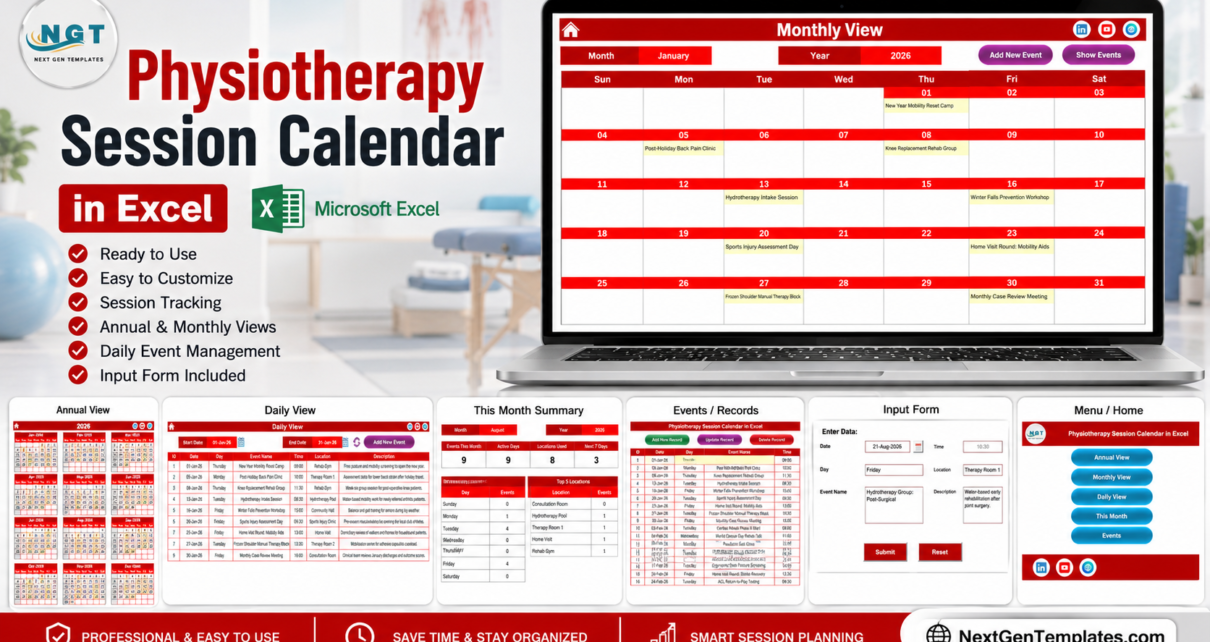
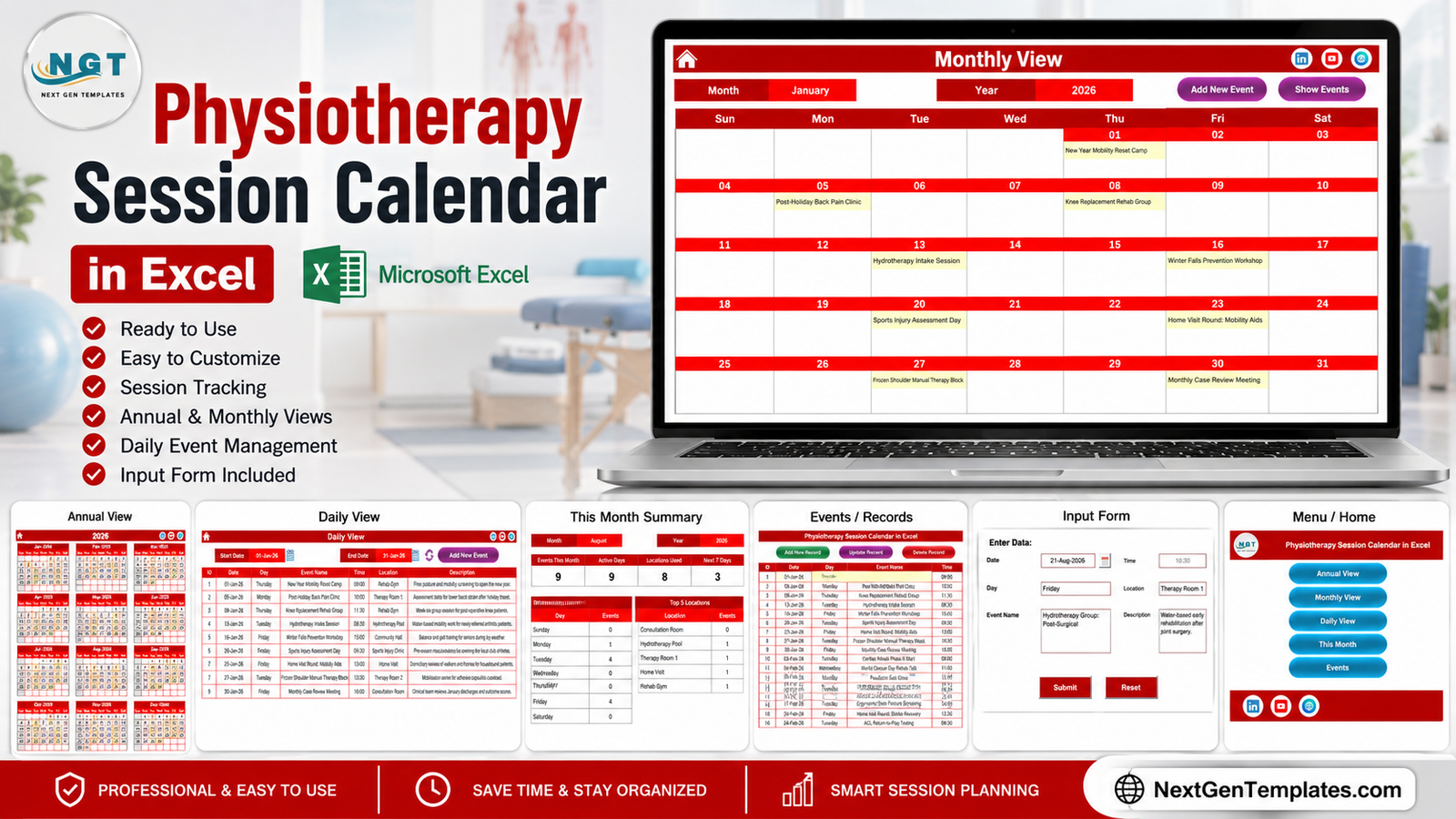
The Physiotherapy Session Calendar in Excel is a seven-worksheet, macro-driven calendar workbook that ships with 100 pre-filled sample physiotherapy sessions dated across the 2026 clinic year, spread over eight session locations and stored in a seven-field events database. Four calendar views – Annual, Monthly, Daily and This Month – all read from that one Events sheet, so a session typed once shows up everywhere. Setup takes under 10 minutes.
Most small physiotherapy practices do not need booking software. They need to see, on one page, which rooms are used on which days, when the hydrotherapy group runs, and whether next Tuesday is already full. That is a calendar problem, not a clinical-systems problem – and this workbook solves exactly that, offline, for a one-time price.
Before anything else, a clear boundary. This workbook is a session scheduling calendar. It is not a patient record, EHR or EMR, and not a practice management system. It is not HIPAA, GDPR or any other health-data-protection compliant or certified, it does not secure or encrypt what you type into it, it takes no online bookings, sends no SMS or email reminders, connects to no clinical, insurance or billing system, and tracks no treatment plans, outcomes or clinical progress. A spreadsheet passed around a clinic is not an appropriate place to store patient-identifiable or clinical information – use initials or an internal reference code in the Event Name and Description fields and keep the real notes in your governed clinical system.
Key Features of the Physiotherapy Session Calendar in Excel
- Four calendar views from one list. Annual View, Monthly View, Daily View and This Month all read the Events sheet. There is no second copy of the schedule to keep in step.
- 100 sample sessions already written for physiotherapy. Hydrotherapy groups, knee replacement rehab groups, falls prevention workshops, sports injury assessment days, home visit rounds, ergonomic desk screenings and monthly case reviews – not “Event 1, Event 2”.
- Eight session locations built into the sample data – Rehab Gym, Therapy Room 1, Therapy Room 2, Hydrotherapy Pool, Sports Injury Clinic, Community Hall, Consultation Room and Home Visit.
- VBA record management. Add New Record, Update Record and Delete Record buttons above the Events table, and Add New Event buttons repeated on the Monthly and Daily views.
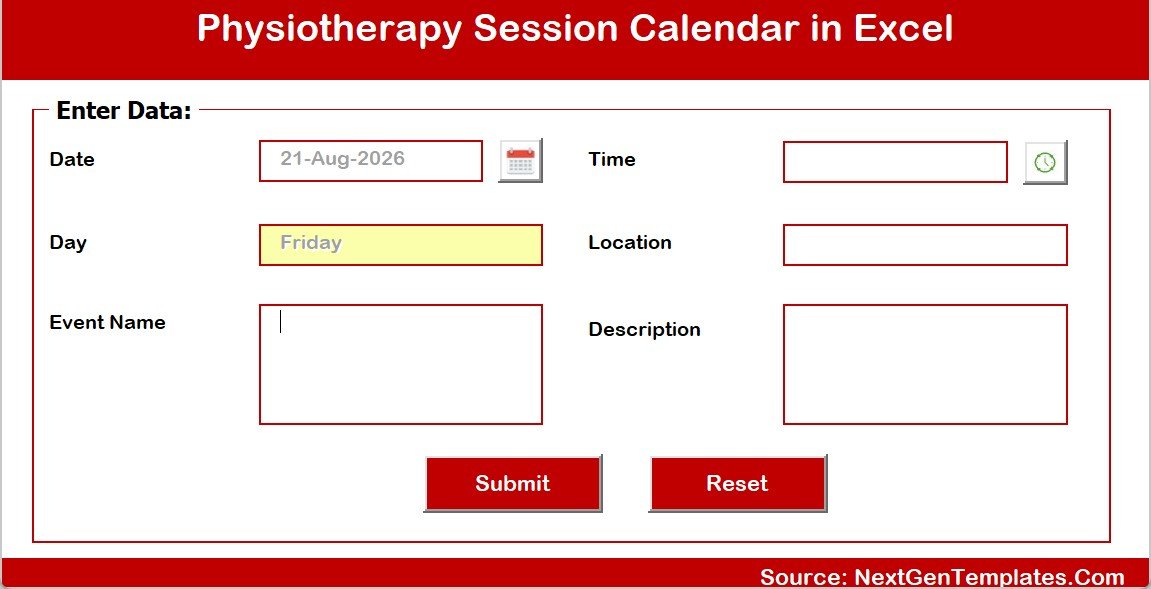
- A pop-up entry form with a date picker, a time picker, Location, Event Name and Description – and a Day field that fills itself from the date you choose.
- A Setting sheet offering any year from 2021 to 2051, the starting month, the week start day, two highlight weekdays, an event-shading switch, and five colour themes: Default, Blue, Red, Black and Orange.
Worksheets Explained
Home Menu
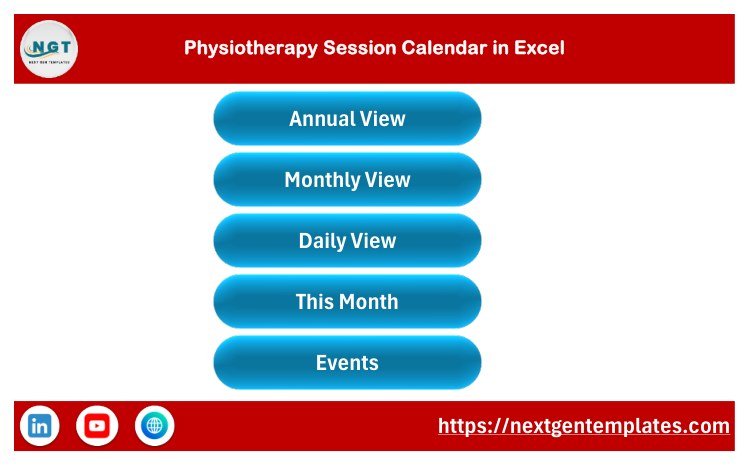
The landing sheet: workbook title plus five navigation buttons – Annual View, Monthly View, Daily View, This Month and Events. Anyone at the front desk reaches a view in one click.
Annual View
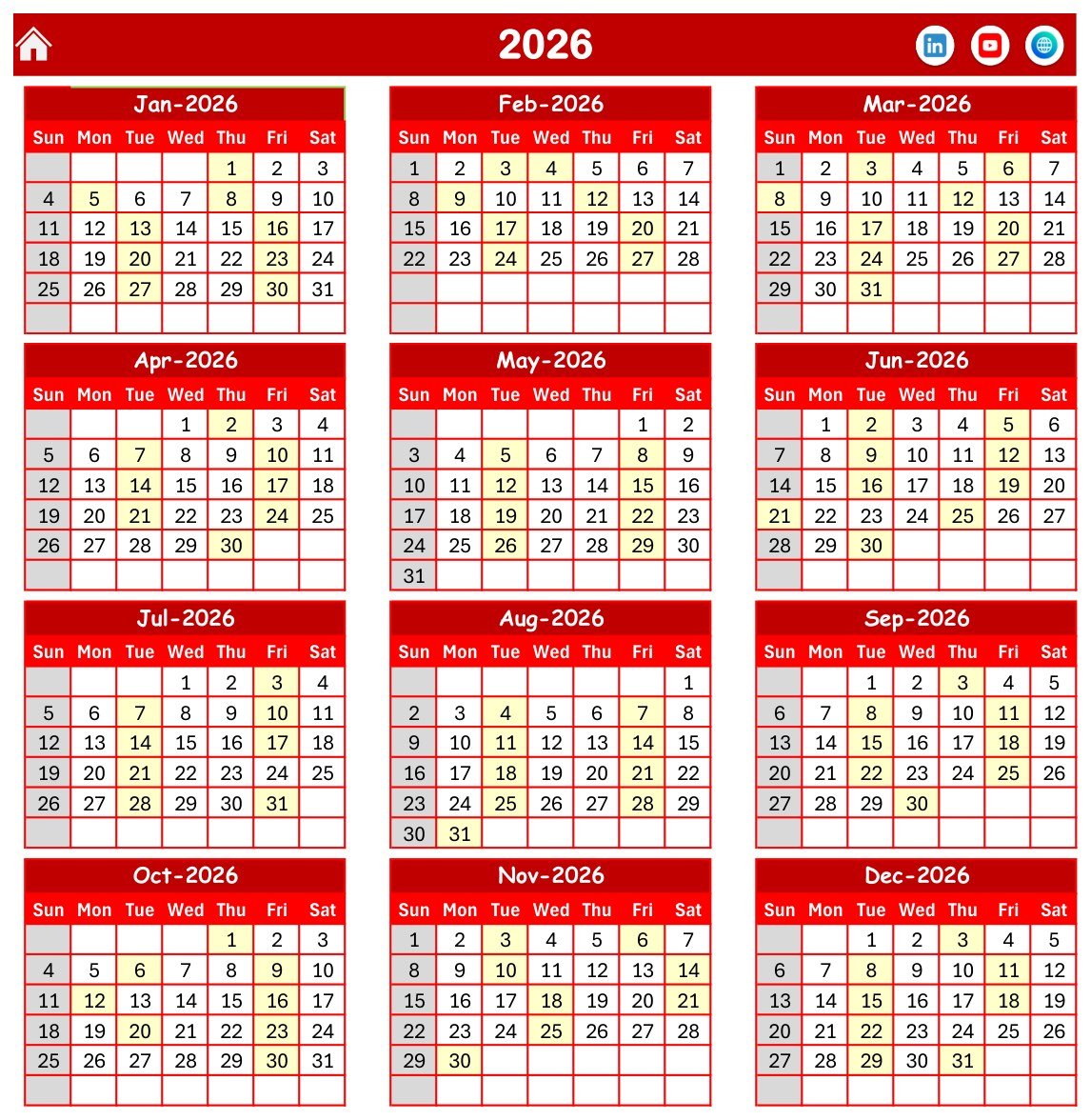
All twelve months of the selected year on one page, laid out four rows by three columns with Sun-to-Sat headers. Days that carry a session are shaded, so the busy stretches – and the quiet weeks worth filling – are obvious at a glance.
Monthly View
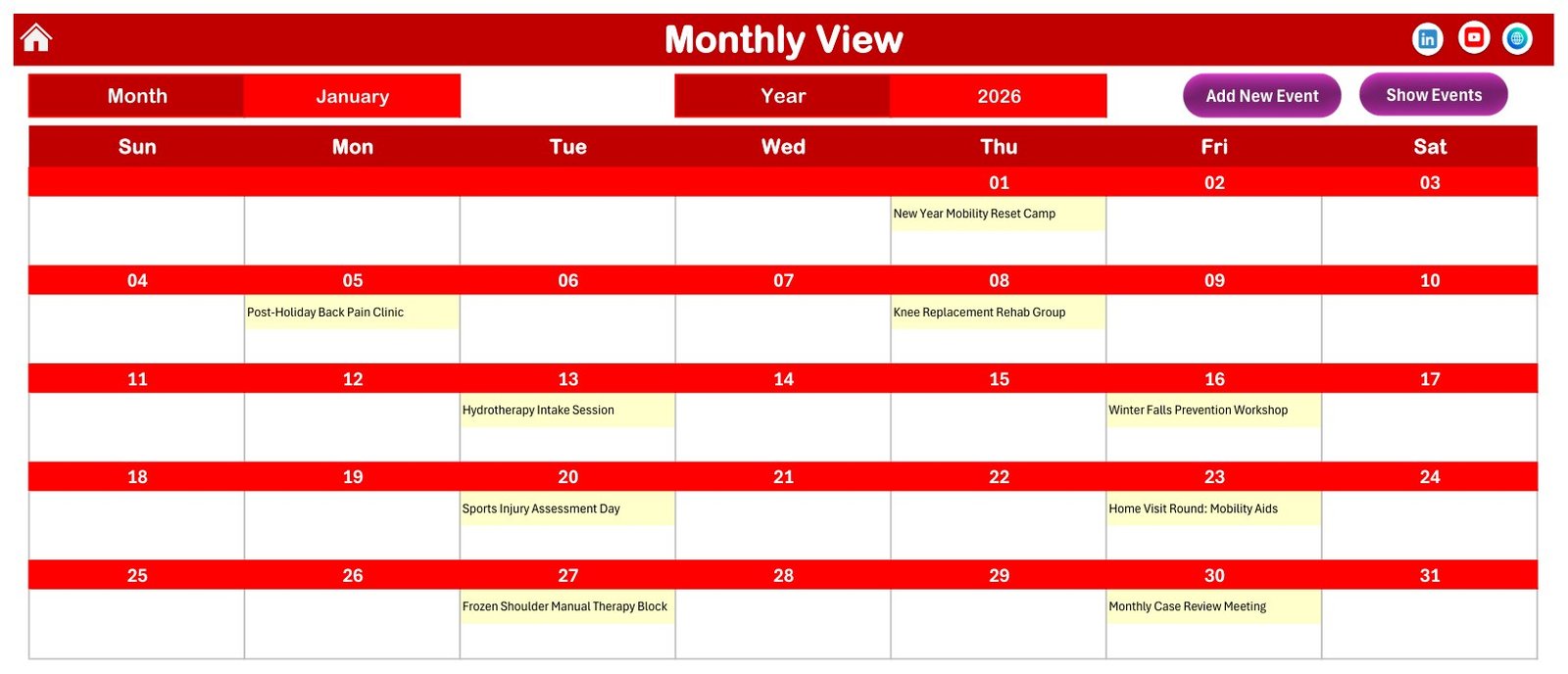
A full month grid driven by Month and Year selectors, with each session name printed inside its date cell. The January 2026 sample shows nine sessions, opening with the New Year Mobility Reset Camp on the 1st and closing with the Monthly Case Review Meeting on the 30th.
Daily View
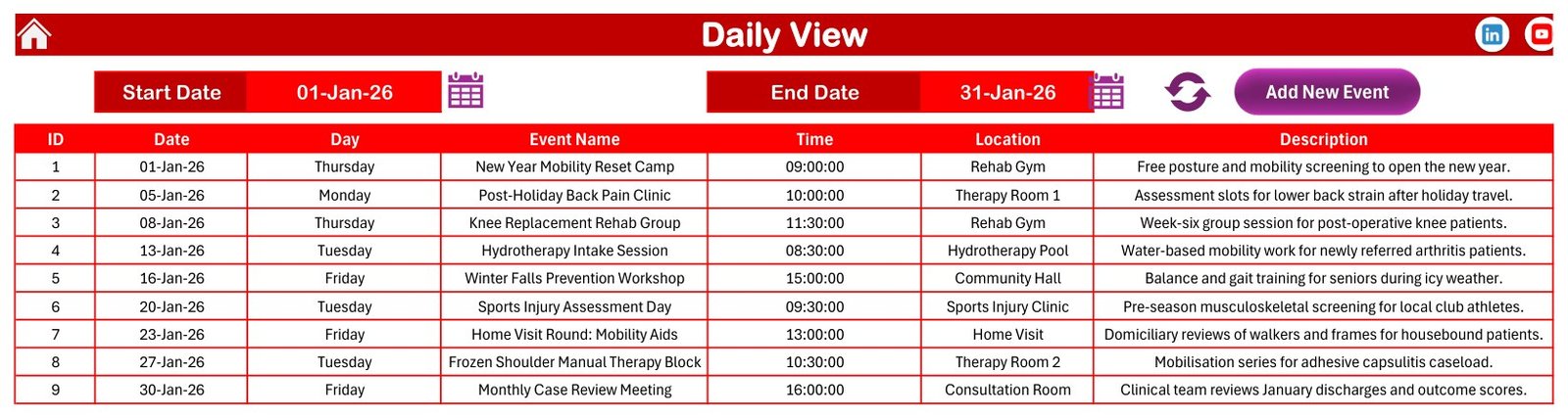
A date-range list rather than a grid. Set a Start Date and End Date, press Refresh, and every session in that window is returned with ID, Date, Day, Event Name, Time, Location and Description. This is the sheet to print as a weekly run sheet.
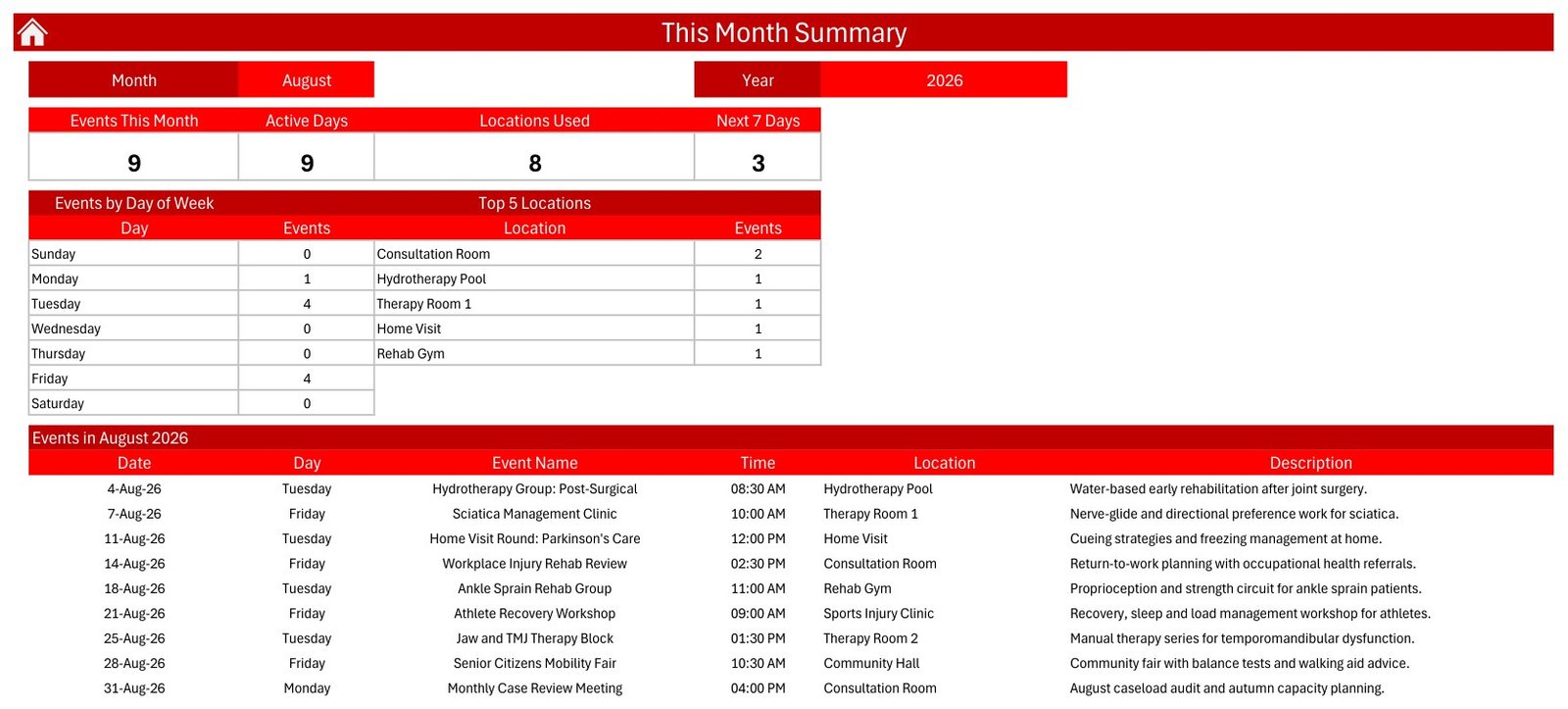
This Month Summary
Pick a month and year and four cards rebuild – Events This Month, Active Days, Locations Used and Next 7 Days – above an Events by Day of Week breakdown and a Top 5 Locations ranking. In the shipped August 2026 sample the cards read 9, 9, 8 and 3, with four sessions each on Tuesday and Friday and Consultation Room top of the locations list with two.
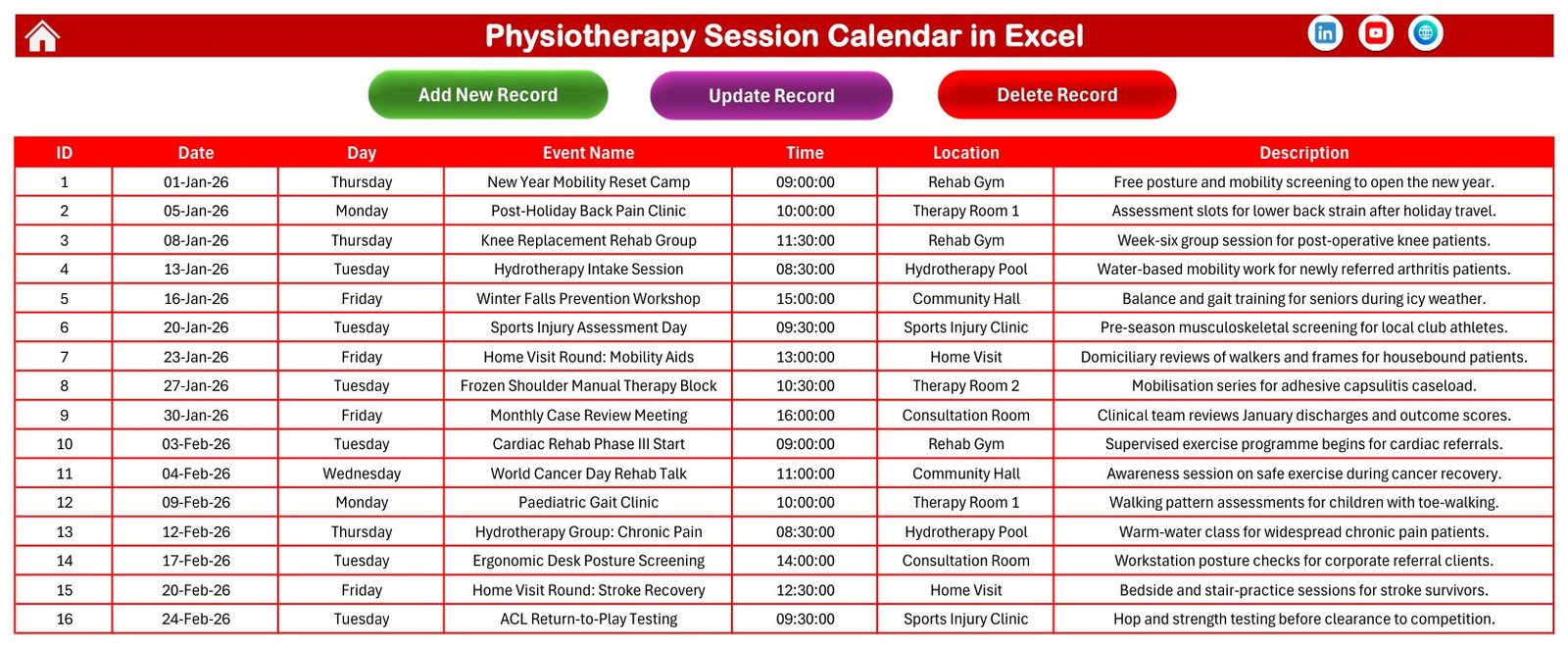
Events Database
The single source of truth: one row per session across seven columns, pre-loaded with 100 records numbered 1 to 100. Add New Record, Update Record and Delete Record sit above the table, and every calendar view reads from here.
The Add New Record Form
A VBA user form with Date, Time, Day, Location, Event Name and Description, plus Submit and Reset. Because the Day field is derived from the date, “Tuesday” can never end up recorded against a Friday.
Setting
The control panel: calendar year, starting month, week start day, two highlight weekdays, an event-highlight switch and the five-theme colour picker. Change a value and every calendar sheet re-draws. The file ships on the Red theme, starting January 2026, with weeks beginning Sunday.
Physiotherapy Session Calendar in Excel vs. a Google Sheets Calendar vs. Paid Clinic Booking Software
| Feature | Physiotherapy Session Calendar in Excel | Google Sheets calendar equivalent | Cliniko / Jane App |
|---|---|---|---|
| Cost | $4.99 one-time | Free with a Google account | $45-95 per practitioner / month |
| Platform | Excel for Windows desktop (.xlsm, macros required) | Browser, any device | Browser and mobile app |
| Setup time | Under 10 minutes | Under 10 minutes | Days – onboarding, imports, training |
| Works fully offline | Yes | No | No |
| Annual, Monthly, Daily and summary views in one file | All four, built in | Usually one view | Yes |
| Patient self-booking online | No | No | Yes |
| Automated SMS / email reminders | No | No | Yes |
| Patient records, clinical notes, billing | No – a calendar, not a clinical system | No | Yes |
| Year-1 cost for a 5-practitioner clinic | $4.99 total | $0 | $2,700-5,700 |
| You own the file, no vendor lock-in | Yes | Tied to a Google account | No |
For a small practice that wants its group sessions, clinics and home-visit rounds laid out clearly – without paying per practitioner every month for booking software it does not need – the Physiotherapy Session Calendar in Excel sits in the sweet spot. If patients must book themselves online or you need clinical notes, buy real practice software instead.
Who Should Use This Template
Perfect for:
- Solo physiotherapists and clinics of 1-10 practitioners planning group sessions, workshops and home-visit rounds
- Receptionists and practice coordinators who print a week’s run sheet and pin it up
- Sports injury clinics, hydrotherapy pools and rehab gyms juggling several rooms and one shared pool
- Community outreach teams planning falls prevention and mobility programmes a year ahead
Not a fit if:
- You need to store patient-identifiable or clinical information – a spreadsheet is the wrong place, and this file offers no protection for it
- You need online self-booking, automated reminders, clinical notes, insurance claims or billing
- You need an audited, access-controlled or HIPAA/GDPR-compliant system
- Your clinic is Mac-only or tablet-only – the forms and refresh buttons need Excel for Windows desktop with macros enabled
- Several people must edit the same calendar simultaneously
Real-World Use Cases
Anita runs a three-room practice with a hydrotherapy pool. Every December she blocks out the year’s group sessions in the Events sheet, then prints the Annual View for the staff room so nobody double-books the pool on a Tuesday morning.
Dev coordinates a community falls prevention programme. His workshops rotate between a community hall, a rehab gym and home visits, so he watches the Top 5 Locations ranking on the This Month sheet to check he is not overloading one venue, and hands the Daily View list to his two assistants each Monday.
Priya is a solo sports physiotherapist working with two local clubs. Pre-season assessment days, return-to-play testing and athlete recovery workshops all live in one file on her laptop – which still works pitch-side where there is no signal.
Advantages of the Physiotherapy Session Calendar in Excel
- One-time cost. At $4.99 on sale it costs less than a tenth of a single month of entry-level clinic software, and there is no renewal.
- No data entry twice. The four views are generated from one Events sheet, which removes the classic spreadsheet failure of a wall planner that disagrees with the diary.
- It works without a connection. Home visits, community halls and pool decks are exactly where cloud tools fail; an .xlsm on a laptop does not.
- Printable. The Annual View prints as a year planner and the Daily View as a run sheet, which is still how most clinic notice boards work.
- Familiar. Anyone who can use Excel can maintain it, so there is no training cost and no dependency on one “system person”.
Opportunities for Improvement
An honest list, because you should know before you buy:
- Windows-only in practice. The user form and the refresh buttons are VBA. Excel for Mac, Excel on the web and mobile Excel will not run them reliably. Macros must be enabled – see Microsoft’s guidance on enabling or disabling macros in Microsoft 365 files.
- Single-user by design. Two people cannot edit it at once. A busy multi-site clinic will outgrow it.
- No clash detection. Nothing stops you booking two sessions into Therapy Room 1 at 10:00; the calendar shows both, but it will not warn you.
- No reminders and no patient-facing anything. It plans your sessions; it does not contact anyone.
- The samples are 2026-dated. Change the year on the Setting sheet and clear the sample rows before you rely on it.
Best Practices
- Set the Setting sheet first. Year, starting month, week start day and theme, before you enter a single session.
- Keep patient identity out of it. Session type plus an internal reference – “Knee Rehab Group”, “Ref 4182 – initial assessment” – is enough for a calendar and keeps the file harmless if it is emailed by mistake.
- Standardise your Location values. The Top 5 Locations ranking is only useful if “Therapy Room 1” is never also typed as “Room 1”.
- Always use Add New Record rather than typing into the grid. The form fills the ID and the Day for you, which is where hand-typed rows usually go wrong.
- Keep a dated backup copy each month. There is no version history in a local workbook.
- Review This Month at month end. Active Days and the day-of-week breakdown quickly show where the clinic has spare capacity.
Explore Relevant Templates
- Physiotherapy Session Calendar in Excel – the template reviewed in this post.
- Physiotherapy Session Data Entry System in Excel – a searchable session log with a form and summary cards instead of a calendar grid.
- Physiotherapy and Rehabilitation Dashboard in Excel – charts and slicers for the same practice.
- Rehabilitation Center KPI Scorecard in Excel – a month-by-month performance scorecard.
- Healthcare Staff Duty Calendar in Excel – the staff rota companion to this session calendar.
- Dental Clinic Appointment Calendar in Excel – new in the same calendar range, built around a dental caseload.
Also available as: a Google Sheets alternative in the Medical Appointment Calendar in Google Sheets, or browse the full Calendar Templates range.
Frequently Asked Questions
Is the Physiotherapy Session Calendar in Excel a patient record system, and is it HIPAA or GDPR compliant?
No. The Physiotherapy Session Calendar in Excel is an offline scheduling calendar only. It is not an EHR, EMR or practice management system, it holds no clinical record, it is not HIPAA, GDPR or any other health-data-protection certified, and it does not secure or encrypt its contents. Never store patient-identifiable or clinical information in it.
Can patients book their own sessions, or will it send reminders?
No. The Physiotherapy Session Calendar in Excel takes no online bookings and sends no SMS or email reminders – it is a workbook you fill in yourself. For self-booking or automated reminders you need dedicated clinic booking software.
What should I type instead of patient details?
Use the session type and an internal reference, such as “Hydrotherapy Group” or “Ref 4182 – initial assessment”. The Physiotherapy Session Calendar in Excel is built around sessions, rooms and times, so it works perfectly well without a single patient name in it.
How long does setup take?
Under 10 minutes. Unzip, enable macros, set your year and theme on the Setting sheet, clear the 100 sample sessions and add your own. Every view rebuilds from the Events sheet, so there is nothing else to configure.
Do I need macros, and does it work on Mac?
Yes to macros. The Add, Update and Delete buttons and the pop-up form are VBA, so the Physiotherapy Session Calendar in Excel needs Excel for Windows desktop with content enabled. Excel for Mac, Excel on the web and mobile Excel do not run these forms reliably.
How does this compare to Cliniko or Jane App?
It does far less, for far less. Cliniko and Jane App handle bookings, notes, claims and reminders from roughly $45 per practitioner per month. The Physiotherapy Session Calendar in Excel is a $4.99 one-time calendar for laying out sessions, rooms and dates – and it keeps working offline.
Can I use it for a year other than 2026?
Yes. The Setting sheet offers any year from 2021 to 2051, along with the starting month and the day your week begins. Change the year and the Annual, Monthly and Daily views redraw around your own dates.
About the Author
Built by PK – Microsoft Certified Professional with 15+ years of Excel, Google Sheets and Power BI experience. Founder of NextGenTemplates, reaching 300K+ subscribers across YouTube channels. Every template is hand-built and tested before release.
Conclusion
If your physiotherapy practice runs on a whiteboard and a paper diary, the Physiotherapy Session Calendar in Excel is a small, honest upgrade: one Events sheet, four views, a form that keeps the data clean, and 100 sessions already written in your language. It will not take bookings, chase patients or hold notes – and it does not pretend to.
👉 Click here to Purchase the Physiotherapy Session Calendar in Excel
Instant download · One-time payment · No subscription
🎥 For step-by-step Excel tutorials, visit Youtube.com/@PK-AnExcelExpert.
Last updated: August 2026