The Pocket Money Log Data Entry System in Excel records 6 fields per entry — Date, Person, Given, Spent, Purpose and Balance — across 4 sheets, driven by 4 one-click VBA macros and 3 live KPI cards. Setup takes under 5 minutes, the file works entirely offline, and it costs $5.99 once instead of the $5.99 to $14.98 a month that kids-money apps charge.
Most families track allowance in their heads, and most hostel students track it in a notes app they abandon by week three. The problem is not discipline — it is that a plain list of amounts never answers the one question that matters: how much was given, how much was spent, and what is left. This Excel pocket money log answers all three at a glance, because those are exactly the three KPI cards sitting above the form.
Key Features of the Pocket Money Log Data Entry System in Excel
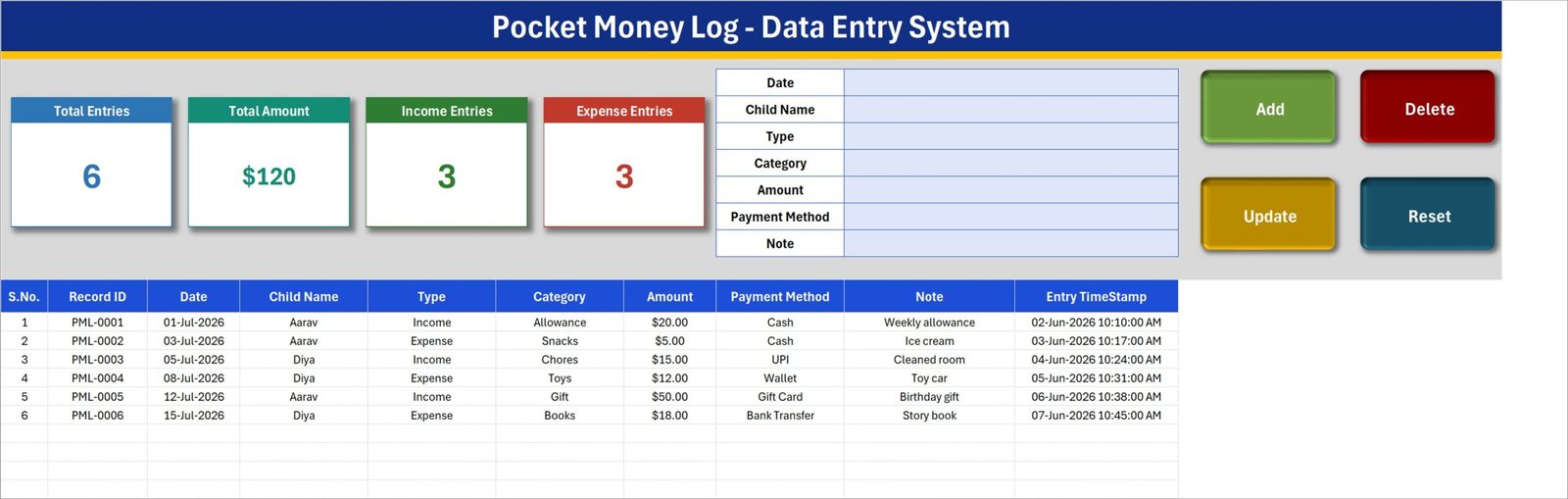
Four VBA macros run the whole log. Add writes the form contents to the next empty row, Update rewrites the record you have selected, Delete removes it after a confirmation prompt, and Reset clears the form fields. Because you never type directly into the records table, the currency formatting, the row numbering and the timestamp column stay intact no matter how many entries pile up.
Three KPI cards recalculate on every save. Total Given sums the Given column, Total Spent sums the Spent column, and Balance is the difference. They are live formulas, not static numbers, so they move the instant a record lands. The same three cards are duplicated on the Setting sheet, which lets you Copy → Paste Special → Linked Picture them onto any other sheet or into a printed summary.
The Purpose dropdown is yours to edit. Spending categories — Snacks, Stationery, Travel, Games, Gifts, Savings and whatever else fits your household — live as a plain list on the Setting sheet and reach the form through a named range. Add a row to that list and the dropdown grows. No formula editing, no data-validation dialog. If you want to understand the mechanism behind it, Microsoft documents the approach in its data validation guide.
Automatic S.No and Entry TimeStamp. Serial numbering runs on a formula that skips blank rows, so deleting a record does not leave a gap in the sequence. Every saved row also carries the date and time it was entered — which is what turns a list into a record you can actually defend when a child, or a parent, disputes a number.
Money columns formatted as currency. Given, Spent and Balance display with a $ symbol against a light hair-grid table. Change the number format once on the column and the whole log switches to ₹, £ or €.
Sheets Explanation
Sheet 1: Data Entry Dashboard
The working screen. A gray dashboard panel at the top holds the six-field entry form on the left and the three KPI cards on the right. Underneath the form sit four coloured button cells in a 2×2 block — Add in green, Delete in red, Update in gold, Reset in dark blue — which you cover with your own glossy shapes and assign the macros to. The records table begins at row 15 with a header row above it, and grows downward as entries are added.
Sheet 2: Setting
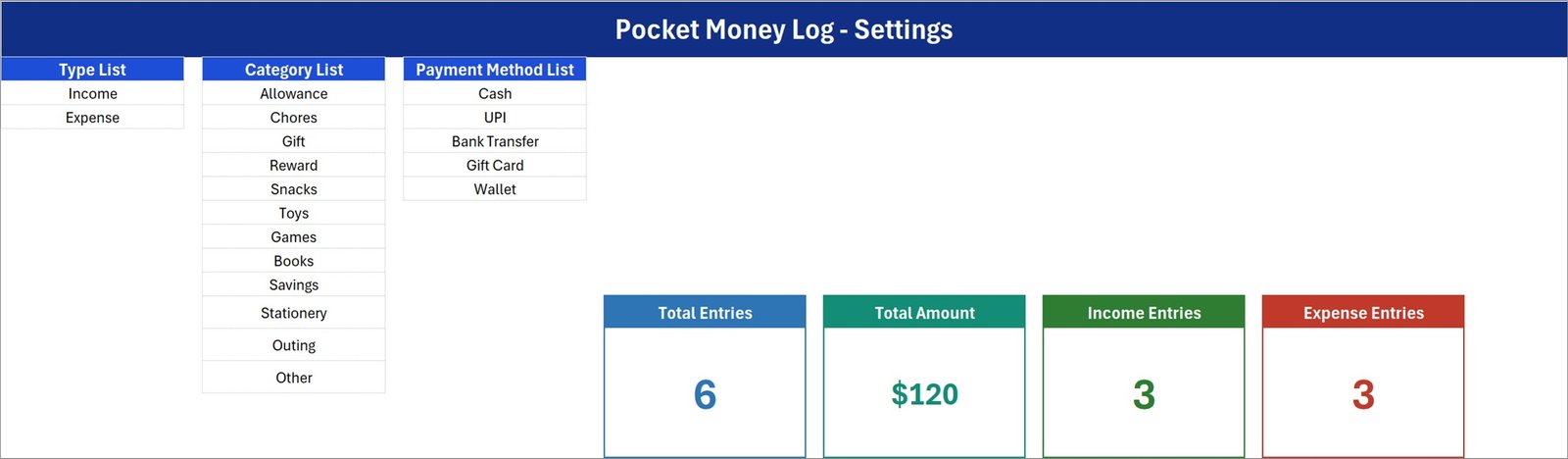
The control sheet. It holds the Purpose dropdown source list and a duplicate set of the three KPI cards. This is the only sheet you edit when you want to change how the form behaves — everything else is driven from here through named ranges.
Sheet 3: Instructions
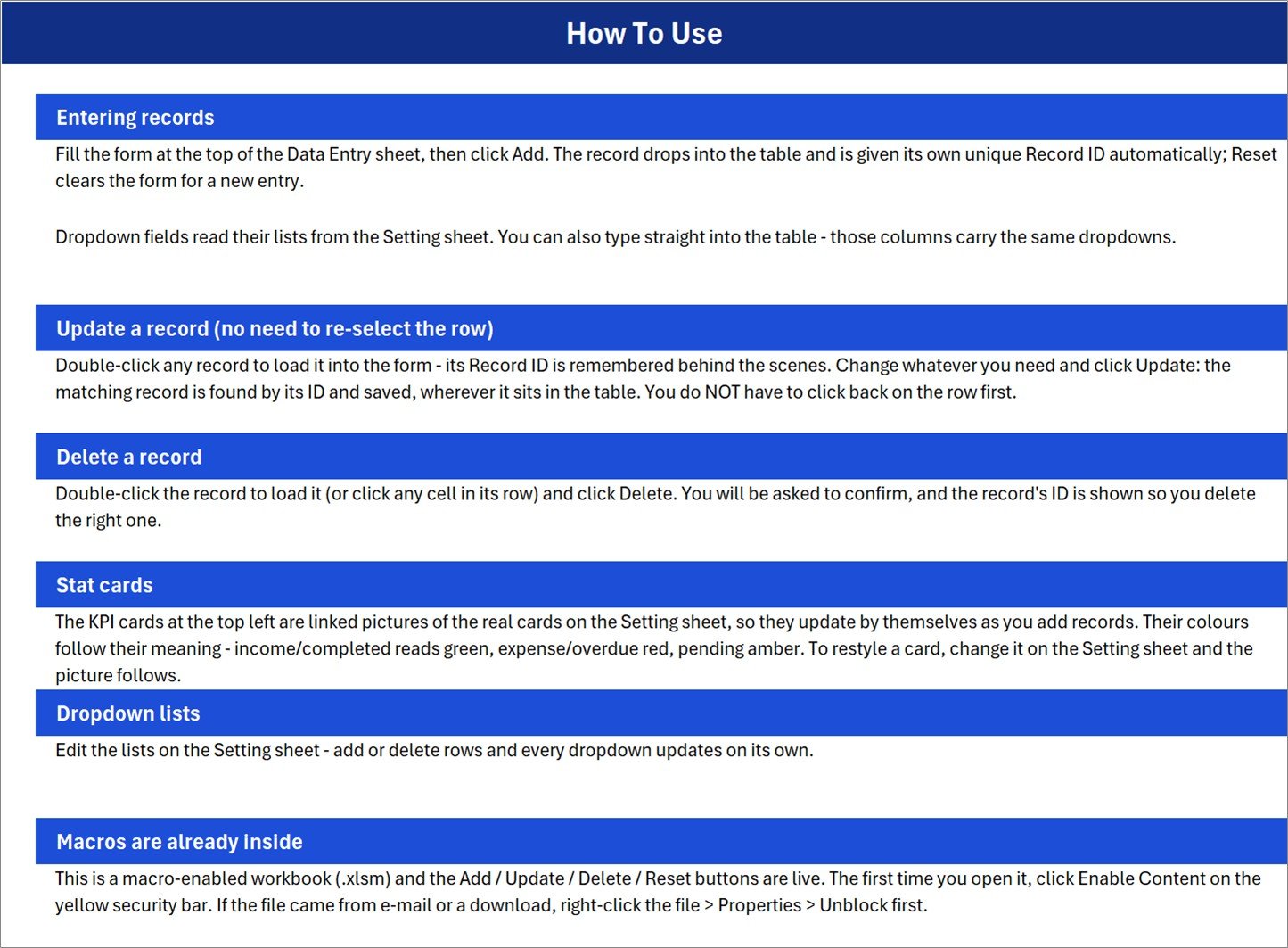
A one-page setup guide covering the VBA import, the Save As .xlsm step, assigning each macro to its button shape, and extending the Purpose list. A fourth sheet, Get More Templates, links back to the wider catalog.
Pocket Money Log in Excel vs. Google Sheets vs. Greenlight / GoHenry — Feature Comparison
| Feature | Pocket Money Log (Excel) | Google Sheets allowance tracker | Greenlight / GoHenry |
|---|---|---|---|
| Cost | $5.99 one-time ✅ | Free to $9.99 one-time | $5.99 to $14.98 / month |
| Platform | Microsoft Excel, offline | Browser, Google account required | Mobile app plus a physical debit card |
| Setup time | Under 5 minutes ✅ | 5 to 10 minutes | 2 to 5 days (KYC plus card delivery) |
| One-click Add / Update / Delete | ✅ VBA buttons | Manual, or write Apps Script | ✅ |
| Works with no internet | ✅ | ❌ | ❌ |
| Bank account or card required | ❌ None ✅ | ❌ None | ✅ Required |
| Custom spending categories | ✅ Unlimited, via Setting sheet | ✅ Unlimited | Limited to app presets |
| Where the data lives | ✅ Your own computer | Google servers | Fintech company servers |
| Year-1 cost, family with 3 children | $5.99 ✅ | $0 to $9.99 | $71 to $180 |
For parents and students who want a private, offline record of money given against money spent — without handing a child’s spending history to a fintech app — the Pocket Money Log Data Entry System in Excel sits in the sweet spot.
Who Should Use This Template
Perfect for:
- Parents giving weekly or monthly allowance to one to five children from a single household file
- College and hostel students accounting for money received from home against what was actually spent
- Hostel wardens, guardians and boarding-school office staff keeping a per-resident money record
- Anyone who wants a plain Given / Spent ledger with a running balance and zero recurring cost
Not a fit if:
- You want a real debit card with spending limits and automatic bank feeds — that is what Greenlight and GoHenry do, and this does not
- Two people need to edit the same log simultaneously from different devices — a Google Sheets allowance tracker handles that better
- You need full household budgeting with envelopes and forecasts — the Daily Expense Tracker Data Entry System in Excel is the right sibling
- You work on Excel for Mac or Excel Online, where VBA button shapes are inconsistent or macros do not run at all
Real-World Use Cases
Meera, mother of two in Pune. Every Sunday she gives each child a fixed allowance and logs it as a Given entry with the Person field set to that child’s name. When they report a purchase, she adds a Spent row and picks Snacks, Stationery or Games from the Purpose dropdown. At month end the three KPI cards tell her exactly how much left the house and how much is still unspent — a conversation she previously had entirely from memory, and lost every time.
Arjun, second-year engineering student. His parents transfer a monthly amount to his hostel account and expect a rough account of it. He logs each transfer under Given and each expense under Spent, then screenshots the KPI cards at month end and sends it home. Setup took him one evening. It replaced three abandoned notes-app lists and one very optimistic mental estimate.
Mr. Fernandes, warden of a 40-bed boarding hostel. Parents deposit pocket money with the office and he releases it in instalments. He runs one workbook per term with the student’s name in the Person field and one row per transaction. When a parent calls asking about a specific date, the Entry TimeStamp column answers it in seconds instead of a hunt through a paper register.
Advantages of the Pocket Money Log Data Entry System
It costs $5.99 once. A family with three children on Greenlight pays $71 to $180 in the first year alone. Over five years the gap is not marginal — it is the difference between a one-off purchase and a recurring line item you forget you are paying.
The data never leaves your machine. Kids-money apps hold a complete, timestamped record of a child’s spending on company servers. This workbook holds the same record in a file on your desktop. For many parents that is the whole argument.
It takes minutes, not days. No KYC, no card in the post, no account verification. Import a module, save as .xlsm, and you are logging entries the same afternoon.
It teaches the underlying habit. A child who watches a Balance card drop as Spent rows accumulate learns something a debit-card app hides behind an interface. That is the actual point of pocket money.
Opportunities for Improvement
Being straight about the limits: this workbook is a log, not a payment system. It records money, it does not move it, so reconciling against a real bank account is manual work.
There is no per-person chart. The KPI cards report household totals, and separating a single child’s numbers means filtering the records table by Person. For two or three children that is fine; past five it starts to feel thin, and a pivot table would earn its place.
The Balance field is entered rather than calculated, which means a typo can leave the column out of step with Given minus Spent. If you would rather it be automatic, replace the input with a running-total formula — a five-minute edit, and one worth making if the file is shared with a child.
Finally, macros mean Windows Excel. Excel for Mac handles the formulas correctly but treats button shapes inconsistently, and Excel Online will not run the VBA at all.
Best Practices
- Start a new file each academic year or term. A twelve-month log stays readable; a four-year log does not.
- Keep the Purpose list under about a dozen values. Categories only help if they are used consistently, and thirty options guarantees they will not be.
- Log the Given entry the moment money changes hands, not at week’s end. Retrospective entries are where the accuracy goes.
- Let the child do the Spent entries. The habit is the product; the spreadsheet is just where it lives.
- Back the .xlsm up to cloud storage. An offline file is private, which also means nobody is keeping a copy for you.
Explore Relevant Templates
If this fits your workflow, a few others from the same family are worth a look. The Daily Expense Tracker Data Entry System in Excel uses the identical form-plus-KPI layout for whole-household spending, and the Bank Account Balance Tracker in Google Sheets covers the account the allowance actually comes out of. For older children, the Week Money Challenge Tracker in Google Sheets turns saving into a game.
Also available as: the Kids Allowance and Chores Money Tracker in Google Sheets — the browser-based version, if shared phone access matters more to you than offline privacy.
Two other data entry systems built the same way: the Blood Donor Register Data Entry System in Excel and the Dental Patient Log Data Entry System in Excel. And if variance analysis is where you are headed next, see Budget vs Actual Tracking in Excel.
💎 Want the whole set? The VBA Management Systems Mega Pack bundles five premium Excel systems for less than buying them separately.
Frequently Asked Questions
What does the Pocket Money Log Data Entry System in Excel track?
The Pocket Money Log Data Entry System in Excel tracks 6 fields per record: Date, Person, Given, Spent, Purpose and Balance. Three KPI cards summarise Total Given, Total Spent and Balance, and every saved row carries an automatic S.No and Entry TimeStamp.
Do I need to know VBA to use it?
No. The Pocket Money Log Data Entry System ships with a ready-written .bas module and an Instructions sheet. You import the module once, save the file as .xlsm, and assign four macros to four buttons. No code is written or edited by you at any point.
How does this compare to Greenlight or GoHenry?
Greenlight and GoHenry issue a real debit card and charge $5.99 to $14.98 every month. The Pocket Money Log Data Entry System in Excel costs $5.99 once, works offline, needs no bank account, and keeps the record on your own computer. It logs money; it does not move money.
How long does setup take?
Under 5 minutes. Import the VBA module, save as .xlsm, assign the four macros to their buttons, and edit the Purpose list on the Setting sheet. Sample records already in the Pocket Money Log show the KPI cards working before you enter anything of your own.
Can I track more than one child in the same file?
Yes. The Person field separates records, so one workbook holds every child in the household. Filter the records table by Person for an individual view, or read the KPI cards in the Pocket Money Log for the combined household total across everyone.
Which Excel versions does it work with?
The Pocket Money Log Data Entry System in Excel is built for Excel 2016, 2019, 2021 and Microsoft 365 on Windows. Excel for Mac runs the formulas correctly but handles VBA button shapes inconsistently, and Excel Online does not run macros at all.
About the Author
Built by PK — Microsoft Certified Professional with 15+ years of Excel, Google Sheets and Power BI experience. Founder of NextGenTemplates, reaching 300K+ subscribers across YouTube channels. Every template is hand-built and tested before release.
Conclusion
Pocket money is the first budget most people ever manage, and it usually gets tracked worse than any budget that follows it. Six fields, three cards and four buttons is not a sophisticated system — that is precisely why it gets used. The Pocket Money Log Data Entry System in Excel is set up in under five minutes, runs offline, and answers the given-spent-left question the moment you open it.
👉 Click here to Purchase the Pocket Money Log Data Entry System in Excel
Instant download · One-time payment · No subscription
🎥 For step-by-step video tutorials, visit Youtube.com/@PK-AnExcelExpert
📅 Last updated: August 2026