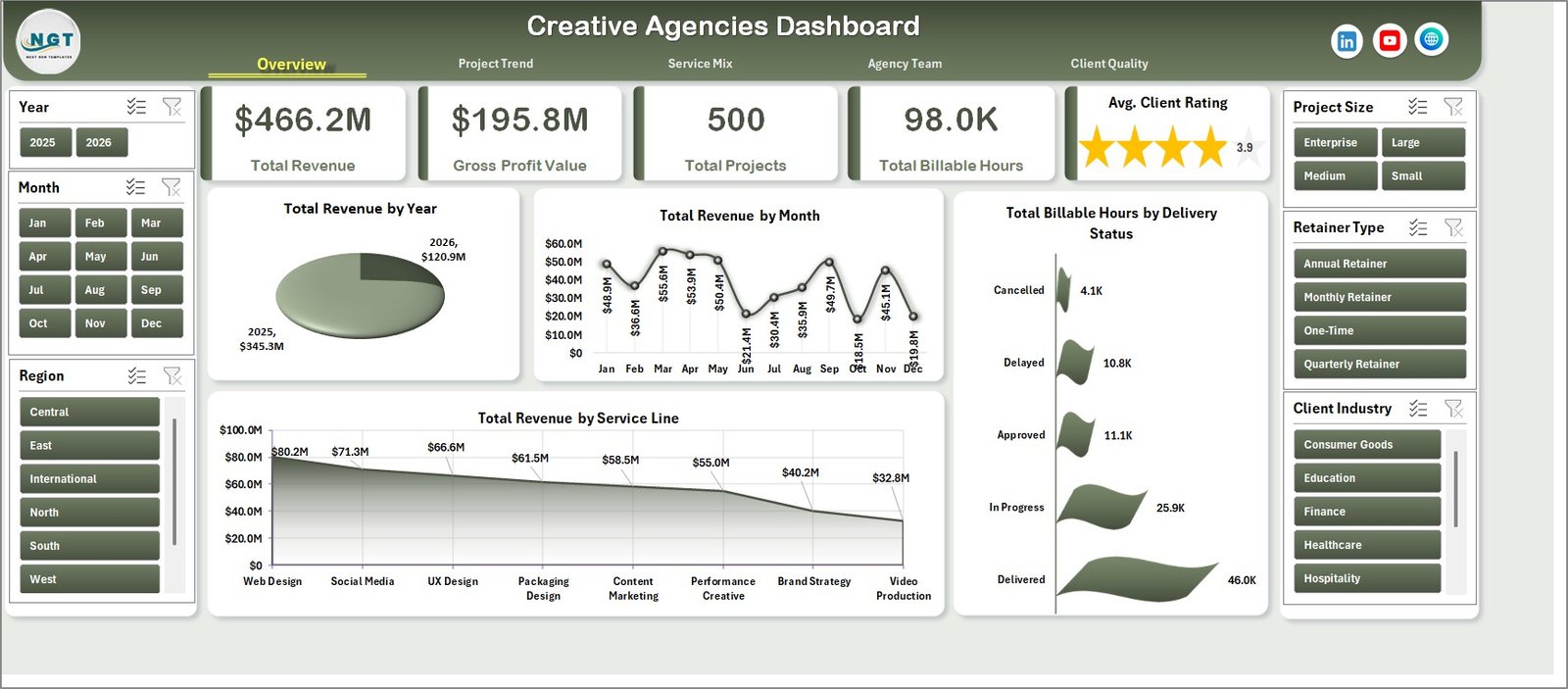
Creative agencies live on fast-moving project work: service lines change, campaign scopes shift, billable hours rise, revision rounds expand, and client satisfaction can vary by industry, account lead, or campaign type. A growing agency can easily manage hundreds of project records per year, but many teams still review performance from disconnected trackers. The Creative Agencies Dashboard in Excel brings those records into one slicer-driven workbook with 5 KPI cards, 5 analysis pages, a structured Data sheet, and a Support sheet powered by pivot tables. It is built for agency owners, account leads, project managers, finance teams, and operations managers who want clear reporting without paying for a monthly analytics platform.
The template uses native Excel reporting features, including pivot tables, charts, slicers, and Refresh All. Microsoft also documents pivot tables as a core way to summarize and analyze worksheet data, which makes this approach practical for spreadsheet-first businesses. You can learn more from Microsoft’s PivotTable guidance.
Key Features of Creative Agencies Dashboard in Excel
- 5 headline KPI cards: Total Revenue, Gross Profit Value, Total Projects, Total Billable Hours, and Avg. Client Rating.
- 5 analysis pages: Overview, Project Trend, Service Mix, Agency Team, and Client Quality.
- Multiple slicers: Filter quickly by agency, service, client, region, campaign, retainer, delivery, and time fields.
- 20+ chart views: Analyze revenue, cost, projects, billable hours, delivery status, revisions, account leads, industries, and ratings.
- Editable Data sheet: Replace the sample agency records with your own data in the same format.
- Support sheet: Pivot tables power the dashboard dynamically and can be kept hidden after setup.
- One-time Excel template: No monthly reporting subscription and no vendor-controlled analytics layer.
Dashboard Pages Explanation
1. Overview Page
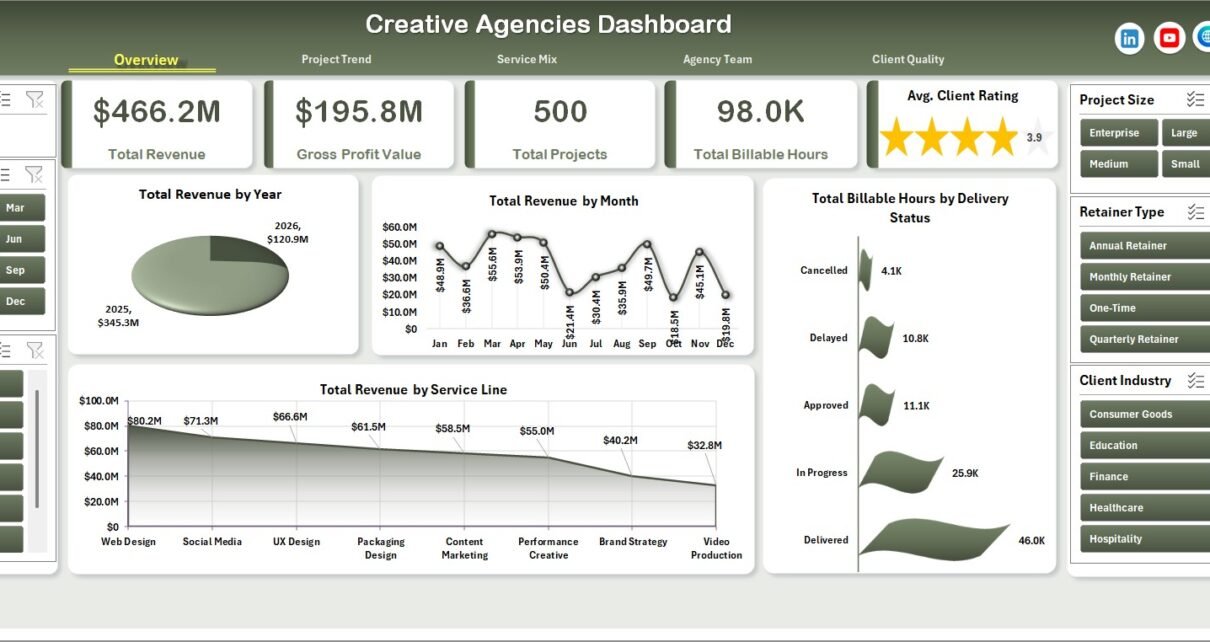
The Overview page gives leadership a high-level read on agency performance. At the top, KPI cards show Total Revenue, Gross Profit Value, Total Projects, Total Billable Hours, and Avg. Client Rating. These cards help teams understand commercial performance, project volume, delivery effort, and satisfaction before reviewing detailed charts.
Total Revenue by Year: This chart shows annual revenue movement. Use it to compare year-over-year growth and review whether the agency is scaling in the right direction.
Total Revenue by Month: This chart shows monthly revenue patterns. It helps identify seasonal peaks, slow months, and periods where pipeline support may be needed.
Total Revenue by Service Line: This chart compares revenue from different creative services. It helps leaders see whether branding, design, content, production, media, or strategy is contributing the most revenue.
Total Billable Hours by Delivery Status: This chart connects team effort with project progress. It helps operations managers see whether hours are concentrated in completed, active, delayed, or pending work.
2. Project Trend
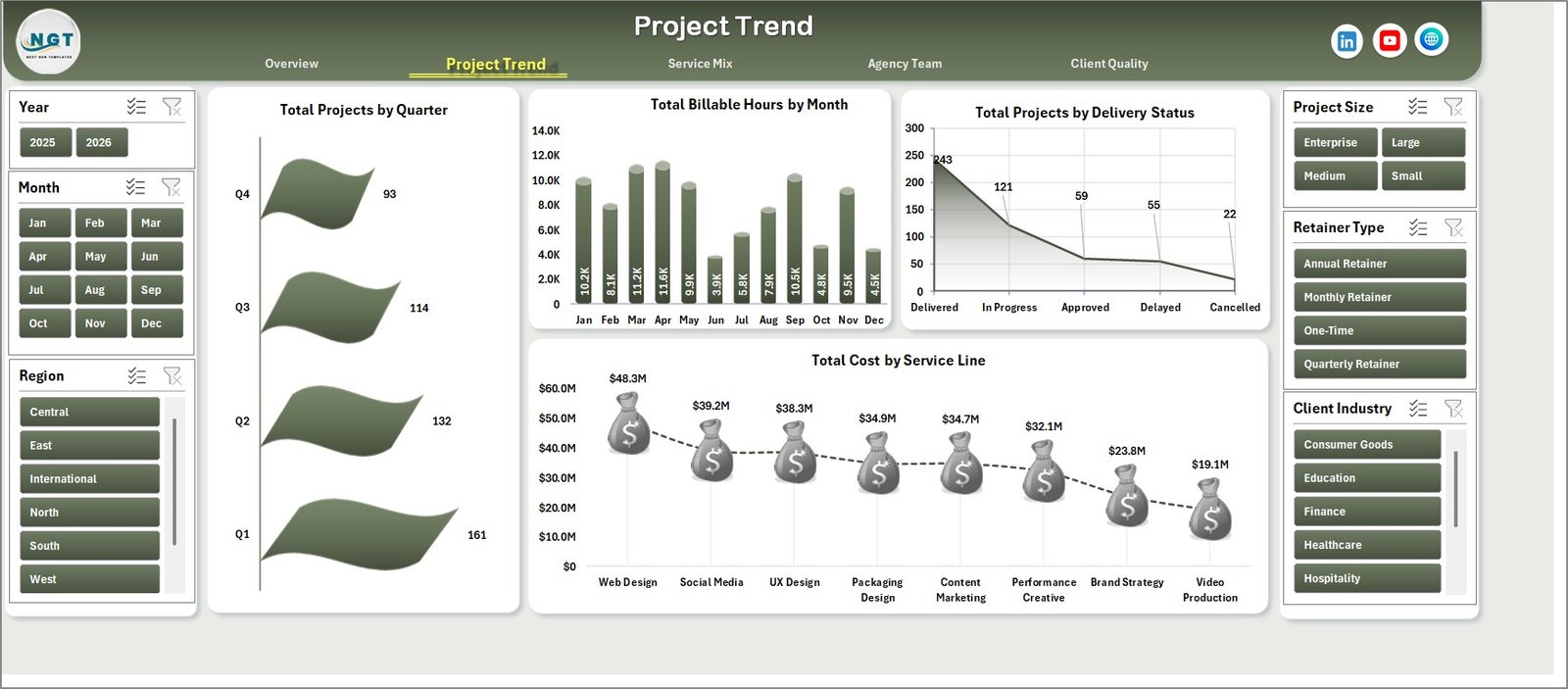
The Project Trend page focuses on project volume, billable effort, delivery health, and cost movement. Total Projects by Quarter shows how workload changes across the year. Total Billable Hours by Month helps teams spot delivery pressure. Total Projects by Delivery Status reveals whether work is completed, delayed, active, or pending. Total Cost by Service Line highlights which services consume the most delivery cost.
3. Service Mix
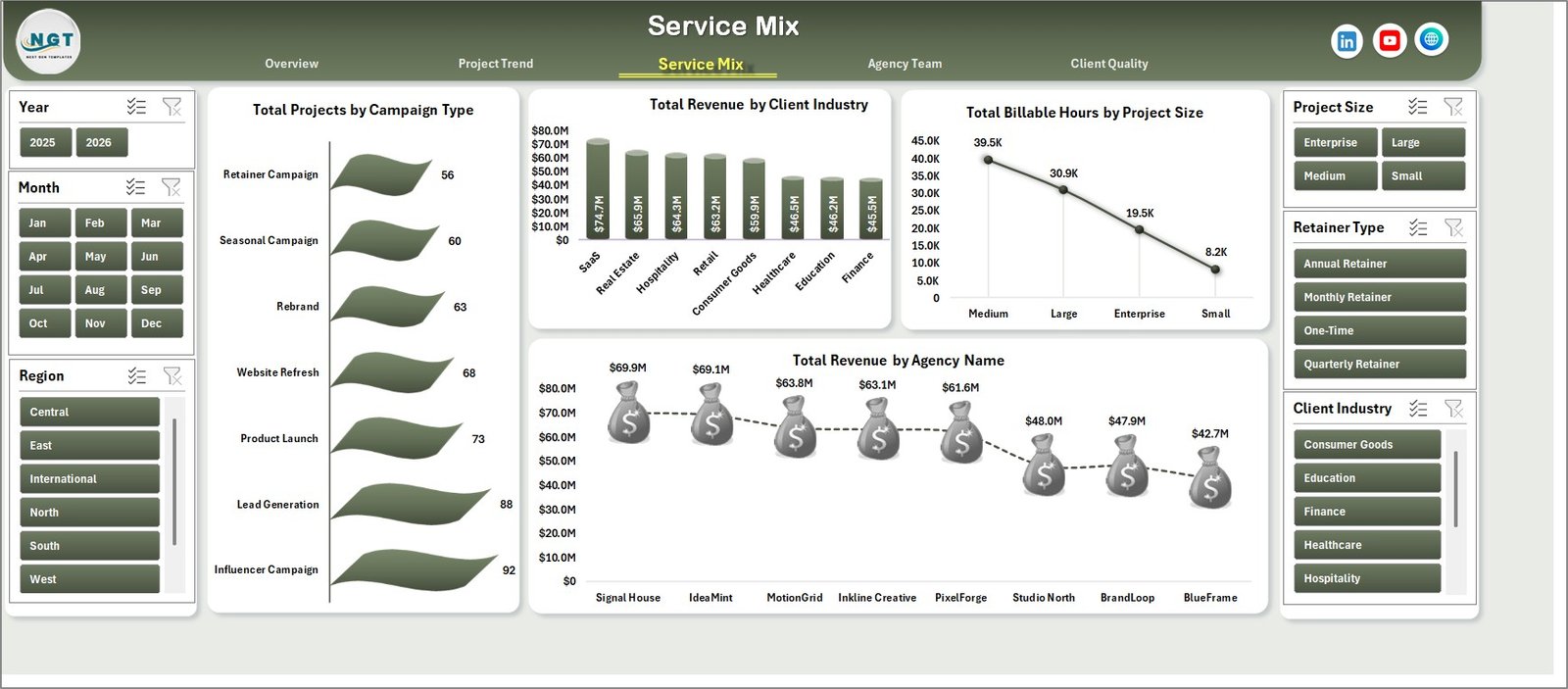
The Service Mix page explains what kind of work is driving the agency. Total Projects by Campaign Type shows project distribution across campaign categories. Total Revenue by Client Industry reveals which industries contribute the highest revenue. Total Billable Hours by Project Size helps compare effort for small, medium, and large work. Total Revenue by Agency Name is useful for agencies with multiple brands, divisions, or business units.
4. Agency Team
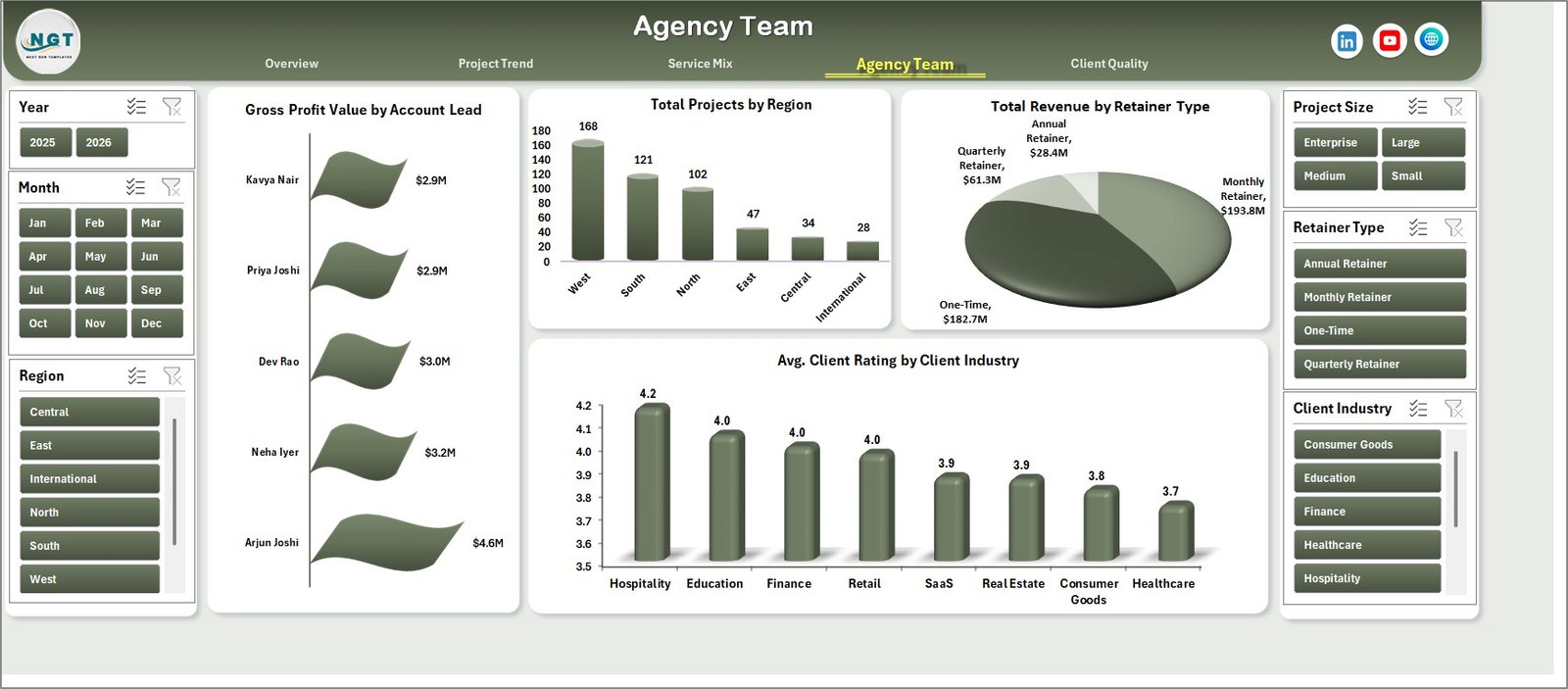
The Agency Team page links people, markets, retainers, and satisfaction. Gross Profit Value by Account Lead shows which account leads are associated with stronger margin. Total Projects by Region shows where delivery volume is concentrated. Total Revenue by Retainer Type compares recurring and one-off project models. Avg. Client Rating by Client Industry helps identify where the agency earns stronger client feedback.
5. Client Quality
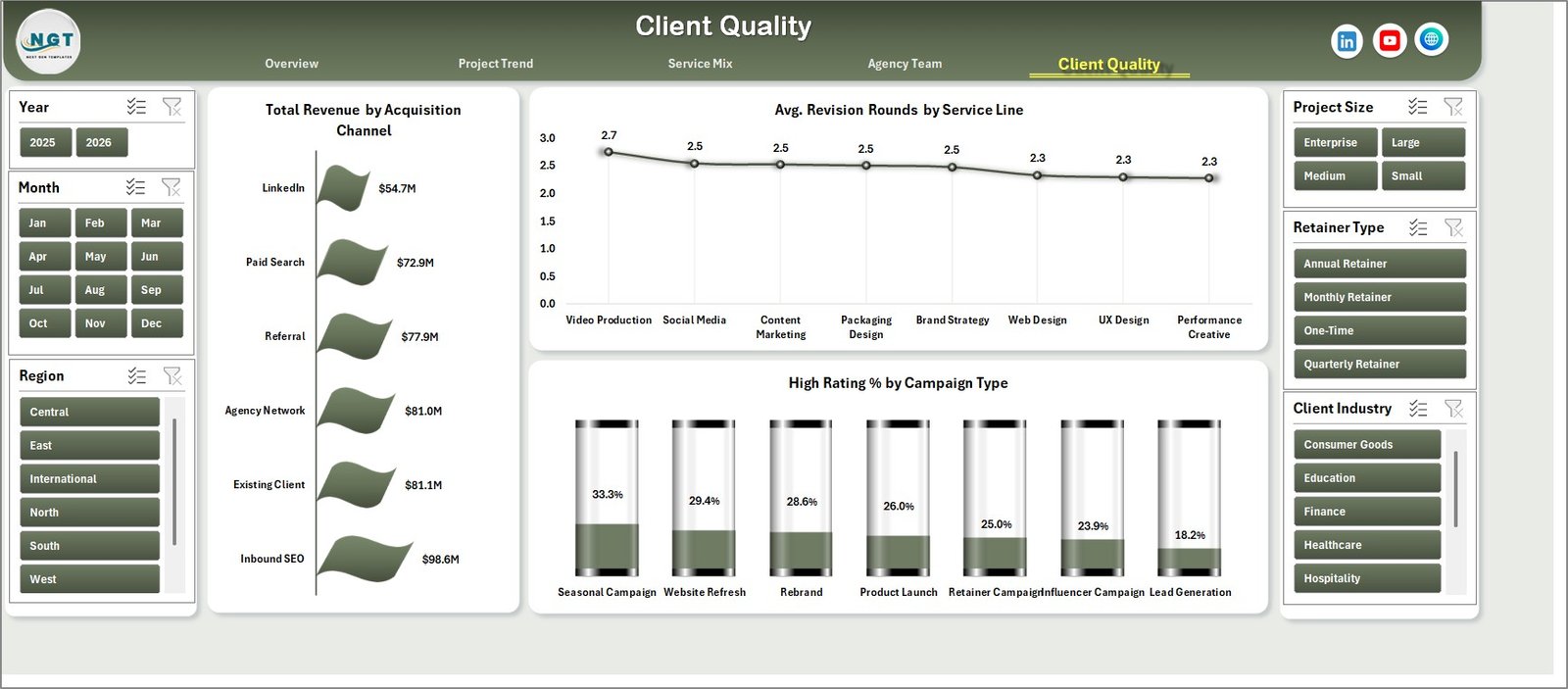
The Client Quality page turns acquisition and satisfaction data into action. Total Revenue by Acquisition Channel shows which channels bring higher-value clients. Avg. Revision Rounds by Service Line highlights services that may need clearer briefs or better scoping. High Rating % by Campaign Type shows which campaign types produce stronger client outcomes.
6. Data Sheet Tab
The Data sheet is where users add the agency records in the same structured format. Keep the columns consistent, update the sample rows with real data, and the workbook can refresh the dashboard pages from the updated dataset.

7. Support Sheet
The Support sheet contains the pivot tables that power the dashboard. After updating the Data sheet, go to the Data tab in the Excel Ribbon and click Refresh All. This refreshes pivots and charts, and you can keep the Support sheet hidden during normal use.

Creative Agencies Dashboard in Excel vs. Google Sheets vs. Paid CRM/SaaS – Feature Comparison
| Feature | Creative Agencies Dashboard in Excel | Google Sheets Alternative | Paid Agency SaaS |
|---|---|---|---|
| Cost | $17.99 one-time | Manual build or template cost | Monthly subscription |
| Platform | Microsoft Excel | Browser-based spreadsheet | Vendor cloud app |
| Setup time | Replace data and refresh | Depends on formula and chart setup | Onboarding required |
| Real-time collaboration | Possible with Microsoft 365 sharing | Native collaboration | Usually included by paid seat |
| Mobile access | Limited through Excel mobile | Google Sheets app | Usually included |
| Customizable fields | Editable workbook and pivots | Editable sheet | Plan dependent |
| Share with link | Possible through OneDrive or SharePoint | Yes | Often login-based |
| Year-1 cost at 5 users | $17.99 plus Excel access | Template or build cost | Often hundreds or thousands |
| Best fit | Agency reporting and review | Shared lightweight tracking | Full workflow automation |
Who Should Use This Template
This dashboard is useful for creative agencies, branding studios, digital marketing agencies, design teams, content teams, account managers, project managers, client services leads, operations managers, and finance teams that already maintain agency project data in spreadsheets.
It is not meant to replace a CRM, project management platform, invoicing system, automated time tracker, or client approval portal. Teams that need live task boards, automated billing, contract approvals, or resource scheduling should use this dashboard as the reporting layer beside their operational tools.
Real-World Use Cases
Maya, agency founder: Maya opens the Overview page before monthly leadership meetings to discuss revenue, gross profit, billable hours, and client ratings in one view.
Daniel, operations manager: Daniel reviews Project Trend each week to see whether delayed work is consuming too many billable hours and whether project cost is concentrated in one service line.
Priya, client services lead: Priya uses Client Quality to compare revision rounds and high-rating percentages, then improves scoping and onboarding for campaign types with lower satisfaction.
Advantages of Creative Agencies Dashboard in Excel
The main advantage is clarity without a new system. A team can continue using Excel while adding a finished reporting layer for revenue, margin, project load, hours, quality, and team performance. The dashboard is also fully editable, which means users can change chart titles, update fields, customize slicers, and adjust the workbook to match their agency language. Because it is a one-time template, it is easier to approve than another monthly software subscription.
Opportunities for Improvement
The workbook does not include automated time tracking, live CRM sync, approval workflows, client portals, or automatic invoice creation. It also depends on clean data entry. For best results, keep the Data sheet structure consistent and avoid overwriting pivot source fields unless you are comfortable editing Excel pivots and charts.
Best Practices
- Update the Data sheet on a consistent weekly or monthly schedule.
- Keep service line, campaign type, client industry, and status names standardized.
- Refresh all pivots after every data update.
- Use slicers during review meetings to answer follow-up questions quickly.
- Keep a backup copy before changing pivot tables, chart ranges, or workbook structure.
Explore Relevant Templates
- Creative Agencies Dashboard in Excel – purchase the dashboard template on NextGenTemplates.
- Creative Agencies KPI Dashboard in Excel – KPI-focused version for target and performance tracking.
- Digital Advertising Calendar in Google Sheets – useful for campaign planning teams.
- Browse Excel Dashboard Templates.
Frequently Asked Questions
What KPIs are included in the Creative Agencies Dashboard in Excel?
The top KPI cards are Total Revenue, Gross Profit Value, Total Projects, Total Billable Hours, and Avg. Client Rating.
How do I update the dashboard?
Replace the sample records in the Data sheet, then go to the Data tab in Excel and click Refresh All. The pivot tables and charts will update.
Can I add my own agency data?
Yes. Add your own data in the same format used by the Data sheet. Keeping the same column structure helps the dashboard refresh correctly.
Can I hide the Support sheet?
Yes. The Support sheet contains pivot tables that power the workbook. You can keep it hidden during normal use.
Does this dashboard replace agency management software?
No. It is a reporting dashboard, not a CRM or project management tool. It works best for analysis and review after your data is exported or entered into the Data sheet.
Is this suitable for small agencies?
Yes. It is especially useful for small and mid-size agencies that want better visibility without a monthly reporting platform.
About the Author
Built by PK – Microsoft Certified Professional with 15+ years of Excel, Google Sheets, and Power BI experience. Founder of NextGenTemplates, reaching 300K+ subscribers across YouTube channels. Every template is hand-built and tested before release.
Conclusion
The Creative Agencies Dashboard in Excel gives agency teams a practical way to review revenue, gross profit, project volume, billable hours, account lead performance, service mix, delivery status, acquisition quality, revision rounds, and client ratings from one workbook. If your agency already manages data in spreadsheets, this template gives you a ready-made reporting structure that can be updated with your own records and refreshed through Excel.
Visit our YouTube channel for step-by-step Excel dashboard tutorials.
Creative Agencies Dashboard in Excel