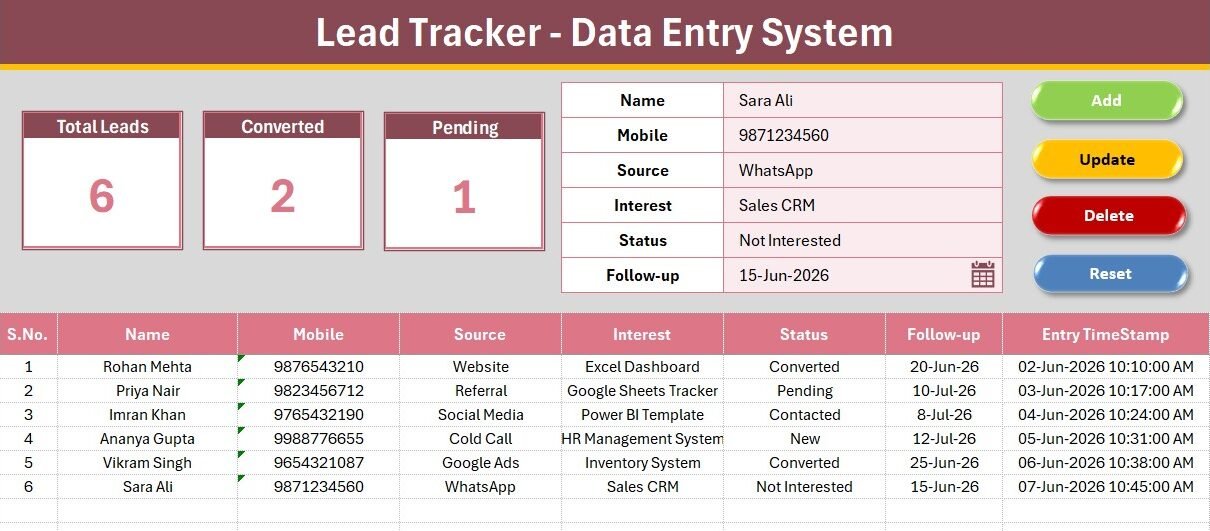
The Lead Tracker Data Entry System in Excel logs every sales lead across six fields — Name, Mobile, Source, Interest, Status and Follow-up — and updates three live KPI cards (Total Leads, Converted, Pending) the moment a record is added. First-time setup takes under 5 minutes, and the tool works entirely offline with no login and no per-seat fees.
Most solo founders and small sales teams don’t need a $25-per-seat CRM to answer one simple question: who is the lead, where did they come from, and are they closing? This Lead Tracker Data Entry System in Excel gives sales teams a clean, VBA-driven form to capture that in seconds and keep a permanent, timestamped record of every lead.
Key Features of the Lead Tracker Data Entry System in Excel
This is a macro-driven data entry form, not a static spreadsheet. Every record action runs through a button, so the underlying table stays clean no matter who is entering leads.
- Four one-click VBA buttons — Add, Update, Delete and Reset handle every record action from the form, so nobody types directly into the table and breaks a formula.
- Three auto-calculating KPI cards — the dashboard tracks Total Leads, Converted (Status = Converted) and Pending (Status = Pending), and all three recalculate instantly with each entry.
- Two dropdown-controlled fields — Source and Status pull from editable lists on the Setting sheet, covering 18 combined preset options so every entry stays standardized for clean filtering and reporting.
- Auto S.No and Entry TimeStamp — every lead is numbered automatically and stamped with its entry date-time, creating a reliable audit trail for follow-up.
- Double-click to edit — click any row to load that lead back into the form, change it, and hit Update to write it back in place.
Sheets Explanation
Data Entry Dashboard and KPI Cards
The main sheet holds the entry form, the three KPI cards, the Add/Update/Delete/Reset buttons, and the records table below. Enter a lead’s details, click Add, and the row drops into the table with an auto S.No and timestamp.
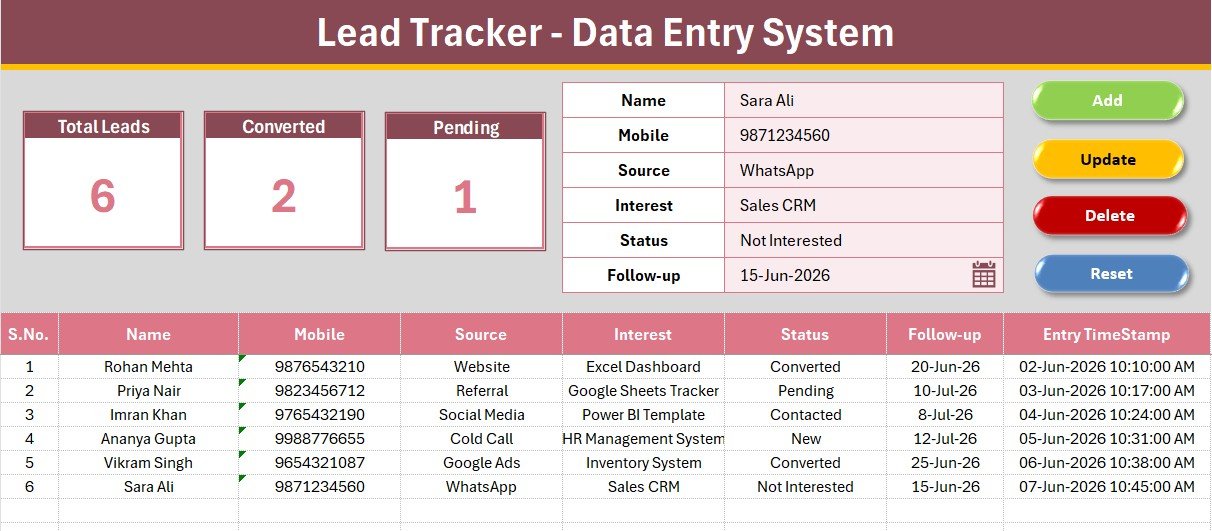
Data Entry Form Close-up
A closer look at the form and dashboard panel: bold field labels, light-tinted input lines, the three KPI cards, and the coloured Add/Delete/Update/Reset button cells that the VBA macros attach to.
Setting Sheet — Dropdown Lists
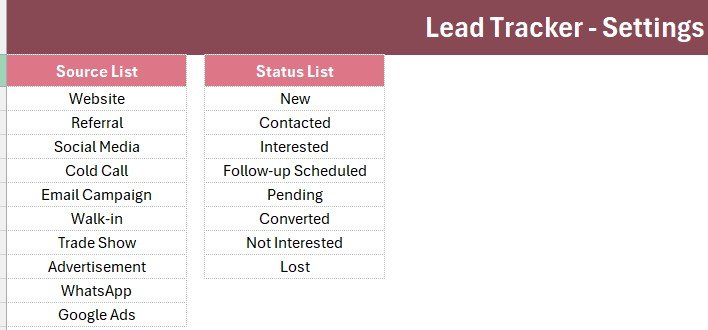
The Setting sheet holds the source lists for the two dropdown fields: Source (Website, Referral, Social Media, Cold Call, Email Campaign, Walk-in, Trade Show, Advertisement, WhatsApp, Google Ads) and Status (New, Contacted, Interested, Follow-up Scheduled, Pending, Converted, Not Interested, Lost). Edit these lists to match your own pipeline and the form dropdowns update automatically — this is powered by Excel’s own data validation dropdowns.
Lead Tracker Data Entry System in Excel vs. Google Sheets vs. HubSpot / Salesforce / Pipedrive — Feature Comparison
| Feature | Lead Tracker (Excel) | Google Sheets equivalent | HubSpot / Salesforce / Pipedrive |
|---|---|---|---|
| Cost | $5.99 one-time | Free but build-it-yourself | $15–90 / user / month |
| Platform | Microsoft Excel (offline) | Google Sheets (cloud) | Web / mobile SaaS |
| Setup time | Under 5 minutes | Hours to build | Days of onboarding |
| One-click Add/Update/Delete | Yes, VBA buttons | Manual / scripts needed | Yes |
| Works fully offline | Yes | No | No |
| Per-user fees | None | None | Charged per seat |
| Own your data locally | Yes | In Google cloud | On vendor servers |
| Year-1 cost at 5 users | $5.99 | $0 | $900–$5,400 |
For solo founders and small teams that want fast, structured lead logging without paying per seat every month, the Lead Tracker Data Entry System sits in the sweet spot.
Who Should Use This Template
Perfect for:
- Solo founders and freelancers who need one place to log every inbound lead
- Small sales teams (2–10 people) that prefer a one-time Excel tool over a monthly CRM subscription
- Marketing and agency staff who need to track lead source and interest for ROI reporting
Not a fit if:
- You need real-time cloud collaboration with several reps editing the same file at once
- You require automated email sequences, lead scoring, or a visual drag-and-drop pipeline — a dedicated CRM platform fits better
Real-World Use Cases
Meera is a freelance web designer. She logs every inbound inquiry from her website contact form and Instagram DMs into the Lead Tracker, checks the Pending card each morning, and follows up before a lead goes cold — without paying for a CRM she’d barely use.
Arjun runs a 4-person outbound sales team at a small SaaS startup. His reps log calls and demos by Source and Status, and he reviews the Converted count weekly to see which channel — cold call, LinkedIn, or referral — is actually closing deals.
Fatima manages partnerships at a nonprofit. She tracks donor and sponsor leads by Interest and Follow-up date, filters the records table by Status, and updates entries in seconds using the double-click-to-edit form.
Advantages of the Lead Tracker Data Entry System
The biggest advantage is cost against time saved. At a one-time $5.99, the tool pays for itself immediately versus a per-seat CRM that can run $900–$5,400 a year for a five-person team. Because it runs in Excel, there is nothing to learn beyond typing into a form and clicking a button, and your lead data stays on your own machine. The auto S.No and timestamp give you a follow-up audit trail for free, and the three KPI cards turn a plain list into a live pipeline snapshot.
Opportunities for Improvement
Being honest about limits: this is a single-user Excel tool, so it is not built for several people editing the same file simultaneously. It does not send automated follow-up emails, score leads, or visualise a drag-and-drop pipeline, and it relies on macros, which means users must enable macros and save the file as .xlsm. Teams that outgrow it can step up to a dedicated CRM once lead volume and team size justify the monthly cost.
Best Practices
- Customize the Setting-sheet Source and Status lists first — set your real lead channels and pipeline stages before entering live data.
- Use consistent Status values so the Converted and Pending KPI cards stay accurate.
- Set a Follow-up date on every lead so nothing slips through the cracks.
- Keep one master file and back it up; since data is local, a weekly copy protects your lead history.
- Use the double-click-to-edit flow instead of typing into the table directly, to preserve formulas.
Explore Relevant Templates
Ready to see more of the Data Entry System line? Read our guides on the Task Assignment Data Entry System, the Leave Application Data Entry System, and the Daily Expense Tracker Data Entry System. You can also browse the full Sales & Marketing Templates collection on NextGenTemplates.
Frequently Asked Questions
What fields does the Lead Tracker Data Entry System track?
The Lead Tracker Data Entry System captures six fields per record: Name, Mobile, Source, Interest, Status and Follow-up date. Source and Status are dropdown-controlled from the Setting sheet to keep every entry consistent.
Do I need to enable macros?
Yes. The Lead Tracker Data Entry System uses VBA for the Add, Update, Delete and Reset buttons, so you must enable macros and save the file as a macro-enabled workbook (.xlsm) for the buttons to work.
How long does setup take?
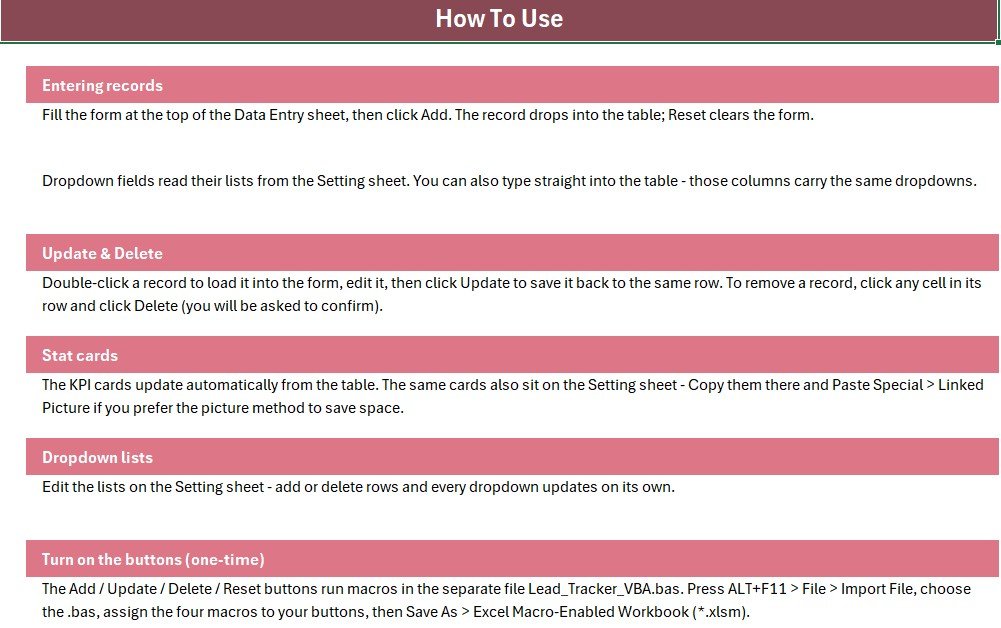
Setup takes under 5 minutes. You import the VBA module, attach four buttons to the coloured cells, save as .xlsm, and start entering leads — the built-in Instructions sheet walks you through each step.
How does this compare to HubSpot or Salesforce?
HubSpot and Salesforce charge $15–90 per user each month. The Lead Tracker Data Entry System is a one-time $5.99 Excel tool that works offline with no per-user fees — ideal for solo founders and small teams that don’t need pipeline automation or email sequencing.
Can I change the Source and Status dropdown options?
Yes. Both dropdown lists live on the Setting sheet. Edit the values there and the form dropdowns update automatically, so you can match the Lead Tracker Data Entry System to your own lead sources and pipeline stages.
Does this replace a full CRM?
No. It is a lightweight lead log, not a pipeline-forecasting or email-automation platform. Teams that outgrow it can step up to a dedicated CRM once lead volume and team size justify the monthly cost.
About the Author
Built by PK — Microsoft Certified Professional with 15+ years of Excel, Google Sheets, and Power BI experience. Founder of NextGenTemplates, reaching 300K+ subscribers across YouTube channels. Every template is hand-built and tested before release.
Conclusion
The Lead Tracker Data Entry System in Excel gives solo founders and small sales teams a fast, structured, offline way to log and follow up on leads by source, interest and status — with live KPI cards and a permanent timestamped record. Click here to purchase the Lead Tracker Data Entry System in Excel.
Instant download · One-time payment · No subscription. For step-by-step video tutorials, visit YouTube.com/@PK-AnExcelExpert.
Last updated: July 2026