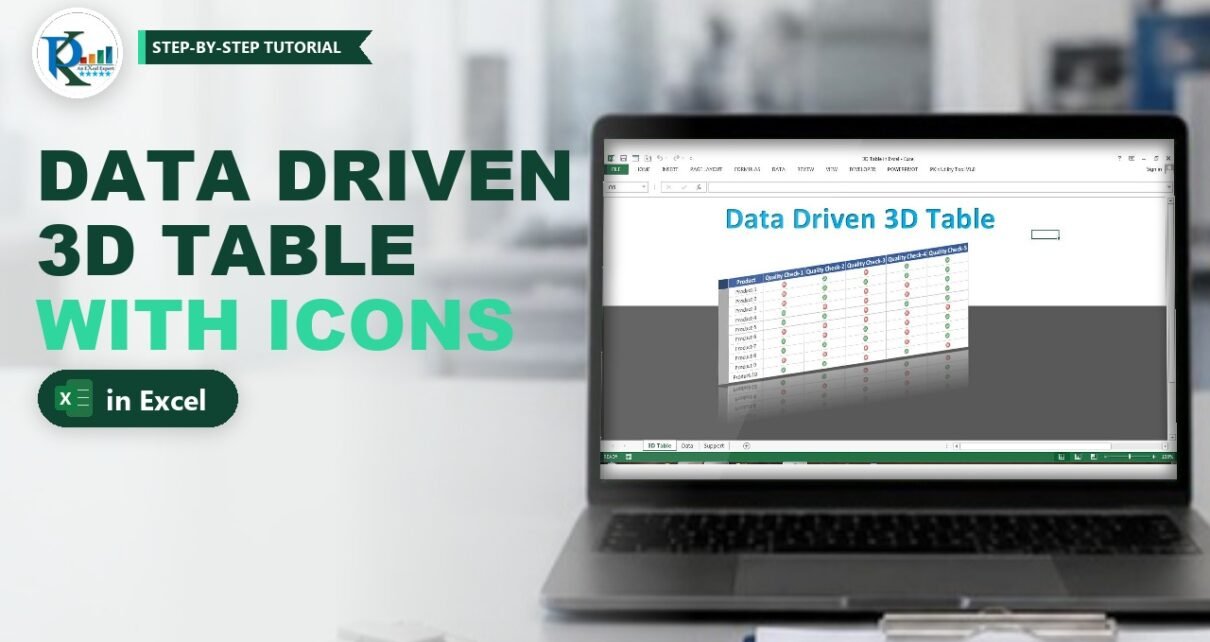
A data driven 3D table in Excel makes a plain status grid look like a tilted, glossy panel that still updates live with your data. In this tutorial you build a quality-check table for ten products: Pass and Fail entries become green tick and red cross icons through conditional formatting, a linked picture copies the table, and 3-D Rotation, a few shapes and a reflection give it real depth. No VBA and no charts are needed, and every change on the data sheet appears in the 3D table instantly, which makes it ideal for dashboards and presentations.

Watch the Video Tutorial
In the video PK converts Pass and Fail into 1 and 0 on a support sheet, shows them as icons only, pastes the range as a linked picture and turns it into a 3D table with 3-D Rotation, two parallelogram shapes and a reflection.
What You Will Build
- A Data sheet where each product’s five quality checks are set to Pass or Fail from a drop-down.
- A Support sheet that turns Pass into 1 and Fail into 0 with a simple IF formula.
- Icon-only conditional formatting: a green tick for 1 and a red cross for 0.
- A linked picture of the support table, so the 3D view always shows the latest data.
- A 3D look from 3-D Rotation, side and header shapes, a dark background and a reflection.
How the Workbook Is Laid Out
- Data – A1 holds Product, B1:F1 hold Quality Check-1 to Quality Check-5, A2:A11 hold Product-1 to Product-10, and B2:F11 hold Pass or Fail chosen from a drop-down list.
- Support – the same layout, but B2:F11 hold 1 or 0 calculated from the Data sheet.
- 3D Table – the presentation sheet with the linked picture and shapes.
Turn off gridlines on every sheet with View → Gridlines so nothing distracts from the table.
Part 1 – Prepare the Support Sheet
Step 1: Copy the data and clear the drop-downs
Add a sheet named Support and paste the Data table into it. The pasted cells still carry the Pass/Fail drop-down, so select B2:F11 and go to Data → Data Validation → Clear All.
Step 2: Turn Pass and Fail into 1 and 0
Delete the Pass/Fail text in B2:F11. In B2 enter the formula below, then copy it to the rest of B2:F11:
B2 =IF(Data!B2="Pass",1,0)The reference is relative, so in C5 it becomes Data!C5 and every cell reads its own check. A pass returns 1 and anything else returns 0, which gives the icon set clean numbers to work with.
Part 2 – Show Icons Only
Step 3: Add the icon set
Select B2:F11 and go to Home → Conditional Formatting → New Rule → Format all cells based on their values. Set Format Style to Icon Sets and choose the 3 Symbols (Circled) style. Then set the rules:
- First icon: green tick when value is >= 1, Type Number.
- Second icon: change it to the red cross, when value is >= 0, Type Number.
Click OK. Every 1 now shows a green tick and every 0 a red cross.
How the rule works
- Icon sets test the thresholds from the top down. A cell with 1 meets the first condition (>= 1), so it gets the green tick.
- A cell with 0 fails the first test but meets the second (>= 0), so it gets the icon you assigned there, the red cross.
- Setting the Type to Number instead of the default Percent makes the thresholds exact values, so 1 and 0 always map to the right icon.
Step 4: Hide the numbers
The 1s and 0s are still visible next to the icons. Press Alt, O, D to open the Conditional Formatting Rules Manager, select the Icon Set rule, click Edit Rule and tick Show Icon Only. Now only the ticks and crosses appear.
Part 3 – Create the Data Driven 3D Table in Excel
Step 5: Paste a linked picture
Select A1:F11 on the Support sheet and copy it. Go to a new sheet, then choose Home → Paste → Other Paste Options → Linked Picture. Click the picture and look at the formula bar: it shows =Support!$A$1:$F$11. That link is what makes the table data driven: the picture is a live view of those cells.
Step 6: Apply 3-D Rotation
With the picture selected, go to Picture Tools Format → Picture Effects → 3-D Rotation and under Parallel choose Off Axis 1 Right. The table now leans back like a panel standing on a desk.
Part 4 – Add Depth with Shapes
Step 7: The side edge
Go to Insert → Shapes → Basic Shapes and draw a Parallelogram along the left edge of the picture. Give it a light grey fill and no outline. Right-click it, open Format Shape → Size & Properties → Size and adjust the Rotation angle until the shape follows the slant of the table edge.
Step 8: The header edge
Press Ctrl+D to duplicate the shape, make it small and fill it dark blue. Place it next to the header row so the blue header seems to continue around the edge. In the video this small shape ends up around 0.2" by 0.33" with a rotation of minus 3 degrees, but adjust the numbers until it lines up with your picture.
Step 9: Group everything
Keep nudging the shapes until you are happy with the fit, then select the picture and both shapes, right-click and choose Group.
Part 5 – Background and Reflection
Step 10: Add a dark background
A reflection looks best on a dark surface. Select a block of cells under the table on the 3D sheet and fill it with dark grey. You will notice the table itself is transparent, because a linked picture copies the cells’ fill and the support cells have none. Go back to the Support sheet, select A1:F11 and fill it white; the 3D table now has a solid white background.
Step 11: Add the reflection
Select the picture and go to Picture Effects → Reflection and pick the first reflection variation. The table now appears to stand on a glossy floor.
Optional: other 3D styles
For a different look, paste another linked picture and try Picture Effects → Preset, Bevel and Shadow. The video shows a bevelled table with a soft shadow made this way in a few clicks.
Common Errors and Fixes
These fixes are general Excel guidance added to the video steps.
The 3D table does not change when I edit the data
You pasted a normal picture instead of a linked one. Click the picture: the formula bar must show =Support!$A$1:$F$11. If it is empty, delete the picture and paste again with Linked Picture.
All cells show the red cross
The IF formula did not find the word Pass. Check for extra spaces or a different spelling in the Data sheet, and make sure the drop-down list uses exactly Pass and Fail.
Numbers still appear next to the icons
Edit the icon set rule and tick Show Icon Only.
The table looks see-through on the dark background
Give the source range on the Support sheet a white fill. The linked picture always shows the source cells exactly as they are formatted.
Tips
- Keep the Data sheet for input and the Support sheet hidden, so users only touch the drop-downs.
- Resize the support columns and rows before you paste the linked picture; the picture follows the source sizes.
- The same technique works for any icon set, such as traffic lights or arrows for KPI status.
- Excel’s Camera tool (add it to the Quick Access Toolbar) creates the same kind of linked picture in one click.
- Microsoft’s guide to conditional formatting in Excel explains icon sets and their thresholds.
Want It Ready-Made?
If you want the finished workbook with the Data, Support and 3D Table sheets already built, get Data Driven 3D Table in Excel from NextGenTemplates.com, or browse more Excel charts and visualization templates. To turn visuals like this into complete dashboards, take the course Excel Pivot Tables and Dashboards on NextGenTemplates Academy.
Related Tutorials
- Dynamic Graph with the Camera Tool in Excel
- Beautiful 3D Visualization in Excel
- 3D KPI Indicator in Excel
- Stylish Traffic Lights in Excel
- Free Excel Dashboard Tutorials with Downloads
Frequently Asked Questions
What makes this 3D table data driven?
The 3D table is a linked picture of the Support range. The Support cells calculate from the Data sheet, so changing a Pass to Fail updates the icon and the 3D picture right away.
Why convert Pass and Fail to 1 and 0?
Icon sets only work with numbers. The IF formula on the Support sheet returns 1 for Pass and 0 for Fail, and the icon set shows a green tick for 1 and a red cross for 0.
Where is the Linked Picture option?
Copy the range, then go to Home, open the Paste drop-down and look under Other Paste Options. Linked Picture is the last icon in that group.
Can I rotate a table in Excel in 3D?
Not the cells themselves, but you can rotate a picture of them. Paste the range as a linked picture and use Picture Effects, 3-D Rotation, then pick a Parallel or Perspective preset.
Does this need VBA?
No. The whole effect uses a formula, conditional formatting, a linked picture and built-in picture effects, so the file stays a normal workbook.
About the Author
PK is a Microsoft Excel expert and trainer and the founder of PK: An Excel Expert and NextGenTemplates.com. He has been teaching Excel, Power Query and Power BI since 2016 on his YouTube channel.
Conclusion
A data driven 3D table in Excel is built from simple pieces: an IF formula that turns Pass and Fail into 1 and 0, an icon set shown without numbers, a linked picture of the range and a few picture effects and shapes. Change any check on the Data sheet and the 3D table updates by itself, ready for your next dashboard or presentation.