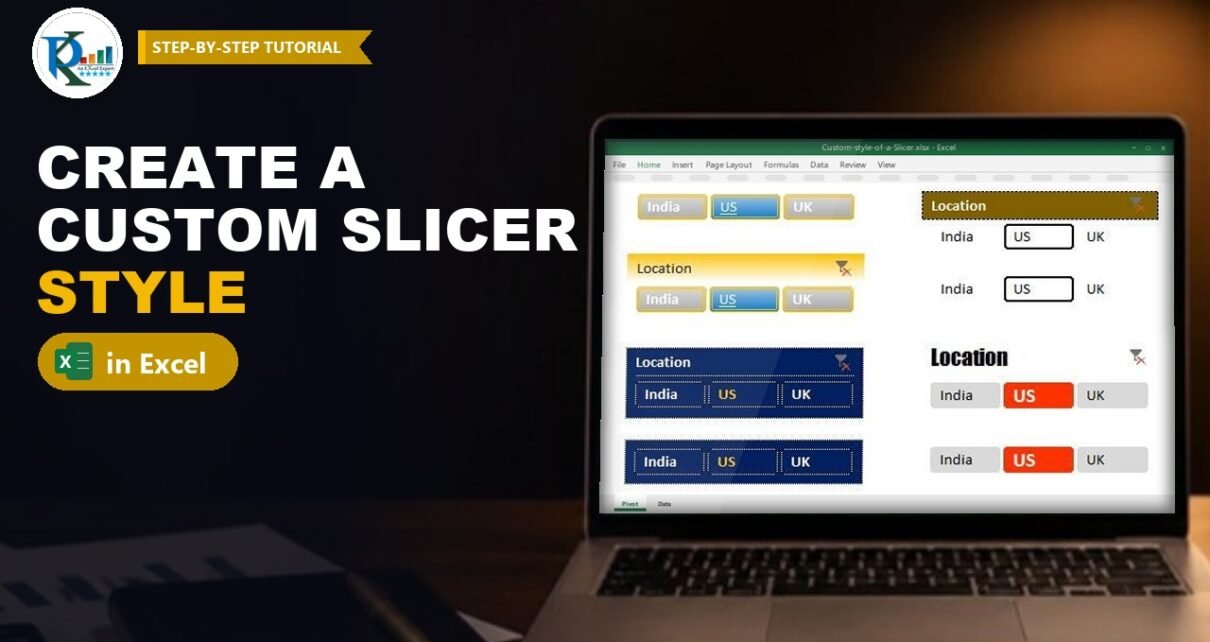
A custom slicer style in Excel lets your slicers match the colours of your dashboard instead of the default blue, orange and grey buttons. In this tutorial you will create your own slicer style from scratch with the New Slicer Style dialog, format each slicer element (header, selected items, items with no data and hover states), duplicate a built-in style to save time, set your style as the default, and carry it to another workbook. It works for slicers on Pivot Tables and Excel Tables in Microsoft 365, Excel 2021, 2019, 2016 and 2013 (Excel 2010 for Pivot Table slicers).
⬇️ Download the Practice File
Custom-style-of-a-Slicer.xlsx · .xlsx · Excel 2013 or later / Microsoft 365
Watch the Video Tutorial
The video takes a simple Location slicer and builds a custom style step by step: the New Slicer Style dialog, the Format Slicer Element window, and the finished style in the Custom section of the gallery.
What You Will Learn
- Where the New Slicer Style command lives in Microsoft 365 and older versions.
- What each of the ten slicer elements controls, so you format only the ones you need.
- How to set font, border and fill (including gradients) for each element.
- How to duplicate a built-in style instead of starting from zero.
- How to make your style the default and reuse it in another workbook.
The Practice File
The download has two sheets. Data holds an Excel Table (Table1) with Date, Location, Sales and Revenue for three locations: India, US and UK. Pivot holds a Pivot Table (Sum of Sales by location) and a set of Location slicers, each formatted with one of five custom styles named Slicer Style 1 to Slicer Style 5. Open it next to this guide and right-click any of those styles to see exactly how it was built.
Part 1 – Create a Custom Slicer Style in Excel
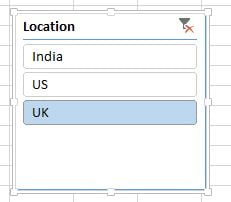
Step 1: Insert a slicer
Click inside the Pivot Table, go to PivotTable Analyze > Insert Slicer, tick Location and click OK. For an Excel Table use Table Design > Insert Slicer instead. Both kinds of slicer use the same styles.
Step 2: Open New Slicer Style
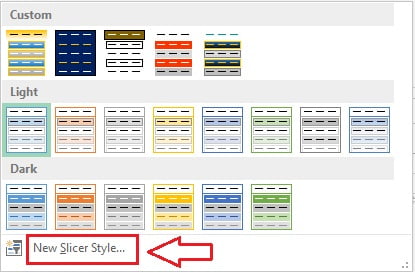
Select the slicer. The Slicer tab appears on the ribbon. In the Slicer Styles group, click the More arrow at the bottom-right of the gallery, then click New Slicer Style… at the bottom of the list.
In Excel 2010 to 2019 the same tab is called Slicer Tools > Options, and the command is in the same place.
Step 3: Name the style
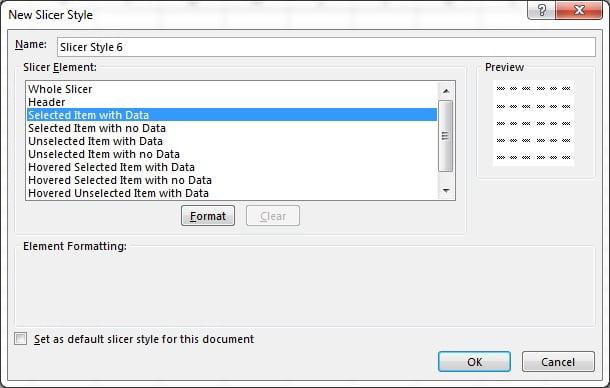
The New Slicer Style dialog opens with a name such as Slicer Style 6. Replace it with something you will recognise later, for example Navy Gold Dashboard. The name is all you see when you hover over the style in the gallery.
Step 4: Understand the slicer elements
The Slicer Element list has ten parts. You do not have to format all of them; any element you leave alone keeps Excel’s plain look.
- Whole Slicer – the outer box: background behind the buttons and the outside border.
- Header – the caption bar at the top (for example “Location”).
- Selected Item with Data – a button that is currently filtered in. This is the most important element.
- Selected Item with no Data – a selected button whose item has no matching rows.
- Unselected Item with Data – a button that is filtered out but still has data.
- Unselected Item with no Data – a filtered-out button with no data.
- Hovered Selected Item with Data, Hovered Selected Item with no Data, Hovered Unselected Item with Data and Hovered Unselected Item with no Data – the same four states while the mouse pointer is over the button.
“No data” states appear when another slicer or filter leaves an item with nothing to show. Format them in a lighter, muted colour so users can see at a glance which buttons are empty.
Step 5: Format each element
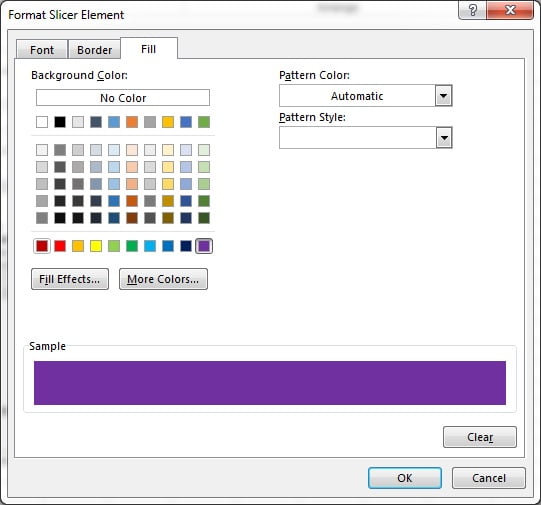
Click an element in the list and click Format. The Format Slicer Element window has three tabs:
- Font – font name, style (bold, italic), size, underline and colour.
- Border – line style and colour for each side of the element.
- Fill – background colour, pattern, or a two-colour gradient through Fill Effects.
A clean order that works for most dashboards:
- Whole Slicer: a dark fill (for example navy) and a thin border.
- Header: bold white font, or a gradient fill for a softer bar.
- Selected Item with Data: bold font in your accent colour (for example gold) or a bright fill.
- Unselected Item with Data: white font on the same dark fill.
- Both “no data” items: grey font so empty items fade back.
- Hovered elements: a slightly lighter fill, so the user feels the button respond.
Click OK after each element. The Element Formatting area under the list describes what you set, and the Preview box shows the result. Made a mistake? Select the element and click Clear.
Step 6: Apply the style
Click OK to save the style. Creating a style does not change the selected slicer by itself. Select the slicer again, open the Slicer Styles gallery and click your style in the new Custom section at the top.
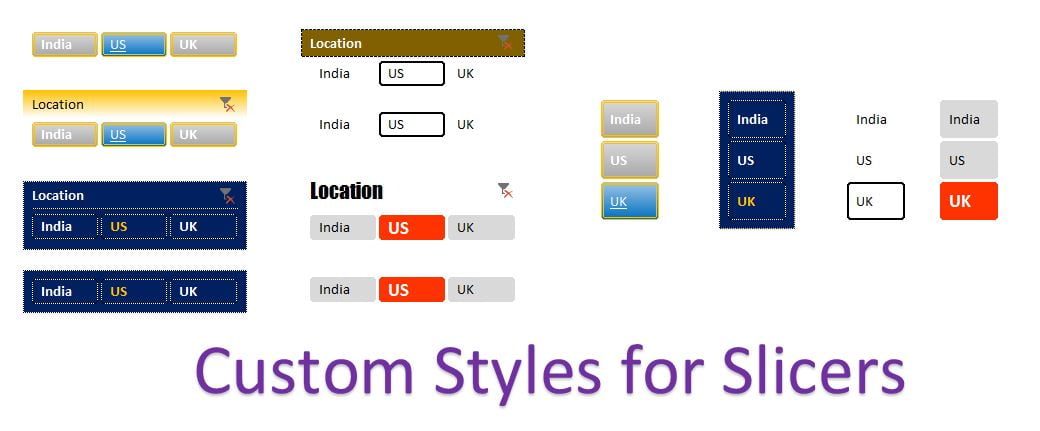
The practice file shows how far this goes: a navy slicer with gold selected items, a gold gradient header, a black-and-orange slicer with an Impact header font, and an outline style where only the selected button gets a border.
Part 2 – Duplicate, Modify and Set a Default Style
Duplicate a built-in style
Built-in styles cannot be edited, but they can be copied. In the Slicer Styles gallery, right-click the style that is closest to what you want and choose Duplicate. The Modify Slicer Style dialog opens with every element already formatted; change only the colours you need, rename it, and click OK. The copy appears under Custom.
Modify or delete a custom style
Right-click your custom style and choose Modify to change it. Every slicer in the workbook that uses the style updates immediately, which is ideal when a dashboard changes colour theme. Delete removes the style from the workbook, so only delete styles you no longer use.
Set the style as the default
Tick Set as default slicer style for this document in the New (or Modify) Slicer Style dialog, or right-click the style in the gallery and choose Set As Default. New slicers you insert in this workbook then get your style automatically. The setting belongs to the workbook, not to Excel as a whole.
Part 3 – Use Your Slicer Style in Another Workbook
Custom slicer styles are saved inside the workbook where you create them. There is no import button, but two simple methods work:
- Copy a slicer: select a slicer that uses your style, press Ctrl + C, switch to the other workbook and press Ctrl + V. The style comes across with it and shows under Custom. You can then delete the pasted slicer; the style stays in the workbook.
- Save a template: create your styles in a blank workbook and save it as an Excel Template (
.xltx). Every new file you start from that template already has the styles.
Finishing Touches for Dashboard Slicers
- Columns: on the Slicer tab, set Buttons > Columns to 3 to lay the buttons out side by side, as in the practice file.
- Hide the header: right-click the slicer, choose Slicer Settings and clear Display header when a chart title already says what the slicer filters.
- Empty items: in Slicer Settings choose Hide items with no data, or keep them visible with Visually indicate items with no data so your “no data” formatting shows.
Common Errors and Fixes
My new style does not appear on the slicer
Creating a style does not apply it. Select the slicer and click the style under Custom in the Slicer Styles gallery.
Modify is greyed out
You right-clicked a built-in Light or Dark style. Use Duplicate instead, then modify the copy.
The “no data” formatting never shows
Those elements only appear when an item has no matching rows and the slicer is set to Visually indicate items with no data. If Hide items with no data is ticked, those buttons are not shown at all.
My style is missing in a new workbook
Styles live inside the file. Copy a slicer that uses the style into the new workbook, or start from a template that contains it.
Tips
- Use the same two or three colours as your charts so the slicer feels like part of the dashboard.
- Make the Selected Item with Data state the strongest contrast; that is the one people read first.
- Microsoft’s guide Use slicers to filter data covers inserting, connecting and formatting slicers.
Want It Ready-Made?
If you want a styled slicer and chart you can drop straight into a report, see the Stylish Pivot Chart with Slicer in Excel on NextGenTemplates.com, or browse more Excel templates. To learn Pivot Tables, slicers and interactive dashboards from the basics up, join the video course Excel Pivot Tables & Dashboards: Basic to Advanced.
Related Tutorials
- Slicers in Pivot Table: insert, connect and set columns
- Pivot Table styles, slicer styles and timeline styles in Excel
- Build a sales dashboard with Pivot Tables, slicers and Pivot Charts
- Sort and filter an Excel Table with slicers and the Total Row
Frequently Asked Questions
How do I create a custom slicer style in Excel?
Select the slicer, go to Slicer > Slicer Styles, open the gallery with the More arrow and click New Slicer Style. Name it, format the elements you need with Format, click OK, then apply it from the Custom section of the gallery.
Can I edit a built-in slicer style?
No. Built-in styles are locked. Right-click one and choose Duplicate, then change the copy. The copy is a custom style you can modify any time.
Can I change the font size of slicer buttons?
Yes. In the Format Slicer Element window, the Font tab lets you set the font name, style, size and colour for each element, such as the header or the selected items.
How do I make my custom slicer style the default?
Tick Set as default slicer style for this document in the style dialog, or right-click the style in the gallery and choose Set As Default. It applies to new slicers in that workbook.
How do I copy a custom slicer style to another workbook?
Copy a slicer that uses the style and paste it into the other workbook. The style is added to that workbook, and you can delete the pasted slicer afterwards. A template (.xltx) with your styles is another option.
Do custom slicer styles work for Excel Table slicers too?
Yes. Slicers on Excel Tables (Excel 2013 and later) and on Pivot Tables share the same Slicer Styles gallery, so one custom style works for both.
About the Author
PK is a Microsoft Excel expert and trainer and the founder of PK: An Excel Expert and NextGenTemplates.com. He has been teaching Excel, Pivot Tables, dashboards and Power BI since 2016 on the PK: An Excel Expert YouTube channel.
Conclusion
A custom slicer style in Excel takes a few minutes to build and makes every slicer in your report look like it belongs there. Format the key elements, set the style as the default, and carry it to new workbooks by copying a slicer or using a template.