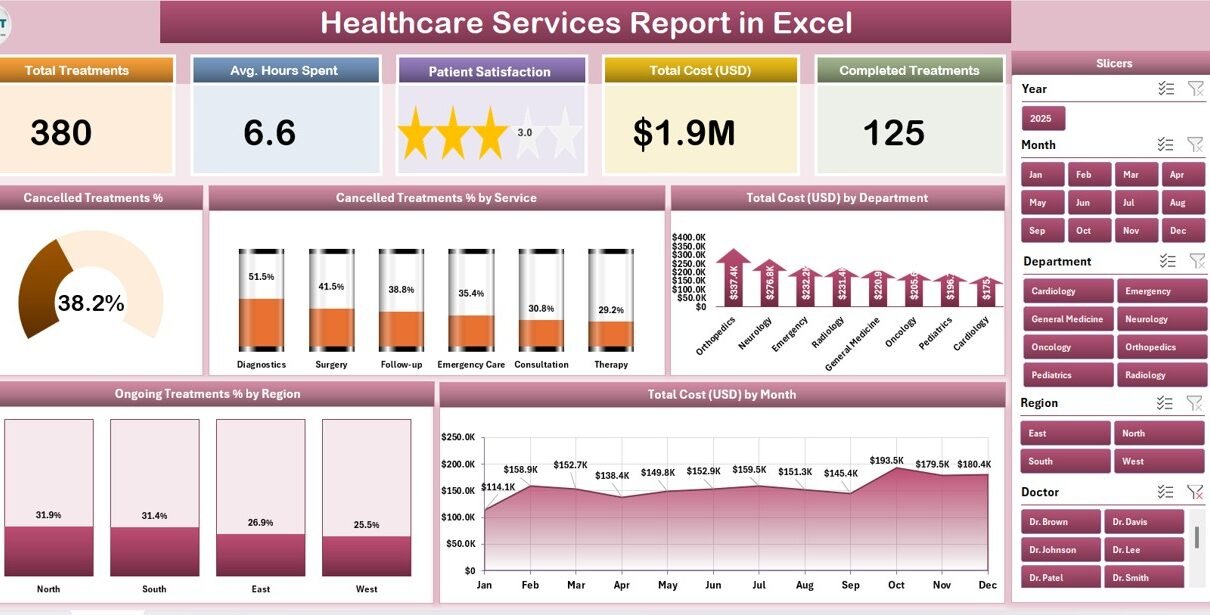
Running a hospital, multi-branch clinic, or healthcare service line means juggling treatment volumes, cancellation rates, departmental budgets, and regional capacity — all at the same time. Most administrators end up exporting from their EHR or HMS into a spreadsheet anyway. The Healthcare Services Report in Excel turns that messy export into a polished, pivot-driven monthly report with 5 KPIs and 5 charts across 4 sheets — for $7.99 instead of $1,680+ per provider per year.
🌍 Used by 8,400+ teams in 40+ countries replacing paid SaaS tools with one-time-purchase Excel templates.
✅ Instant download · One-time $7.99 payment · No subscription · Works offline on Windows & Mac.
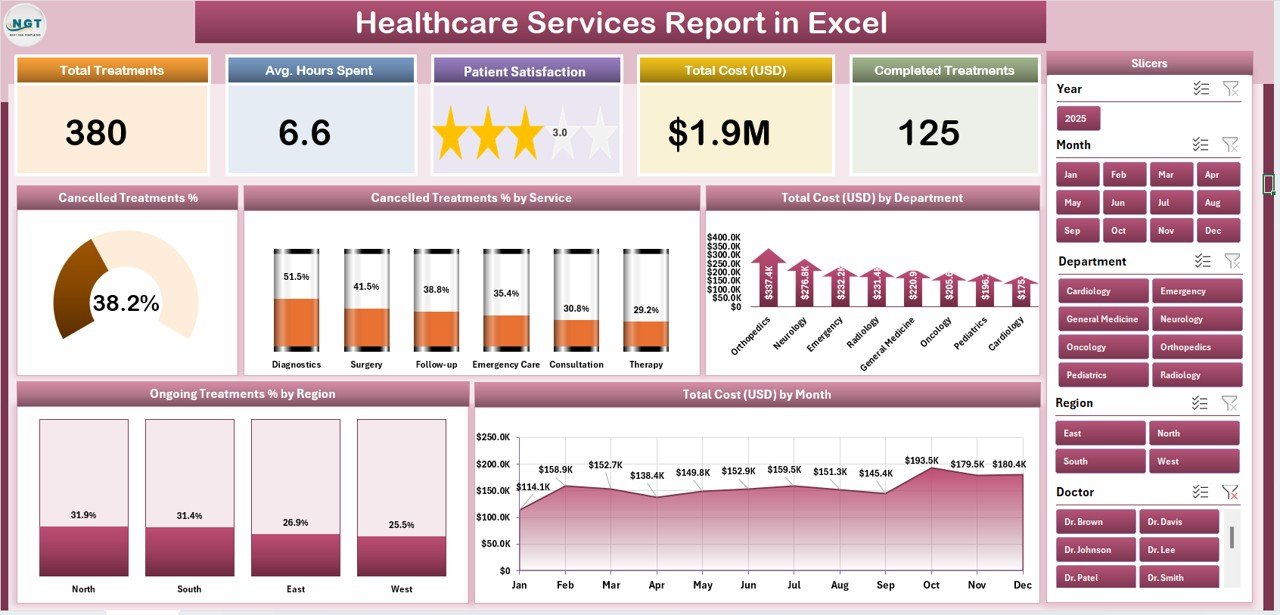
Healthcare Services Report in Excel – Summary Page
Introduction to the Healthcare Services Report in Excel
Most hospital administrators and clinic managers live inside an EHR or hospital management system — Epic, Cerner, MEDITECH, Athenahealth, or a homegrown product. These systems are great for clinical workflow and billing, but the monthly operational story of the practice — which services are losing revenue, where cancellations cluster, how costs spread across departments and regions — almost always ends up in a spreadsheet.
The Healthcare Services Report in Excel takes your service-level data — dates, departments, regions, service categories, treatment statuses, and costs — and converts it into a single Summary Page with 5 KPI cards and 5 interactive charts, plus a dedicated Report Page for line-item analysis. Everything runs through pivot tables, so updating the raw data and clicking Refresh All rebuilds the entire report. No VBA, no macros, no internet connection. According to Microsoft’s official PivotTable documentation, the Refresh All workflow is the recommended approach for dashboards built on structured ranges — which is exactly how this report is wired.
Key Features of the Healthcare Services Report
The template is intentionally compact — 4 sheets — but every sheet earns its place in a month-end reporting workflow.
Five KPI Cards on the Summary Page: The top strip displays the 5 headline metrics every hospital administrator wants ready for a board meeting or department review.
Right-Side Slicer Panel: Filter the entire Summary Page by department, region, service category, or time period. Slicers on Excel dashboards are the single biggest usability upgrade over static pivot reports.
Five Analytical Charts: Each chart answers a specific operational question — Cancelled Treatment % (where is capacity leaking?), Cancelled Treatment % by Service (which service lines are weakest?), Total Cost by Department (where is spend concentrated?), Ongoing Treatment % by Region (which locations are over-or-under-loaded?), and Total Cost by Month (is the trend healthy?).
Report Page with Information Table: A separate worksheet with a left-side slicer and a transaction-level table — ideal for pulling case lists for insurance audits, internal reviews, or accountant exports.
100% Pivot-Table Architecture: Every chart on the Summary Page draws from a pivot table on the Support sheet. Replace data → click Refresh All → the entire report rebuilds. No formula edits.
Sheets Explanation
Here’s a walkthrough of each sheet.
1. Summary Page
The main dashboard view. Five KPI cards sit at the top, giving hospital leadership an at-a-glance snapshot of operational performance. Below them, 5 interactive charts cover the analytical questions most often asked in a month-end review. On the right edge, a vertical slicer panel lets you filter by department, region, service, and time period — the same filter applies to all cards and charts simultaneously.
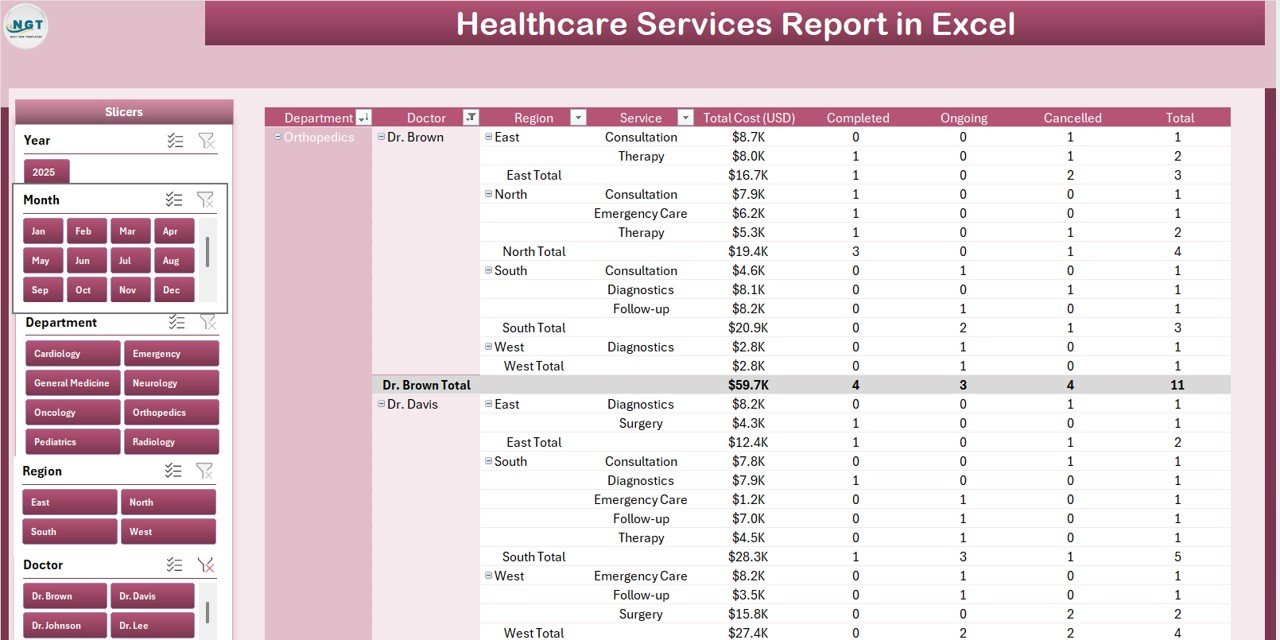
Report Page with slicer and information table
2. Report Page
A separate worksheet with a left-side slicer and a detailed information table. Think of this as the audit-trail view — useful when an insurance payer asks for a list of all surgeries billed in a specific month, when your CFO wants line-item costs by department, or when your accountant needs raw data for GST/VAT or tax filings.
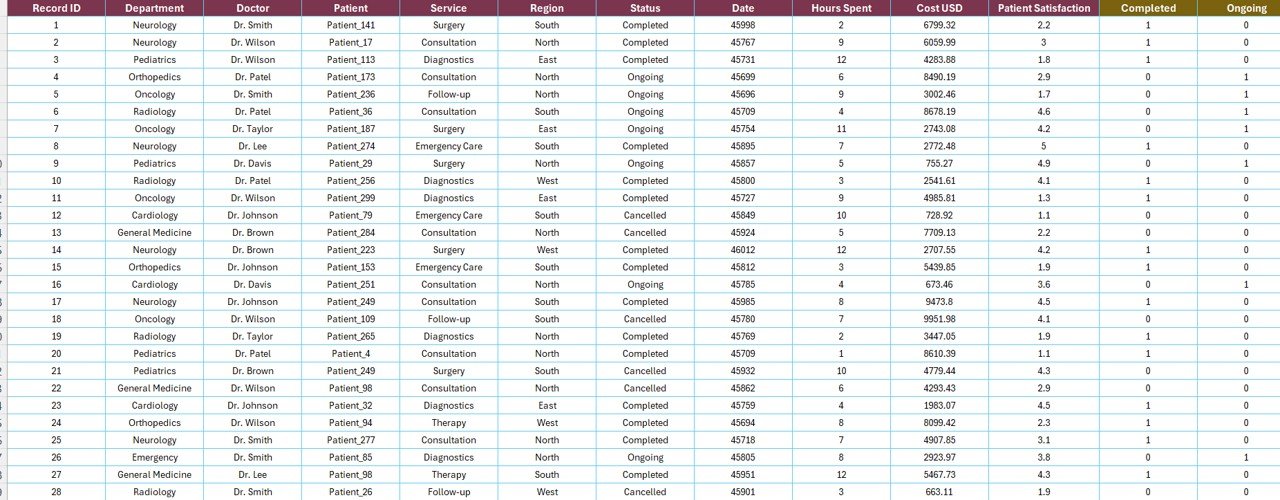
Data Sheet — paste your service-level records here
3. Data Sheet
The raw input sheet. It holds columns for Date, Department, Region, Service Category, Treatment Status, Treatment Cost, and the other dimensions that drive the report. To use the template with your hospital’s data, simply replace the sample rows — keeping the column headers identical. Pivot tables in the Support sheet reference these headers directly, so any rename will break a chart.
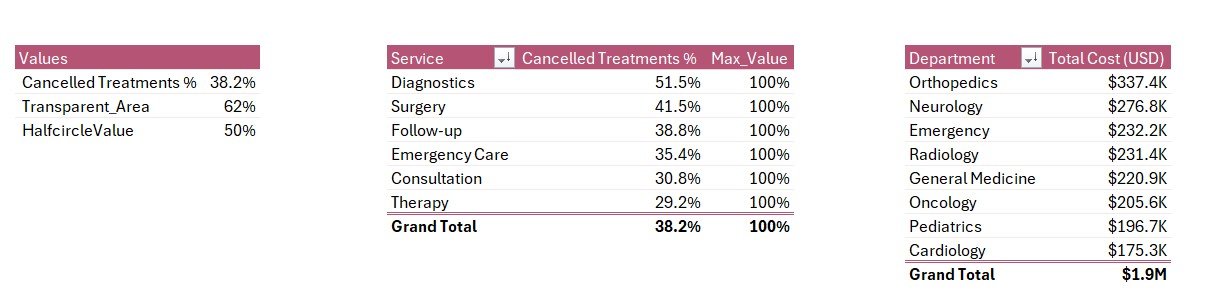
Support Sheet with pivot tables driving every chart
4. Support Sheet
Holds every pivot table that feeds the Summary Page. After updating the Data sheet, go to Data → Refresh All in the Excel ribbon and every pivot recalculates. In production, hide this sheet so administrators and department heads only see the Summary Page and Report Page.
Healthcare Services Report in Excel vs. Google Sheets Equivalent vs. Athenahealth / Kareo — Feature Comparison
| Feature | Healthcare Services Report in Excel | Google Sheets equivalent | Athenahealth / Kareo / AdvancedMD |
|---|---|---|---|
| Cost | $7.99 one-time | ~$10 one-time template | $140–$500 / provider / month |
| Platform | Microsoft Excel (desktop) | Google Sheets (browser) | Web + mobile SaaS |
| Works offline | ✅ Yes | ❌ Requires internet | ❌ Requires internet |
| Setup time | Under 10 minutes | ~15 minutes | 4–12 weeks onboarding |
| Customizable KPIs & charts | ✅ Fully editable | ✅ Editable | ❌ Fixed reports |
| Per-user licence fees | None | None | $140+ per provider / month |
| Data stays on your device | ✅ Yes | ❌ Cloud | ❌ Vendor cloud |
| Year-1 cost at 5 providers | $7.99 | ~$10 | $8,400 – $30,000 |
| Department + region breakdown | ✅ Pre-built | Needs rebuild | ✅ Pre-built |
For hospitals and clinics that want department, region, and service-line cost visibility without paying $8,000+ per year in SaaS fees, the Healthcare Services Report in Excel sits in the sweet spot.
Who Should Use This Template
Perfect for:
- Hospital administrators tracking departmental cost and treatment-cancellation trends month over month
- Multi-branch clinic owners running 2–10 locations who need regional service comparisons
- Healthcare finance and revenue-cycle managers preparing CFO and board-level reports
- Service-line directors (Cardiology, Orthopaedics, Surgery, Diagnostics) reviewing performance
- Healthcare consultants and BPOs delivering monthly client reports without rebuilding charts in PowerPoint
Not a fit if:
- You run a hospital network needing HIPAA-certified cloud infrastructure with SSO and audit logs
- You need integrated patient scheduling, e-prescribing, telehealth, and billing in one EHR system
- You only use Google Sheets — in that case, browse our Google Sheets Healthcare Dashboards
Real-World Use Cases
Dr. Anand — operations director at a 120-bed multi-speciality hospital, Pune. Anand uses the Healthcare Services Report each month to spot which service categories lose the most revenue to cancelled treatments. The Cancelled Treatment % by Service chart helped him identify that orthopaedic day-care surgeries had a 14% cancellation rate. He restructured the pre-admission counselling workflow and recovered an estimated ₹18 lakh per quarter.
Lisa — regional manager for a 6-clinic primary care network, Midwest US. Lisa uses the Ongoing Treatment % by Region and Total Cost by Department views every Monday to compare clinic-level performance. After spotting that her Indianapolis branch had 30% higher costs but matching patient volume, she rebalanced staffing and saved roughly $42,000 in the next quarter — without paying $14,000 a year for an Athenahealth analytics module.
Kavya — freelance healthcare consultant working with mid-size Indian hospital chains. Kavya uses the Healthcare Services Report as her standard monthly client deliverable. Each engagement gets the same 4-sheet model — replace data, refresh, screenshot the Summary Page into the client’s PowerPoint deck. Cuts her reporting prep from 6 hours to 45 minutes per client.
Advantages of the Healthcare Services Report
The template’s biggest advantage is cost efficiency. A 5-provider clinic paying $200/month per provider for a hospital management SaaS spends $12,000 a year on the reporting layer alone. The Healthcare Services Report is $7.99 one-time. Over three years that’s roughly $35,000 saved — enough to fund a full-time admin hire or a mid-sized capital expense.
The second advantage is data sovereignty. Treatment data never leaves your machine. For hospitals operating under HIPAA (US), GDPR (EU), or India’s DPDP Act, keeping data on-device dramatically simplifies compliance reviews compared to vendor-cloud SaaS.
The third advantage is zero learning curve. Anyone on your team who’s used Excel can open the file, filter, and export a chart within five minutes — no admin training, no role permissions to configure, no onboarding calls.
Opportunities for Improvement
Being honest: the Healthcare Services Report in Excel is a report, not a full hospital management system. It doesn’t handle appointment booking, e-prescribing, lab ordering, or automated insurance claim submission. If you need those features in one integrated platform, you’ll want a dedicated SaaS tool like Athenahealth, Kareo, or AdvancedMD.
The template also assumes you already have service-level data in a clean, column-structured format. If your current system exports messy or multi-line records, you’ll spend extra minutes cleaning the data before pasting it in. For larger hospital networks we recommend automating the export from your HMS or EHR using a monthly scheduled query.
Finally, the template is Excel-desktop-first. It opens in Excel Online but slicers and some chart interactions don’t render as smoothly — for a browser-native alternative, see the Hospital Patient Flow Dashboard in Google Sheets.
Best Practices
Standardise your category names. Use the same spelling for departments, regions, and service categories every month. “Orthopaedics” vs “Ortho” will create two pivot rows and distort your charts.
Refresh before every review meeting. It’s a 2-second action (Data → Refresh All) that prevents stale numbers from sneaking into a board deck.
Keep a backup of the original template. Save the blank version before you paste your data — if something breaks, you can always start over without re-downloading.
Hide the Support sheet before sharing. Right-click the Support tab → Hide. Department heads and finance staff should only interact with the Summary Page and Report Page.
Combine with a peer report. For mental health and counselling clinics, pair this with the Mental Health Services Report in Excel for therapy-specific KPIs. For pharmacy operations, pair with the Pharmacy Dashboard in Excel.
Explore Relevant Templates
🔹 Mental Health Services Report in Excel — A peer report built for therapy and counselling clinics tracking session-level financials.
🔹 Medical Practice Dashboard in Excel — A broader medical-practice dashboard covering appointments, patient mix, and revenue.
🔹 Telehealth Dashboard in Excel — For virtual-visit practices tracking no-shows and connection quality.
🔹 Pharmacy Dashboard in Excel — Companion template for hospital pharmacies tracking dispensing volumes and revenue.
🔹 Hospital Patient Flow Dashboard in Google Sheets — A Google Sheets companion for browser-first teams.
Frequently Asked Questions
What KPIs does the Healthcare Services Report in Excel track?
The Healthcare Services Report tracks 5 headline KPIs on the Summary Page displayed as card visuals, plus 5 interactive charts: Cancelled Treatment %, Cancelled Treatment % by Service, Total Cost by Department, Ongoing Treatment % by Region, and Total Cost by Month. All metrics auto-update when you refresh the pivot tables after pasting new data.
How does this template compare to Athenahealth or Kareo?
Athenahealth and Kareo charge $140–$500 per provider per month — roughly $1,680–$6,000 per provider per year. The Healthcare Services Report in Excel is a $7.99 one-time purchase with no per-user fees, works offline, and keeps treatment data on your device. It doesn’t replace a full EHR — it replaces the monthly reporting workflow.
How long does setup take?
Setup takes under 10 minutes. Open the .xlsx file, paste your service-level data into the Data sheet (keep the column headers identical), then click Data → Refresh All in the Excel ribbon. Every card, chart, and slicer on the Summary Page updates automatically. No formulas to rewrite, no DAX, no macros.
Does this template work on Mac Excel?
Yes. The Healthcare Services Report in Excel uses only pivot tables and slicers — no VBA, no macros — so it runs identically on Windows Excel and Mac Excel 2016 or later. No internet connection is required, which makes it ideal for hospital networks with strict data-isolation policies.
Can I add new departments, regions, or service categories?
Yes. Add new categories directly to the Data sheet. After adding rows, click Data → Refresh All in the ribbon and every pivot table on the Support sheet picks up the new categories. The Summary Page charts populate automatically — no manual chart edits.
Is patient data safe with this template?
Treatment data stays entirely on your device. The Healthcare Services Report doesn’t connect to any cloud service, API, or external database. For full HIPAA, GDPR, or DPDP compliance you’ll still need to encrypt the file and control access — but no third party can see your records by default, unlike with cloud-based SaaS tools.
Can multiple administrators use the same file?
Yes. Email the .xlsx file or share it via OneDrive, Dropbox, or SharePoint. There’s no per-user licence — administrators, department heads, and finance staff can open and filter the report freely with any Microsoft Excel installation. For multi-user editing, use OneDrive co-authoring or a shared SharePoint location.
About the Author
Built by PK — Microsoft Certified Professional with 15+ years of Excel, Google Sheets, and Power BI experience. Founder of NextGenTemplates, reaching 300K+ subscribers across YouTube channels. Every template is hand-built and tested before release.
Conclusion
The Healthcare Services Report in Excel is a focused, month-end reporting tool for hospitals and multi-branch clinics that want department, region, and service-line visibility without paying thousands a year for SaaS. Five KPIs, 5 charts, 4 sheets, one-time $7.99 — that’s the whole promise.
👉 Click here to Purchase the Healthcare Services Report in Excel
✅ Instant download · One-time payment · No subscription
🎥 For step-by-step video tutorials, visit our YouTube channel: Youtube.com/@PK-AnExcelExpert
📅 Last updated: April 2026


