The Office Renovation Feedback Tracker in Excel captures structured employee feedback across 8 purpose-built worksheets — Login Form, Home Page, Dashboard, Data Sheet, List Sheet, Support Sheet, Settings Sheet, and User Management Sheet — driven by a VBA UserForm with Add, Update, and Delete buttons. The Dashboard ships with 4 slicers and 5 auto-refreshing charts, so a project manager can move from raw feedback to a board-ready visual in under 10 minutes.
If you are running an office refurbishment for a 30–500 person workplace, getting honest, slice-able feedback at every phase (planning, design, execution, handover) is the difference between a $500K project that lands well and one that triggers a year of complaint tickets. This post walks through every sheet inside the Office Renovation Feedback Tracker in Excel, shows how the VBA workflow stops manual data-entry errors, and explains where this template wins versus paid survey SaaS like SurveyMonkey Enterprise or Qualtrics CoreXM.
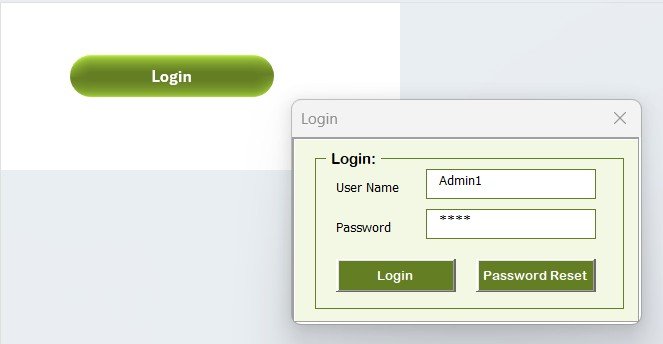
Office Renovation Feedback Tracker in Excel — Login Form
Key Features of the Office Renovation Feedback Tracker in Excel
The tracker is built around three repeating ideas: a single source of truth for feedback (the Data Sheet), a VBA-driven entry layer that prevents bad data, and a slicer-first dashboard for instant analysis. Concretely:
- 8 integrated worksheets — every sheet is connected through VBA so a new feedback record on the Data Sheet flows directly into the Dashboard charts and slicers without any manual refresh.
- VBA-driven Data Entry form with Add, Update, and Delete buttons. The same UserForm handles all three actions, so end users never edit cells directly.
- Login-protected access backed by a User Management sheet that stores usernames, passwords, and roles. The same sheet drives the Login Form’s validation logic.
- Interactive Dashboard with 4 slicers (Department, Renovation Phase, Feedback Aspect, Sentiment) and 5 charts (response volume, average score, sentiment mix, aspect breakdown, department comparison).
- Dropdown-driven entry from the List Sheet — every combo box on the form pulls its values from a named range, so adding a new department or stage is a single-row change.
- Hidden Support Sheet with the pivot tables that drive the dashboard charts. End users never need to touch it.
- Settings Sheet for organisation logo, project name, and renovation start / end dates.
- Works in Excel 2016, 2019, 2021, and Microsoft 365 on Windows. VBA UserForms are required, so Mac compatibility is limited.
Sheets Explanation — How Every Worksheet Fits Together
Below is a sheet-by-sheet walk-through, in the order users navigate them after logging in.
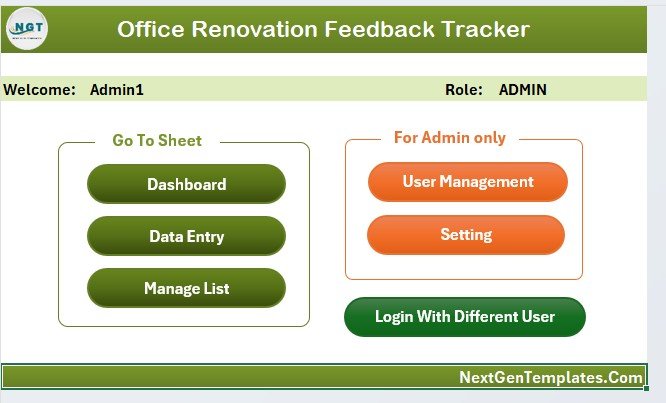
Home Page — central navigation hub
1. Login Form
The first thing a user sees on opening the workbook is a password-protected Login Form. It runs a VBA validation routine against the User Management sheet — if the credentials match, the workbook unlocks and routes the user to the Home Page. If they fail, the form clears and counts the attempt.
2. Home Page
A central navigation hub with one-click buttons to every sheet. This stops users from clicking on the sheet tabs and lets you keep most sheets hidden. The Home Page is the only “front door” inside the workbook.
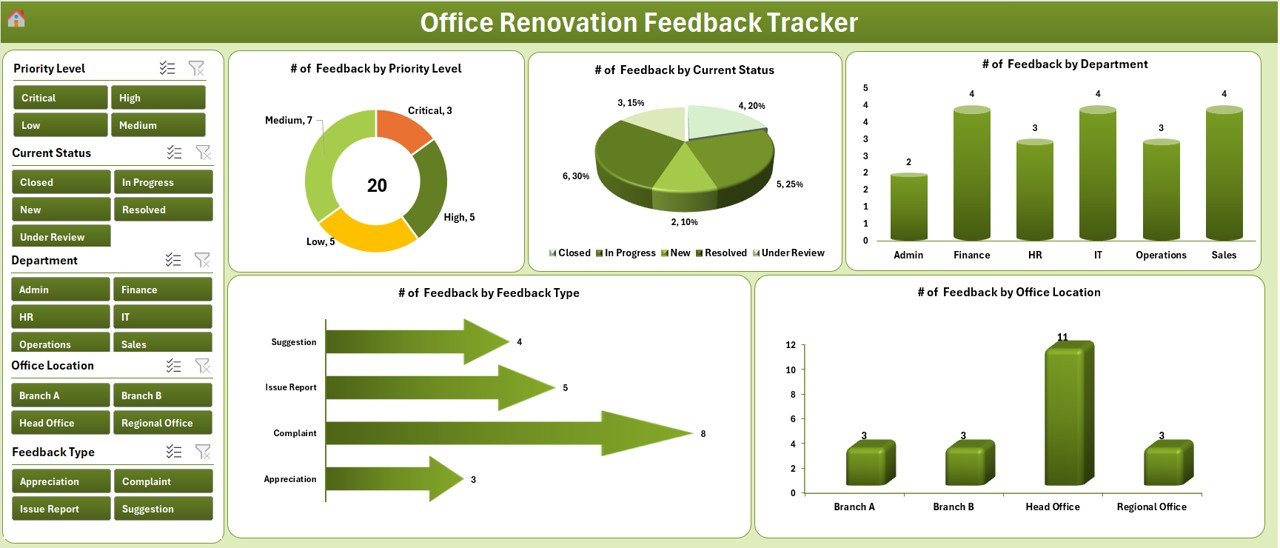
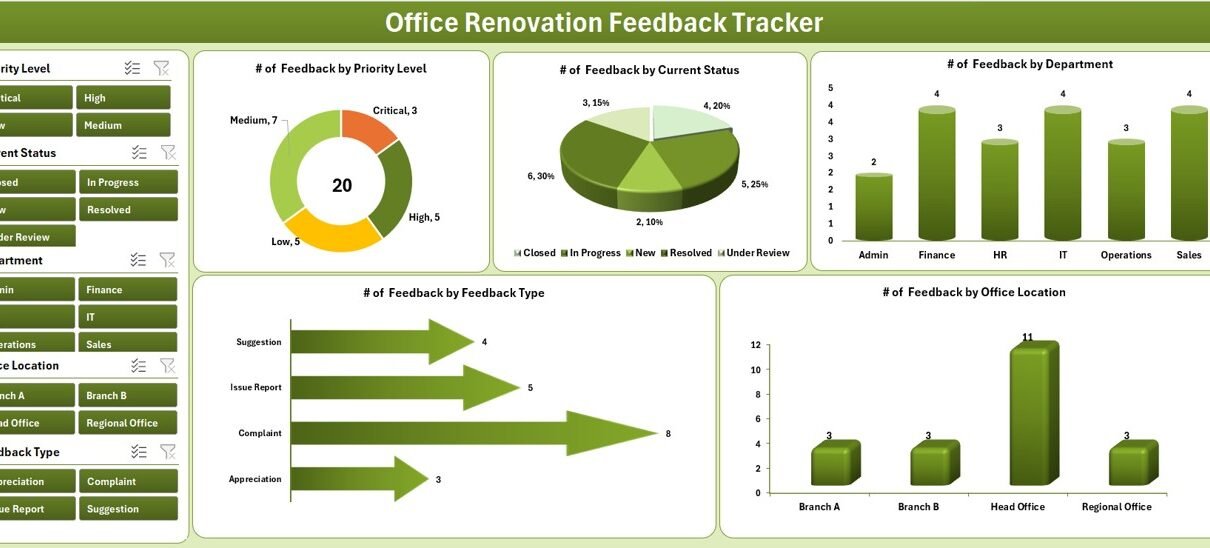
Dashboard with 4 slicers and 5 auto-refresh charts
3. Dashboard
The Dashboard is the analytical hub. It carries a KPI strip on top — total responses, average satisfaction score, sentiment ratio, and completion percentage by phase — followed by 4 slicers and 5 charts. Slicers cover Department, Renovation Phase, Feedback Aspect, and Sentiment. The 5 charts visualise response volume by phase, average score by aspect, sentiment distribution, department-wise satisfaction, and a trend line of weekly responses.
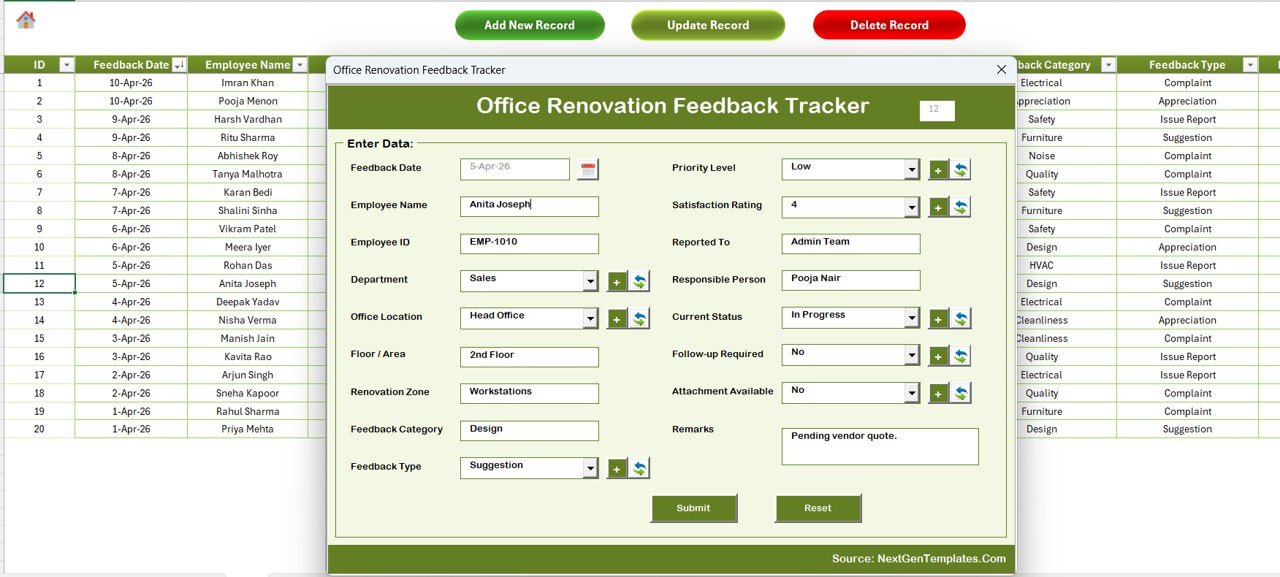
Data Sheet — Add / Update / Delete buttons drive the VBA UserForm
4. Data Sheet
The Data Sheet is the master record table. Three buttons sit above the table — Add New Record, Update Record, and Delete Record. All three open the same VBA UserForm: Add inserts a new row, Update prefills the form when a Feedback ID is selected, and Delete confirms before removing the row. End users never type into cells directly.
List Sheet — feeds every combo box in the form
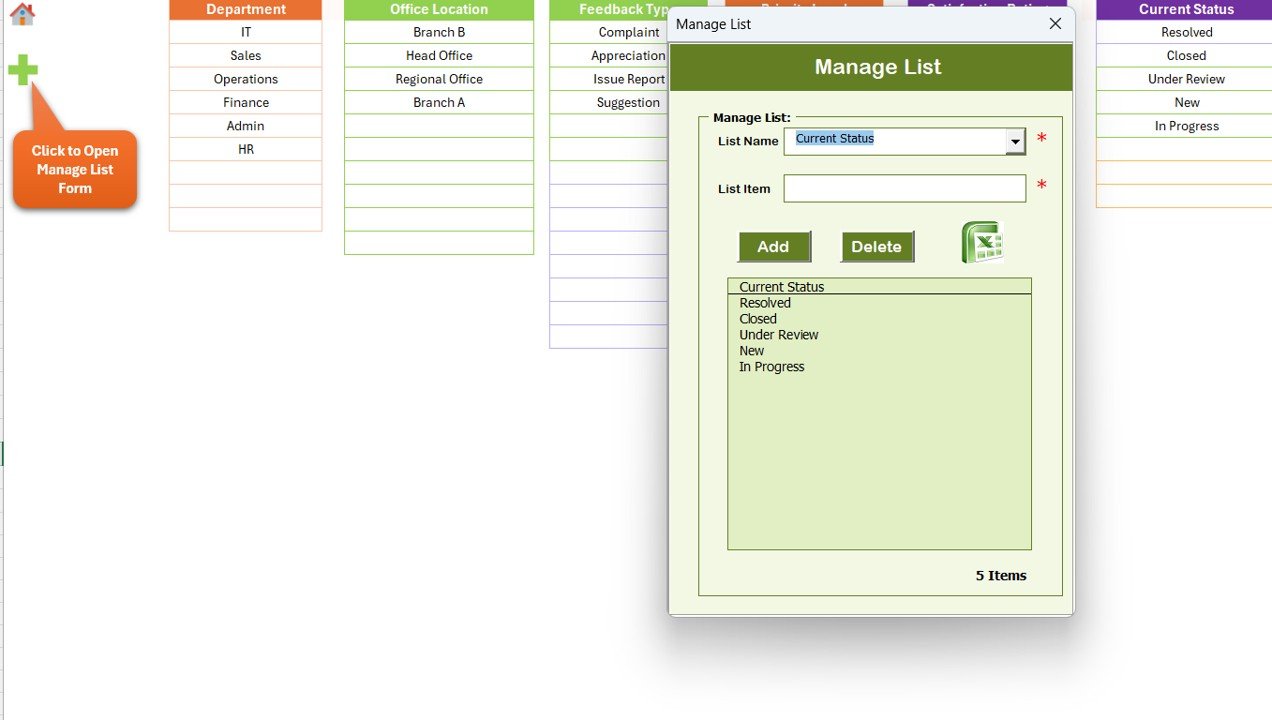
5. List Sheet
The List Sheet is the single source of truth for every dropdown on the Data Entry form. Departments, Renovation Stages, Feedback Aspects, Sentiment values, and Floor / Building IDs all live here. Add a new value to a column and it automatically appears in the matching combo box on the form.
Support Sheet — hidden pivot tables that drive the charts
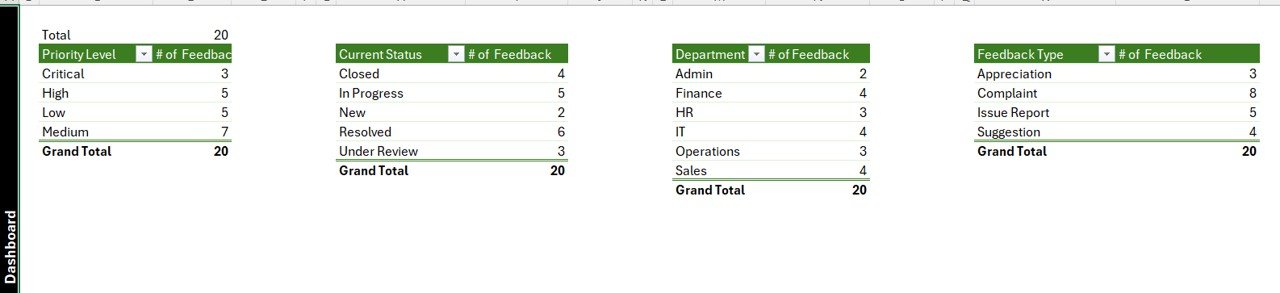
6. Support Sheet
The Support Sheet contains the pivot tables that drive the Dashboard charts. There is no end-user interaction needed here — once the workbook is set up, you can hide this sheet completely so the user only ever sees the front-end pages. The dashboard refreshes pivots automatically through VBA when a record is added.
VBA Data Entry Form — used for Add, Update, and Delete operations
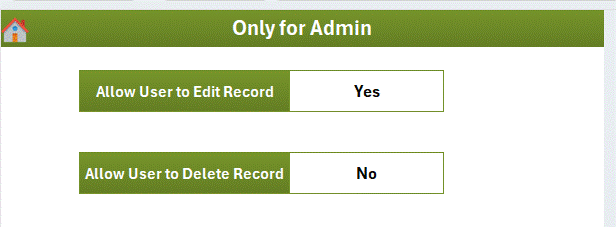
7. Settings Sheet
The Settings Sheet holds your organisation logo, contact details, project name, renovation start date, and target close-out date. The Login Form and Dashboard read these values, so a quick edit here re-brands the entire workbook.
User Management Sheet — usernames, passwords, and roles
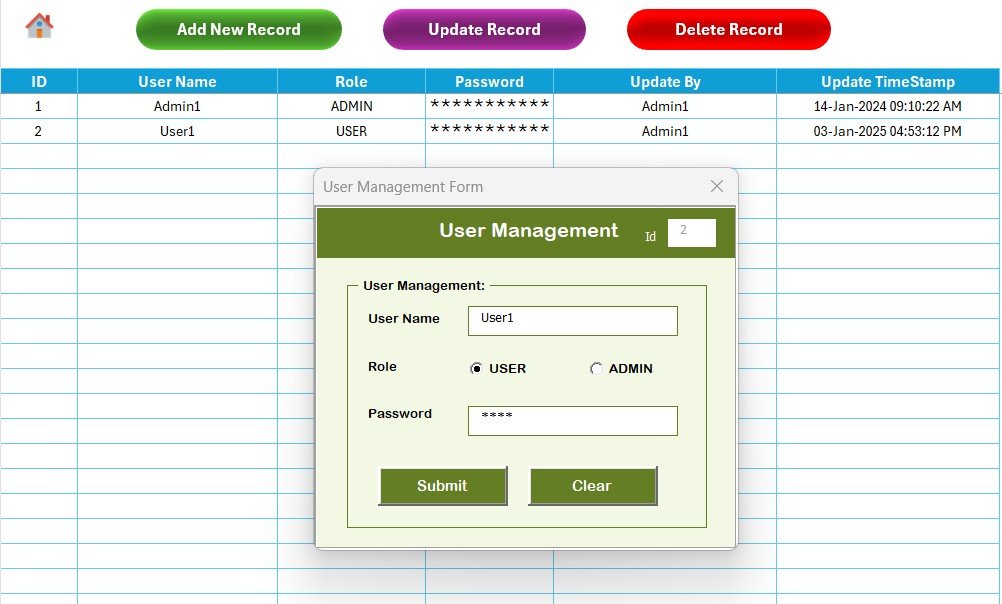
8. User Management Sheet
The User Management Sheet defines every user, their password, and their role. The Login Form reads from here to validate credentials. To add or remove someone, edit a row — no VBA changes required. Combined with sheet-level protection on Data, Support, and Settings, this gives you an in-workbook authorisation model without buying an SSO add-on.
Office Renovation Feedback Tracker vs. Google Sheets Equivalent vs. Paid Survey SaaS — Feature Comparison
| Feature | Office Renovation Feedback Tracker in Excel | Google Sheets equivalent | Paid SaaS (e.g., SurveyMonkey Enterprise / Qualtrics CoreXM) |
|---|---|---|---|
| Cost | $6.99 one-time ✅ | $6.99 one-time | $25–$120 per user / month ($1,500–$7,200/yr at 5 admins) |
| Platform | Microsoft Excel (offline) ✅ | Google Sheets (browser-only) | Cloud SaaS — vendor lock-in |
| Setup time | Under 10 minutes ✅ | Under 10 minutes | 2–6 weeks (vendor onboarding) |
| VBA Data Entry form (Add / Update / Delete) | Yes — built-in UserForm ✅ | Apps Script form | Yes (web survey) |
| Login + role-based access | Yes — User Management sheet ✅ | Sheet protection only | Yes (SSO / SOC 2) |
| Slicer-driven dashboard | 4 slicers, 5 charts, auto-refresh ✅ | Pivot filter views | Pre-built dashboards |
| Customisable feedback fields | Fully editable — own your code ✅ | Fully editable | Vendor-controlled question types |
| Year-1 cost at 5 admins | $6.99 ✅ | $6.99 | $1,500 – $7,200 |
| Mobile data entry | Excel mobile (limited) | Yes (browser + app) ✅ | Yes (native app) |
For office managers and HR-Ops leads who want a slicer-driven renovation-feedback workflow without a per-seat subscription, the Office Renovation Feedback Tracker in Excel sits in the sweet spot.
Who Should Use This Template
Perfect for:
- Office managers and admin teams running a renovation project for a 30–500 person workplace
- Facilities coordinators tracking employee feedback at planning, design, execution, and handover stages
- HR / Operations leads who want a login-protected feedback log without buying a $1,500–$7,000/year survey-software subscription
- Real-estate and workplace-strategy teams comparing satisfaction across floors, buildings, or business units
- Project managers who need to attach a quantitative feedback log to the renovation project file for audit purposes
Not a fit if:
- You need SOC 2 compliance, SSO, or audit-trail logs across 5,000+ respondents
- You require cryptographically anonymous surveys — passwords are stored in a sheet, not an enterprise vault
- You are Mac-only — VBA UserForms render reliably only on Windows Excel
- You want a mobile-first respondent flow for employees to submit feedback from their phones
Real-World Use Cases
Aanya runs admin at a 140-person fintech in Bengaluru that is mid-way through a two-floor refurbishment. She uses the Office Renovation Feedback Tracker in Excel to log responses after each design walkthrough, slice satisfaction by department, and present a weekly chart-pack to the project sponsor. She replaced a $4,800/year survey-platform contract with a one-time $6.99 purchase and kept all feedback data inside the project share rather than a vendor cloud.
Marco manages facilities at a coworking operator in Lisbon with three buildings being renovated in sequence. He uses the tracker to capture member feedback per phase (planning, design, execution, handover) and slices the dashboard by building. When the landlord asks for evidence of resident satisfaction, Marco exports the dashboard to PDF in 30 seconds — no SaaS export queue, no waiting on a CSV download.
Priya is the HR-Ops lead at a 60-person creative agency in Mumbai that is moving from open-plan to hybrid pods. She uses the User Management sheet to give the design partner read-only access while keeping edit rights with herself. The slicer-driven dashboard helps her reply to renovation-progress questions in Slack with screenshots in under a minute.
Advantages of the Office Renovation Feedback Tracker in Excel
- Save $1,500–$7,000 per year compared to paid survey platforms while keeping the same Add / Update / Delete workflow.
- Cut data-entry errors — combo boxes prevent typos that break pivot tables, and a single source-of-truth List Sheet stops “Marketing” / “marketing” / “Mktg” pollution.
- Own your data — the .xlsm file lives on your share, not in a vendor cloud. No vendor account = no vendor migration when a contract ends.
- Audit-ready — the Data Sheet preserves every row including soft-deleted records (visible to admins via the User Management role), which matches the audit pattern most facilities teams already use.
- Editable VBA — the source code is unprotected, so an in-house developer can extend the UserForm, add fields, or wire up Outlook to email a weekly digest.
Opportunities for Improvement
Every template has trade-offs, and being honest here builds trust:
- Mac compatibility — VBA UserForms do not render reliably on Excel for Mac. If the team is Mac-heavy, the Google Sheets equivalent is a better fit.
- Password storage — passwords sit in a worksheet, not an enterprise vault. For sensitive deployments, layer on Excel’s workbook protection and store the file in a SharePoint or OneDrive folder with strict permissions.
- Mobile data entry — Excel for iOS / Android opens the file but UserForms are not interactive on mobile. Either collect feedback through the desktop file, or pair the workbook with a Microsoft Forms / Google Form that pipes responses into the Data Sheet through Power Automate.
- Concurrent editing — .xlsm files do not support real-time co-editing the way Google Sheets does. For multi-admin teams, store the file in OneDrive with check-in / check-out enabled, or split data collection from analysis.
Best Practices
- Configure users first — open the User Management sheet before anyone else logs in. Add admin and read-only roles for every user up front.
- Lock the List Sheet — once your Departments, Stages, Aspects, and Sentiment values are finalised, protect the sheet. Pivot tables break the moment a value changes spelling.
- Set the renovation timeline in Settings — the Dashboard reads start and end dates from the Settings sheet to compute “% time elapsed” and “responses-per-week” metrics.
- Trigger a monthly export — once a month, copy the Data Sheet to a dated archive file. This protects against accidental Delete actions and gives you a frozen snapshot for the renovation post-mortem.
- Hide the Support Sheet — once the dashboard is wired, right-click and hide the Support Sheet so end users never accidentally edit pivot ranges.
- Pair with a guide — Microsoft’s official VBA UserForm reference is the best place to learn how to extend the form with new fields.
Explore Relevant Templates
- Office Renovation Feedback Tracker in Excel — buy this template directly.
- Office Renovation Feedback Tracker in Google Sheets — same workflow, browser-based, mobile-friendly for respondents.
- Office Parking Permit Request Tracker in Excel — same VBA login + UserForm + slicer dashboard pattern, applied to parking permits.
- Meeting Feedback Tracker in Excel — sister template for capturing post-meeting feedback with the same architecture.
- Customer Satisfaction Survey Tracker in Excel — turn the same feedback-collection pattern outward toward customers.
- Facilities Management Report in Excel — pair this with the renovation feedback tracker for a complete facilities reporting stack.
- Browse all Excel Tracker Templates on NextGenTemplates.
Frequently Asked Questions
What sheets are included in the Office Renovation Feedback Tracker in Excel?
The Office Renovation Feedback Tracker in Excel includes 8 sheets — Login Form, Home Page, Dashboard, Data Sheet, List Sheet, Support Sheet, Settings Sheet, and User Management Sheet — all wired together through VBA so adding a feedback record updates the dashboard automatically.
How does the VBA Data Entry form work in this tracker?
Three buttons on the Data Sheet — Add, Update, Delete — open the same UserForm. Add inserts a new feedback row; Update prefills the form when you click an existing Feedback ID; Delete confirms before removing the row. No manual cell editing on the Data Sheet itself.
How long does setup take for the Office Renovation Feedback Tracker?
Setup of the Office Renovation Feedback Tracker in Excel takes under 10 minutes — open the file, enable macros, edit the List Sheet dropdowns, configure users on the User Management sheet, and personalise the Settings sheet. The Dashboard works without any further configuration.
How does this compare to paid survey SaaS like SurveyMonkey Enterprise or Qualtrics?
Paid survey SaaS typically costs $25–$120 per user per month — about $1,500 to $7,200 per year for five admins. The Office Renovation Feedback Tracker in Excel is $6.99 one-time with no recurring fees, no per-user pricing, and full ownership of your code and feedback data.
Does the Office Renovation Feedback Tracker work on Mac?
The Office Renovation Feedback Tracker uses VBA UserForms which render reliably only in Excel for Windows (2016, 2019, 2021, Microsoft 365). Mac Excel does not fully support UserForm controls, so we recommend Windows. The Google Sheets equivalent works on any device including Mac.
Can I add custom feedback fields and dropdowns to the tracker?
Yes. All combo-box values come from the List Sheet, so adding a new Department, Renovation Stage, Feedback Aspect, or Sentiment label takes one row. For new fields, edit the UserForm in the VBA editor — full source code is included and unprotected.
Is the Office Renovation Feedback Tracker a one-time purchase?
Yes. The Office Renovation Feedback Tracker in Excel is $6.99 one-time, instant download, no subscription, no per-user fees, and lifetime access. You also get free updates whenever the template is revised.
About the Author
Built by PK — Microsoft Certified Professional with 15+ years of Excel, Google Sheets, and Power BI experience. Founder of NextGenTemplates, reaching 300K+ subscribers across YouTube channels. Every template is hand-built and tested before release.
Conclusion
If you are running an office renovation right now, you do not need a $7,000-a-year SaaS contract to capture good feedback — you need a clean Data Sheet, a forced-validation UserForm, and a slicer-driven dashboard you can show to the project sponsor on Friday. The Office Renovation Feedback Tracker in Excel gives you all three in a single .xlsm file, with VBA login, role-based access, and 8 worksheets wired together so a new entry on Monday morning updates Friday’s chart-pack on its own.
👉 Click here to Purchase the Office Renovation Feedback Tracker in Excel
✅ Instant download · One-time payment · No subscription
🎥 Visit Youtube.com/@PK-AnExcelExpert for step-by-step video tutorials on building Excel dashboards, VBA UserForms, and trackers like this one.
📅 Last updated: April 2026