The Cybersecurity Risk Assessment KPI Dashboard in Power BI tracks cyber risk performance across 3 interactive pages with MTD, YTD, and prior-year comparisons against targets. Built around an Excel data source with 3 worksheets — Input_Actual, Input_Target, and KPI Definition — it lets security teams refresh their entire risk scorecard by editing one Excel file. Setup takes under 10 minutes.
For CISOs, IT directors, vCISOs, and audit teams who report cyber risk metrics to leadership monthly, this template replaces the need for $8,000–$80,000/year GRC SaaS tools like Vanta or Drata when all you need is a clean board-level KPI report. It’s a one-time $11.99 purchase with lifetime access. Below is the full breakdown.
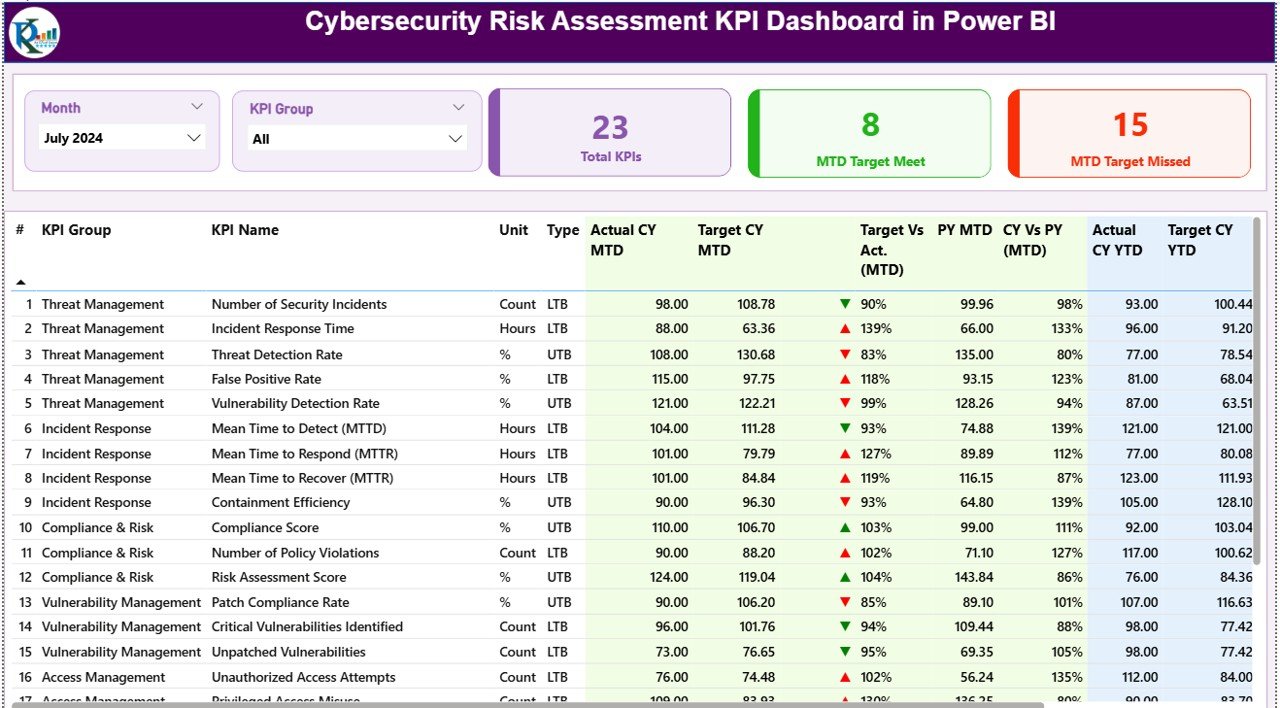
Cybersecurity Risk Assessment KPI Dashboard in Power BI
Key Features of the Cybersecurity Risk Assessment KPI Dashboard
This Power BI dashboard tracks cyber risk performance across 3 distinct pages. The Summary page surfaces every KPI, the Trend page visualizes change over time, and the hidden KPI Definition page provides drill-through context for any metric on demand.
- 3 fully interactive Power BI pages — Summary (KPI table + cards), KPI Trend (combo charts), KPI Definition (hidden drill-through).
- MTD & YTD comparison — every KPI shows Actual vs Target for both month-to-date and year-to-date, plus comparison against the same period in the previous year (CY vs PY).
- Visual ▲▼ status icons — red and green directional icons in the MTD Icon and YTD Icon columns instantly show which KPIs are missing target.
- Two slicers on Summary page — filter by Month and KPI Group with a single click. The Trend page adds a KPI Name slicer.
- 3 KPI summary cards — Total KPIs count, MTD Target Met count, MTD Target Missed count.
- LTB / UTB logic — define each KPI as Lower-the-Better or Upper-the-Better; the dashboard auto-flips icon colors accordingly.
- Excel-driven data refresh — fill three Excel tabs and click Refresh. No DAX, no Power Query editing required.
Dashboard Pages Explanation
1) Summary Page
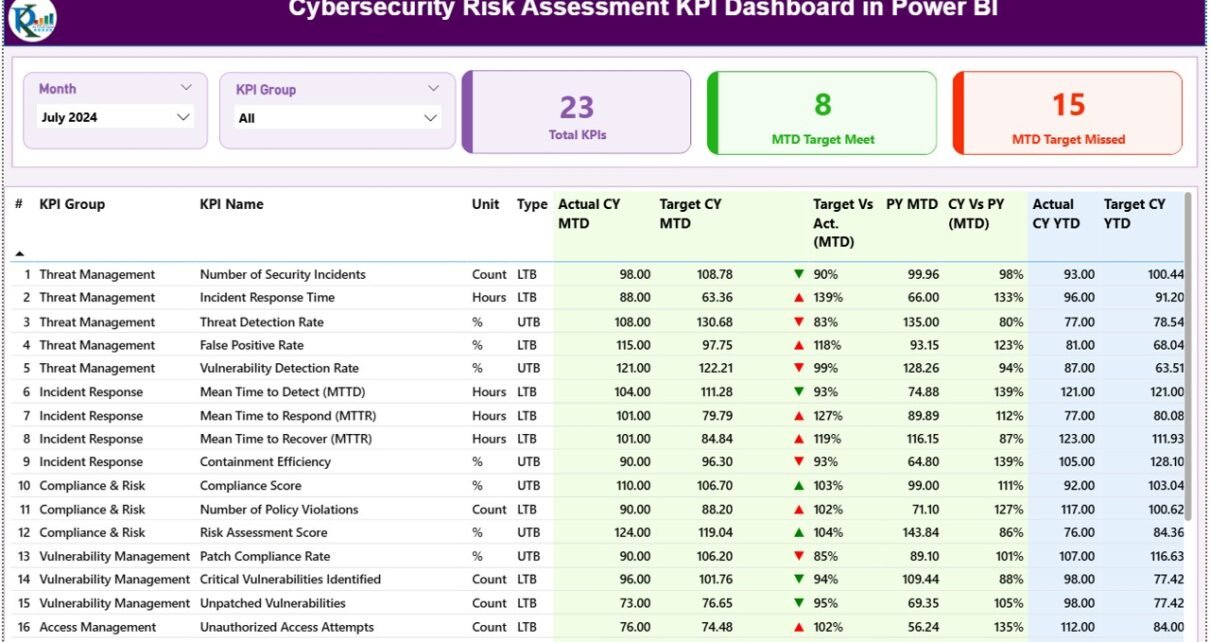
The Summary page is the main view of the Cybersecurity Risk Assessment KPI Dashboard in Power BI. At the top, two slicers — Month and KPI Group — let you filter the entire view in one click. Three cards display the Total KPIs count, MTD Target Met count, and MTD Target Missed count.
Below the cards, a detailed table shows the following columns for every KPI: KPI Number (sequence number), KPI Group (category like Vulnerability Management, Awareness, Incident Response), KPI Name, Unit (% , count, hours, etc.), Type (LTB or UTB), Actual CY MTD, Target CY MTD, MTD Icon (▼/▲ in red/green), Target Vs Act. (MTD) calculated as Actual MTD / Target MTD, PY MTD, CY Vs PY (MTD) calculated as Current Year MTD / Previous Year MTD, Actual CY YTD, Target CY YTD, YTD Icon, Target Vs Act. (YTD), PY YTD, and CY Vs PY (YTD).
2) KPI Trend Page
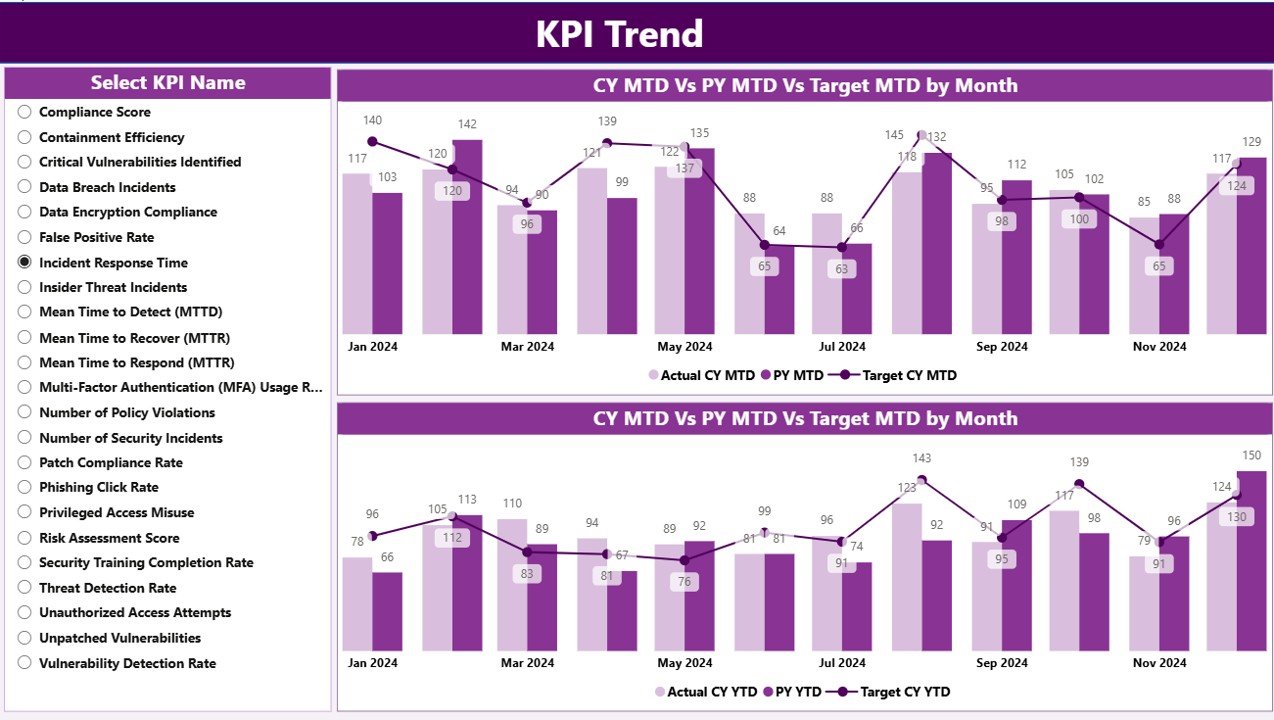
KPI Trend Page
The KPI Trend page contains 2 combo charts. The first plots MTD Actual numbers for the Current Year, Previous Year, and the Target line. The second does the same for YTD numbers. A KPI Name slicer on the left lets you isolate any single KPI to study its trajectory across months without noise from other metrics. This view answers the natural follow-up to a missed target — “is this a one-month anomaly or a downward trend?”
3) KPI Definition Page
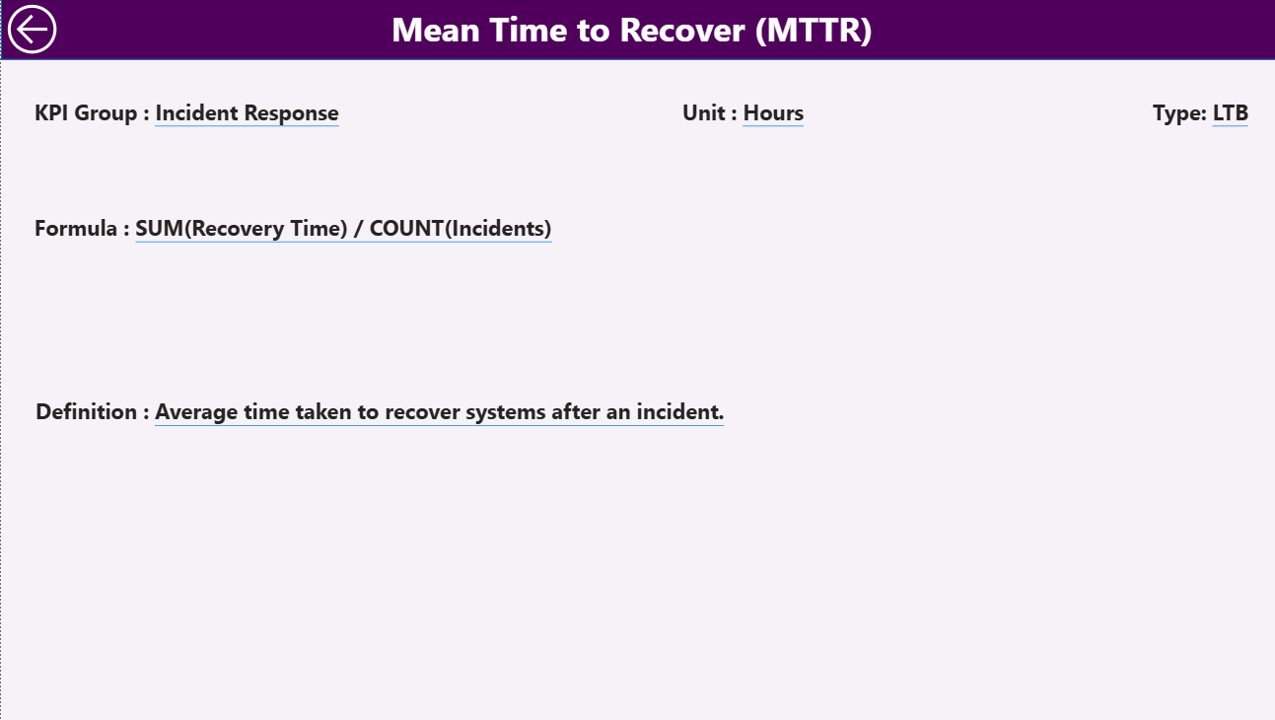
KPI Definition Page
The KPI Definition page is a drill-through page that has been kept hidden from the navigation. From the Summary page, right-click any KPI row and choose drill-through to view that KPI’s formula and definition on this page. To return to the Summary, click the back-arrow at the top-left corner. This pattern keeps the main dashboard clean while giving stakeholders one-click access to the calculation logic — useful when an auditor or board member asks “what exactly is MTTR measuring here?”
Excel Data Source — 3 Worksheets to Fill
The Cybersecurity Risk Assessment KPI Dashboard in Power BI uses an Excel file as its data source. You fill three worksheets:
- Input_Actual — fill in the Actual number for each KPI Name, Month (use the first date of the month), MTD number, and YTD numbers.
- Input_Target — fill in the Target number for each KPI Name, Month (first date of the month), MTD number, and YTD numbers.
- KPI Definition — fill KPI Number, KPI Group, KPI Name, Unit, Formula, Definition, and Type (LTB or UTB).
Once filled, save the Excel file and click Refresh in Power BI Desktop. All three pages update automatically. For deeper context on Power BI data models and refresh, the official Microsoft Learn — Power BI data refresh guide is the authoritative source.
Cybersecurity Risk Assessment Dashboard vs. Tableau Equivalent vs. Paid GRC SaaS — Feature Comparison
| Feature | This Power BI Dashboard | Tableau / Qlik Equivalent | Paid GRC SaaS (Vanta, Drata, LogicGate) |
|---|---|---|---|
| Cost | $11.99 one-time | $70–$150 / user / month | $8,000–$80,000 / year |
| Platform | Power BI Desktop (free) | Tableau / Qlik Sense | Browser-only SaaS |
| Setup time | Under 10 minutes | 2–4 hours data modeling | 2–6 weeks onboarding |
| MTD & YTD vs PY comparison | ✅ Built in | Custom calculations | ✅ Available |
| Drill-through KPI definitions | ✅ Hidden page included | Build manually | Limited |
| Custom KPIs (LTB / UTB) | ✅ Edit Excel tab | Edit data + formulas | Restricted to vendor list |
| Data ownership | ✅ On your machine | Server-hosted | Vendor-hosted |
| Year-1 cost at 5 users | $11.99 | $4,200–$9,000 | $8,000–$80,000 |
For security and risk teams that want CISO-grade KPI tracking without paying $8,000+ per year for GRC SaaS, the Cybersecurity Risk Assessment KPI Dashboard in Power BI sits in the sweet spot.
Who Should Use This Template
Perfect for:
- CISOs and security managers at 20–500 person companies reporting monthly cyber risk to the board
- IT directors at SMBs needing a defensible cybersecurity scorecard without GRC SaaS spend
- vCISOs serving multiple clients who want one reusable Power BI template
- Internal audit teams tracking cybersecurity remediation against SLA targets
- Compliance leads preparing for SOC 2, ISO 27001, or NIST CSF assessments
Not a fit if:
- You need automated continuous monitoring with live API integrations to AWS, Okta, Jira (use Vanta / Drata)
- Nobody on your team is comfortable editing Excel
- You’re a SOC analyst needing real-time threat detection (this is monthly KPI reporting, not a SIEM)
Real-World Use Cases
Marcus runs information security at a 180-person FinTech. Every month he reports 14 cyber risk KPIs to the audit committee — vulnerability remediation rate, MTTD, MTTR, patching SLA, phishing test failure rate, security training completion, third-party risk score, and more. Using the Cybersecurity Risk Assessment KPI Dashboard in Power BI, he updates the Excel data source on the first business day of each month, refreshes the .pbix, and exports the Summary page to PDF for the board pack. His predecessor was about to renew a $24,000/year Drata subscription; Marcus replaced it with this $11.99 template plus his existing Tenable scanner.
Priya is a vCISO serving 11 mid-market clients. She duplicates the .pbix file for each client, swaps in client-specific Excel data, and delivers branded monthly cybersecurity KPI scorecards within 30 minutes per client. The drill-through KPI Definition page means she doesn’t have to re-explain what each metric measures every quarter — clients self-serve the definitions when needed.
Jamal heads internal audit at a 90-person healthcare SaaS company preparing for SOC 2 Type II. He uses the dashboard to track MTD vs Target on 12 control-effectiveness KPIs. The CY-vs-PY columns let him show the auditor a clear trend line of improving cyber posture year-over-year — exactly the evidence the auditor needs for CC7-series controls.
Advantages of the Cybersecurity Risk Assessment KPI Dashboard
The largest advantage is cost — replacing a $24,000/year GRC subscription with a $11.99 one-time purchase frees roughly $23,988 of annual budget for actual security tooling like an EDR upgrade, a phishing simulation platform, or a third-party pentest.
The second advantage is data ownership. Every metric lives in your Excel file on your machine. There’s no vendor that can lock you out, raise prices, or get breached with your control data inside their database.
The third advantage is speed of iteration. Adding a new KPI takes about 60 seconds — one new row in the KPI Definition tab and corresponding rows in Input_Actual and Input_Target. The dashboard picks it up on next refresh. With most GRC SaaS, custom KPIs require vendor-side configuration tickets that take weeks.
Opportunities for Improvement
To be honest about limitations: this template is a reporting layer, not a continuous monitoring layer. It does not connect to AWS, Azure, GitHub, Okta, or any control source via API. If you need automated control evidence collection, pair it with a tool that does scanning (Tenable, Qualys, Wiz) or buy GRC SaaS instead.
The dashboard is also single-tenant by design. Each .pbix file represents one organization. vCISOs serving multiple clients should expect to maintain one .pbix per client — which the template makes easy, but it’s not a multi-tenant SaaS.
Finally, real-time refresh is not the use case. This is for monthly board-style reporting, not minute-by-minute SOC monitoring. For real-time, route data to a SIEM.
Best Practices
- Pick 12–16 KPIs maximum. Boards lose attention beyond that. Use the NIST Cybersecurity Framework function categories (Identify, Protect, Detect, Respond, Recover) to allocate KPIs evenly.
- Set targets monthly at the start of the year, not retroactively. The Input_Target tab supports this — fill all 12 months upfront.
- Use the KPI Definition page religiously. Define formula AND definition in plain English. Six months later, “MTTR” needs to still mean exactly what you measured the first time.
- Run the dashboard for 13 months minimum before drawing trend conclusions. The CY vs PY columns only become meaningful once you have 12+ months of historical data.
- Color-code KPI Groups consistently so the board pack looks the same every month — recognizability beats novelty.
Explore Relevant Templates
Build out your cybersecurity reporting stack with these complementary templates:
- 🛡️ Security Dashboard in Power BI — broader security operations view with incident metrics.
- 🔍 IT Security Auditing KPI Dashboard in Power BI — control-effectiveness scorecard for audit teams.
- ☁️ Cloud Computing Dashboard in Power BI — cloud spend, capacity, and security posture.
- 🚨 Cyber Incident Response KPI Scorecard in Excel — incident-focused Excel companion.
- 🌐 Border Security Tech Dashboard in Power BI — adjacent national-security analytics use case.
Frequently Asked Questions
What KPIs does the Cybersecurity Risk Assessment KPI Dashboard track?
The Cybersecurity Risk Assessment KPI Dashboard in Power BI tracks any cyber risk KPIs you define in the Excel KPI Definition tab — typical examples include vulnerability remediation rate, mean time to detect (MTTD), mean time to respond (MTTR), patching SLA compliance, phishing test failure rate, and security training completion rate.
How does this compare to GRC SaaS like Vanta or Drata?
Vanta and Drata cost $8,000–$80,000 per year and offer continuous monitoring with API integrations. The Cybersecurity Risk Assessment KPI Dashboard in Power BI is a one-time $11.99 purchase for monthly board-style KPI reporting — ideal for teams that already have monitoring tools and just need a reporting layer.
How long does setup take?
Setup of the Cybersecurity Risk Assessment KPI Dashboard takes under 10 minutes if you have your KPI list and target values ready. You fill 3 Excel tabs (Input_Actual, Input_Target, KPI Definition), open the .pbix in Power BI Desktop, and click Refresh.
Do I need Power BI Pro or just Power BI Desktop?
Power BI Desktop (free from Microsoft) is enough to open and edit the Cybersecurity Risk Assessment KPI Dashboard. Pro is only needed if you want to publish to Power BI Service and share live dashboards. For PDF exports to a board pack, free Desktop is sufficient.
Can I add or remove KPIs?
Yes. Add a new row in the KPI Definition tab, then add corresponding monthly rows in Input_Actual and Input_Target. The Cybersecurity Risk Assessment KPI Dashboard in Power BI will pick up the new KPI on the next refresh — no DAX edits required.
What is LTB vs UTB?
LTB (Lower the Better) applies to KPIs where a lower value is good — for example, MTTR or vulnerability count. UTB (Upper the Better) applies where higher is good — for example, patching SLA compliance percentage or training completion rate. The dashboard auto-flips red/green icon logic per KPI type.
Can I rebrand the dashboard with my company colors and logo?
Yes. Open the .pbix in Power BI Desktop and edit the theme colors, header images, and titles. The Cybersecurity Risk Assessment KPI Dashboard structure stays intact — only visuals are updated.
About the Author
Built by PK — Microsoft Certified Professional with 15+ years of Excel, Google Sheets, and Power BI experience. Founder of NextGenTemplates, reaching 300K+ subscribers across YouTube channels. Every template is hand-built and tested before release.
Conclusion
The Cybersecurity Risk Assessment KPI Dashboard in Power BI gives security and risk teams a board-ready monthly KPI report at a fraction of GRC SaaS cost. With 3 pages, MTD/YTD/PY comparisons, drill-through definitions, and full Excel-driven control over what gets tracked, it covers the reporting layer cleanly while letting your existing monitoring stack do the detection work.
👉 Click here to Purchase the Cybersecurity Risk Assessment KPI Dashboard in Power BI
✅ Instant download · One-time payment · No subscription · Lifetime access
🎥 Visit our YouTube channel for tutorials: Youtube.com/@PK-AnExcelExpert
📅 Last updated: April 2026