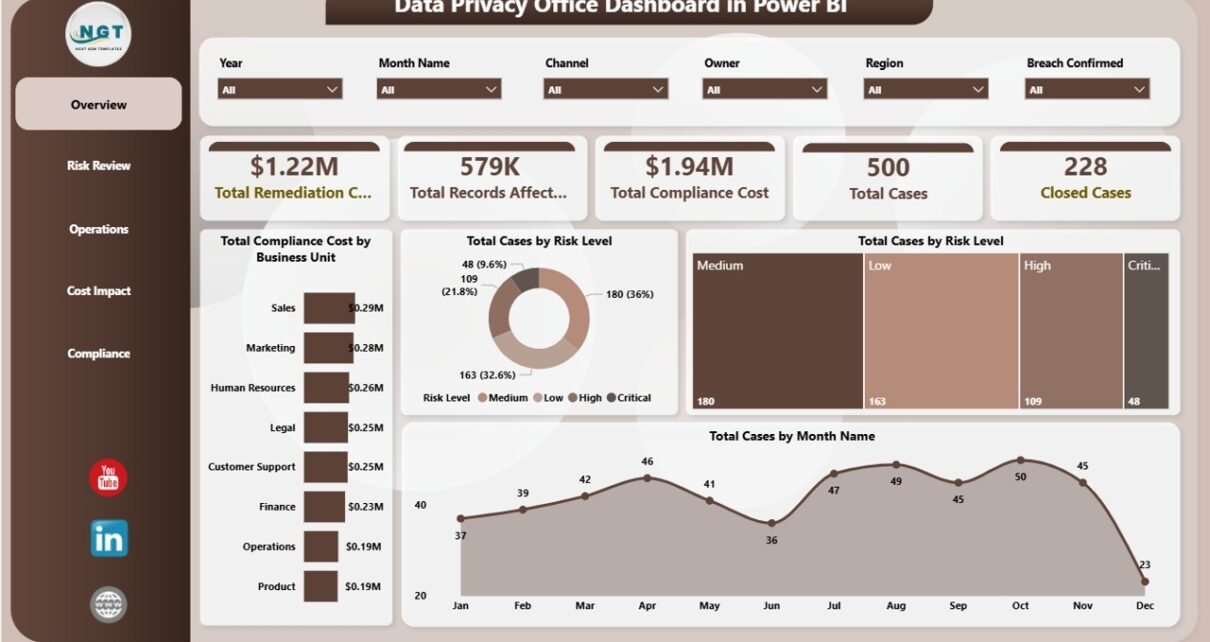
The Data Privacy Office Dashboard in Power BI consolidates more than 30 privacy KPIs across 5 interactive report pages, covering data subject access requests (DSARs), breach incidents, consent records, records of processing activities (ROPA), and staff training compliance. Everything sits on one Power BI data model, so the moment you point it at your own source the visuals refresh — no manual chart rebuilding.
Privacy teams juggle GDPR Article 30 records, a 72-hour breach notification clock, and a one-month DSAR deadline across spreadsheets that rarely talk to each other. The Data Privacy Office Dashboard in Power BI turns those scattered logs into a single board a Data Protection Officer can read in seconds and defend in a regulator audit. It is a one-time purchase at $17.99, with no per-user fees and no annual subscription.
Key Features of the Data Privacy Office Dashboard in Power BI
This template is built around the day-to-day metrics a privacy office is measured on. Three things make it stand out:
- 📊 30+ privacy KPIs on one model – total DSARs, open and overdue requests, average response time in days, breach count, 72-hour notification rate, consent rate, ROPA count, and training completion percentage all read from the same dataset.
- 🔎 Five purpose-built pages – Program Overview, DSAR Analysis, Breaches and Incidents, Consent and Processing Activities, and Training, Risk and Policy Compliance, so each function of the privacy office has its own view.
- ⚡ Refresh in minutes, not hours – replace the sample tables with your own register exports and every card, chart, and slicer updates automatically through the data model.
- 🗂️ Regulation-aware structure – the data layout maps cleanly to GDPR concepts like lawful basis, data subject rights, and processor inventories, making it equally usable for CCPA and other privacy frameworks.
- 🎛️ Interactive slicers for date, department, request type, and severity, so a DPO can move from a board-level summary to a single overdue request in two clicks.
Dashboard Pages Explanation
Each page is a self-contained report that answers one set of questions a privacy team is asked every week.
Page 1: Privacy Program Overview
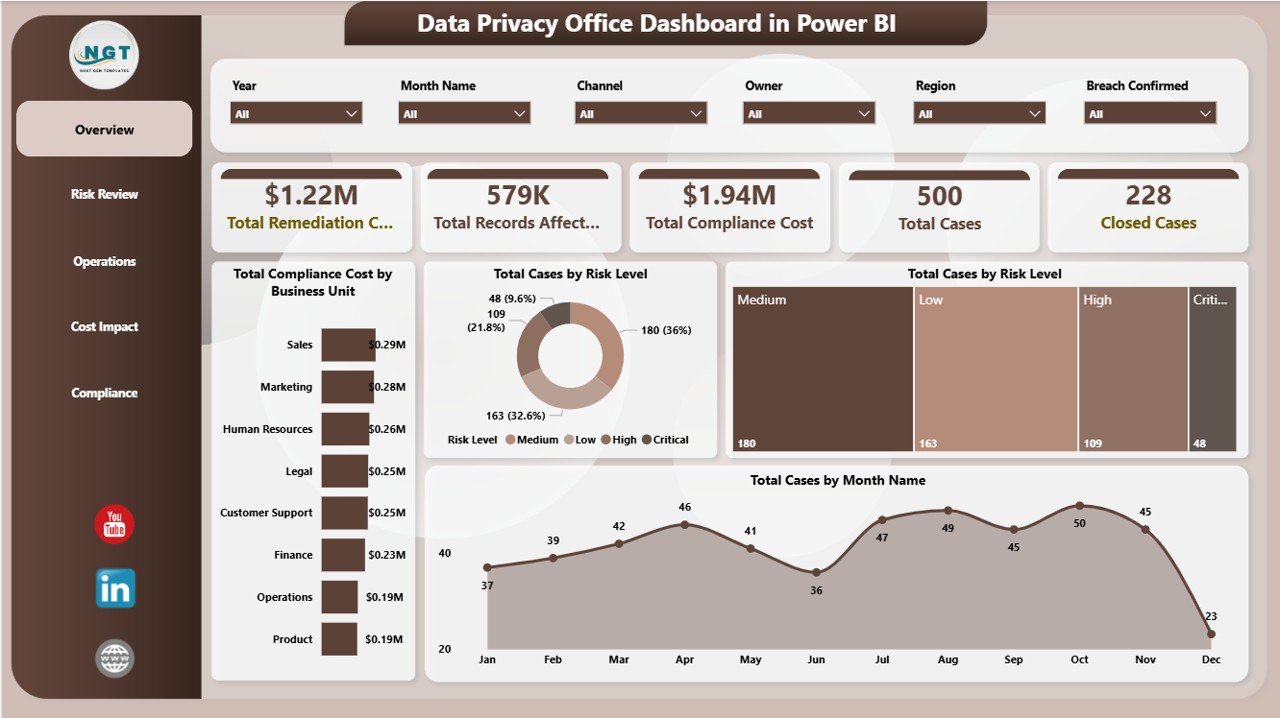
The landing page shows headline KPI cards for Total DSARs, Open Requests, Overdue Requests, Data Breaches, Average Response Time, Consent Rate, Training Completion, and DPIAs Completed. Charts include DSARs by Month, Requests by Type, Breach Trend by Month, and Compliance Score by Department.
Page 2: Data Subject Request (DSAR) Analysis
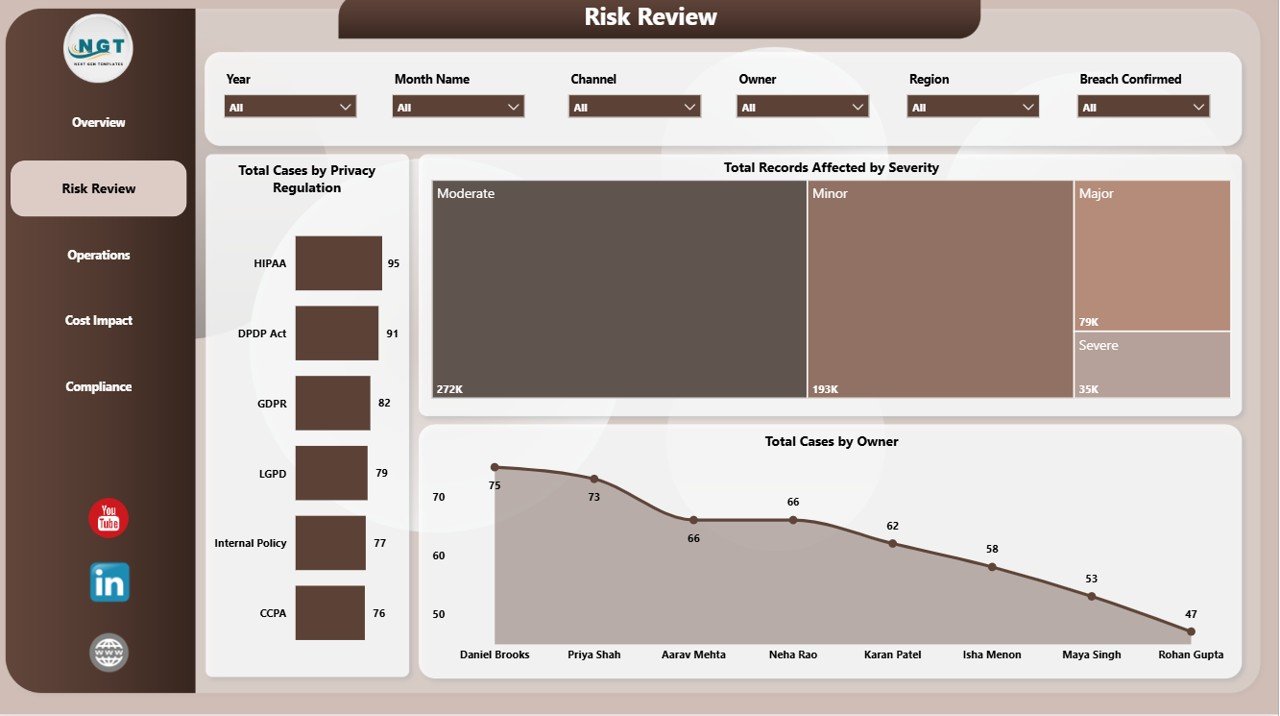
This page tracks request volume and turnaround against the one-month statutory deadline. It surfaces Total Requests, Access Requests, Erasure Requests, Average Resolution Days, and SLA Compliance, with charts for Requests by Type, Requests by Status, Resolution Time by Request Type, Requests by Department, and Requests by Channel.
Page 3: Data Breaches and Incidents
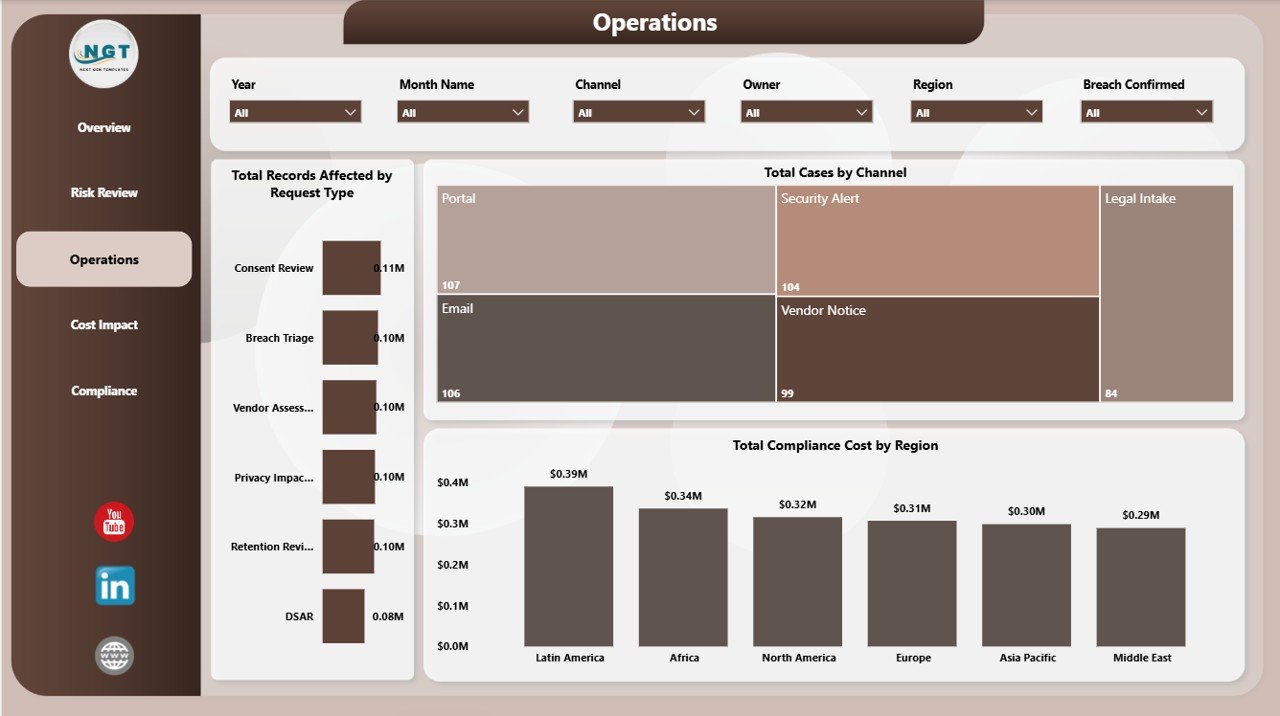
Built for the 72-hour notification clock, this page reports Total Breaches, 72-Hour Notifications, Affected Records, Open Incidents, and Average Containment Time. Charts include Breaches by Severity, Breaches by Root Cause, Affected Records by Month, Incidents by Status, and Notification Timeliness.
Page 4: Consent and Processing Activities (ROPA)
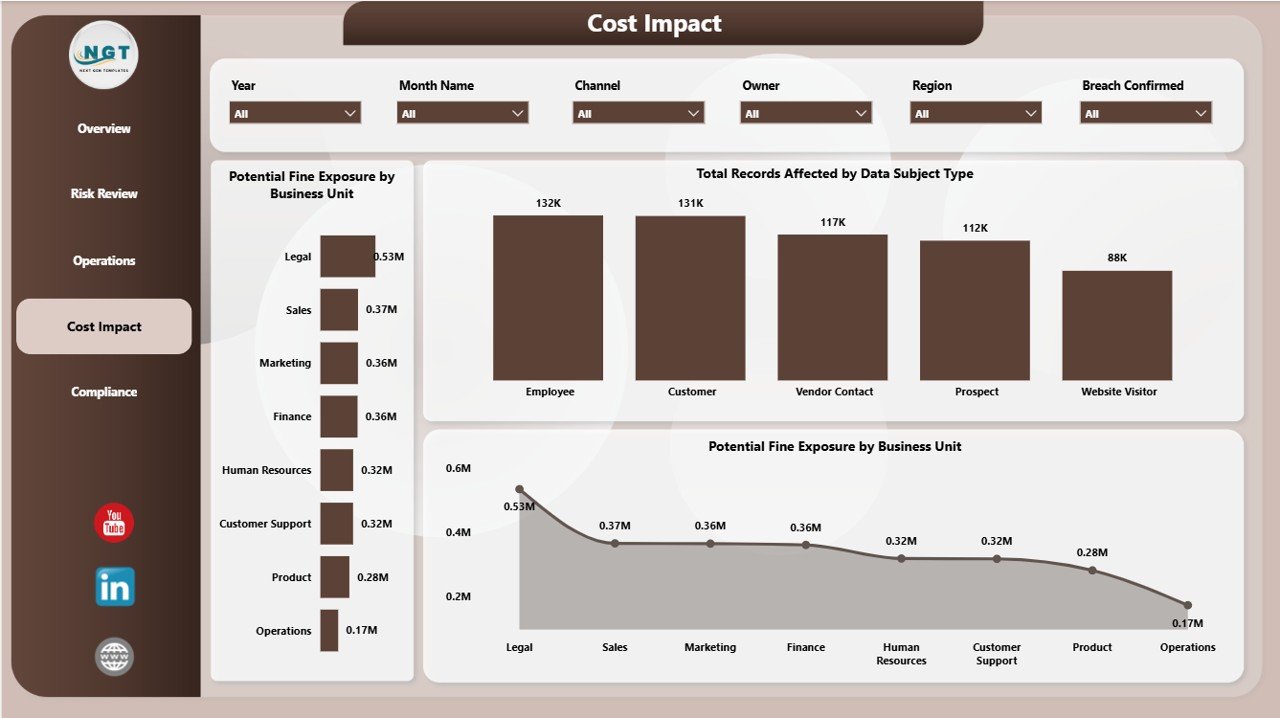
This page maintains the Article 30 picture: Active Consents, Withdrawn Consents, Consent Rate, Processing Activities (ROPA), Third-Party Processors, and High-Risk Activities. Charts include Consent by Channel, Consent Status, Processing Activities by Department, Lawful Basis Breakdown, and Processors by Risk Level.
Page 5: Training, Risk and Policy Compliance
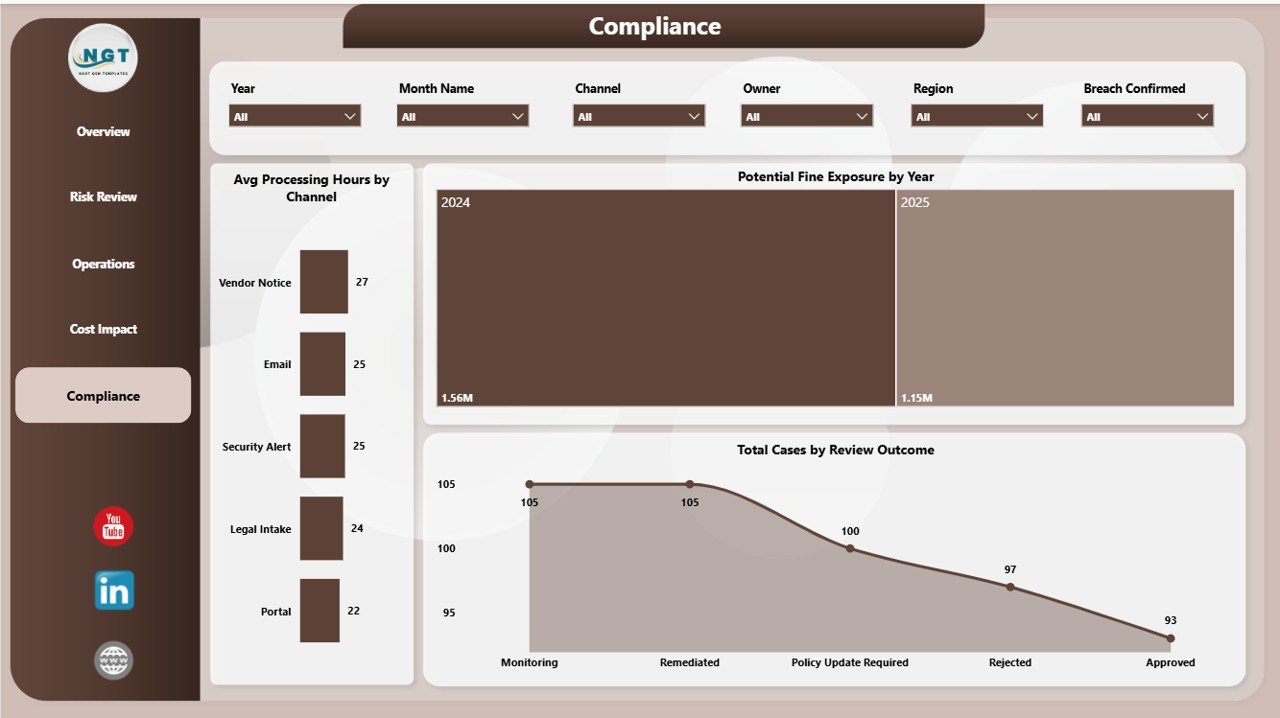
The final page covers the human and governance side: Training Completion, Employees Trained, Policies Reviewed, Vendor Assessments, and an Overall Risk Score. Charts include Training Completion by Department, Risk Level by Category, Policy Compliance by Region, Audit Findings by Status, and DPIA Status.
Data Privacy Office Dashboard in Power BI vs. Tableau/Qlik vs. Privacy SaaS — Feature Comparison
How does a one-time Power BI template compare to building the same thing in Tableau or Qlik, or paying for a dedicated privacy platform like OneTrust or TrustArc?
| Feature | Data Privacy Office Dashboard in Power BI | Tableau / Qlik Build | OneTrust / TrustArc (Privacy SaaS) |
|---|---|---|---|
| Cost | $17.99 one-time | $70–$75 / user / month licence | $15,000–$50,000+ / year |
| Platform | Power BI Desktop (free) | Tableau / Qlik licence | Vendor-hosted SaaS |
| Setup time | Under 15 minutes ✅ | Days of report building | Weeks of implementation |
| DSAR and breach tracking | Built in across 5 pages ✅ | Build from scratch | ✅ Included |
| Customizable fields | Full model access ✅ | ✅ Full access | Limited to vendor schema |
| Mobile access | ✅ Power BI mobile app | ✅ Vendor app | ✅ Vendor app |
| You own the data | 100% on your tenant ✅ | ✅ On your tenant | Stored with the vendor |
| Year-1 cost at 5 users | $17.99 ✅ | ~$4,200+ | $15,000–$50,000+ |
For privacy teams that want a regulator-ready DSAR, breach and consent view without a five-figure platform bill, the Data Privacy Office Dashboard in Power BI sits in the sweet spot.
Who Should Use This Template
Perfect for:
- Data Protection Officers and privacy leads at small and mid-size organisations who report to a board or audit committee.
- Compliance and risk managers who need GDPR or CCPA metrics without a dedicated GRC platform.
- IT and security teams that already run Power BI and want privacy reporting on the same stack.
- Consultants and DPaaS providers who need a portable, white-labelable privacy dashboard for multiple clients.
Not a fit if:
- You need a fully automated privacy platform that ingests cookie scans and runs assessment workflows — a tool like OneTrust is the right choice there.
- Your organisation has no Power BI Desktop access and cannot install it.
- You want a live system of record rather than a reporting and analytics layer over your existing registers.
Real-World Use Cases
Anita is the DPO at a 220-person fintech. She uses the Data Privacy Office Dashboard in Power BI to walk her risk committee through DSAR turnaround, overdue requests, and breach notification timeliness every quarter, replacing three separate spreadsheets she used to merge by hand.
Marcus runs compliance for a health-tech scale-up. He points the consent and ROPA page at his processing register so he can show auditors, on one screen, every processing activity, its lawful basis, and which third-party processors carry high risk.
Priya is an independent privacy consultant. She deploys the dashboard for each new client in under 15 minutes, swapping in their request and incident logs to deliver a board-ready privacy report without buying a per-seat platform licence.
Advantages of the Data Privacy Office Dashboard in Power BI
The biggest advantage is cost certainty: a single $17.99 purchase replaces recurring licence fees that scale with headcount. Because it runs in Power BI Desktop, which is free from Microsoft, there is no platform tax to add a viewer. The model also keeps every record on your own tenant, which is itself a privacy benefit — you are not shipping personal data to a third-party reporting vendor. Finally, the page structure mirrors how regulators actually ask questions, so audit preparation becomes a matter of filtering rather than rebuilding.
Opportunities for Improvement
To be balanced, this is a reporting and analytics layer, not a workflow engine. It will not send breach notifications, run automated cookie consent capture, or manage assessment approvals — those remain in your operational tools. The dashboard is also only as current as the data you load; teams that want near-real-time figures will need to schedule refreshes against a live source through the Power BI service. Organisations with very large registers may want to model their data in a star schema before connecting for best performance.
Best Practices
- Keep your source registers in clean, tabular form with consistent column headers so the model maps without edits.
- Schedule a daily or weekly refresh in the Power BI service so the breach and DSAR clocks stay accurate.
- Use the department and severity slicers in your committee meetings to drill from summary to specific cases live.
- Review the lawful-basis breakdown each quarter to catch processing activities that have drifted out of scope.
Explore Relevant Templates
Prefer a spreadsheet build, or need a companion view? These related templates pair well with this dashboard:
- Also available as: Data Privacy Office Dashboard in Excel — the same dashboard for teams that live in Excel.
- Data Privacy Office KPI Dashboard in Power BI — a tighter, single-page KPI scorecard view.
- Compliance Audits Dashboard in Power BI — widen coverage from privacy to full audit programmes.
- Compliance and Audit Dashboard in Power BI — track findings and remediation alongside privacy.
- Data Privacy KPI Scorecard in Excel — a lightweight scorecard for monthly check-ins.
For more governance and security reporting, see our Cyber Law Advisory Dashboard in Power BI, the Cybersecurity Operations Center Dashboard in Power BI, and the Excel build of the Data Privacy Office Dashboard in Excel. You can also browse all Power BI Dashboard templates on NextGenTemplates. For the underlying rules these metrics map to, the official GDPR information portal and the Microsoft Power BI documentation are useful references.
Frequently Asked Questions
What KPIs does the Data Privacy Office Dashboard in Power BI track?
The Data Privacy Office Dashboard in Power BI tracks more than 30 KPIs, including total and overdue DSARs, average response time, breach count, 72-hour notification rate, consent rate, ROPA count, and training completion. Every metric updates automatically when you load your own data.
Do I need a paid Power BI licence to use it?
No. The Data Privacy Office Dashboard in Power BI opens in Power BI Desktop, which is free from Microsoft. A paid Power BI service licence is only needed if you want to publish the report online and schedule automatic refreshes for your team.
How long does setup take?
Most users are running the Data Privacy Office Dashboard in Power BI in under 15 minutes. You open the .pbix file, replace the sample tables with your own register exports, and the cards, charts, and slicers refresh through the data model.
How does this compare to OneTrust or TrustArc?
OneTrust and TrustArc are full privacy platforms that cost tens of thousands per year and automate workflows. The Data Privacy Office Dashboard in Power BI is a one-time $17.99 reporting layer over your existing registers — far cheaper, and it keeps your data on your own tenant.
Can I use it for CCPA as well as GDPR?
Yes. The Data Privacy Office Dashboard in Power BI is structured around universal privacy concepts like data subject rights, lawful basis, and processor inventories, so it works for CCPA, GDPR, and most other privacy frameworks with minor relabelling.
Is the data kept private?
Yes. The Data Privacy Office Dashboard in Power BI runs entirely on your own Power BI tenant or desktop. No personal data is sent to NextGenTemplates or any third-party vendor, which makes it a privacy-friendly choice for sensitive records.
About the Author
Built by PK — Microsoft Certified Professional with 15+ years of Excel, Google Sheets, and Power BI experience. Founder of NextGenTemplates, reaching 300K+ subscribers across YouTube channels. Every template is hand-built and tested before release.
Conclusion
If your privacy office still merges DSAR logs, breach trackers, and consent records by hand, the Data Privacy Office Dashboard in Power BI gives you one regulator-ready board for a fraction of the cost of a privacy platform. Click here to purchase the Data Privacy Office Dashboard in Power BI and start reporting today.
Instant download · One-time payment · No subscription. For video walkthroughs, visit YouTube.com/@PK-AnExcelExpert.
Last updated: June 2026