The Dialysis Centers Dashboard in Power BI is a ready-made analytics report for dialysis center administrators, healthcare finance teams, regional clinic managers, and nephrology analysts who need a clearer way to review sessions, revenue, net profit, treatment duration, insurance coverage, center performance, clinical quality, and treatment insights. A dialysis network can process hundreds or thousands of treatment sessions every month, and manual reports often make it difficult to see where revenue, cost, quality, and utilization are changing.
This Power BI dashboard includes 5 KPI cards, 5 report pages, interactive slicers, and healthcare-specific visuals for operational and financial review. You can open the .pbix file in Power BI Desktop, replace the sample data with your own source, refresh the report, and use the dashboard in weekly operations, monthly finance reviews, and clinical quality discussions. Download the Dialysis Centers Dashboard in Power BI here.
Key Features of Dialysis Centers Dashboard in Power BI
- 5 KPI cards: Total Sessions, Total Revenue, Net Profit, Avg Session Duration, and Total Insurance Coverage.
- 5 dashboard pages: Overview Page, Monthly Trend, Center Analysis, Clinical Quality, and Treatment Insights.
- Interactive slicers: Filter the report quickly by available dimensions such as month, region, treatment type, center, status, or other source fields.
- Clinical and financial views: Analyze adequacy, complications, treatment types, dialyzer type, nephrologist results, revenue, cost, and profit margin.
- Power BI report structure: Built with cards, bar charts, line charts, column charts, slicers, and comparison views.
- Editable .pbix file: Customize visuals, fields, labels, colors, measures, and data source connections in Power BI Desktop.
Dashboard Pages Explanation
1. Overview Page
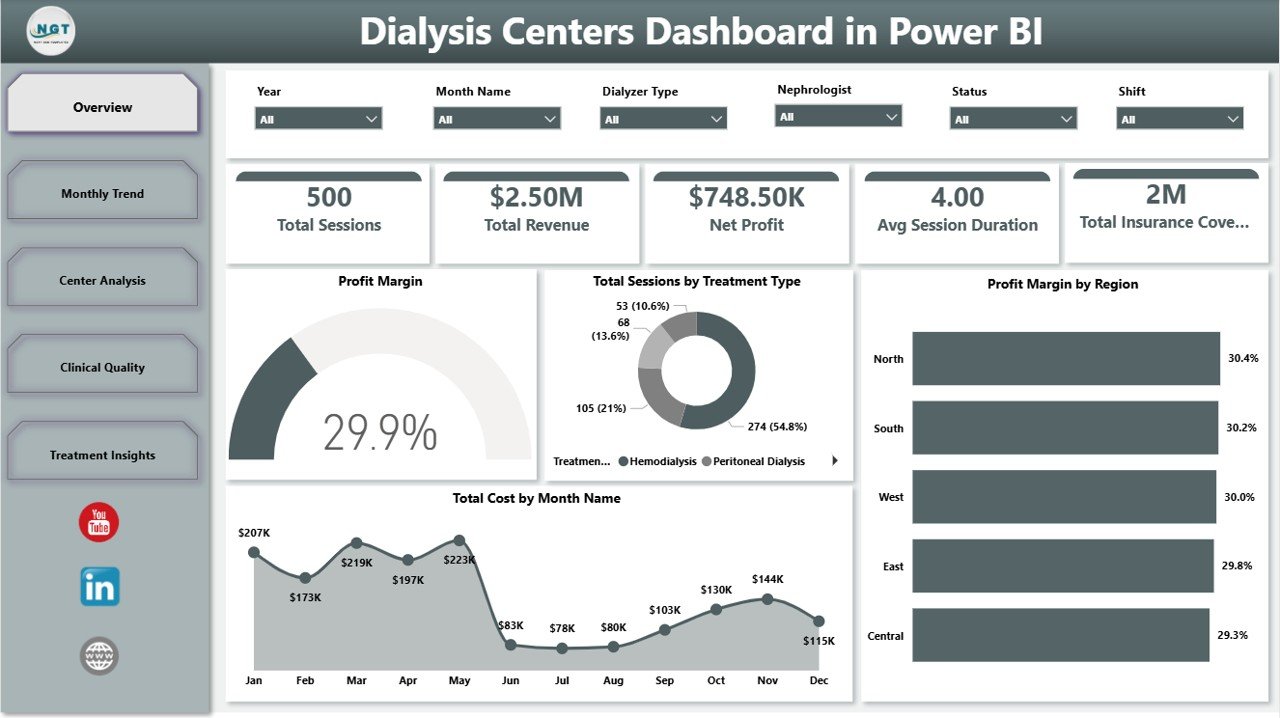
The Overview Page is the executive starting point. The top cards show Total Sessions, Total Revenue, Net Profit, Avg Session Duration, and Total Insurance Coverage so leadership can quickly understand volume, financial performance, time efficiency, and payer coverage.
Profit Margin by Overall Performance shows how profitability varies across performance categories, helping managers spot strong and weak areas. Total Sessions by Treatment Type compares workload by modality, while Profit Margin by Region highlights regional profitability differences. Total Cost by Month Name shows monthly cost movement and helps finance teams identify cost pressure.
2. Monthly Trend
The Monthly Trend page focuses on time-based review. Total Revenue by Year compares yearly revenue movement and supports annual planning. Total Sessions by Month Name shows monthly treatment volume patterns, making it easier to identify demand spikes or slower periods.
Total Revenue by Center Name ranks centers by revenue contribution. This is useful for regional managers who need to understand which centers are driving results and which centers may need follow-up.

3. Center Analysis
The Center Analysis page helps compare locations and geographic performance. Profit Margin by Adequacy connects quality grouping with profitability, allowing clinical and finance leaders to review performance from both angles. Total Revenue by City shows which cities are generating the highest revenue.
Total Sessions by Center Name compares treatment volume across centers. Administrators can use this view to identify high-volume centers, underused centers, and locations that may require staffing or operational review.

4. Clinical Quality
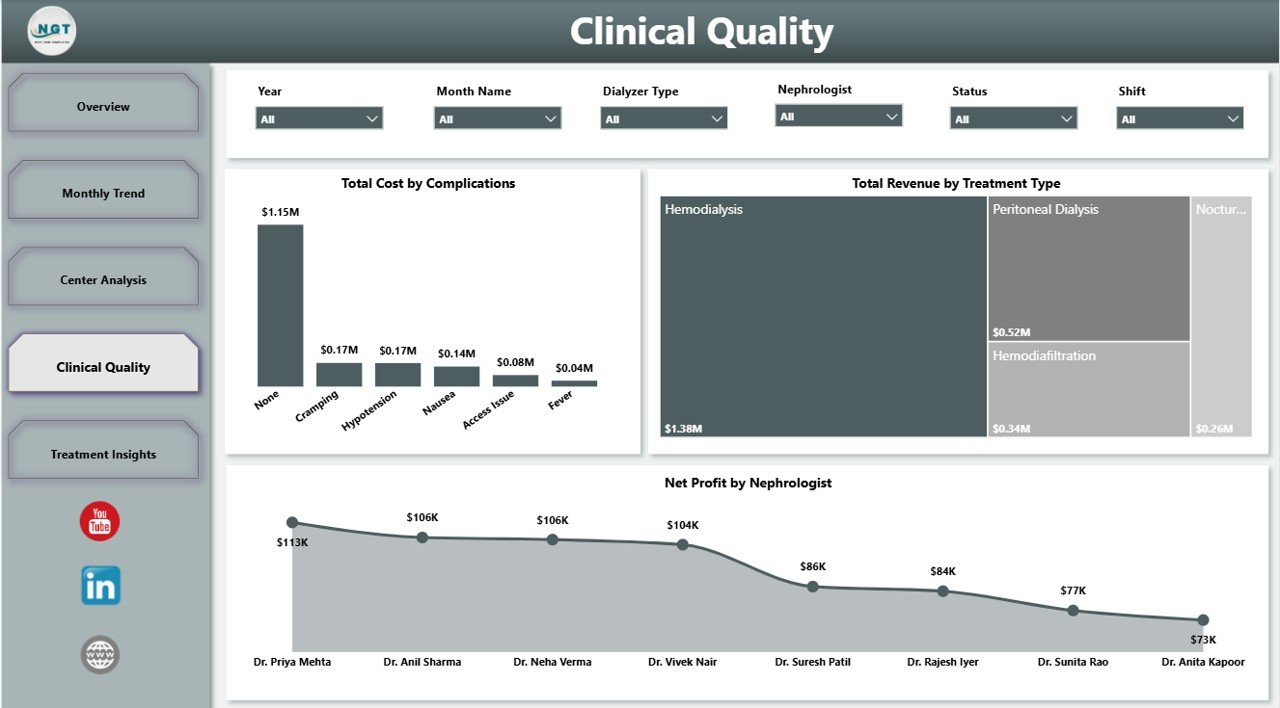
The Clinical Quality page connects complications, treatment types, and provider-level profitability. Total Cost by Complications helps quantify how complications affect operating cost. This can support quality improvement conversations and cost-control initiatives.
Total Revenue by Treatment Type compares financial contribution across treatment categories. Net Profit by Nephrologist gives leadership a provider-level profitability view for internal management reporting, while still requiring careful context and responsible use.
5. Treatment Insights
The Treatment Insights page focuses on treatment delivery patterns. Profit Margin by Dialyzer Type compares profitability across dialyzer categories, which can support cost and product review discussions. Total Sessions by Status shows completed, cancelled, pending, or other session states.
Profit Margin by Treatment Type compares financial performance by modality. This helps teams understand which treatment categories contribute most strongly to profitability and which ones may need review.

Dialysis Centers Dashboard in Power BI vs. Tableau vs. Paid Healthcare SaaS – Feature Comparison
| Feature | Dialysis Centers Dashboard in Power BI | Tableau Alternative | Paid Healthcare SaaS |
|---|---|---|---|
| Cost | $17.99 one-time | Separate build and licenses | Monthly or annual subscription |
| Platform | Power BI Desktop | Tableau Desktop or Cloud | Vendor-hosted platform |
| Setup time | Open .pbix and replace source | Build model and visuals | Implementation and onboarding |
| Real-time team collaboration | Available after publishing to Power BI Service | Available through Tableau Cloud/Server | Usually included |
| Mobile access | Power BI mobile after publishing | Tableau mobile after publishing | Vendor app or browser |
| Customizable fields | Editable report and model | Editable with Tableau skills | Limited by vendor settings |
| Share with link | Possible through Power BI Service | Possible through Tableau Cloud | Login controlled |
| Year-1 cost at 5 users | $17.99 plus any Microsoft licensing | Often much higher after licenses | Often hundreds or thousands |
| Dialysis-specific views | Built in across 5 pages | Must be built | Depends on vendor module |
Who Should Use This Template
This template is useful for dialysis center administrators, clinic owners, regional operations managers, healthcare finance teams, nephrology department analysts, clinical quality reviewers, and consultants who prepare management reports for dialysis operations. It is especially helpful when teams already have source data but need a clean Power BI report to explain sessions, revenue, net profit, insurance coverage, treatment quality, center performance, and treatment mix.
It is not designed to replace an EHR, patient scheduling system, claims platform, billing system, or clinical decision support tool. Use it as a management reporting layer after approved source data has been prepared for analysis.
Real-World Use Cases
Aisha, dialysis center administrator: Aisha opens the Overview Page every Monday to review sessions, revenue, net profit, session duration, and insurance coverage before the operations meeting.
Rahul, healthcare finance manager: Rahul uses Monthly Trend and Center Analysis to compare revenue by center, cost by month, and profit margin by region. This helps him identify sites that need closer financial review.
Maria, clinical quality analyst: Maria reviews Clinical Quality and Treatment Insights to understand complications, adequacy, dialyzer type, treatment type, and session status before preparing quality discussion points.
Advantages of Dialysis Centers Dashboard in Power BI
- Fast executive visibility: KPI cards and page-level visuals reduce the time needed to prepare monthly performance summaries.
- Better clinical-financial connection: The report places adequacy, complications, treatment type, cost, revenue, and profit in the same reporting structure.
- Flexible Power BI format: You can update data connections, adjust DAX measures, and customize visuals based on your reporting needs.
- No recurring template fee: The dashboard is a one-time purchase, unlike many SaaS analytics products.
- Useful for multi-center review: Center, city, and region visuals make it suitable for branch-level performance conversations.
Opportunities for Improvement
This is a Power BI template, so the quality of the dashboard depends on the quality of your source data. Larger healthcare groups may want to connect it to governed data sources, automate refresh in Power BI Service, add role-level security, or extend the model with additional quality, staffing, machine utilization, and patient outcome metrics. Teams that need live clinical alerts or patient-level workflows should use dedicated healthcare systems alongside this reporting template.
Best Practices
- Keep your source data column names and data types consistent before refreshing the report.
- Validate Total Sessions, Total Revenue, Net Profit, and Total Insurance Coverage against your source system before presenting the dashboard.
- Use slicers during review meetings to compare centers, regions, treatment types, and monthly trends.
- Document any exclusions, manual adjustments, or reporting-period definitions so users interpret results correctly.
- Publish to Power BI Service only after checking access permissions and data privacy rules.
- Use Microsoft guidance for Power BI Desktop when changing sources, refreshing reports, or preparing dashboards for sharing: Microsoft Learn – What is Power BI Desktop?
Explore Relevant Templates
You may also like the Dialysis Centers Dashboard in Excel, the Dialysis Centers KPI Dashboard in Power BI, and the Cardiac Care Units Dashboard in Power BI. Browse more Power BI dashboard templates on NextGenTemplates.
Frequently Asked Questions
What KPI cards are included in this Power BI dashboard?
The Overview Page includes Total Sessions, Total Revenue, Net Profit, Avg Session Duration, and Total Insurance Coverage.
How many report pages are included?
The dashboard includes 5 report pages: Overview Page, Monthly Trend, Center Analysis, Clinical Quality, and Treatment Insights.
Do I need Power BI Desktop?
Yes. Open the .pbix file in Power BI Desktop, replace the sample data source with your own data, and refresh the report.
Can I customize the visuals?
Yes. You can edit visuals, fields, measures, labels, colors, and page layout in Power BI Desktop.
Can this replace a clinical system?
No. This is a management reporting dashboard, not an EHR, medical device, claims system, billing platform, or clinical decision support tool.
Can this dashboard support multiple centers?
Yes, if your dataset includes center, city, or region fields. The Center Analysis and Monthly Trend pages are designed for multi-center review.
About the Author
Built by PK – Microsoft Certified Professional with 15+ years of Excel, Google Sheets, and Power BI experience. Founder of NextGenTemplates, reaching 300K+ subscribers across YouTube channels. Every template is hand-built and tested before release.
Conclusion
The Dialysis Centers Dashboard in Power BI gives healthcare teams a practical way to review dialysis center operations without starting from a blank report. With KPI cards, monthly trends, center analysis, clinical quality views, and treatment insights, the dashboard helps connect financial and clinical reporting in one editable Power BI file. Download the template, replace the sample data, validate your results, and use the report to support clearer operations, finance, and quality conversations.
Visit our YouTube channel for tutorials: YouTube.com/@PKAnExcelExpert