Freight insurance teams often review thousands of premium, claim, policy, provider, cargo, region, and freight-lane records across disconnected systems. When this reporting is handled manually, teams can miss rising loss ratios, claim-heavy lanes, premium concentration, and provider-level risk until the next monthly review. The Freight Insurance Providers Dashboard in Power BI gives insurance, logistics, and risk teams a ready-to-use PBIX report for faster analysis.
This dashboard includes 5 Power BI pages, 5 high-level KPI cards, multiple slicers, and focused visuals for premium trends, provider review, risk claims, and lane insights. It is designed for users who want an editable analytics layer without building the full report from scratch.
Click here to view the Freight Insurance Providers Dashboard in Power BI.
Key Features of Freight Insurance Providers Dashboard in Power BI
- 5 Power BI report pages: Overview Page, Premium Trend, Provider Review, Risk Claims, and Lane Insights.
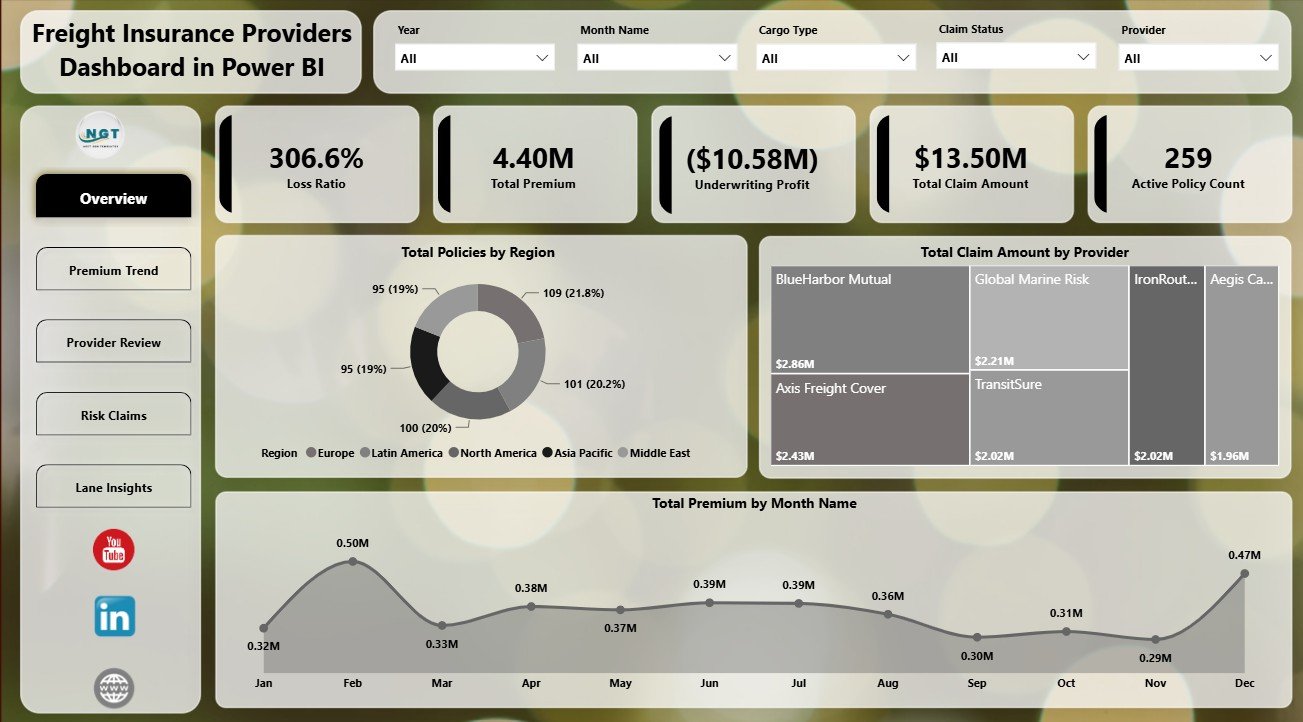
- 5 executive KPI cards: Loss Ratio, Total Premium, Underwriting Profit, Total Claim Amount, and Active Policy Count.
- Interactive slicers: Filter quickly by provider, region, coverage type, cargo type, freight lane, month, quarter, and available business fields.
- Premium analytics: Analyze premium by month, quarter, provider, coverage type, client segment, and region.
- Risk and claims analytics: Review claim amount, loss ratio, cargo type risk, freight lane exposure, and coverage performance.
- Power BI flexibility: Customize visuals, measures, fields, relationships, and report design in Power BI Desktop.
Dashboard Pages Explanation
1. Overview Page
The Overview Page is the executive starting point of the report. The top KPI cards show Loss Ratio, Total Premium, Underwriting Profit, Total Claim Amount, and Active Policy Count so users can quickly understand profitability, claim pressure, premium volume, and active exposure.
Total Policies by Region shows how policy records are distributed geographically. This helps regional teams identify where policy activity is concentrated and where future servicing or underwriting attention may be needed.
Total Claim Amount by Provider compares claim value across providers. It supports provider review discussions and helps managers identify providers associated with higher claim exposure.
Total Premium by Month Name tracks monthly premium movement. It helps users spot seasonality, premium spikes, slow months, and periods that deserve deeper sales or underwriting review.
2. Premium Trend
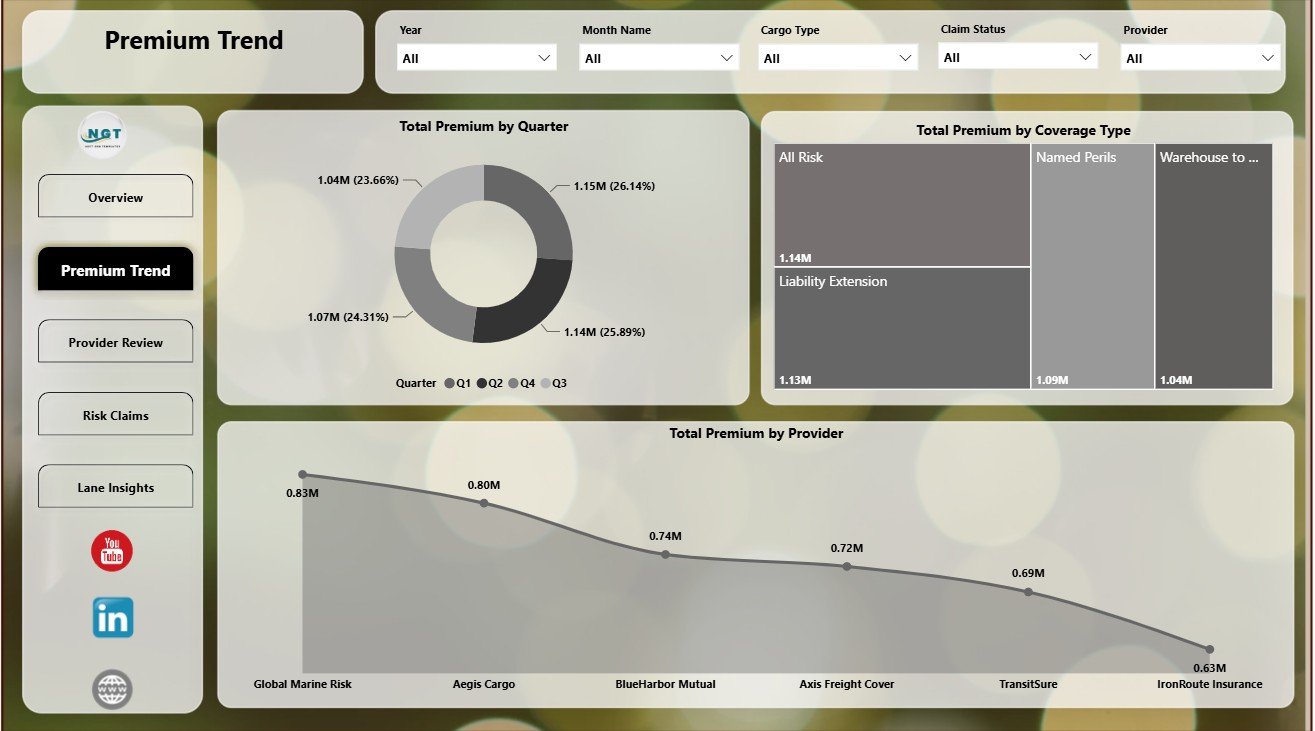
The Premium Trend page focuses on premium movement over time and premium distribution across key insurance dimensions. It is useful for finance, underwriting, account management, and leadership review.
Total Premium by Quarter shows quarterly premium performance. This helps teams compare business cycles, measure growth, and review premium volume during management meetings.
Total Premium by Coverage Type explains which coverage categories generate the most premium. This can guide pricing review, product focus, and coverage-level performance discussions.
Total Premium by Provider ranks providers by premium contribution. This helps teams understand provider concentration and prepare for provider negotiation or renewal conversations.
3. Provider Review
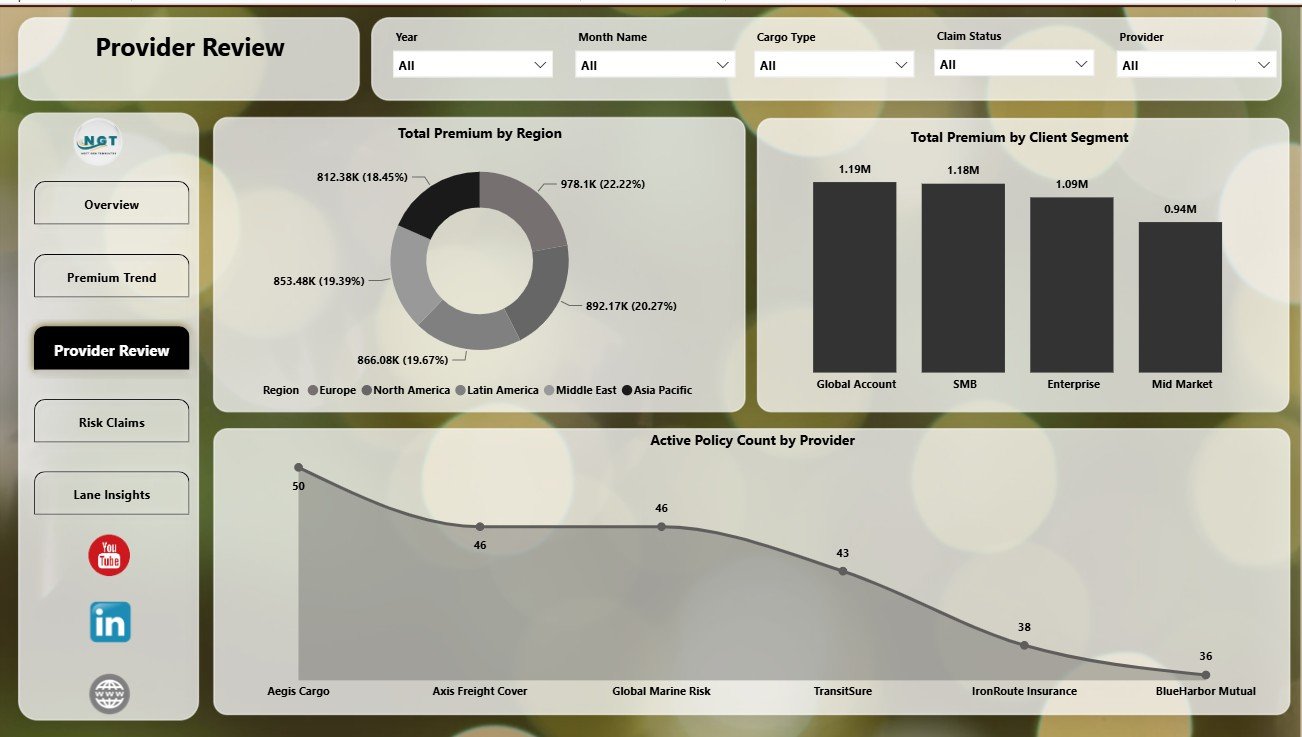
The Provider Review page helps teams compare provider performance, region contribution, client segment mix, and active policy counts. It is especially useful before provider meetings or monthly portfolio reviews.
Total Premium by Region compares premium contribution across locations. This helps leaders understand which markets are driving premium and where sales or risk concentration is growing.
Total Premium by Client Segment breaks premium down by customer group. It helps teams see whether enterprise clients, brokers, small businesses, or other segments are driving premium value.
Active Policy Count by Provider shows the active policy load by provider. This supports provider dependency review and helps operations teams understand servicing volume.
4. Risk Claims
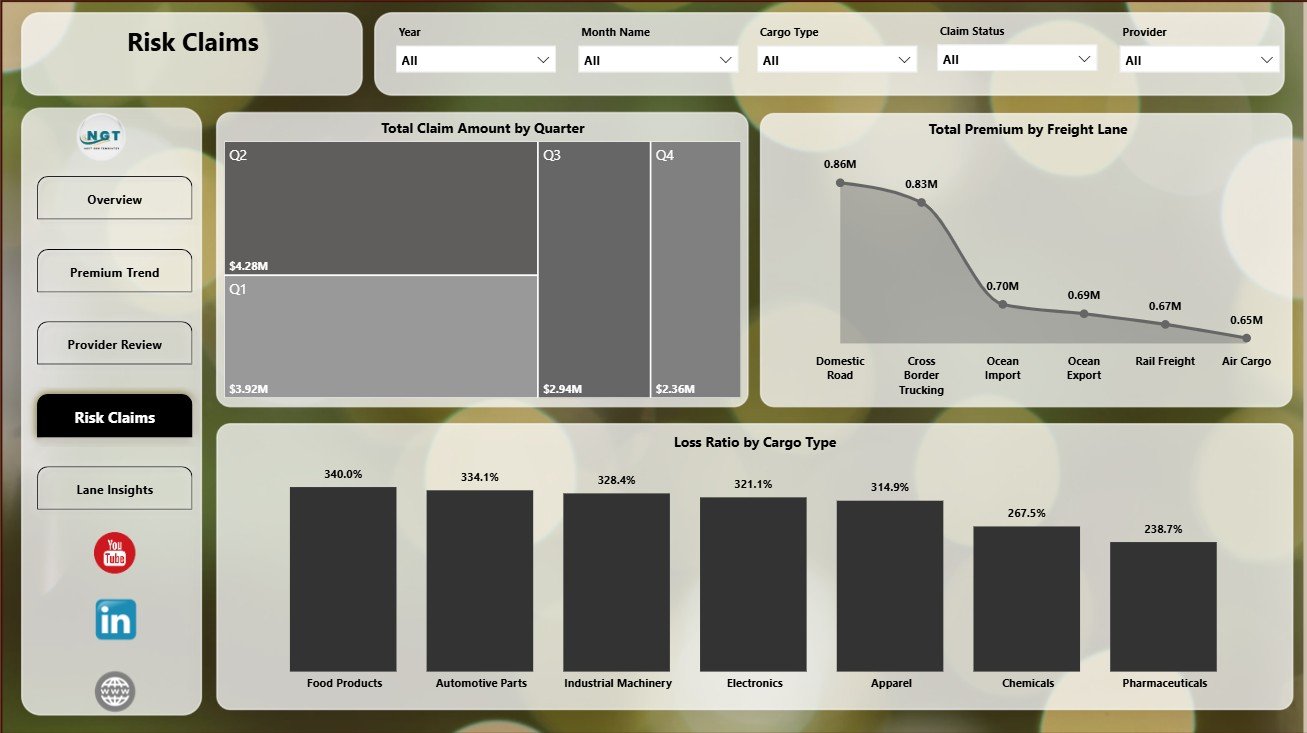
The Risk Claims page connects claim amount, quarter, freight lane, premium, and cargo type risk. This is the page underwriting and claims teams can use to identify where loss pressure is increasing.
Total Claim Amount by Quarter tracks claim value over time. It supports quarterly claims review, reserve discussions, and early investigation of rising claim cost.
Total Premium by Freight Lane shows premium contribution by route. This helps teams understand which lanes generate revenue and where exposure is concentrated.
Loss Ratio by Cargo Type compares claim cost against premium by cargo category. It helps identify cargo types that may require pricing changes, policy wording review, or tighter risk controls.
5. Lane Insights
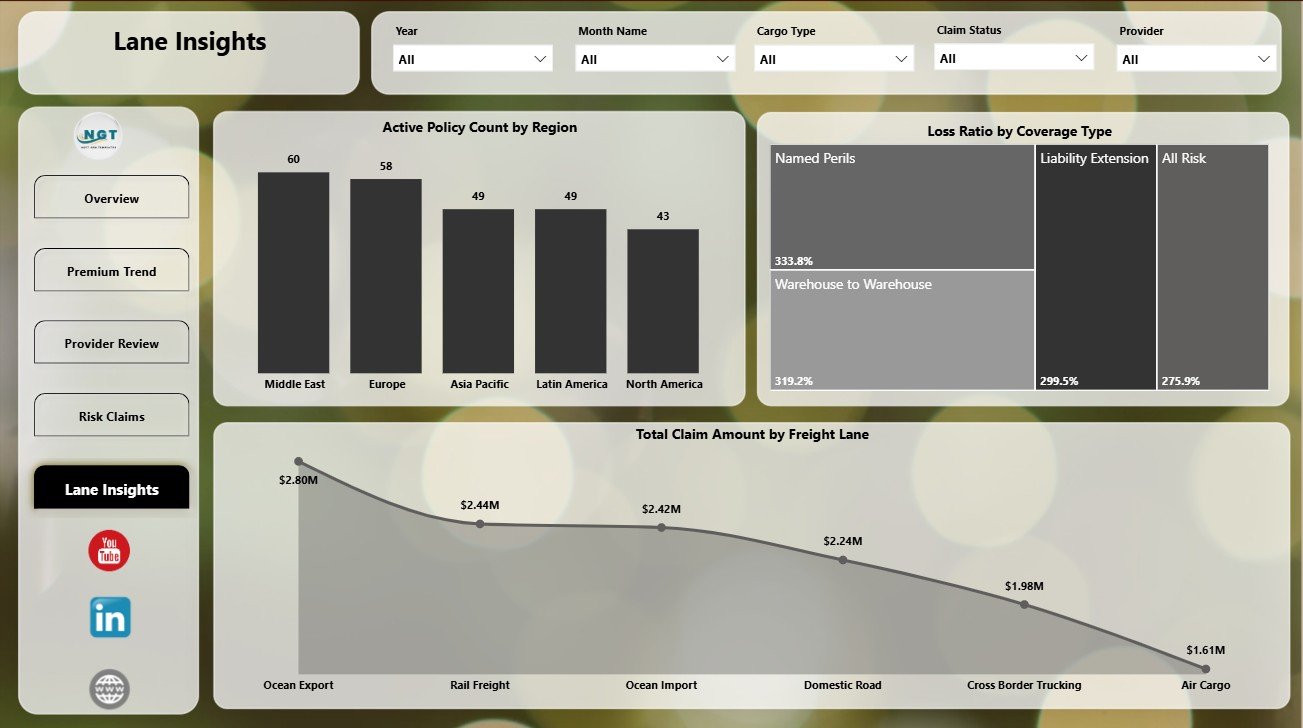
The Lane Insights page focuses on active policy distribution, coverage-level loss ratio, and claim amount by freight lane. It helps teams understand route-level and coverage-level risk exposure.
Active Policy Count by Region shows the regional split of active policies. This helps operations teams understand where policy servicing and underwriting activity are concentrated.
Loss Ratio by Coverage Type compares coverage categories by claim performance. This can support pricing, product design, and coverage profitability review.
Total Claim Amount by Freight Lane highlights routes with heavier claim exposure. This helps risk teams prioritize lane-level investigation, carrier discussions, and loss-control actions.
Freight Insurance Providers Dashboard in Power BI vs. Tableau vs. Paid CRM/SaaS – Feature Comparison
| Feature | Freight Insurance Providers Dashboard in Power BI | Tableau alternative | Paid insurance SaaS |
|---|---|---|---|
| Cost | $17.99 one-time template purchase | License plus report build time | Monthly or annual subscription |
| Platform | Power BI Desktop / Power BI Service | Tableau Desktop / Tableau Cloud | Vendor-hosted application |
| Setup time | Open PBIX, connect or replace data, refresh | Build data model and visuals manually | Implementation and onboarding |
| Real-time team collaboration | Available after publishing to Power BI Service | Available through Tableau Cloud | Usually included |
| Mobile access | Power BI mobile app after publishing | Tableau mobile app after publishing | Vendor app or browser portal |
| Customizable fields | Editable model, visuals, measures, and fields | Editable if you build or own the workbook | Limited by vendor configuration |
| Share with link | Possible through Power BI Service permissions | Possible through Tableau permissions | Usually login controlled |
| Year-1 cost at 5 users | $17.99 plus any Power BI licensing | Licenses plus development cost | Often hundreds or thousands |
| Freight insurance analysis | Built in across 5 pages | Requires custom setup | Depends on module and plan |
Who Should Use This Template
This dashboard is useful for freight insurance providers, cargo insurance teams, freight brokers, 3PL reporting teams, transportation risk managers, underwriting analysts, logistics finance analysts, and consultants who need Power BI reporting for premiums, claims, policies, providers, cargo types, coverage types, regions, and freight lanes.
It is not designed to replace policy administration software, claims workflow systems, regulatory filing tools, live carrier integrations, or billing systems. It works best as a management reporting and analytics layer after your source data has already been prepared.
Real-World Use Cases
Neha, Cargo Insurance Manager: Neha reviews Loss Ratio, Total Claim Amount, Underwriting Profit, and Active Policy Count before monthly provider meetings. She uses Risk Claims to identify cargo types and lanes where losses are rising.
Arjun, Logistics Finance Analyst: Arjun uses Premium Trend and Provider Review to explain quarterly premium movement by coverage type, region, provider, and client segment. This helps finance leaders understand where premium growth is coming from.
Maria, Freight Broker Consultant: Maria filters Lane Insights by region and freight lane to prepare client-facing recommendations. She uses claim amount and loss ratio visuals to show which routes deserve extra review.
Advantages of Freight Insurance Providers Dashboard in Power BI
- Faster reporting: Prebuilt visuals reduce the time needed to prepare recurring freight insurance reports.
- Better risk visibility: Loss ratio, claim amount, cargo type, and freight lane visuals help teams identify concentrated risk.
- Provider review support: Provider premium, active policy count, and claim amount views make provider discussions more data-driven.
- Interactive analysis: Slicers let users filter the full report quickly instead of creating separate manual summaries.
- Power BI flexibility: Users can edit visuals, measures, fields, relationships, and themes in Power BI Desktop.
Opportunities for Improvement
The dashboard is designed as a template, so users should connect it to clean and consistent source data. If your company uses multiple policy systems, claims systems, or broker data exports, you may need a data-preparation step before connecting everything to Power BI.
Teams can improve the report further by adding custom DAX measures, automated refresh schedules, row-level security, additional claim status fields, and drill-through pages. Microsoft provides helpful documentation for getting started with Power BI Desktop.
Best Practices
- Use consistent names for providers, regions, coverage types, cargo types, and freight lanes.
- Review loss ratio and claim amount every month, not only at year-end.
- Separate active, expired, cancelled, and pending policy records clearly.
- Validate claim amounts before refreshing the report.
- Use slicers during provider meetings to focus the discussion on one region, provider, or freight lane at a time.
- Back up the PBIX file before making major model or visual changes.
Explore Relevant Templates
You may also like the Freight Insurance Providers Dashboard in Excel and Logistics Dashboard in Power BI. You can also browse more Power BI dashboard templates on NextGenTemplates.
Frequently Asked Questions
What KPI cards are included in this Power BI dashboard?
The report includes Loss Ratio, Total Premium, Underwriting Profit, Total Claim Amount, and Active Policy Count KPI cards.
How many pages are included?
The dashboard includes 5 Power BI report pages: Overview Page, Premium Trend, Provider Review, Risk Claims, and Lane Insights.
Do I need Power BI Desktop?
Yes. Open and edit the PBIX file in Power BI Desktop. You can publish it to Power BI Service if your organization uses online sharing.
Can I customize the dashboard?
Yes. You can edit visuals, page layouts, measures, fields, relationships, colors, and branding in Power BI Desktop.
Can this replace insurance claims software?
No. This is a reporting dashboard template, not a claims processing, policy administration, billing, or compliance system.
How do I update the dashboard after changing data?
Replace or connect your source data, then refresh the Power BI model. Make sure your field names and data structure remain consistent.
About the Author
Built by PK – Microsoft Certified Professional with 15+ years of Excel, Google Sheets, and Power BI experience. Founder of NextGenTemplates, reaching 300K+ subscribers across YouTube channels. Every template is hand-built and tested before release.
Conclusion
The Freight Insurance Providers Dashboard in Power BI helps insurance and logistics teams move from scattered reporting to interactive analysis. With pages for overview KPIs, premium trends, provider review, risk claims, and lane insights, users can review premium, claims, policies, providers, cargo, coverage, regions, and freight lanes in one place.
Use it when you need a practical Power BI reporting template for management reviews, provider discussions, underwriting analysis, and freight lane risk monitoring. Visit Youtube.com/@PKAnExcelExpert for step-by-step Excel and Power BI tutorials.