Indoor Farming Systems Dashboard in Power BI helps indoor farm owners, vertical farming teams, greenhouse operators, controlled-environment agriculture managers, and agribusiness analysts review revenue, nutrient cost, labor cost, energy cost, harvest weight, completion rate, Grade A yield, regions, crop types, growing systems, zones, technicians, and months in one interactive report. Indoor farming teams often manage 100+ production and batch records across sites and zones, but manual reporting makes it hard to answer key questions quickly: Which crop type has the best Grade A yield? Which zone has the highest energy cost? Which technician has the strongest completion rate? This dashboard turns those records into clear Power BI pages, KPI cards, slicers, and visuals.
The template includes 5 Power BI pages: Overview, Crop Yield, Cost Analysis, Quality, and Operations. Users can open the PBIX file in Power BI Desktop, replace or connect the sample data, refresh the model, and use slicers to explore filtered views. For official setup help, see Microsoft Learn on getting started with Power BI Desktop. You can view the product here: Indoor Farming Systems Dashboard in Power BI.
Indoor Farming Systems Dashboard in Power BI
Key Features of Indoor Farming Systems Dashboard in Power BI
- 5 report pages: Overview, Crop Yield, Cost Analysis, Quality, and Operations.
- Executive KPI cards: Total Revenue, Total Nutrient Cost, Total Labor Cost, Total Energy Cost, and Total Harvest Weight.
- Crop yield analytics: Review Grade A yield by crop type and growing system.
- Cost analysis: Compare nutrient cost, labor cost, energy cost, revenue, farm site, region, and zone performance.
- Quality review: Analyze completed batches, Grade A yield rate, month movement, and zone-level energy cost.
- Operations tracking: Study harvest weight by crop type, completion rate by technician, and energy cost by quarter.
- Interactive slicers: Filter dashboard pages quickly during management reviews.
- Editable PBIX: Customize visuals, fields, measures, colors, slicers, and report pages in Power BI Desktop.
Dashboard Pages Explanation
1. Overview Page
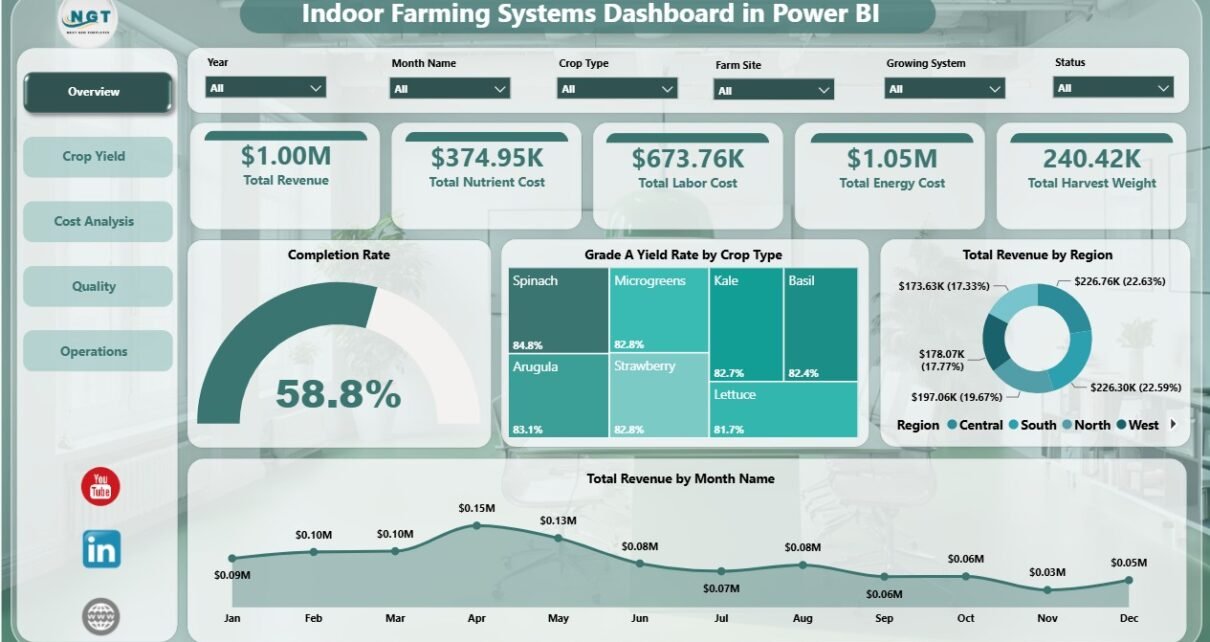
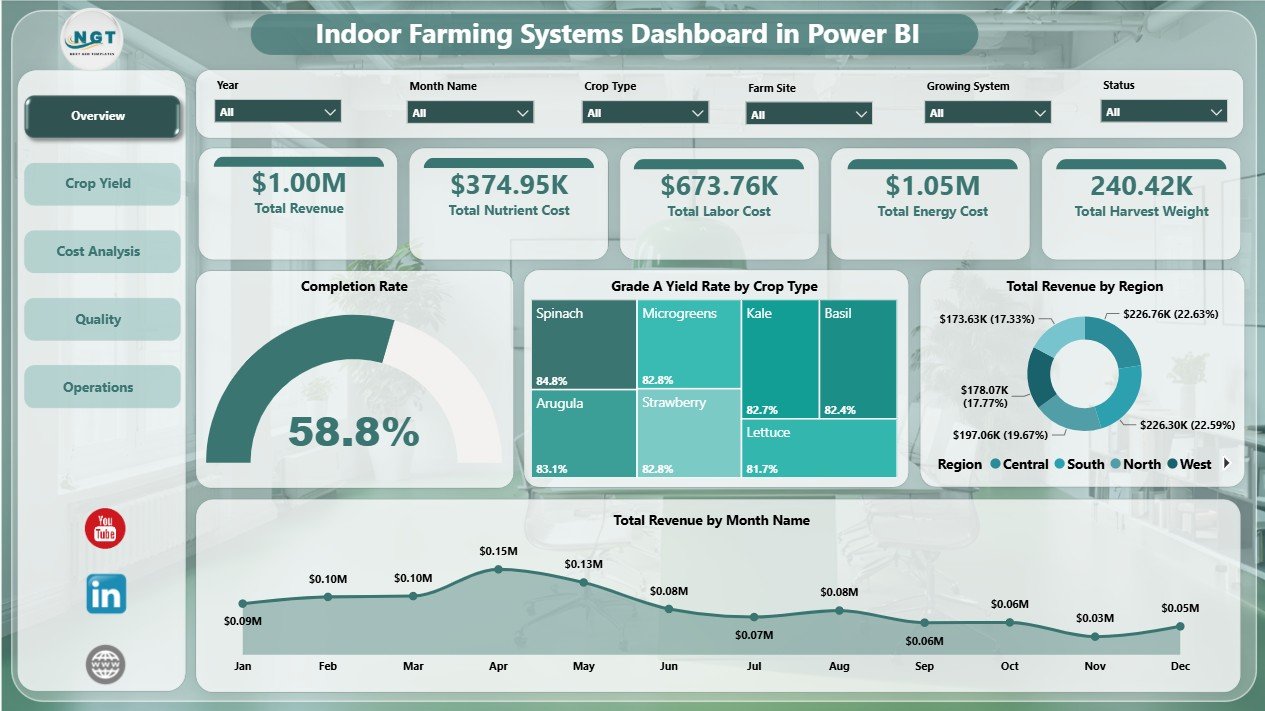
The Overview page works as the executive summary of the report. The top cards show Total Revenue, Total Nutrient Cost, Total Labor Cost, Total Energy Cost, and Total Harvest Weight, giving leadership a quick read on financial performance, input cost, labor spend, energy spend, and production output.
Completion Rate by Status: This chart compares completion rate across operating statuses. It helps users see whether batches are moving through the process smoothly or whether certain statuses need follow-up.
Grade A Yield Rate by Crop Type: This chart shows premium yield performance by crop type. It helps crop managers identify which crops are producing stronger market-grade output.
Total Revenue by Region: This chart compares revenue contribution across regions. It helps teams understand which regions are producing stronger commercial results.
Total Revenue by Month Name: This chart displays month-wise revenue movement. It helps managers spot seasonal patterns, strong months, and periods that may need closer review.
Overview Page
2. Crop Yield
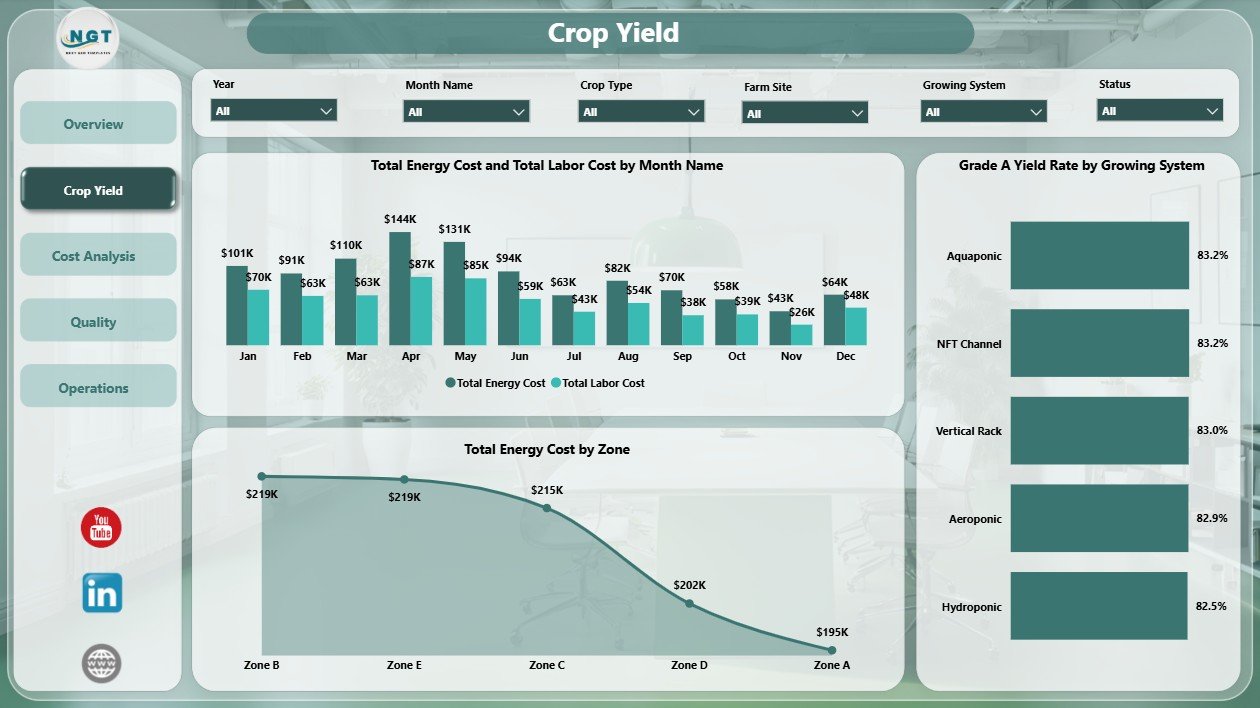
The Crop Yield page focuses on production quality and cost movement. Total Energy Cost and Total Labor Cost by Month Name compares two major cost lines over time, making it easier to detect months where operating pressure is increasing.
Grade A Yield Rate by Growing System compares premium output across cultivation methods. Total Energy Cost by Zone shows where energy cost is concentrated, which is useful for zone-level troubleshooting and cost planning.
Crop Yield
3. Cost Analysis
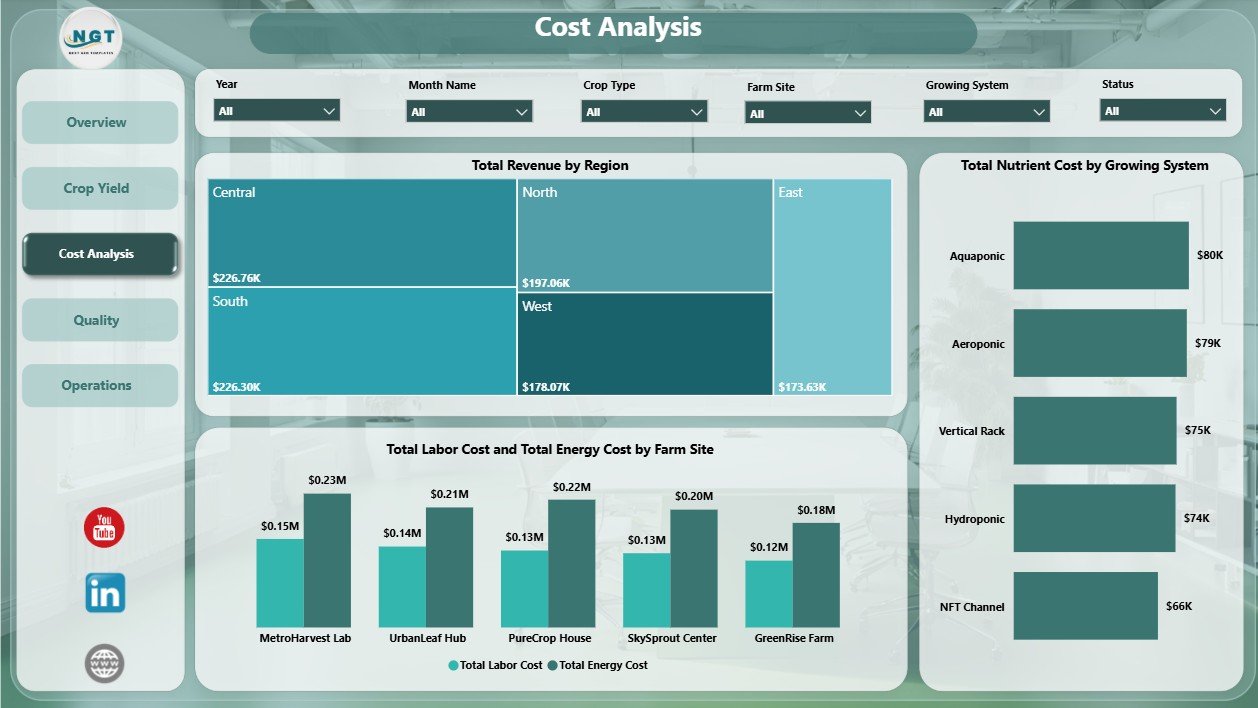
The Cost Analysis page gives a financial lens for indoor farming performance. Total Revenue by Region identifies the regions that contribute the most revenue. Total Nutrient Cost by Growing System helps compare input cost by cultivation method.
Total Labor Cost and Total Energy Cost by Farm Site compares two major operating costs by site. This is useful for budgeting, cost review, and identifying locations that may need process improvement.
Cost Analysis
4. Quality
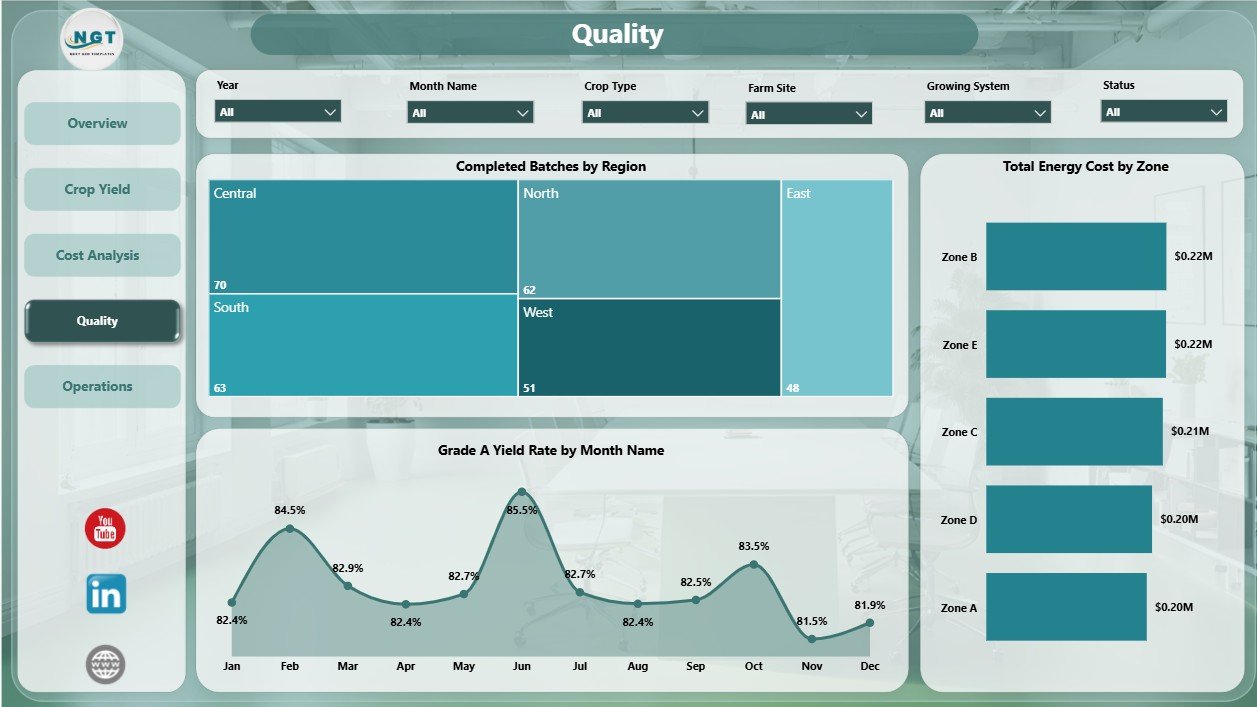
The Quality page is built for teams responsible for crop standards and production consistency. Completed Batches by Region shows where batch completion is strongest. Grade A Yield Rate by Month Name tracks premium output trends over time.
Total Energy Cost by Zone adds an operating cost signal to quality review. This helps users compare quality results and energy demand by production zone.
Quality
5. Operations
The Operations page supports weekly execution reviews. Total Harvest Weight by Crop Type compares production output across crops. Completion Rate by Technician helps managers review technician-level throughput and identify where support or training may be needed.
Total Energy Cost by Quarter shows quarterly energy cost movement. This helps leaders plan budgets, review energy usage, and investigate quarter-over-quarter changes.
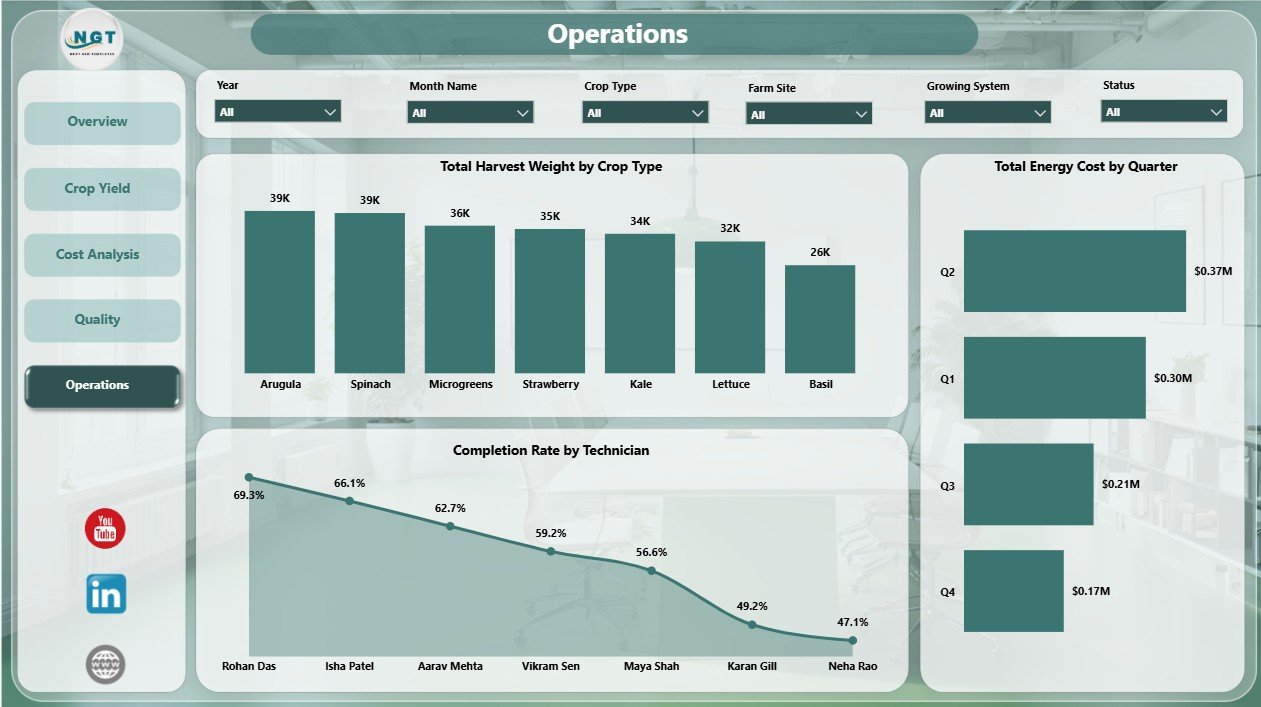
Operations
Indoor Farming Systems Dashboard in Power BI vs. Tableau vs. Paid CRM/SaaS – Feature Comparison
| Feature | Indoor Farming Systems Dashboard in Power BI | Tableau or Qlik alternative | Paid farm SaaS |
|---|---|---|---|
| Cost | $17.99 one-time template | License cost plus report build time | Monthly or annual subscription |
| Platform | Power BI Desktop and Power BI Service | Tableau or Qlik environment | Vendor cloud platform |
| Setup time | Open PBIX, connect data, refresh | Build model and visuals manually | Implementation and onboarding |
| Real-time team collaboration | Available after publishing to Power BI Service | Available by platform plan | Usually included by plan |
| Mobile access | Power BI mobile app after publishing | Vendor mobile app | Usually included |
| Customizable fields | Edit model, visuals, measures, pages, and slicers | Editable with platform skills | Depends on vendor permissions |
| Share with link | Available through Power BI sharing settings | Available through platform permissions | Usually login controlled |
| Year-1 cost at 5 users | Template cost plus any Microsoft licensing | License cost plus analyst time | Often hundreds or thousands |
| Indoor farming metrics | Revenue, nutrient cost, labor, energy, harvest, Grade A yield, zones, and technicians | Must be designed manually | Depends on product module |
Who Should Use This Template
This dashboard is a strong fit for indoor farm owners, vertical farm teams, greenhouse operators, controlled-environment agriculture companies, crop production managers, operations teams, quality managers, financial analysts, and consultants who use Power BI for recurring performance reporting.
It is also useful for small and mid-sized teams that need structured reporting but are not ready to implement a larger farm management system. It is not a live climate-control system, IoT sensor platform, ERP, inventory purchasing workflow, payroll system, or regulatory compliance tool.
Real-World Use Cases
Priya, indoor farm owner: Priya reviews Total Revenue, Total Nutrient Cost, Total Labor Cost, Total Energy Cost, and Total Harvest Weight before weekly leadership meetings.
Marco, operations manager: Marco checks completion rate by status, technician, and quarter to identify execution gaps and follow-up actions.
Elena, agribusiness consultant: Elena uses the Crop Yield, Cost Analysis, and Quality pages to prepare client reports on Grade A yield, nutrient cost, energy cost, region, and farm site performance.
Advantages of Indoor Farming Systems Dashboard in Power BI
- Faster reporting: Start from a ready PBIX file instead of designing a dashboard from a blank canvas.
- Power BI flexibility: Edit charts, fields, DAX measures, filters, and page layouts as needed.
- Quality and cost together: Review Grade A yield, revenue, nutrient cost, energy cost, labor cost, and harvest output in one report.
- Meeting-ready pages: Use separate pages for leadership, crop yield, cost, quality, and operations reviews.
- No recurring template subscription: The dashboard is a one-time downloadable product from NextGenTemplates.
Opportunities for Improvement
Advanced users can extend this report with live data connections, scheduled refresh in Power BI Service, additional drill-through pages, role-level security, custom DAX measures, and extra pages for climate readings, inventory, waste, seed batches, or nutrient recipes. The template is designed as a reporting layer, so it can grow as your indoor farming data process matures.
Best Practices
- Keep crop type, growing system, region, site, zone, technician, and status names consistent in the source data.
- Validate revenue, nutrient cost, labor cost, energy cost, and harvest weight fields before refreshing monthly reports.
- Use the Overview page first, then move to Crop Yield, Cost Analysis, Quality, and Operations for deeper review.
- Publish to Power BI Service only after checking slicers, cards, visuals, and refresh behavior.
- Document any custom measures you add so future users understand the calculation logic.
Explore Relevant Templates
- Indoor Farming Systems Dashboard in Power BI
- Indoor Farming Systems Dashboard in Excel
- Agriculture and Farm Dashboard in Power BI
- Greenhouse Farming Dashboard in Power BI
- Vertical Farming Dashboard in Power BI
Frequently Asked Questions
What is the Indoor Farming Systems Dashboard in Power BI?
It is an editable PBIX dashboard template for indoor farming revenue, nutrient cost, labor cost, energy cost, harvest weight, completion rate, Grade A yield, crop type, region, zone, farm site, technician, status, and month analysis.
What pages are included?
The report includes Overview, Crop Yield, Cost Analysis, Quality, and Operations pages.
Do I need Power BI Desktop?
Yes. Power BI Desktop is needed to open, refresh, and customize the PBIX file. Power BI Service is optional for online sharing and scheduled refresh.
Can I customize the report?
Yes. You can edit visuals, measures, labels, colors, slicers, fields, relationships, and report pages in Power BI Desktop.
Can I use my own indoor farming data?
Yes. Replace or connect the sample data source with your own structured indoor farming records, then refresh the report.
Is this a full farm management system?
No. It is a reporting dashboard, not a live automation, ERP, payroll, procurement, compliance, or sensor-control system.
About the Author
Built by PK – Microsoft Certified Professional with 15+ years of Excel, Google Sheets, and Power BI experience. Founder of NextGenTemplates, reaching 300K+ subscribers across YouTube channels. Every template is hand-built and tested before release.
Conclusion
The Indoor Farming Systems Dashboard in Power BI gives indoor farming teams a clear way to review revenue, nutrient cost, labor cost, energy cost, harvest weight, completion rate, Grade A yield, regions, growing systems, zones, farm sites, technicians, and quarterly trends. Instead of starting from a blank Power BI file, users get a ready report structure they can refresh, customize, and adapt to their own data.
Visit our YouTube channel for step-by-step Excel, Power BI, and dashboard tutorials.