The International Development Report in Excel tracks 5 headline KPIs across 4 sheets, with 5 interactive charts and dual slicers covering project, region, funding source, and month. According to the OECD, official development assistance reached over $211 billion globally in recent years, yet most small and mid-size international NGOs still rely on scattered spreadsheets because paid donor CRMs typically cost $99 to $499 per month per organization.
This Excel report file is built for international development NGOs, aid organizations, and humanitarian charities that need a clean, board-ready snapshot of projects, donors, regions, and fund utilization without paying a monthly SaaS bill. Setup of the International Development Report in Excel takes under 10 minutes — paste your data into the Data sheet and every KPI card, chart, and table refreshes automatically.
👉 Click here to Purchase the International Development Report in Excel
What is the International Development Report in Excel?
The International Development Report in Excel is a 4-sheet Microsoft Excel workbook designed for international development NGOs, aid organizations, and humanitarian charities to consolidate project performance, donor analytics, regional impact, and fund utilization into a single reporting layer. The file uses standard Excel features only — no macros, no add-ins, and no internet connection — so it works equally well in Microsoft Excel for Windows, Mac, Excel 2019, Excel 2021, and Microsoft 365.
The workbook ships with realistic sample data covering projects, regions, funding sources, fund flows, and beneficiary counts. Replace the samples with your own records and every visualization on the Summary Page and Report Page updates immediately.
Key Features of the International Development Report
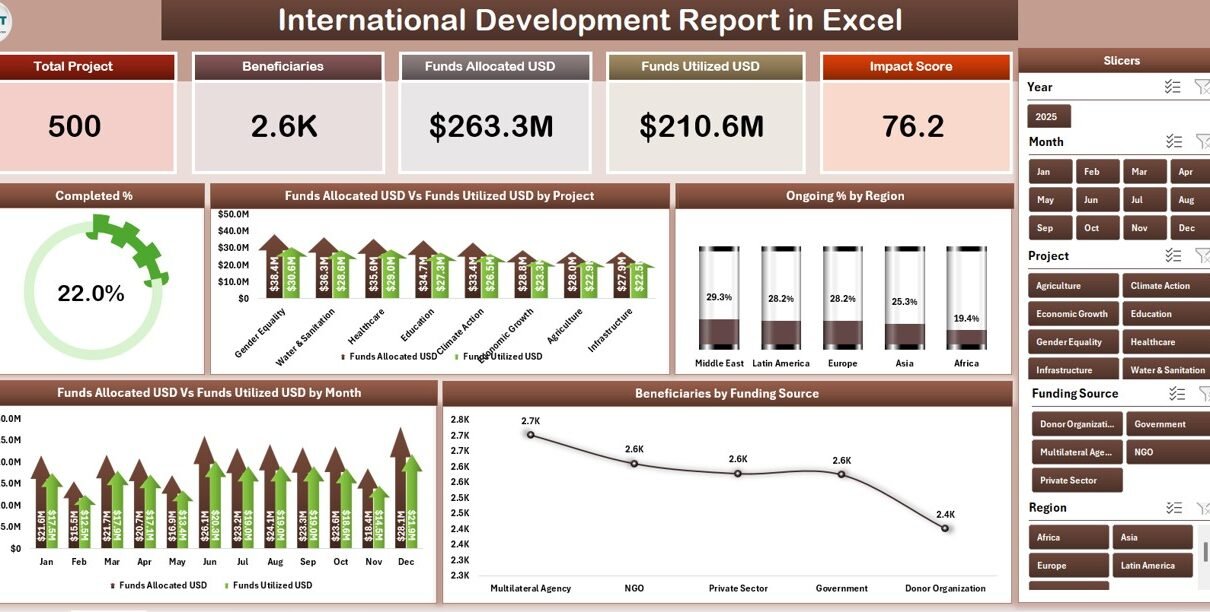
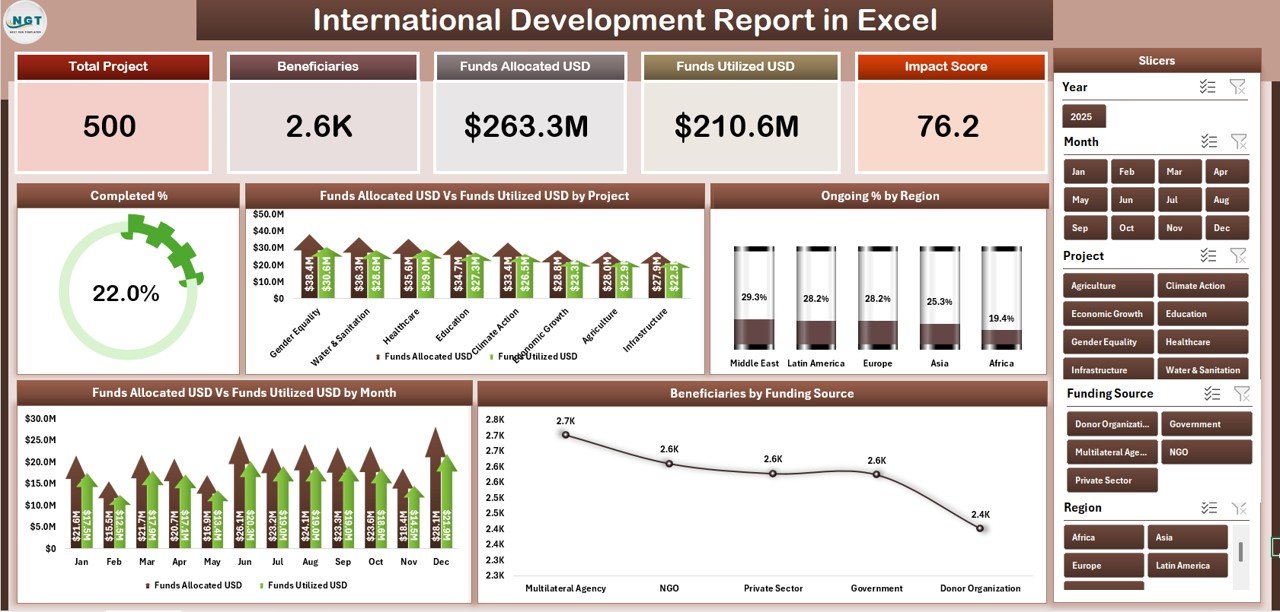
- 5 KPI cards on the Summary Page — Total Projects, Completed Projects, Total Funds Allocated, Total Funds Utilized, and Total Beneficiaries.
- 5 interactive charts — Completed %, Funds Allocated vs Utilization by Project, Ongoing % by Region, Funds Allocated vs Utilization by Month, and Beneficiaries by Funding Source.
- Right-side slicer on the Summary Page that filters every card and chart at once.
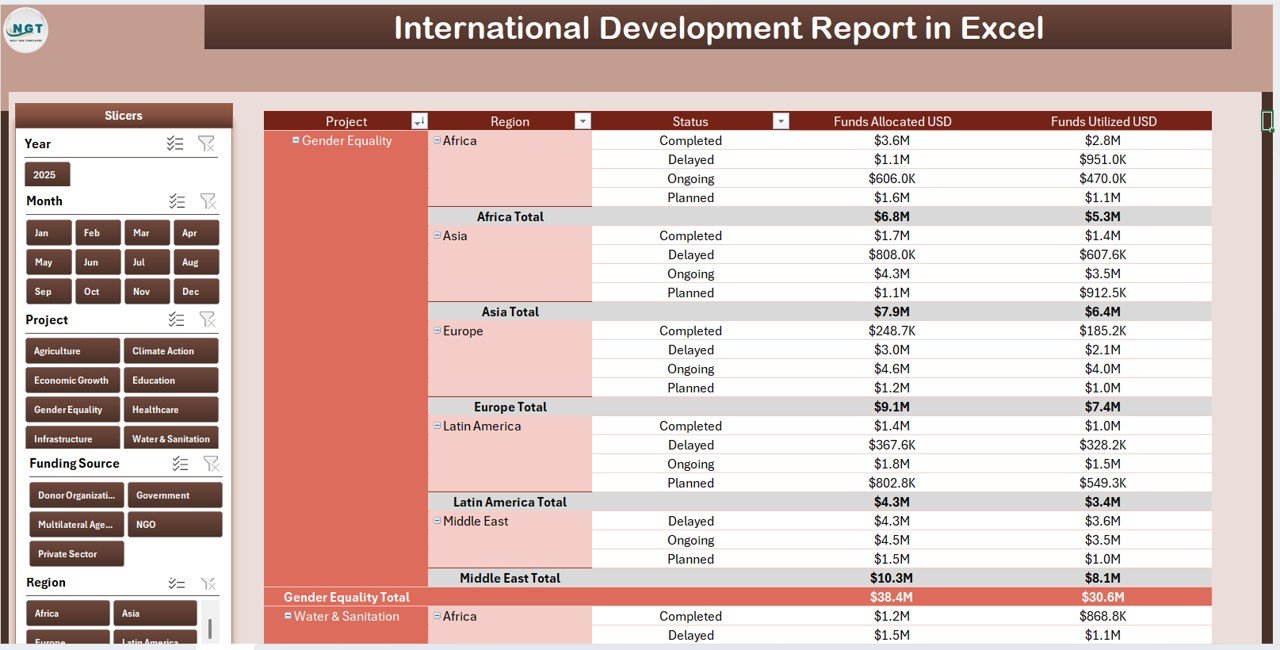
- Dedicated Report Page with a left-side slicer and a tabular information view for board packs and donor letters.
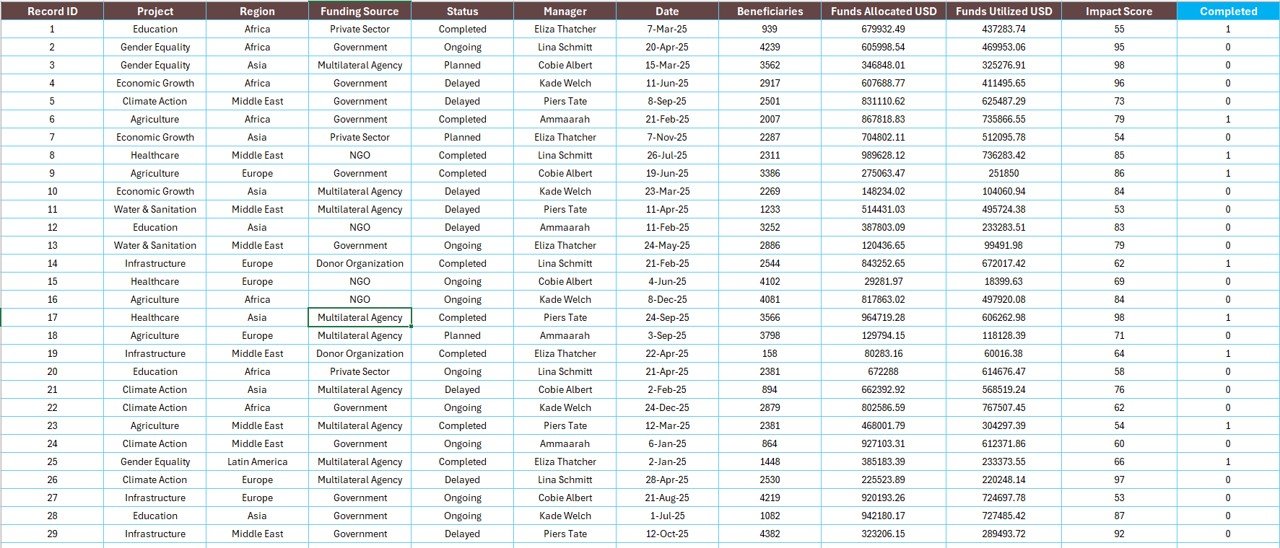
- Editable Data sheet with 200+ sample rows and clear column headers.
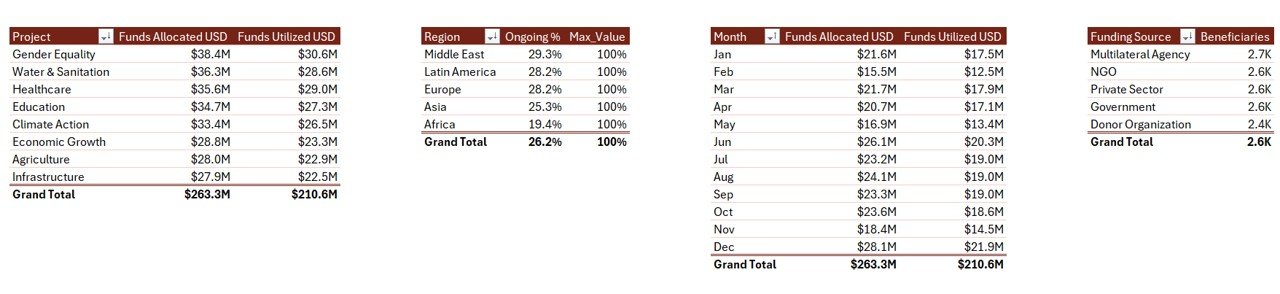
- Support sheet housing lookup lists for regions, funding sources, and project types.
- Works offline in Excel desktop on Windows and Mac (Microsoft 365, Excel 2019+).
- One-time $7.99 sale price — no subscription, no per-user fee, lifetime access.
Sheets Explanation
1. Summary Page — KPI Cards, Slicer, and 5 Charts
The Summary Page is the headline view of the International Development Report. Five KPI cards sit across the top: Total Projects, Completed Projects, Total Funds Allocated, Total Funds Utilized, and Total Beneficiaries. To the right is a single slicer that drives the whole page — choose a region, a funding source, a project, or a year, and every chart and card updates together.
The five charts give you a complete picture: Completed % shows the share of projects that closed successfully; Funds Allocated vs Utilization by Project highlights where money is moving fastest or sitting idle; Ongoing % by Region tells you which regions still have active projects in flight; Funds Allocated vs Utilization by Month gives the cash-flow rhythm across the year; and Beneficiaries by Funding Source shows which donors are powering the largest impact in beneficiary counts.
2. Report Page — Left Slicer and Information Table
The Report Page strips the dashboard down to the essentials reviewers actually want: a clean, structured table of project records (project name, region, country, funding source, funds allocated, funds utilized, beneficiaries, status) with a left-side slicer to filter it. This is the page you copy into a board deck, a grant report, or a stewardship letter to a major donor.
Filter the table by funding source to send a single donor a clean list of only their projects. Filter by region to brief regional managers. The Report Page is intentionally lighter on charts so it prints cleanly to PDF.
3. Data Sheet — Your Editable Source Records
The Data sheet is where you paste or type your own records. Columns include date, project name, region, country, funding source, funds allocated, funds utilized, beneficiaries, project type, and status. Keep the column headers exactly as shipped and the formulas powering the Summary and Report pages will keep working without any edits.
4. Support Sheet — Lookups and Dropdown Lists
The Support sheet holds the central lookup lists for regions, funding sources, and project types. Update a list once and every dropdown on the Data sheet, every slicer label on the Summary and Report pages, and every chart category stays consistent. This is what keeps the workbook tidy as it grows.
International Development Report vs. Google Sheets Equivalent vs. Paid NGO CRMs — Feature Comparison
| Feature | International Development Report (Excel) | Google Sheets equivalent | Salsa / Bloomerang / NeonCRM |
|---|---|---|---|
| Cost | $7.99 one-time | Free, but you build it | $99–$499 / month |
| Platform | Microsoft Excel desktop | Google Sheets | Cloud SaaS |
| Setup time | Under 10 minutes | Hours of formula work | Multi-week onboarding |
| Real-time co-authoring | Via OneDrive / SharePoint | ✅ Native | ✅ Native |
| Works offline | ✅ | ❌ | ❌ |
| Customizable fields | ✅ Full control | ✅ | Vendor-defined |
| Donor & beneficiary data ownership | ✅ Your file | ✅ | Hosted by vendor |
| Year-1 cost (5 users) | $7.99 once | $0 + your hours | $1,200–$6,000+ |
For international NGOs that want clean board-ready reports without paying $1,200+ a year for a donor CRM, the International Development Report in Excel sits in the sweet spot.
Who Should Use This Template
Perfect for:
- Small to mid-size international development NGOs (5–100 staff) tracking projects, donor funds, and beneficiaries
- Country directors and program managers preparing quarterly board reports and grant utilization summaries
- Aid organizations and humanitarian charities running multi-donor, multi-region project portfolios
- Charity finance volunteers using Excel — not a SaaS subscription — for monthly reporting
- Grant-funded teams reporting fund utilization to multiple donors separately
Not a fit if:
- You are a large international NGO needing SOC 2, SSO, and full audit-trail compliance
- You need a full donor CRM with individual donor profiles, communication logs, and pledge tracking
- You only have web-only Excel without the desktop app (slicers behave with limits in Excel for the web)
Real-World Use Cases
Aisha runs operations at a 25-person education-focused international NGO in Nairobi. She uses the International Development Report each quarter to show her board exactly how much of the $480,000 in donor funds was utilized across 12 projects, broken down by region. The Funds Allocated vs Utilization by Project chart has saved her from rebuilding the same pivot every quarter — and the right-side slicer lets her show a single funder only their projects without exposing the rest.
David is the country director of a 40-person humanitarian aid charity working across East Africa. He uses the Report Page with its left-side slicer to filter the information table by funding source and export it for individual donor stewardship letters. Replacing his old Educational NGOs KPI Dashboard in Excel with this lighter report file means his program managers can update one Data sheet and he gets a clean snapshot in minutes instead of hours.
Priya volunteers as the finance lead for a community development NGO in Mumbai. Her team came off a $99/month nonprofit CRM and now shares this Excel report on OneDrive. Five program leads paste their monthly numbers into the Data sheet; the Summary Page keeps the Beneficiaries by Funding Source chart up to date, and the board sees the same view as the funders.
Advantages of the International Development Report
- $1,200+ per year saved compared to entry-level paid nonprofit CRMs at 5 seats — and the file is yours forever.
- Quarterly reporting cycle compresses from days to hours because slicers replace manual pivot rebuilds.
- Works offline and on Mac, which matters for field teams in regions with patchy internet.
- Single-file portability — email it, OneDrive it, or share it with auditors without any vendor lock-in.
- Total customization — every formula and chart is editable, unlike a vendor SaaS where the schema is fixed.
Opportunities for Improvement
Honesty matters. There are areas where this report file has limits:
- No automatic donor email automation — for that, pair this report with a fundraising tool like Charity Fundraising KPI Scorecard in Google Sheets.
- Single-currency by default — if you accept multi-currency donations you’ll need to add a conversion column on the Data sheet.
- Not a CRM — there is no individual donor profile, communication log, or pledge tracking. This is reporting, not relationship management.
- No automated audit trail — Excel keeps revision history via OneDrive, but it is not an SOC-2 audit log.
Best Practices
- Lock the Support sheet after setup so volunteers don’t accidentally rename a region or funding source.
- Save the file on OneDrive or SharePoint for co-authoring across program leads.
- Keep a monthly archive copy — at month-end, save a snapshot version (e.g., “IntlDev_Report_2026_05.xlsx”) for board records.
- Standardize funding source names at the start (Bilateral, Multilateral, Foundation, Individual, Corporate) so the slicer stays clean.
- Refresh before reporting using Ctrl+Alt+F5 — easy to forget when you’re rushing to send a quarterly update.
Explore Relevant Templates
- 📊 Nonprofit Organizations Report in Excel — sister Excel report focused on nonprofit donor analytics.
- 📚 Educational NGOs KPI Dashboard in Excel — fuller KPI dashboard if you need more than 5 charts.
- 📖 Adult Literacy Programs Dashboard in Excel — adjacent education-focused NGO dashboard.
- ❤️ Charity Fundraising KPI Scorecard in Google Sheets — fundraising-specific scorecard, complementary to this reporting file.
- 🎉 Event Management Analysis Dashboard in Excel — useful for NGOs that run fundraisers and galas.
Frequently Asked Questions
What KPIs does the International Development Report track?
The International Development Report tracks 5 headline KPIs on cards (Total Projects, Completed Projects, Total Funds Allocated, Total Funds Utilized, Total Beneficiaries) plus 5 charts covering Completed %, Funds Allocated vs Utilization by Project, Ongoing % by Region, Funds Allocated vs Utilization by Month, and Beneficiaries by Funding Source.
Does the International Development Report work in Excel for Mac?
Yes. The International Development Report works in Microsoft Excel for Windows and Mac (Excel 2019, Excel 2021, and Microsoft 365). Slicers, charts, and KPI cards all function on both platforms because the file uses standard Excel features only — no macros, no add-ins, no internet required.
Can multiple staff members edit the Data sheet at the same time?
Yes — if you save the International Development Report on OneDrive or SharePoint, multiple staff members can edit the Data sheet simultaneously through Excel’s co-authoring. Charts on the Summary and Report pages refresh for everyone when a record is updated, with no extra cost per user.
How does this compare to a paid NGO CRM like Bloomerang or NeonCRM?
Bloomerang and NeonCRM are full donor CRMs starting at roughly $99–$499 per month. The International Development Report in Excel is a $7.99 one-time Excel reporting layer — perfect if you already track donors elsewhere and just need a clean board-ready report file with KPI cards, slicers, and 5 charts focused on funds and beneficiaries.
How long does setup take?
Setup of the International Development Report takes under 10 minutes. Open the file, replace the sample rows on the Data sheet with your own project and donor records, refresh the workbook (Ctrl+Alt+F5), and the Summary Page and Report Page update automatically.
Can I customize the regions, funding sources, and project types?
Yes. The International Development Report uses a Support sheet that holds lookup lists for regions, funding sources, and project types. Edit those lists once and every dropdown, slicer, and chart in the workbook reflects your NGO’s structure.
Do slicers work in Excel for the web?
Slicers display in Excel for the web, but interactive filtering is most reliable in Excel desktop. For the smoothest experience with the International Development Report, open the file in Excel desktop on Windows or Mac.
About the Author
Built by PK — Microsoft Certified Professional with 15+ years of Excel, Google Sheets, and Power BI experience. Founder of NextGenTemplates, reaching 300K+ subscribers across YouTube channels. Every template is hand-built and tested before release.
Conclusion
The International Development Report in Excel gives small and mid-size international NGOs a clean, board-ready reporting layer for projects, donors, regions, and fund utilization — at $7.99 one-time instead of $99–$499 per month. With 5 KPI cards, 5 interactive charts, dual slicers, and a Data sheet built for replacement, you can move from raw spreadsheets to a proper quarterly report in under 10 minutes.
👉 Click here to Purchase the International Development Report in Excel
✅ Instant download · One-time payment · No subscription · Lifetime access
🎥 Visit Youtube.com/@PK-AnExcelExpert for free Excel and dashboard tutorials.
📅 Last updated: May 2026