Contact centers can spend hundreds or thousands per year on analytics add-ons, AI reporting tools, and agent-based support platforms. The Contact Center AI Dashboard in Power BI gives customer service leaders a one-time reporting template for tracking AI containment, total interactions, revenue impact, operating cost, AI cost savings, average CSAT, handle time, sentiment, language, channels, priorities, and trend performance in one editable PBIX file.
This dashboard is designed for teams that already export data from a contact center platform, help desk, chatbot system, CRM, or CCaaS tool and want a clean Power BI reporting layer. Instead of building every visual from scratch, you can open the PBIX file in Power BI Desktop, connect or replace the sample source, refresh the report, and use five report pages for management reviews.
Click here to purchase the Contact Center AI Dashboard in Power BI
Contact Center AI Dashboard in Power BI
Key Features of Contact Center AI Dashboard in Power BI
- Six executive KPI cards for Total Revenue Impact, Total Operating Cost, Total Interactions, Net AI Cost Savings, Avg CSAT, and AI Containment Rate.
- Five report pages covering Overview, AI Performance, Customer Insights, Channel Analysis, and Trend Analysis.
- AI containment analytics by overall interactions, channel, priority, and AI agent.
- Financial impact views to connect automation with revenue impact, operating cost, and cost savings.
- Customer experience analysis for sentiment, CSAT, handle time, resolution time, customer segment, and language demand.
- Channel-level reporting for service leaders managing voice, chat, email, bot, and other support paths.
- Interactive slicers so users can filter dashboard pages quickly during meetings.
- Editable Power BI format for customizing visuals, data model fields, measures, page titles, colors, and slicers.
Dashboard Pages Explanation
The Contact Center AI Dashboard in Power BI is organized into five report pages. Each page answers a different management question: overall performance, AI quality, customer insight, channel efficiency, and trend direction.
1. Overview Page
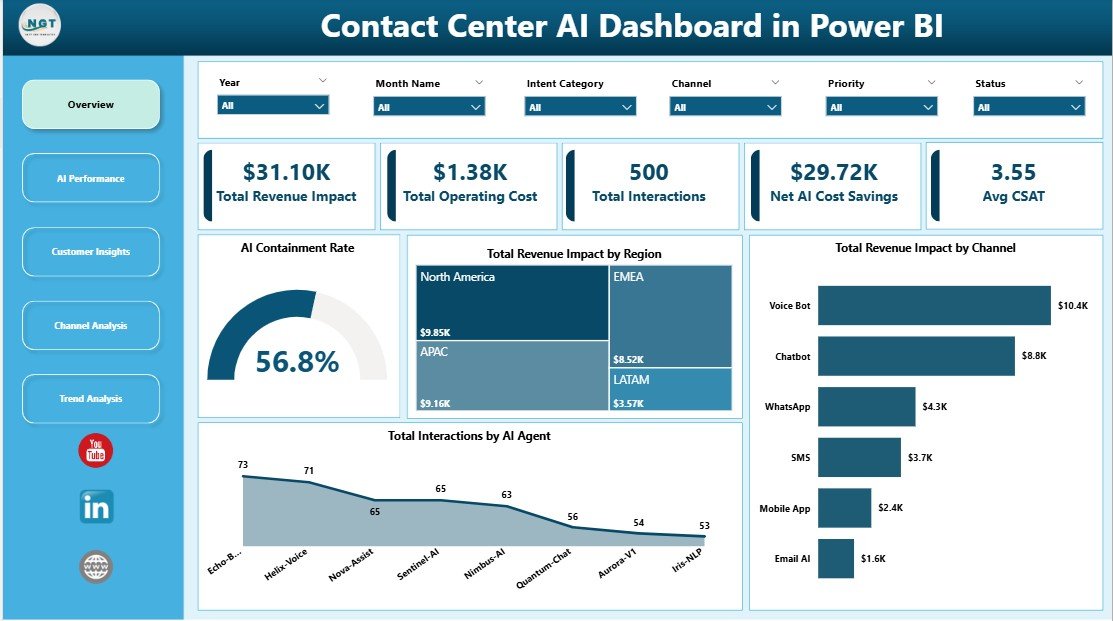
The Overview page is the leadership summary. At the top, it displays Total Revenue Impact, Total Operating Cost, Total Interactions, Net AI Cost Savings, Avg CSAT, and AI Containment Rate so managers can understand the contact center’s AI and customer experience performance in seconds.
AI Containment Rate by Overall Interactions: This chart compares contained AI interactions against total activity. It helps managers understand whether automation is reducing human workload or simply adding another layer to the support journey.
Total Revenue Impact by Region: This chart compares revenue impact across service regions. It helps leaders identify markets where contact center outcomes are strongest and where customer support may need more attention.
Total Revenue Impact by Channel: This visual connects revenue contribution to channels such as chat, voice, email, bot, or social support. It helps teams decide where automation and staffing investment should go next.
Total Interactions by AI Agent: This chart shows workload handled by each AI agent. It is useful for spotting heavily used virtual agents, underused assistants, and candidates for retraining.
Overview Page
2. AI Performance
The AI Performance page focuses on how well automation is handling customer demand. Avg AI Confidence by AI Agent compares model confidence across assistants, Net AI Cost Savings by Channel shows where automation produces the most financial benefit, and Total Interactions by Intent Category highlights the customer issues that generate the highest interaction volume.
This page is useful for AI operations leads who need to prioritize training data, improve bot flows, and show where virtual agents are saving money without harming the customer experience.
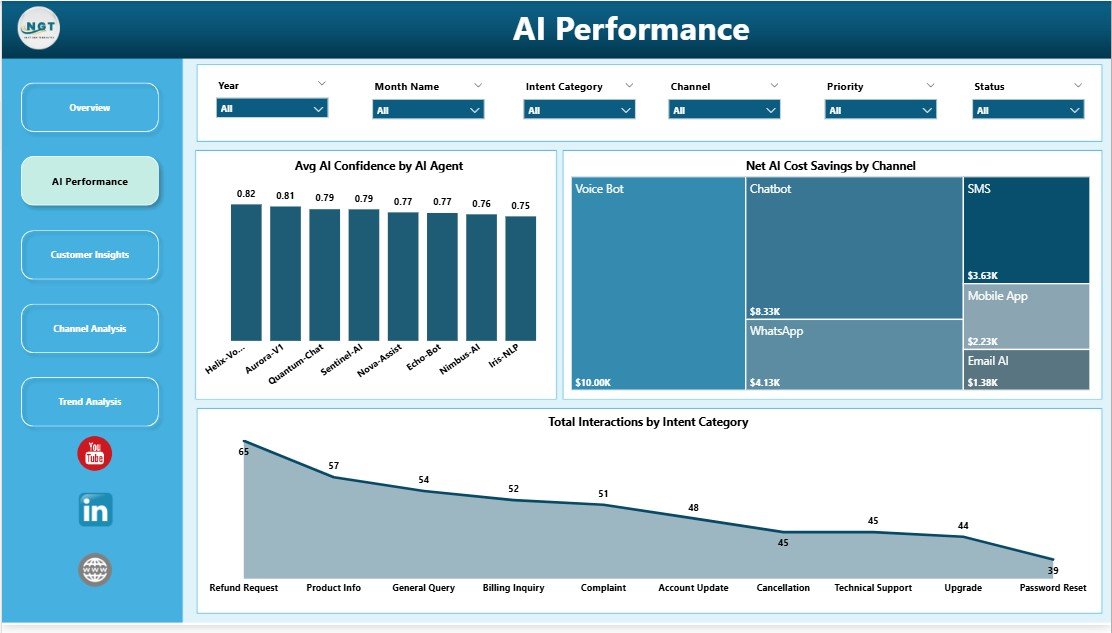
AI Performance
3. Customer Insights
The Customer Insights page connects support activity with customer behavior and experience. Avg Resolution Time Minutes by Sentiment shows whether negative or neutral interactions take longer to resolve, Total Revenue Impact by Customer Segment highlights commercially important customer groups, and Avg Handle Time Seconds by Channel compares operational effort across service paths.
Use this page when leadership asks whether AI is improving customer experience or only lowering cost. It gives analysts a way to compare speed, sentiment, revenue impact, and channel workload together.
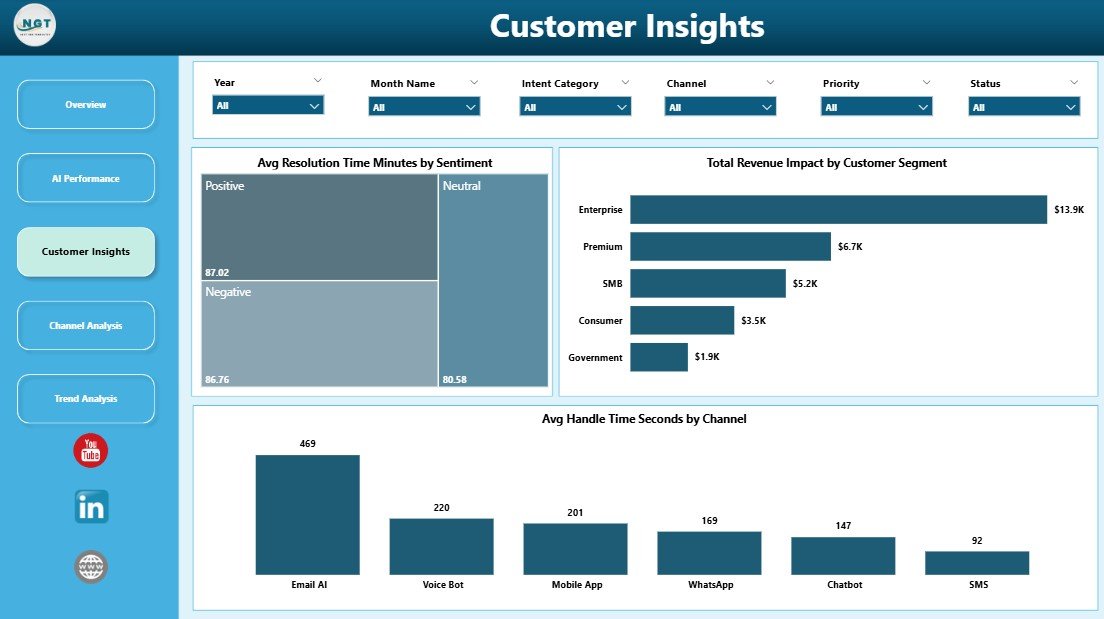
Customer Insights
4. Channel Analysis
The Channel Analysis page compares containment, status, and priority performance by support channel. AI Containment Rate by Channel shows where automation performs best, Total Interactions by Status explains backlog or workflow distribution, and AI Containment Rate by Priority shows whether urgent interactions still require human escalation.
This page is especially helpful for teams managing multiple channels. If chat containment is strong but email resolution is slow, leaders can target process improvements instead of applying one broad policy to every support path.
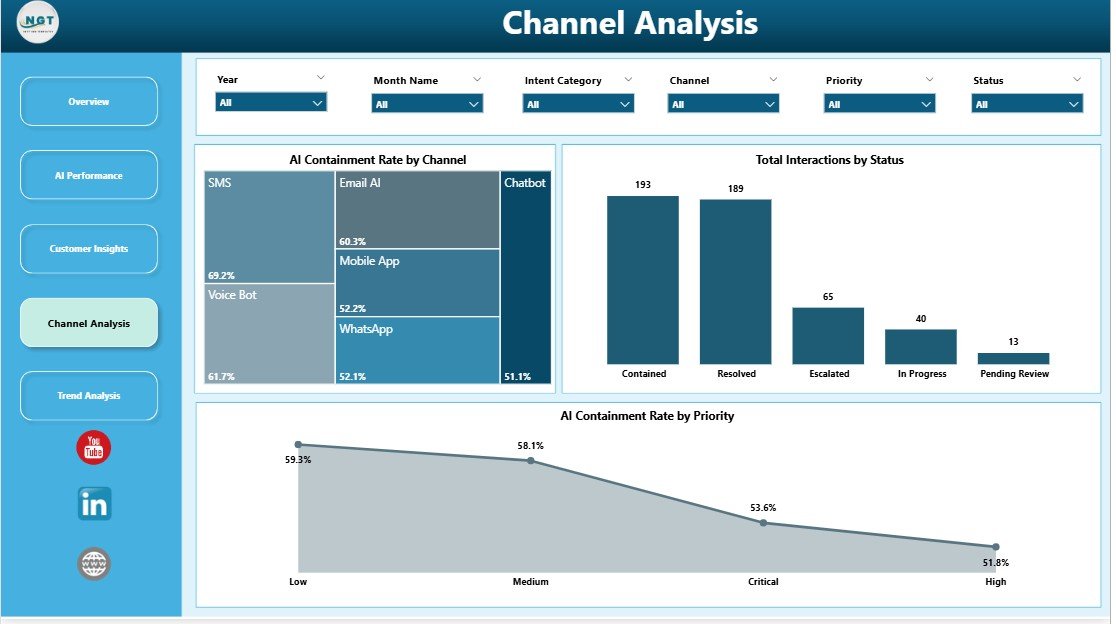
Channel Analysis
5. Trend Analysis
The Trend Analysis page is designed for recurring performance reviews. Avg Resolution Time Minutes by Priority helps teams see whether high-priority issues are slowing down, Total Interactions by Language reveals multilingual support demand, and Avg Resolution Time Minutes by Channel shows which channels need process improvement.
Use this page during weekly or monthly reviews to explain whether service quality is improving over time and whether AI adoption is reducing resolution pressure.
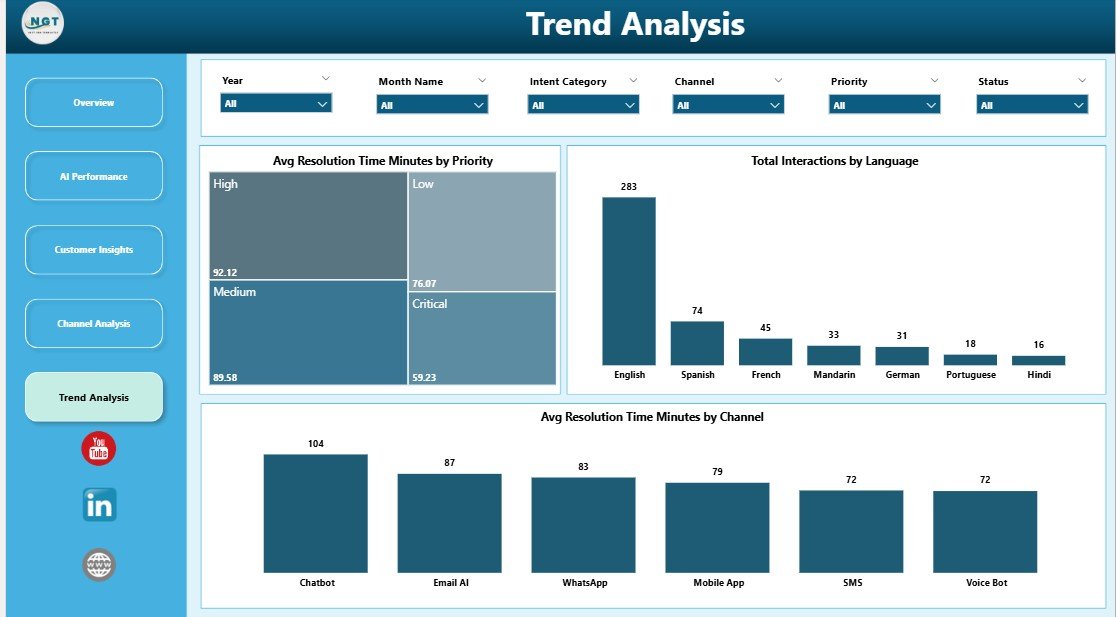
Trend Analysis
Contact Center AI Dashboard in Power BI vs. Tableau vs. Paid CRM/SaaS – Feature Comparison
| Feature | Contact Center AI Dashboard in Power BI | Tableau Alternative | Paid CRM/SaaS Analytics |
|---|---|---|---|
| Cost | $17.99 one-time purchase | License or custom dashboard cost | Monthly subscription or agent-based pricing |
| Platform | Power BI Desktop and Power BI Service | Tableau Desktop or Tableau Cloud | Vendor-hosted cloud tool |
| Setup time | Under 10 minutes after download | Depends on model setup and licensing | Often requires onboarding and configuration |
| AI containment reporting | Built into Overview and Channel Analysis | Possible with custom build | Often available in higher plans |
| Mobile access | Available through Power BI Service and mobile app after publishing | Available through Tableau Cloud | Usually available |
| Customizable fields | Editable PBIX file, report pages, measures, and visuals | Editable with Tableau skills | Limited by vendor permissions |
| Share with link | Possible after publishing to Power BI Service | Possible through Tableau sharing | Usually user accounts required |
| Year-1 cost at 5 users | $17.99 plus Microsoft licensing you already use | Can rise with licenses and build time | Can reach hundreds or thousands per year |
Who Should Use This Template
Perfect for:
- Contact center managers reporting AI containment, cost savings, and customer service performance.
- CX analysts who need repeatable Power BI reporting from help-desk, chatbot, CRM, or CCaaS exports.
- AI operations leads responsible for virtual agent performance, confidence, intent coverage, and escalation rules.
- BPO supervisors who need to compare regions, channels, priorities, statuses, and language demand.
- Small and mid-sized support teams that want a Power BI dashboard without buying a full analytics subscription.
Not a fit if:
- You need real-time queue management, call routing, workforce scheduling, or call recording.
- You need a prebuilt live API connector to every contact center platform.
- You need enterprise governance, compliance workflows, or certified audit controls inside the dashboard file itself.
Real-World Use Cases
Priya, contact center manager: She opens the Overview and Channel Analysis pages every Monday to see whether AI containment improved while CSAT stayed stable.
Daniel, CX analyst: He uses sentiment, resolution time, and customer segment views to explain why some interactions still need faster human escalation.
Maria, BPO operations lead: She uses channel cost savings and region revenue impact to show clients where AI support is reducing cost and where manual handling is still necessary.
Advantages of Contact Center AI Dashboard in Power BI
Lower cost: A one-time template purchase is easier to justify than another recurring analytics subscription.
Faster reporting: The five-page structure gives managers a ready-made starting point instead of building every visual from zero.
Better AI visibility: Containment, confidence, intent category, channel, and priority views help teams move beyond basic ticket counts.
Editable model: Because it is a PBIX file, analysts can change visuals, measures, fields, and pages as business questions change.
Opportunities for Improvement
The template does not replace a full contact center platform. It does not route calls, manage agent schedules, record interactions, or enforce enterprise-grade governance. Teams with advanced live integration needs should connect Power BI to their approved data sources or use this dashboard as a reporting companion.
Best Practices
- Keep field names consistent when replacing sample data.
- Validate AI containment, savings, and revenue impact logic before presenting to leadership.
- Review high-priority interactions separately so automation does not hide urgent customer pain.
- Use the same date and channel definitions across all source systems.
- Publish to Power BI Service only after checking permissions and data sensitivity.
Explore Relevant Templates
Contact Center AI Dashboard in Power BI – buy the dashboard template on NextGenTemplates.
Contact Center AI Dashboard in Excel – spreadsheet version for teams that prefer Excel.
Moving Company Dashboard in Power BI – operational service dashboard with similar Power BI structure.
Pest Control Dashboard in Power BI – field service analytics and technician performance dashboard.
Complaint Management System: Web App Version – structured complaint tracking with role-based access.
Frequently Asked Questions
What does the Contact Center AI Dashboard in Power BI track?
It tracks revenue impact, operating cost, total interactions, net AI cost savings, average CSAT, AI containment rate, AI confidence, channel, intent category, customer segment, sentiment, status, priority, language, and resolution time.
Do I need Power BI Desktop?
Yes. Open the PBIX file in Power BI Desktop to replace data sources, refresh the report, and customize the visuals.
Can I use this with chatbot and human-agent interaction data?
Yes. As long as your exported data includes the required fields, you can use it for AI-assisted, chatbot, and human support interactions.
Does it connect directly to Zendesk, Genesys, Freshdesk, or Salesforce?
The template does not include a universal live connector. You can connect Power BI to supported exports or approved data sources from your own environment.
Can I customize the dashboard pages?
Yes. You can edit report pages, visuals, measures, slicers, data model fields, labels, and colors in Power BI Desktop.
Is this a replacement for a full contact center platform?
No. It is an analytics dashboard, not a ticketing, routing, QA, scheduling, or call recording platform.
About the Author
Built by PK – Microsoft Certified Professional with 15+ years of Excel, Google Sheets, and Power BI experience. Founder of NextGenTemplates, reaching 300K+ subscribers across YouTube channels (@PK-AnExcelExpert, @NextGenTemplates, @NeoTechNavigators). Every template is hand-built and tested before release.
Conclusion
The Contact Center AI Dashboard in Power BI gives support teams a practical way to measure AI containment, cost savings, revenue impact, CSAT, channel performance, agent behavior, customer sentiment, and resolution trends without building a dashboard from scratch. If your team already exports contact center data and wants faster reporting in Power BI, this template gives you a strong starting point at a one-time price.
Click here to purchase the Contact Center AI Dashboard in Power BI
Visit our YouTube channel for step-by-step Excel, Power BI, and dashboard tutorials: Youtube.com/@PKAnExcelExpert
Last updated: May 19, 2026